Nasnas, the halved human of the wastelands
By Ralf Ittermann · last reviewed on
The Nasnas is a demon of Arabian tradition.
The half-human that hops through the wasteland on one leg.
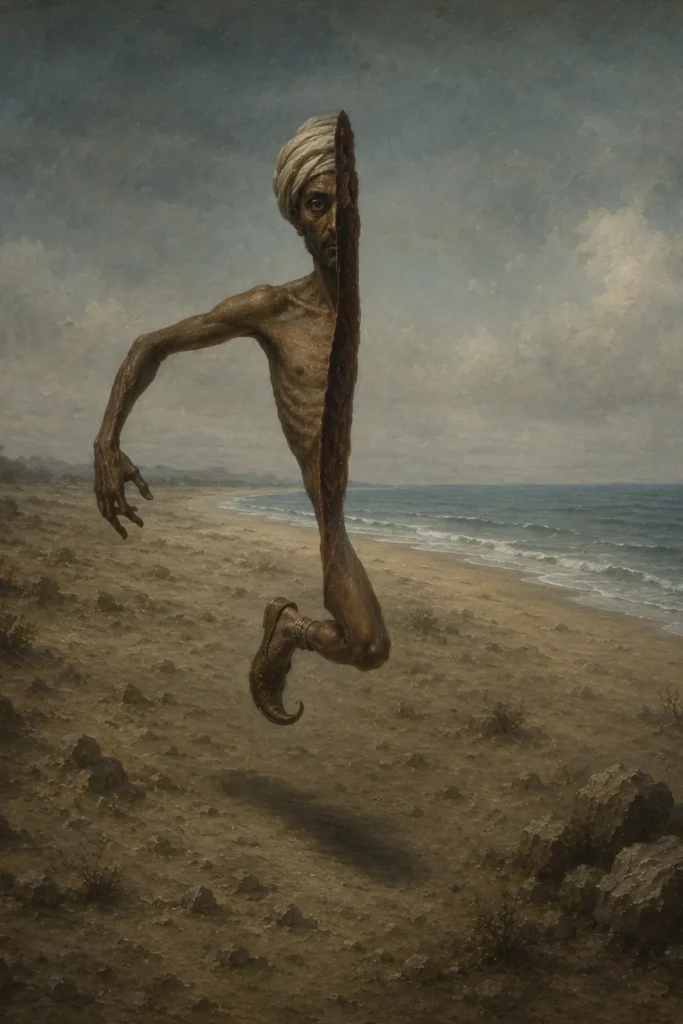
The Nasnas is a half-human desert demon of classical Arabian tradition: a human halved lengthwise, with one arm, one leg and half a face, who hops on its single leg and threatens travellers in the wastelands.
It is located above all in the Hadramaut and Yemen, as well as on the islands of the Indian Ocean, with a literary fixation in the 13th and 14th centuries. Unlike many marginal figures of the djinn world, it is well attested, both in al-Qazwini and in Edward Lane.
Type: Half-human desert demon, lower physical djinn class
Origin: Classical Arabian tradition, Hadramaut and Yemen
Texts: al-Qazwini, al-Damiri, Edward Lane
Period: classical Arabic, 13th to 14th century
Appearance: a human halved lengthwise, with one arm and one leg
Region of origin and sources
Period of the Texts
Classical Arabic, with a literary fixation in the 13th and 14th centuries, among others in al-Qazwini and al-Damiri.
Area of Diffusion
Hadramaut and Yemen, plus the islands of the Indian Ocean: the wastelands and fringe zones of the Arab world.
Sources
Good: al-Qazwini and Lane describe the Nasnas in detail, and al-Damiri includes it in his bestiary.
Name and variants
Arabic: nasnas, plural nasanis, usually traced to the root around n-s and human, fitting the interpretation as a half- or near-human. The double meaning is important here: in Arabic, nasnas denotes both the mythical halved demon and, zoologically, a species of ape, which explains why al-Damiri includes it in his bestiary.
Appearance and behaviour
Appearance
According to Edward Lane, the Nasnas is a half-human: half a head, half a body, one arm and one leg, with which it hops nimbly. Regional variants show the head in the chest or give it bat wings.
Effect
The Nasnas is a danger to travellers in the wastelands: it disguises itself, lures or strikes down wanderers. In the Hadramaut there is a reversal of the motif: there, the Nasnas itself was considered huntable and edible. The tale of the talkative Nasnas in the tree, who betray themselves by talking, illustrates its half-intelligence.
Profile: Nasnas
The most important aspects of the half-human at a glance.
A lower, physical djinn class of classical Arabian tradition, belonging to the motif circle of halved monopod demons.
Wanderers and travellers in the wastelands of the Hadramaut, Yemen and the islands of the Indian Ocean.
A human halved lengthwise: half a head, half a body, one arm, one leg; regionally with the head in the chest or bat wings.
A threat to wanderers: it disguises itself, lures and strikes down; in the Hadramaut the motif is reversed, and there it is hunted itself.
No fixed apotropaic repertoire has been passed down; within the logic of the tales, protection lies in outwitting it or, in the Hadramaut, in hunting it.
From bestiary to djinn zoology
Nasnas, plural nasanis, is usually traced to the root around n-s and human, fitting half- or near-human. The double meaning is essential here: the word denotes both the mythical halved demon and, zoologically, a species of ape, which is why al-Damiri includes it in his bestiary. Classically, the Nasnas is located above all in the Hadramaut and Yemen, with a literary fixation in the 13th and 14th centuries.
Tradition has also settled its origin: the most widespread explanation makes it the offspring of a human and a Shiqq, itself a half demon. Alternatively, it is regarded as the diminished remnant of the tribe of Ad. Both interpretations explain the same thing: why this being is half human and half something else.
From Borges to Quranic exegesis
The Nasnas does not appear in the Quran; in Shiite sources, however, it appears in the context of Surah 2:30 as a pre-Adamite being, the most academically interesting point of its reception. Jorge Luis Borges included it in his Book of Imaginary Beings.
From a religious-studies perspective, the Nasnas belongs to the motif circle of halved monopod demons. Three clarifications should be noted: the blanket equation with a zombie, ignoring the ape meaning, is misleading. The double meaning as demon and ape is essential. And it is interpreted as the offspring of a Shiqq and a human.
Outwitting rather than invoking
No fixed apotropaic repertoire against the Nasnas has come down in the sources. The protection lies in the narrative logic of outwitting it: whoever sees through the half-man escapes it. In Hadramaut the relationship is even reversed, where the Nasnas was considered huntable and edible, and the tale of the chattering Nasnas in the tree shows how they betray themselves through their talking. Here the human being is not only a victim but also a hunter.
Half beings: the Shiqq and the Monopods
The Nasnas is a lower, corporeal djinn class. The most common explanation of its origin makes it a descendant of a human and a Shiqq, which is itself a half-demon; alternatively, it is considered a punished remnant of the tribe of Ad. Among the dangers of the desert it stands alongside the Ghaddar and the Dulhath, and more broadly it belongs to the world of the Jinn, of which it is the most corporeal marginal figure.
Frequently asked questions about the Nasnas
What is a Nasnas?
A desert demon halved lengthwise, with one arm, one leg and half a face, who hops on one leg and threatens travellers in the wastelands.
Does the word have another meaning?
Yes. Zoologically, Nasnas also refers to a species of monkey, which is why al-Damiri lists it in his animal lexicon. This double meaning is essential for understanding it.
How does the Nasnas come into being?
According to the most common explanation, as the descendant of a human and a Shiqq, which is itself a half-demon; alternatively, it is considered a punished remnant of the tribe of Ad.
Further links
Further reading:
- Islam – all beings of the Islamic world of belief
- Shiqq – the half-demon regarded as its father
- Ghaddar, Dulhath – further desert demons of the travel routes
- Iron, Amulet, Holy water – traditional protective means
- Protection Compass – protective means at a glance
Literature (selection)
Further standard works in the bibliography.
As a half-human demon and monopod, the Nasnas embodies the halved order of the wasteland: a being that is literally missing half of itself, and precisely in this has its uncanny completeness.