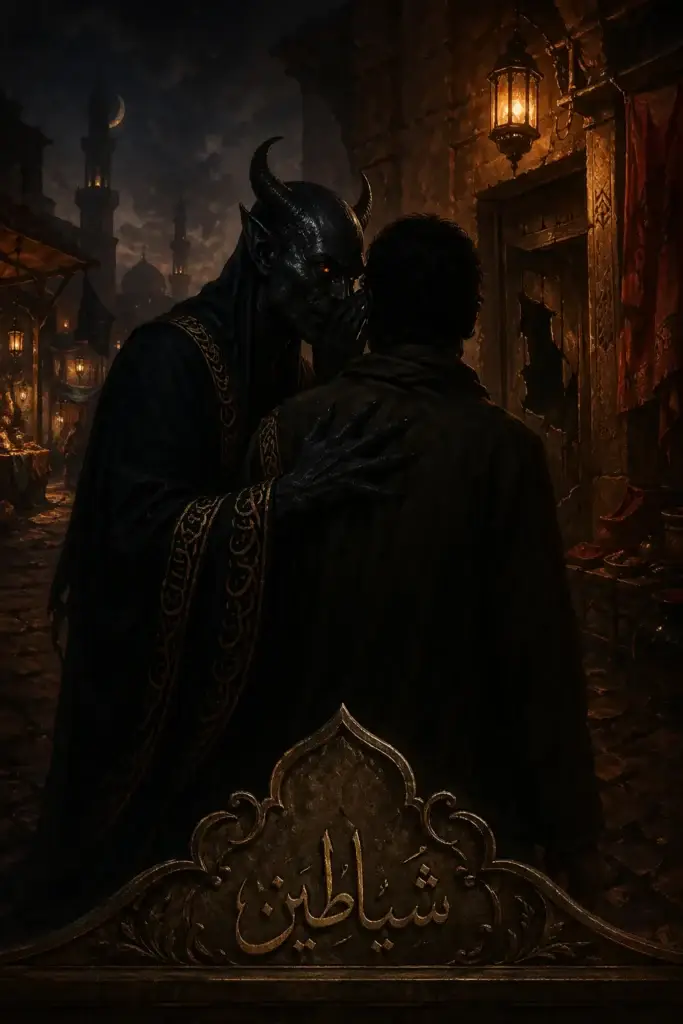
Ghaddar, the Treacherous One from al-Qazwini's cosmography
By Ralf Ittermann · last reviewed on
The Ghaddar is a demon of Arabian tradition.
The Treacherous One, who lures and attacks travellers. Ghaddar appears in this profile as the Treacherous One, a figure recorded in al-Qazwini’s cosmography and outlined here in its narrative context.
The Ghaddar, the Treacherous One, is a cruel desert demon of classical Arabic tradition. It is rooted in Yemen and the coastal regions of Egypt; its trade is the ambush: it lures travellers and falls upon them.
At the same time it is a being with a narrow source base. The first attestation appears in al-Qazwini in the 13th century, and at its core everything later rests on this one brief passage. Anyone who describes the Ghaddar is therefore describing, above all, what the tradition leaves open.
Type: Cruel desert demon, a subtype of the malevolent jinn
Origin: Classical Arabic cosmography
Texts: al-Qazwini (Aja’ib al-makhluqat), passed on via Hughes, Lane, Bane, Lebling
Period: classical Islamic, from the 13th century onwards
Appearance: undescribed, apart from one lethal characteristic

Textual history
Period of the Texts
Classical Islamic, from the 13th century onwards: the first attestation appears in al-Qazwini, and all later mentions build on this passage.
Area of Diffusion
Yemen and the coastal regions of Egypt according to al-Qazwini; Hughes extends this area in 1885 to the Tihama and the Red Sea coastal land.
Sources
Thin: a single brief passage in al-Qazwini, passed on via Hughes, Lane, Bane and Lebling. Detailed modern accounts are elaborations.
Name and variants
Arabic: ghaddar, the intensive form of the root gh-d-r, betrayal: the treacherous one. A variant of the name is Gharrar. The name thus does not describe the figure’s appearance but its behaviour, the breach of trust against the traveller.
Nature and effect
Appearance
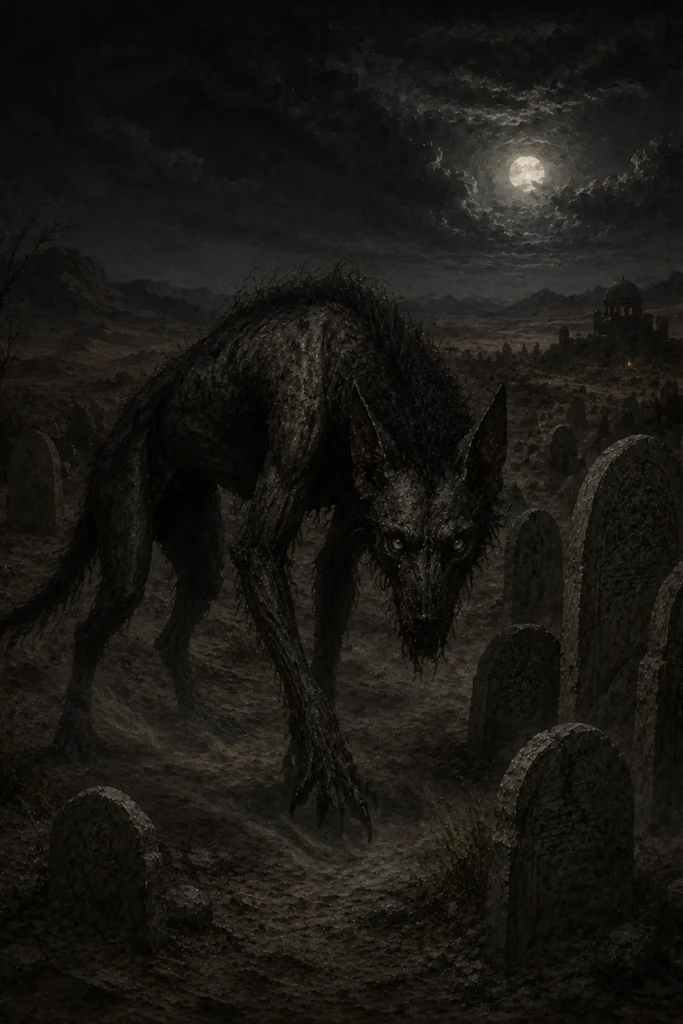
A clarification is important here: al-Qazwini does not describe the Ghaddar’s appearance, apart from one lethal characteristic. The descriptions in circulation, as dog-like or goat-like, horned, or hatched from an egg, come from later compilations, not from al-Qazwini.
Effect
The Ghaddar lures its victims and attacks them. The outcome ranges from mortal terror to assault, with the one characteristic noted by al-Qazwini being potentially lethal. According to Lebling, it torments or frightens its victims and leaves them behind in the wilderness.
Profile: Ghaddar
The little that the sources say about the Treacherous One, at a glance.
A subtype of the malevolent jinn in classical Arabic cosmography, classed among the desert demons that threaten travellers.
Travellers in the desert and coastal land: the Ghaddar specifically targets living wanderers, whom it lures and attacks.
Not described by al-Qazwini, apart from one lethal characteristic; the dog-like or goat-like details are a later addition.
Ambush, torment and terror: it lures, attacks and leaves its victims behind in the wilderness, in the most extreme case fatally.
No dedicated ritual is recorded: general anti-jinn protection with the Throne Verse, protective suras and the formula of seeking refuge in God.
A brief passage and its long-lasting effect
The name is the intensive form of the root gh-d-r, betrayal, and means the treacherous one; a variant is Gharrar. The first attestation appears in al-Qazwini in the 13th century, who places the Ghaddar in Yemen and on the coasts of Egypt. Hughes extends this area in 1885 to the Tihama and the Red Sea coastal land.
The sources offer little more than this, and that is precisely the actual finding: the Ghaddar is a literary-cosmographic motif that was passed on via Hughes, Lane, Bane and Lebling. Whatever details modern compendia offer are elaborations on a few sentences, not an independent tradition.
Source criticism and classification
The Ghaddar is thinly attested and rests at its core on a single brief al-Qazwini passage, passed down through Hughes, Lane, Bane and Lebling; all elaborate modern accounts are embellishments of a few sentences.
From a religious-studies perspective, the Ghaddar is a cruel but thinly attested desert demon. Three clarifications belong here: attributing a detailed description of its form to al-Qazwini is a mistake. It is primarily a literary-cosmographic motif, not a widespread folk figure. And its gender varies depending on the source.
General defence rather than a dedicated ritual
No Ghaddar-specific protection has been passed down. The secondary sources apply general anti-djinn protection: Quran recitation, namely the Throne Verse and the protective surahs, together with the formula of seeking refuge in God. The Faithless One has thus not produced its own defensive repertoire but shares the means that Islamic tradition holds in reserve against malicious djinn in general.
Ghul, Si'lat and the demons of the travel routes
The Ghaddar is a subtype of the malicious djinn and belongs to the desert demons that threaten travellers, alongside the Ghul and the Si’lat. The distinction is clear: the Ghul eats carrion and corpses, while the Ghaddar specifically targets living travellers. The Nasnas and the Shiqq also belong to this same series of wasteland dangers.
Frequently asked questions about the Ghaddar
What is a Ghaddar?
A cruel desert demon of Yemen and the coastal regions of Egypt, which lures and attacks travellers. Its name means the Faithless One.
What does the Ghaddar look like?
al-Qazwini does not describe its appearance, apart from one lethal trait. The detailed images now in circulation come from later compilations and are embellishment.
Is it well attested?
No. At its core it rests on a single brief passage by al-Qazwini, passed down through Hughes, Lane, Bane and Lebling.
Further links
Further reading:
- Islam – all beings of the Islamic world of belief
- Ghul – the corpse-eater, from which the Ghaddar must be distinguished
- Si’lat, Nasnas, Shiqq – further demons of the wastelands
- Iron, Holy Water, Amulet – traditional protective means
- Protection Compass – protective means at a glance
Literature (selection)
Further standard works in the bibliography.
As an Arabian desert demon, the Ghaddar, the Faithless One, remains above all one thing: a warning in a few sentences, migrating through the compendia since al-Qazwini without ever acquiring a fixed face.