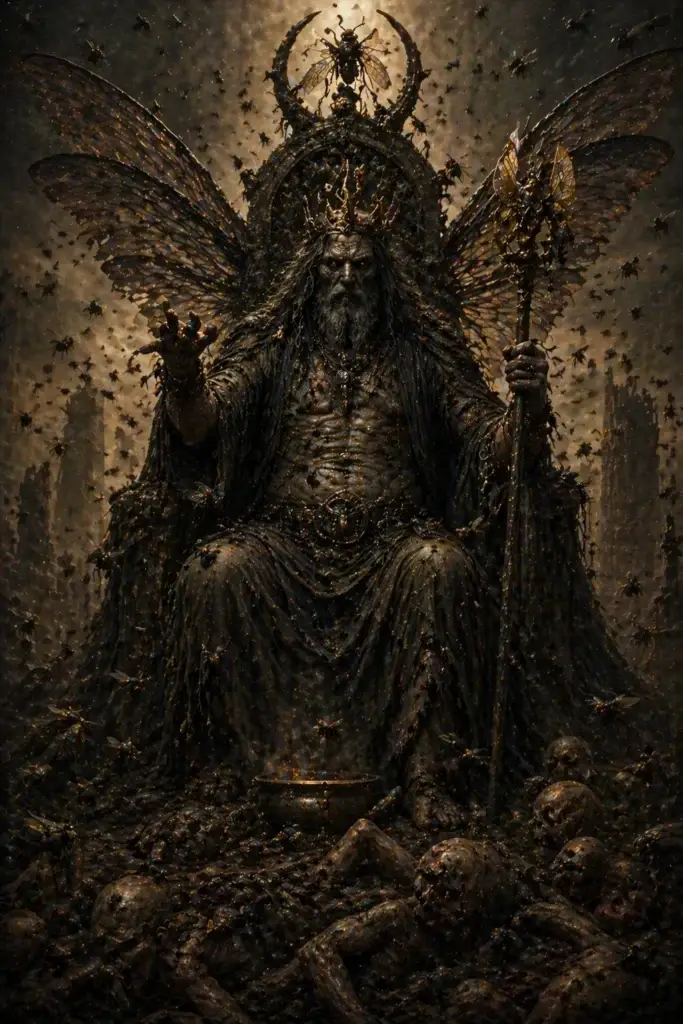
Beings from the Christian tradition on iWell Guard. A Christian tradition since the 1st century, with a demonological layer drawn from apocrypha, medieval theology and the early modern period.
Christianity is monotheistic in a trinitarian sense, one God in three persons, and in its official confession recognises no further divine beings. Nonetheless, it has an exceptionally differentiated doctrine of angels and demons, which derives from Jewish roots and was elaborated over two millennia.
The angelic hierarchy was systematised in particular by Pseudo-Dionysius in the 5th century: Seraphim, Cherubim, Thrones, Dominions, Powers, Authorities, Principalities, Archangels, Angels, nine choirs in three triads.
Michael, Gabriel and Raphael are the archangels named in the Bible; Uriel comes from apocryphal tradition. The Catholic and Eastern Church traditions also recognise guardian angels and saints as intercessors.
The demonology has a long history: from the New Testament Satan and the “Legion” through the medieval angelic classification of fallen spirits to the early modern Goetia with its named hierarchies (Bael, Belial, Asmodeus).
Folk Christianity (witch belief, Marian devotion, saints as patron protectors) developed a broader world of beings that was not always officially accepted, yet was present everywhere in religious practice.

Period: Since the 1st century AD, demonological layer mainly 3rd to 17th century.
Distribution: Roman Empire, medieval Europe, worldwide during the colonial era.
Sources: Bible (Revelation, Isaiah 14), apocrypha (Enoch), Pseudo-Areopagite, Goetia, Lemegeton, Eliphas Levi.
Pantheon and classes of beings: angelic hierarchies (Cherubim, Seraphim, Archangels), fallen angels (Lucifer, Satan), Goetia demons.
Christianity arose in the 1st century as a reform movement within Judaism and later became a universal religion with three confessions (Catholic, Orthodox, Protestant).
Central to it is the theology of a monotheistic God, beneath whom a hierarchy of angels is subordinate. The Pseudo-Areopagite writings of the 5th and 6th centuries codified the model of the nine angelic choirs.
In contrast to the Jewish and Islamic traditions, Christianity developed a pronounced demonology: the fall of Satan and his angels is interpreted as a central cosmic catastrophe.
Medieval and early modern theologians (for example Thomas Aquinas in the 13th century) integrated it into scholastic theology, where it remained authoritative well into the 20th century. The four or seven archangels (Michael, Gabriel, Raphael, Uriel) trace back to the Book of Enoch and liturgical tradition.
Christian demonology grew out of Jewish-Hellenistic roots and Mesopotamian-Greek folk religion. Augustine of Hippo systematised the concept of demons as fallen angels; Thomas Aquinas elaborated it scholastically.
In the late medieval and early modern periods this became linked with the persecution of witches; the Malleus Maleficarum (Hammer of Witches, 1486) is the notorious principal document.
The veneration of saints filled the gap in Christianity that the polytheistic pantheon had left behind. Local saints took over the functions of former gods; Brigid, Christianised as Saint Brigid of Kildare, retained aspects of the Celtic goddess of the same name.
Mary absorbed numerous aspects of Mediterranean mother goddesses. The calendar of saints with its patronages functions, in terms of the phenomenology of religion, like a pantheon.
Christian religious scholarship is the methodologically most fully developed branch of religious studies.
Standard works on angelic magic include David Keck, “Angels and Angelology in the Middle Ages” (1998); on demonology, Jeffrey Burton Russell‘s four-volume history (“The Devil”, “Satan”, “Lucifer”, “Mephistopheles”, 1977-1986); on the veneration of saints, Peter Brown, “The Cult of the Saints” (1981).
Christian protective practice includes Saint Christopher medals for travellers, scapulars for religious communities and blessed cross pendants for everyday wear.
iWell Guard fits into this cultural-historical line of wearable objects of protection, in a contemporary material architecture, made in Germany. 41 layers, solid gold, platinum, silver. 30-day right of return.
Personal experiences may vary. Not a medical device. No promise of healing.
The term mythology is traditionally used with reserve in Christianity, since the biblical narratives are understood theologically as salvation history and not as myth.
From the perspective of religious studies, Christian mythology nonetheless encompasses narratives of creation, the fall and the end times, as well as an elaborate system of angels, saints, demons and apocryphal figures drawn from Jewish, Hellenistic and late antique sources.
The lexicon of protective symbols covers several signs and objects from Christianity on dedicated pages: Christian protective medals and the cross as a protective sign. A cross-cultural overview is provided by the page on protective symbols.