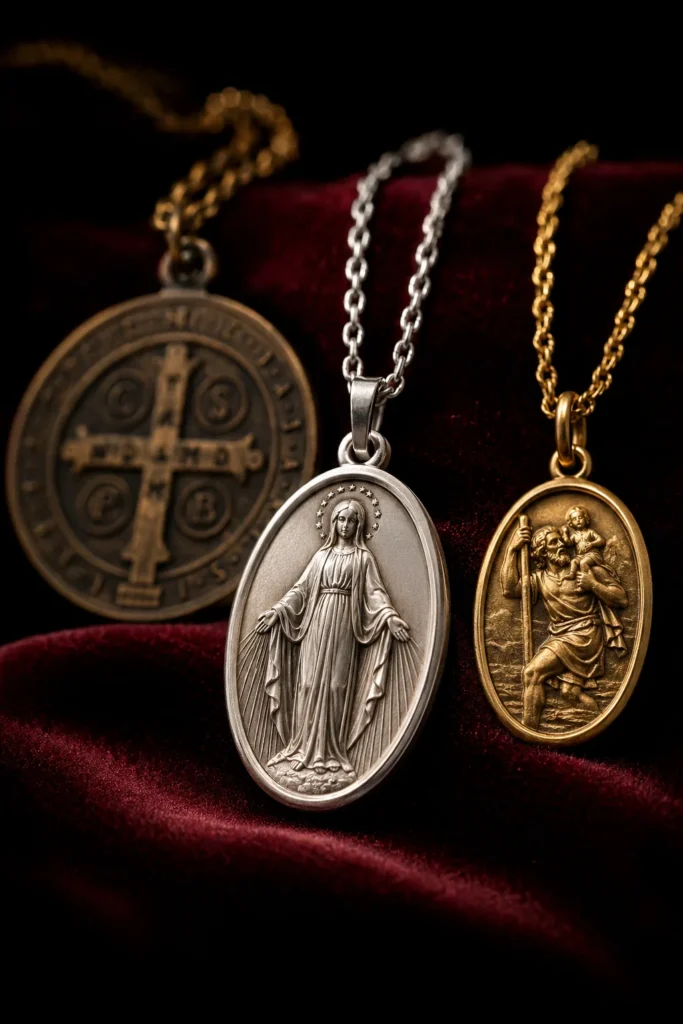
This overview presents the most important Christian protective medals, their connections to saints and their tradition of being worn, in a single coherent treatment. Christian protective medals are among the most widely worn religious objects of the Western world.
The Benedict medal, the Miraculous Medal and the Saint Christopher medal combine an ancient need for protection with the world of faith of the Church, and they do so in a way that differs clearly from magical amulets.
Christian protective medals are small, usually round or oval pendants made of metal that carry a religious image and often a short inscription. They are worn on a chain around the neck, attached to rosaries, mounted in vehicles or hung up in homes. In the Catholic tradition of Christianity they are extraordinarily widespread.
In the language of the Church such medals belong to the sacramentals. By this are meant consecrated signs and acts that are directed toward the sacraments without being sacraments themselves.
A protective medal is therefore a blessed object that makes faith visible and calls it to mind, and not an object with its own, automatically acting power.
This distinction is essential for understanding the medals. It explains why the Church encourages the wearing of medals and at the same time warns against a superstitious use of them.
According to Church teaching, a protective medal does not act like a magical amulet, but as a sign of trust in God and of the intercession of the saints.
Protective medals are among the most frequently produced religious objects of all. They are distributed at places of pilgrimage, in church shops and by religious orders, and they reach people in all walks of life.
From the child to whom a grandmother gives a medal, to the traveller who fixes a plaque in the car, the circle of those who wear such signs is wide. This broad anchoring makes the medal a revealing example of lived piety.
The wearing of consecrated signs is very old in Christianity. Already in late antiquity the faithful wore small pendants called encolpia, often with a cross or a relic. Pilgrims brought back small keepsakes from the great places of pilgrimage, so-called pilgrim badges, which made present the consecrated destination of the journey.
From these early forms the cast or struck medal developed in the course of the Middle Ages and the early modern period. With the advent of efficient striking technology, medals could be produced in great numbers. They thus became affordable and reached broad sections of the population rather than individual pilgrims alone.
In the 19th and early 20th centuries the protective medal experienced a heyday. Marian apparitions, canonisations and great pilgrimages gave occasion for new types of medal, some of which remain among the best known to this day. The medal thus became a fixed component of Catholic piety.
Confraternities and religious orders played an important role in spreading them. They promoted particular medals, bound them to their forms of piety and ensured that a type became known beyond individual regions.
With the improvement of striking technology, medals could moreover be produced in very large numbers and at low cost. Only through this did the protective medal turn from a rare keepsake into an everyday companion of broad sections of the population.
The Benedict medal is the best-known form expressly understood as a protective medal. It shows Saint Benedict of Nursia, the founder of Western monasticism, with a cross and a book, the Rule of the order. Its form in use today goes back to a jubilee edition struck in 1880 at the Abbey of Montecassino.
What is special about the Benedict medal is the many letters that cover its reverse and obverse. They are the initial letters of a Latin prayer and blessing formula that asks for protection against evil and calls for turning away from it. The medal thus carries a condensed prayer in the form of signs.
In Catholic practice the Benedict medal is regarded as a sign of protection against spiritual harm. It is blessed, worn and attached to houses or above doors. Here too the Church view applies that it is not the metal that acts, but the prayer and the faith that the medal expresses.
The Abbey of Montecassino, the place of origin of the Benedictine order, is closely associated with the medal and blesses it in a form of its own.
Among the people the Benedict medal is regarded in particular as a sign against spiritual temptation and is also used in connection with the Church’s prayer for deliverance. The dense sequence of letters makes it one of the most distinctive medals, for it carries its prayer of protection visibly on its own surface.
The Miraculous Medal goes back to events of the year 1830 in Paris.
The religious sister Catherine Labouré reported apparitions of the Mother of God Mary, in the course of which she said she had received the task of having a medal struck according to an exact model. The medal shows Mary with an invocation that confesses her purity from birth.
The spread of the medal proceeded rapidly and on a large scale. Only a few years after the apparitions, millions of copies were in circulation. The name Miraculous Medal arose because numerous wearers reported answered prayers and help that they connected with the medal.
The Miraculous Medal is a Marian medal. Its idea of protection is closely bound up with the intercession of Mary. Whoever wears it entrusts themselves, according to Catholic understanding, to the assistance of the Mother of God.
The medal is thus less a sign of defence than an expression of a turning toward her and of a request for accompaniment.
The rapid spread of the Miraculous Medal fell in a time of great uncertainty. In the 1830s cholera epidemics shook Europe, and the need for protection and consolation was great.
The chapel in the Paris Rue du Bac, in which Catherine Labouré experienced her apparitions, became a much-visited place of pilgrimage. To this day it counts among the best-known Marian sites of the city and attracts numerous pilgrims.
The Saint Christopher medal is the classic medal of protection while travelling. It shows Saint Christopher, who according to the legend carried a child across a raging river and in doing so recognised that he had Christ himself on his shoulders. The name Christopher means literally bearer of Christ.
From this legend the role of the saint as patron of travellers is explained. Whoever had a dangerous journey ahead placed themselves under his protection. With the spread of the automobile in the 20th century, the Saint Christopher medal became the typical plaque in the vehicle and the pendant of many travellers.
The Saint Christopher medal shows exemplarily how a protective medal can be bound to a concrete area of life. While the Benedict medal is meant to protect generally against evil, the Saint Christopher medal relates to the situation of travel. Both belong to the same family of consecrated signs, but address different concerns.
In the Middle Ages Christopher belonged to the Fourteen Holy Helpers, a group of saints who were invoked in particular distress. Widespread was the belief that even the sight of an image of Christopher in the morning would preserve one from a sudden, unprepared death on that day.
From this notion it is explained why large images of Christopher were placed on churches and along roads. The medal of today in the vehicle continues this old connection of image and protection while travelling.
Alongside the three great types there are numerous further protective medals. Widespread are medals of individual saints who are regarded as patrons of particular professions, concerns or situations of life. Angel medals too, especially those of the guardian angel, belong to this group and are gladly given to children.
Closely related to the medal is the scapular. It consists of two small pieces of cloth, connected by bands, that are worn over chest and back. The best known is the brown scapular, which goes back to the Carmelite tradition. Often a scapular medal is worn today that replaces the cloth.
This variety shows that the Christian protective medal is not a uniform object but a whole category. Common to all forms is that they carry a religious image on the body and thus keep visible a connection to a saint, to Mary or to Christ.
Bound up with the scapular is a tradition of piety of its own that goes back to the Carmelite order and is tied to the Mother of God. Whoever wears the scapular commits themselves to particular prayers and places themselves under the protection of Mary.
Widespread, moreover, are medals of the guardian angel, which are often given to children. They combine the idea of the heavenly companion with the worn sign and thus likewise belong to the great family of protective medals.
Protective medals are made from various materials. Widespread are simple medals of aluminium or base metal; alongside these there are pieces of silver and gold. The choice of material says, according to the Church view, nothing about the spiritual meaning, for this does not depend on the value of the metal.
The design follows fixed image types. A medal usually shows on one side the main image, such as the saint or Mary, and on the other side a complementary sign or an inscription.
This visual language has remained stable over a long time, so that the great types of medal are easy to recognise again.
Essential is the blessing. A medal is blessed by a priest or deacon and thereby becomes a sacramental. Only this blessing turns the struck metal into a consecrated object. The consecration underlines that the medal is integrated into the faith and into the prayer of the Church.
A medal can be blessed by any priest or deacon; a special place of consecration is not necessary. The protective medal is thus deliberately low-threshold. Its spiritual rank depends neither on the material nor on the price, but solely on the blessing and on the faith of the wearer.
Precisely simple medals of base metal, such as are handed out in great numbers at places of pilgrimage, are therefore just as fully valid sacramentals as precious pieces of gold.
Catholic teaching places great value on the distinction between a sacramental and a magical amulet. According to the magical conception, an amulet acts out of itself, as it were mechanically, as soon as it is worn. According to Church teaching, a protective medal does not act in this way.
The medal is a sign. It reminds the wearer of their faith, it directs their prayer and it asks for the intercession of a saint or of Mary.
The protection that is hoped for proceeds from God, not from the object. The Church expressly warns against attributing an automatic effect to a medal, for that would be superstition.
This classification is also instructive from a religious-studies point of view. It shows that the wearing of protective signs need not necessarily be interpreted as magical. The Christian protective medal stands for a model in which the worn sign is related entirely to prayer, faith and intercession.
The Catechism of the Catholic Church expressly admonishes against using religious signs superstitiously. Superstition is present, according to Church teaching, where an object is attributed an as it were mechanical effect, independent of the inner attitude of the person.
The protective medal, by contrast, is meant to support faith, not to replace it. To draw this boundary between piety and superstition precisely was an abiding concern of the Church over the centuries.

Christian protective medals are extraordinarily widespread to this day. In countries shaped by Catholicism they belong to First Communion, to baptism and to many other occasions on which they are given as gifts. They are thus often connected with a particular life event and a personal memory.
Beyond strictly religious use, some medals have also gained a cultural meaning. The Saint Christopher plaque in the car is in some places fixed almost as a matter of course, even by people who are distant from Church practice. Here the meaning shifts from the consecrated sign to a general symbol of luck and protection.
Within Catholic piety itself the protective medal remains alive. It is an example of how the need for a worn sign of protection persists over centuries and how a great religion has given this need a form of its own, theologically thought through.
Protective medals are encountered in many places right into more recent history. Soldiers wore them in the wars of the 20th century, emigrants took them along on their journeys, and to this day they are given as gifts at baptism, First Communion and Confirmation.
In this constancy it shows that the protective medal is more than a historical object. It is a living form in which the need for protection and religious confession come together.
Related key terms: Benedict medal, Miraculous Medal, Christopher, sacramental, scapular, saint’s medal, blessing, protection while travelling.
iWell Guard stands in the cultural-historical line of wearable protective objects, to which the Christian protective medals also belong. A modern companion for people who live with protective symbols: made in Germany, 41 layers of solid gold, platinum and silver, with a 30-day right of return.
Personal experiences may vary. Not a medical device. No promise of healing.