Astaroth, Demon of the Christian Tradition
By Ralf Ittermann · last reviewed on
In Christian Western demonology, Astaroth is a powerful demon or demon prince, typically portrayed as a being conceived as male. In religious studies, Astaroth represents the conversion of ancient Near Eastern deities (especially the Assyrian-Phoenician Astarte) into demonic figures by Christian heresiologists.
Astaroth
In the Goetia (Lemegeton), Astaroth is one of the 72 spirits of the Holy Name, often described as a proud and learned demon. Astaroth is said to impart secret knowledge of the past, present and future, and can enter into dialogue with magicians.
Depiction: often humanoid and male, sometimes with demonic features (wings, horns). Central myths: Solomonic magic (Lemegeton), later occult traditions (MacGregor Mathers), modern magical orders. Functionally: a source of forbidden knowledge, a tempter (pleasure, vice), but also a negotiating partner for magicians.
Short Profile: Astaroth
Astaroth emerged as a demonic concept in early medieval Christian heresy texts (roughly the 4th to 8th century), based on older demonizations of deities. Central sources: De Doctrina Apostolorum, early ecclesiastical demon catalogues, and later the Lemegeton (the Lesser Key of Solomon, 16th to 17th century).
Spread: Western European, and later global through occult movements. State of research: Joshua Trachtenberg (Jewish Magic and Superstition), Owen Davies (Grimoires), Steven Flowers (Rune Primer), S. L. MacGregor Mathers (magical historian and Lemegeton editor).
Classification
The history of the name can be traced in the sources: from the West Semitic goddess Astarte, via the Hebrew distortion Ashtoreth, a male prince of hell emerged in the demonological literature of the Middle Ages and the early modern period. This reinterpretation remained stable: from Weyer through the Lemegeton to Collin de Plancy’s Dictionnaire Infernal (1818), Astaroth consistently appears as a demon. In present-day occultism and in popular culture the name continues to be used, mostly in direct reliance on the Goetic descriptions.
Astaroth was received almost entirely within learned circles. In the early modern period, his name circulated among educated readers of demonological treatises and among practitioners of ritual magic who studied texts such as the Lemegeton and the Pseudomonarchia Daemonum, works that presupposed Latin literacy and access to rare manuscripts. There was no popular cult and no folk veneration attached to him. Only in the nineteenth and twentieth centuries, through occult revival movements and later through fiction and games, did the figure reach a broader audience beyond scholarly readers.
This clearly points to a central role in the self-understanding of an entire people. Trade, migration and cultural exchange contributed to the geographic spread and to the stable uniformity of the veneration.
The primary sources are the Lemegeton (a Greek and Latin magical text, roughly 16th to 17th century, in various manuscripts), the Table of Solomon (Hebrew-Christian magical traditions) and Goetia texts (the evocation of spirits). Period: 4th to 17th century (layered formation of the concept). Linguistic areas: Latin, Greek, Hebrew, and later German and English.
Geographically: Central Europe, the Mediterranean (originally the Astarte cult). Researchers: Owen Davies (Cunning-Folk and Grimoires), Joseph Dan (Jewish Mysticism and Magic), Darcy Kuntz (Lemegeton editions), Austin Osman Spare (the magical modern era). Legitimacy of the sources: historically contested; the Lemegeton is probably a later compilation (16th to 18th century), not Solomonic or ancient.
Designation and Spellings
In the various sources and artistic traditions, Astaroth is depicted with certain recurring iconographic elements that remain relatively constant across decades and across different geographic areas. These elements are not purely decorative or chosen at random, but are deeply symbolically encoded and carry great meaning.
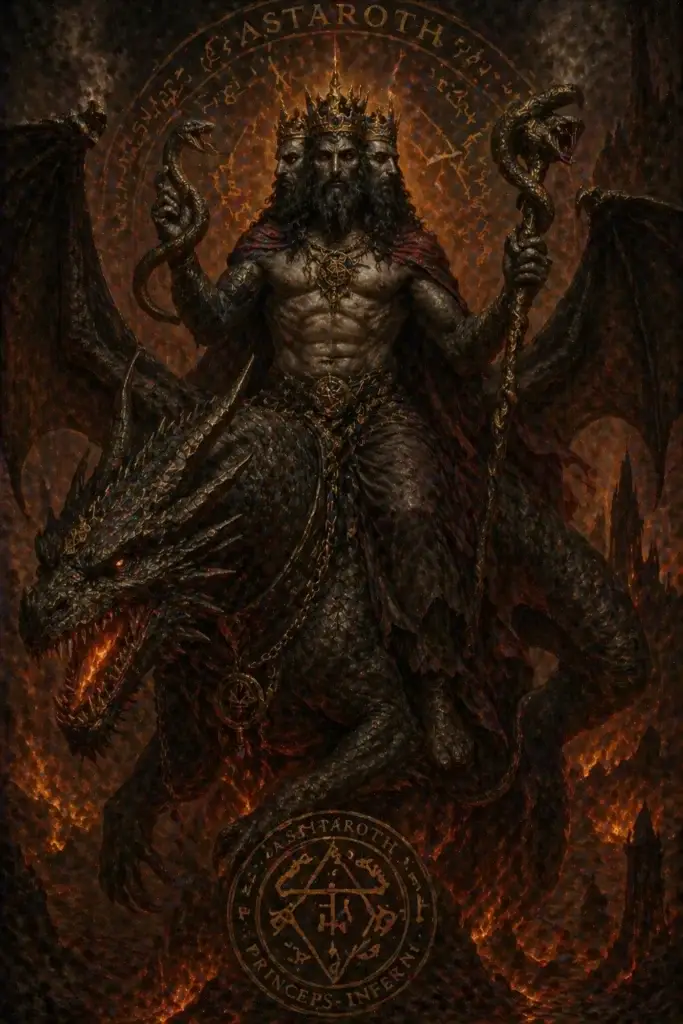
The Goetia describes Astaroth with a fixed set of identifying marks: he appears as an angel riding an infernal dragon, carries a viper in his right hand, and commands 40 legions. Every detail has a function in the grimoire literature. The seal serves identification and binding, the dragon and the viper mark his rank and his dangerousness, and the fields of knowledge attributed to him (past, present, future, the liberal arts) define what he should be summoned for. Anyone familiar with the conventions of this literature could read the spirit‘s area of competence from his appearance and seal.
The overall system is like a sacred script or an encoded image: it allows the initiated or culturally educated to grasp and correctly understand the essential, deeper meaning. Colors, sacred objects or weapons, physical attributes, specific accessories: everything is significant and traditionally handed down.
Character Traits
Dealings with Astaroth followed fixed rules in the grimoires of the early modern period: for summoning the Grand Duke, the Lemegeton (Goetia) specifies a seal, a protective circle, and prescribed formulas of invocation, along with warnings about his poisonous breath, against which the magician is to hold up a silver ring. Such instructions were set down in writing and addressed to learned practitioners with knowledge of Latin and the Bible, not to laypeople.
The continuity of these practices across many generations clearly shows that the practice was regarded as effective and necessary. Its functions were varied: some were preventive (warding off potential harm), some healing (the easing of illness or suffering), some transformative (accompaniment through transitions between stages of life).
Profile: Astaroth
The profile of Astaroth considers its demonological classification, its origin in older deities, its magical function in Goetia practices, its morphology (conceived as male, demonic and elegant), its role in myths of temptation and the imparting of knowledge, protective practices against its seduction, and cultural parallels to older goddess figures.
Astaroth arose chronologically out of the early medieval Christian demonization of pagan deities (4th to 8th century), with a later fixation in the Goetia and occult systems (16th to 17th century). Geographic origin: the Middle East (the original goddess Astarte, Phoenician and Assyrian), and later Europeanized.
Cultural origin: a syncretism of the ancient Near Eastern mother goddess, Christian demonology and early modern occult pragmatism. First attestations: texts of the Church Fathers (Origen, Jerome) mention Astaroth as a pagan deity or idol, not as a demonic figure; the Goetia sources are early modern (Weyer’s Pseudomonarchia Daemonum of 1577, the Lemegeton as a compilation of the 17th century).
Astaroth magic was directed at magicians, alchemists, learned occultists, and elite practitioners of Goetia and ceremonial magic. Occasions: the search for knowledge, occult initiation, negotiation with supernatural powers, and sometimes pleasure or demonic seduction (interpreted theologically as sin).
Social context: the Middle Ages and late Middle Ages (the Inquisition, the persecution of magic), the early modern era (occult movements, alchemy), and the modern era (magical orders, Thelema). The practices were illegal and criminalized; the evocation of Astaroth was a magical venture.
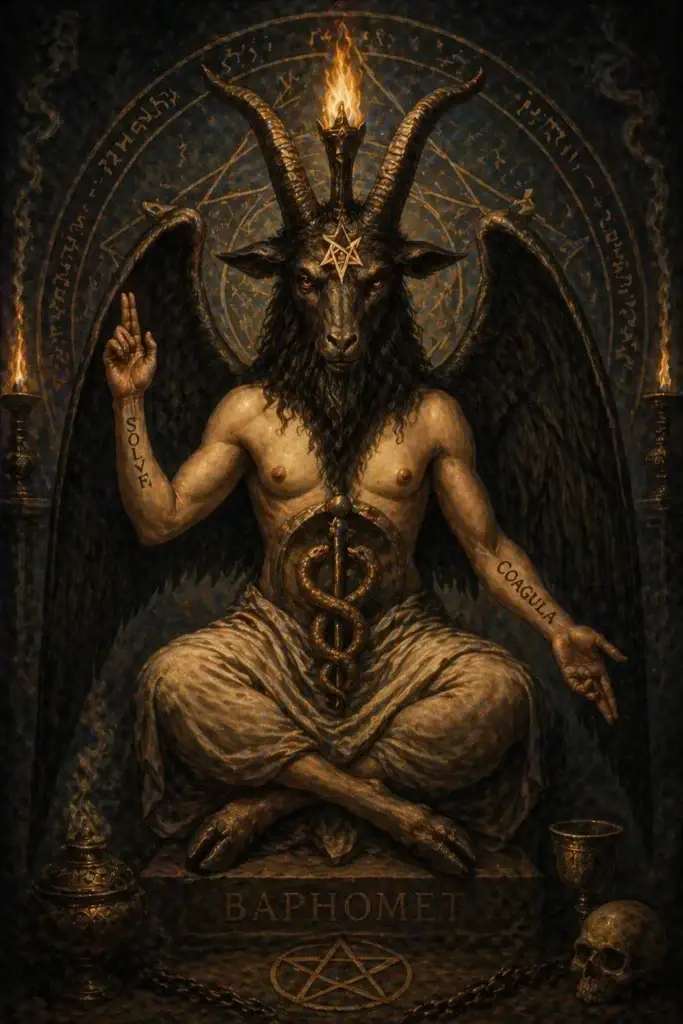
Astaroth is often depicted iconographically as a being conceived as male, elegant and seductive, sometimes with wings, horns or a firelight aura. Colors: purple, red, grey (varying by source). In Lemegeton illustrations: humanoid and demonic, often riding a dragon or shown with symbols (pentacle, magical seals).
Attributes: a torch, a book (knowledge), and sometimes a serpent or scorpion (the danger of poison). In modern occult art: more elegant than monstrous; the depiction varies greatly depending on the magical tradition.
In the Lemegeton (Lesser Key of Solomon), Astaroth is the 29th demon of the goetic hierarchy.
Protective practices against Astaroth: exorcism through Christian prayer and the name of Jesus, magical seals and pentacles (protective symbols from the Lemegeton), the invocation of guardian spirits (the Archangel Michael for the battle against demons), ritual boundaries and circles (a magical protective space), and ethical purity (as a precondition for warding off Astaroth).
Historically: the Church emphasized penance and confession; occult traditions emphasized magic and willpower. The modern approach: psychological distancing from narratives of seduction, or practices of discernment.
Comparable figures are Lilith (the Jewish demoness-goddess), Hecate (the Greek goddess of the underworld, later demonized), Ishtar/Inanna (the Mesopotamian goddess of love and war, ambivalent), the Celtic Mór-Ríghan (goddess of fate, demonized), and Baphomet (a southern French and Templar temple legend, ambivalent and demonic).
All share: goddess origins, demonization through patriarchy and Christianity, and an association with seduction or untamed knowledge.
Defense in Everyday Life
Conjurations and Binding Formulas
Lemegeton practice uses the 72 Names of God (Shem ha-Meforasch) as a counter-charm.
Pentacles and Seals
Astaroth’s seal is recorded in the Lemegeton as a geometric sign.
Safeguards Against Deception
Magical practice emphasizes that Astaroth lies, and that strict binding is therefore necessary.
Astaroth: Parallels in Other Cultures
Jewish tradition: Astaroth is a variant of the demonization of Astarte. Jewish demonology knows Asmodeus (king of the demons, but with ambivalence, sometimes a helper). In the Kabbalah, the impure Kelipot (shells of evil) are often female and seductive.
Lilith is the most important female demon-goddess in Judaism. Astaroth is not discussed centrally, but is structurally similar: demonic authority, seduction, and resentment toward God and humans.
The Greco-Roman world: Hecate is a goddess of the underworld and patroness of magic, similar to Astaroth’s imparting of knowledge. Hera/Juno is the goddess of marriage, but also a goddess of vengeance.
Aphrodite/Venus is a goddess of seduction (later demonized in Christianity as Luxuria, lust). The Graiai (the grey sisters) are old wise women with magical knowledge. Structurally: female deities as gatekeepers of knowledge or of the forbidden.
Mesopotamia: Ishtar/Inanna is the direct predecessor of Astarte (Phoenician). She is love, war and fertility, ambivalent, powerful and seductive. Her descent into the underworld shows a dark side. Ereshkigal is a goddess of the underworld, demonic and enigmatic. Both are open to negotiation, not evil in the Christian sense, but cosmically necessary.
India and Asia: Kali is Shakti in dark form: the destroyer, but also the liberator (a paradox). Durga is a slayer of demons, but also an androgynous being of power.
Chinese Daoism: female immortals (Xiwangmu, Queen Mother of the West) are wise and seductive. Tibetan Buddhism: wrathful female deities (for example the Dakinis) are terrifying and beautiful. All show: female supernatural authority without the Western demonic moral coloring.
From the Goddess Astarte to the Demon Astaroth
The demon Astaroth of the Christian tradition goes back to a deity who was worshipped in the ancient Near East. Astarte, in Hebrew Ashtoreth, was an important goddess of Canaanite and Phoenician religion, associated with fertility, love and in part with war.
She corresponds to the Mesopotamian Ishtar and the Sumerian Inanna and was among the most widely worshipped deities of the region.
The Hebrew Bible mentions this goddess several times, and consistently in a rejecting manner. There she appears as Ashtoreth or, in the plural, Ashtaroth, and is portrayed as a foreign cult from which Israel is to keep its distance.
Linguistically, many researchers assume that the vocalization of the Hebrew name was deliberately altered by inserting the vowels of the word boshet, “shame”. In biblical usage the goddess thus became a figure marked by shame.
In the further Christian tradition, the transition from the rejected deity to a demon took place. A recurring idea of late antique and medieval theology held that the gods of the heathens were in truth demons. Through this interpretation, the goddess Astarte became the demon Astaroth, now conceived of as male.
Religious-studies research sees in this process a textbook example of the so-called demonization of foreign deities, in which a being venerated by one religion is reinterpreted as an evil power in the subsequent or competing religion. The change of sex too is part of this reinterpretation and is well documented in research.
Astaroth in the Demonology of the Early Modern Period
Astaroth acquired his elaborated form in the demonological literature of the late Middle Ages and the early modern period.
During this time numerous writings appeared that ordered hell after the model of an earthly court or state and assigned ranks, offices and areas of responsibility to the demons. In these works Astaroth regularly belongs to the highest level.
In the influential Pseudomonarchia daemonum, which Johann Weyer published in 1577 as an appendix to his treatise against the persecution of witches, Astaroth appears as a powerful Grand Duke of hell.
Weyer describes him as a figure who rides an infernal beast and holds a serpent in his hand; whoever conjures him should beware of his foul breath.
He is credited with giving information about the past and the future and with teaching the secrets of the liberal arts. The Lemegeton, also called the Goetia, which later emerged from this material, took Astaroth into its list of the seventy-two demons.
Religious-studies research emphasizes that these works are not reports of cults that were actually practiced, but learned constructions. They work older lists of names, biblical allusions and literary traditions into a system that says more about the imaginative world of its authors than about real demonic beings.
Astaroth is a fixed entry in this system, one of the few figures that appear in almost all of the relevant writings.
His position as Grand Duke makes him one of the highest-ranking demons of Western demonology. Anyone interested in the logic of these infernal hierarchies will find further examples in the area of Christian demonology.
Astaroth in Witch Trials, Literature and Popular Culture
Beyond learned demonology, the name Astaroth also appeared in the witch trials of the early modern period. In the interrogation records he occasionally appears as one of the demons with whom the accused had supposedly made a pact.
These statements are worthless as sources for any real worship of demons, because they came about under pressure, often under torture, and following the leading questions of the inquisitors. They do show, however, that the names of the demonological handbooks had penetrated the thinking of the persecutors and shaped the image of hell.
In literature too Astaroth found use. His name already appears in medieval and early modern texts, and authors who portrayed hell or the demonic subsequently took it up again and again. Since the name is sonorous and is recorded in the standard works of demonology, it lent itself as a well-attested figure for literary purposes.
In the present day, Astaroth is above all present in popular culture. He appears in computer games, role-playing games, films, comics and music, often as a powerful prince of hell or as an adversary who must be defeated.
This modern use draws almost exclusively on the demonological handbooks, without any knowledge of the long path from the goddess Astarte.
In religious-studies terms, Astaroth thus remains an instructive case: a figure whose trail runs from a respected ancient Near Eastern goddess, through biblical rejection and learned demonization, to the standard demon of modern entertainment. In hardly any other figure can the process of demonization be traced so continuously over two millennia.
Further Links
Literature (Selection)
- Joseph H. Peterson (ed. & trans.): The Lesser Key of Solomon: The Goetia. Weiser Books, 2001.
The protective practice described here is a religious-studies classification of historical traditions. iWell Guard ties in with this cultural-historical line of portable protective objects and represents a contemporary form of it. More about the iWell Guard →