Polynesia denotes the great oceanic triangle between Hawaii in the north, New Zealand in the southwest and Easter Island in the southeast, a cultural unity connected by centuries of seafaring and a shared language family.
Religious concepts such as mana (numinous power), tapu (sacred, forbidden) and atua (deity) shape the entire region, with local expressions among the Maori in Aotearoa-New Zealand and in Hawaii, Samoa, Tonga and Tahiti.
Protective practice in the Pacific region is a focal point; many protective objects originate from across the Pacific.
Mana and tapu are the two defining religious categories of Polynesia. Mana denotes effective, sacred power; it is attached to persons (chiefs, priests, great warriors), places (sacred mountains, springs, shrines), objects (tools of successful ancestors, cult items) and actions.
Tapu (from which the word “taboo” is borrowed) denotes the sacred in the sense of the “set apart”; what is tapu may not be touched or entered without occasion. A violation of tapu can entail a loss of mana and social sanctions.
The Maori in Aotearoa (New Zealand) link their identity to whakapapa, the genealogical line that traces every person back across generations, canoe migrations and ancestral heroes to the atua (gods).
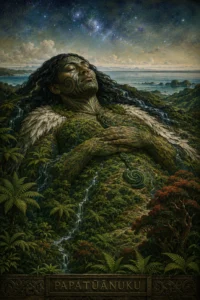
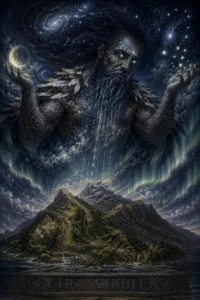
Important atua: Tane Mahuta (god of forests and birds), Tangaroa (sea), Rongo (peace and cultivation), Tu (war), Haumia (wild plants), Tawhirimatea (wind). The creation drama of the separation of Ranginui (sky father) and Papatuanuku (earth mother) by their sons is a central myth.
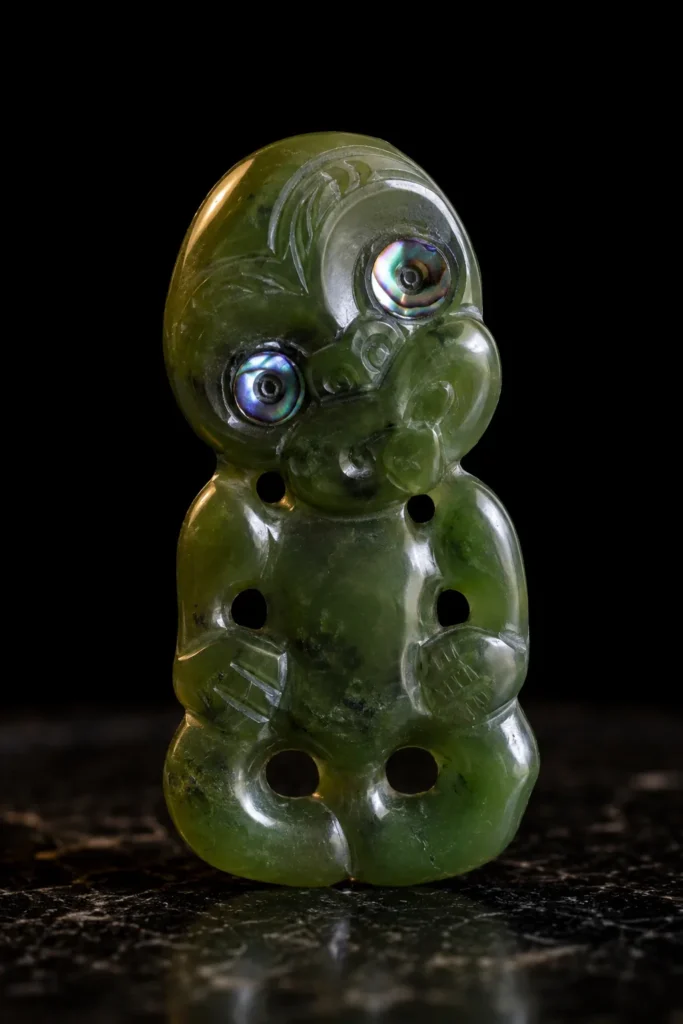
The tiki, a stylized human figure made of pounamu (nephrite jade, greenstone), bone or wood, is the internationally best-known Maori protective object. It often represents the first human or an ancestor and is worn as a protective pendant on a leather cord around the neck.
Hei-matau is a stylized fishhook form made of the same material, a symbol of connection to the sea, of safe travel and prosperity. Both forms are today the main motifs of Maori jewellery art, with reference to whakapapa and personal identity.
Hawaiian religion knows four central gods: Kane (creator, fresh water), Lono (peace, rain, agriculture), Ku (war, politics, male power) and Kanaloa (sea, underworld). Pele is the volcano goddess of Kīlauea; her sister Hi’iaka is a healing dancer.
Maui is a trickster hero: he catches the sun with a lasso and fishes the islands out of the sea. Heiau are temple complexes (stone platforms with wooden buildings) in which kahuna (priests) performed rites.
On Rapa Nui (Easter Island), a distinct culture developed from a Polynesian substrate tradition, with the moai, over 900 monolithic statues representing ancestors or deified chiefs.
The Tangata-Manu ritual (bird-man cult) replaced the erection of moai in a later phase. The rongorongo script remains undeciphered to this day; its cultic or administrative function remains contested.
Tā moko, the Maori facial and body tattoo, is not adornment in the Western sense but an embodiment of whakapapa, rank and personal history. The lines are traditionally struck into the skin with uhi chisels, the colour pigments derived from awheto charcoal.
The Polynesian tattooing tradition (from which the word “tattoo” derives) is today part of a pan-Pacific identity movement. Pounamu jewellery, bone pendants and woven flax bands complement the portable markers of identity.
Maori tradition has undergone a strong revitalization since the 1970s, with language schools (Kohanga Reo), marae as gathering places and recognition of the Treaty of Waitangi. Hawaii has had its own cultural renaissance since the 1970s, with the hula tradition, language schools and a sovereignty movement.
Religious-studies sources: Margaret Orbell The Illustrated Encyclopedia of Maori Myth and Legend, Martha Beckwith Hawaiian Mythology, Patrick Kirch On the Road of the Winds.
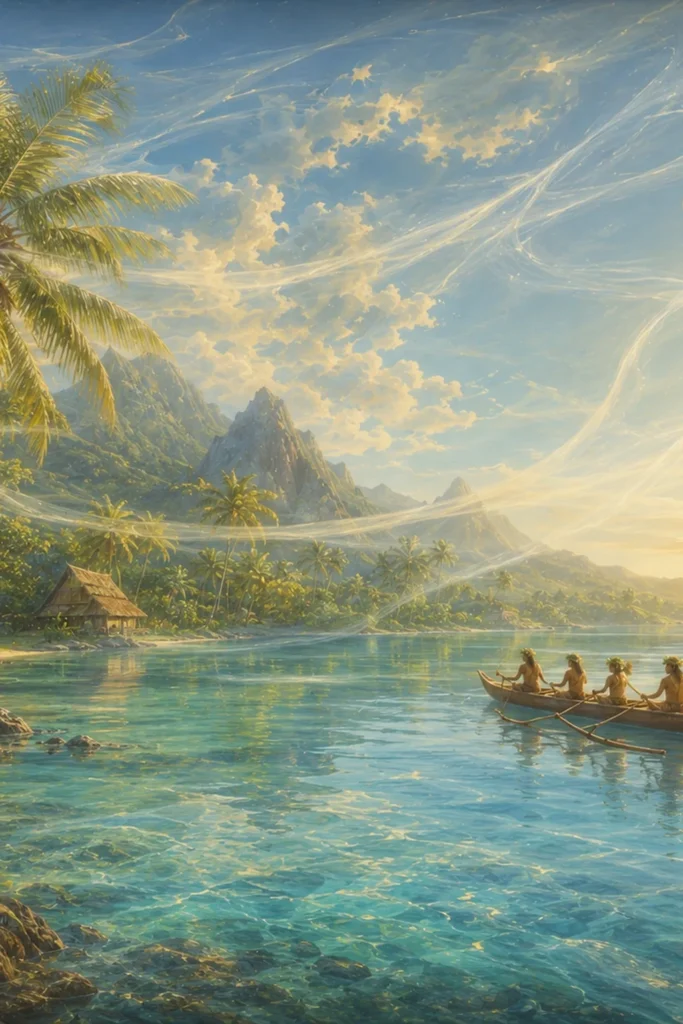
Polynesia denotes a vast triangle in the Pacific structured by islands, whose corners are formed roughly by Hawaii in the north, Easter Island in the southeast and New Zealand, in Maori Aotearoa, in the southwest.
This region was settled through one of the most remarkable migration achievements in history, in the course of which seafarers in double-hulled boats reached ever more distant islands over the centuries. New Zealand was reached only late, around the 13th century.
From this common origin arises a kinship of languages and conceptions that nonetheless developed independently on the individual island groups.
Hawaii, Tahiti and the other Society Islands, Samoa, Tonga, the Marquesas, the Cook Islands, remote Easter Island and Maori Aotearoa each form their own religious worlds with their own pantheon, their own ritual system and their own history.
Kinship shows itself, for example, in that related names for central deities and concepts appear across many island groups, each in a phonetically modified form.
At the same time the rank and significance of these beings shift considerably from island to island, so that a deity stands at the centre on one island group while playing barely any role on another.
Research therefore warns against speaking of Polynesian religion in the singular or taking one island group as representative of all. A comparative view is more appropriate, one that names commonalities without levelling out regional distinctiveness. Individual being-pages of this cultural region treat the deities more concretely.
Two terms shape the understanding of Polynesian religion in research especially strongly: mana and tapu. Mana denotes an effective power or efficacy that accrues to persons, objects and places in varying degrees.
High rank, successful deeds and divine descent go together with high mana. Through ethnology, the term even found its way into general religious studies, but was often overgeneralized in the process.
Closely connected is tapu, from which the word taboo derives. Tapu marks what is set apart, protected and surrounded with rules of conduct. A high-ranking person, a sanctuary or a dead person can be tapu, as can certain activities at certain times.
The counterpart, the state of the ordinary and the released, is named differently depending on the island, in the Maori area for example noa. Rituals often serve to mediate between these states.
The origin of the world is in many cases told as a sequence of begettings and separations. In a version widespread in the Maori area, the sky father and earth mother, Ranginui and Papatuanuku, at first lie closely entwined, until their children forcibly separate them and thus create space for light and life.
Other island groups know narratives of the drawing up of the islands from the sea by a hero or demigod.
Genealogy, in Maori whakapapa, is thereby more than a family tree. It binds gods, natural forces, ancestors and the living into a continuous chain and gives every being its place in the order.
Whoever knows their genealogy and can recite it thereby also demonstrates origin, rank and entitlement. Cosmology and social order are thus inseparably connected.

The Polynesian religions were transmitted orally, carried by a highly developed art of narration, song and genealogy.
In several island societies there were specialized keepers of knowledge and schools in which genealogies, creation narratives and ritual texts were carefully learned and passed on. With the rongorongo tablets, Easter Island possessed a sign system that remains undeciphered to this day and whose character remains disputed.
The written tradition began with contact with Europeans in the 18th and above all in the 19th century. Exploring travellers, missionaries and colonial officials recorded observations, though selectively and coloured by their own viewpoint. The records that arose in cooperation with indigenous informants are often more valuable.
In the Maori area, writing holds a special role, because the Maori were rapidly made literate in the 19th century and themselves began to record genealogies, narratives and songs.
Central early works, such as the collections of George Grey, rest on such indigenous sources, but had to be critically examined by later research, because the collector already selected and smoothed.
For Hawaii, attention should be drawn to the works of native scholars set down in writing in the 19th century, such as David Malo and Samuel Kamakau, who recorded old knowledge from an already Christianized situation.
Present-day research combines these early texts with archaeology, linguistic comparison and cooperation with present-day communities, and is aware that every source already represents a selection.
In the 19th century, large parts of Polynesia were Christianized, often within a few decades. Missionary societies, later colonial administrations, pushed back handed-down rites, dances and in part also languages.
On Hawaii, for example, the hula was at times suppressed; in New Zealand the Maori lost part of their cultural foundations in the course of land dispossession and school policy. Pre-Christian religion was thus in many places not simply replaced but pushed back into family knowledge, genealogies and individual practices.
Since the 20th century, intensified since the 1970s, a broad movement of cultural renewal can be observed. In the Maori area, language nests for children, Maori-language schools and a renaissance of carving art, dance and meeting-house ritual emerged.
The reconstruction of traditional double-hulled boats and long-distance voyages without modern instruments, for example through the Polynesian Voyaging Society, became a symbol of a Pacific-wide reorientation.
This renewal is not a mere reviving of a closed-off past. It connects handed-down conceptions with today’s, often Christian-shaped world of life and with political demands for recognition, language and land. In New Zealand, terms such as tapu, mana and whakapapa have become part of public and in part of legal usage.
Religious studies emphasizes that Polynesian religion can thus be described neither as a vanished mythology nor as an unchanged heritage. It is a living, changing field shaped by the communities themselves.
An appropriate account attends to regional differences, to the colonial history of rupture and to the right of present-day communities to decide over their own knowledge.


The term Polynesian encompasses the cultures between Hawaii, Aotearoa and Rapa Nui, whose protective objects such as Tiki, Hei-Tiki and Patu are anchored in a shared understanding of mana.
Related key terms: Maori Hawaii Tiki Mana Tapu Atua Hei-Matau Pounamu Greenstone Pele Maui Tangaroa Rongo Tu Whakapapa.
Polynesian tradition knows tiki figures of pounamu (greenstone), hei-matau fishhook pendants, woven flax bands and bone work as portable means of protection and objects of identity; tā moko embodies whakapapa directly on the skin.
iWell Guard places itself within this culture-historical line of portable protective objects, in a contemporary material architecture, manufactured in Germany. 41 layers, solid gold, platinum, silver. 30-day right of return.
Personal experiences may vary. Not a medical device. No promise of healing.
The lexicon of protective symbols treats several signs and objects from Polynesia and Māori culture on dedicated pages: Hei-tiki. A cross-cultural overview is offered by the page on protective symbols.