iWell Guard

Hakuturi, the bird flock of the forest god Tane

The Hakuturi are spirits of Maori tradition.

Forest guardians who set upright a tree felled without the proper rite.

SpiritsPolynesia

Table of Contents

Hakuturi, spirit of Maori tradition
Hakuturi

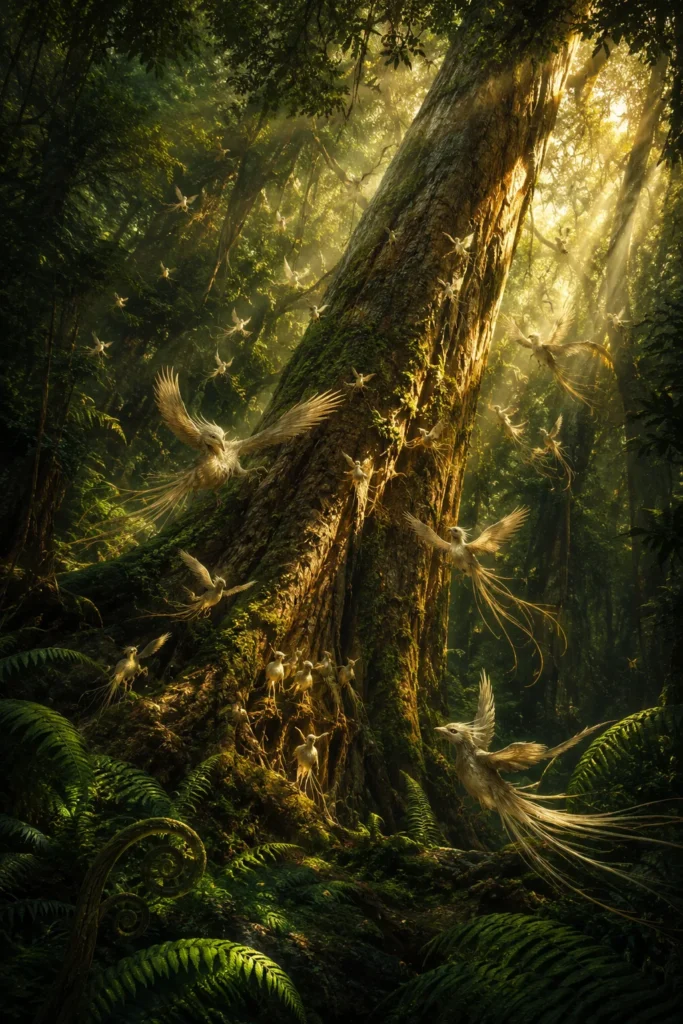
Hakuturi are the forest guardians of the Maori: a flock of spirit beings and children of the forest god Tane. As birds and small forest creatures, they protect the trees and punish violations of the forest’s sanctity.

Their core myth is the story of Rata: the hero fells a tree for a canoe without performing the prescribed prayers, and overnight the Hakuturi set the tree upright again. Only when Rata shows remorse and observes the correct rites do they fell the tree for him.

At a glance: Hakuturi

Type: flock of forest and spirit beings, forest guardians
Origin: classical Maori tradition, New Zealand
Texts: the Rata story, documented by Best, Orbell and Te Ara
Period: classical tradition to the present
Appearance: often as birds or bird-like, also as insects

Origin and sources

Period of the Texts

Classical Maori tradition, well attested in the Rata story and documented by Best, Orbell and Te Ara.

Area of Diffusion

New Zealand, the world of the Maori: the Hakuturi belong to the cosmology surrounding Tane Mahuta, the god of the forest and of birds.

Sources

Good: Elsdon Best’s forest lore of the Maori, Orbell’s encyclopedia and the Te Ara documentation.

Name and variants

Maori: hakuturi, the term for the forest and tree spirits. They are regarded as a flock, not as individual beings, and appear together in myth.

Form and effect

Appearance

The Hakuturi mostly appear as birds or bird-like spirits, also as insects of the forest. Birds and small creatures embody the life force of the forest; the treetop set upright again overnight is the sign of its inviolability without the proper rite.

Effect

The Hakuturi punish and correct ritually incorrect action and reward its proper performance. They embody the rule that use of the forest is permitted only with respect and rite.

Profile: Hakuturi

The key aspects of the forest guardians at a glance.

Cultural Context

Part of the Maori cosmology surrounding Tane Mahuta, the god of the forest and of birds, whose guardianship they enforce.

Relates To

People who fell trees or intervene in the forest: their actions are measured against the prescribed rites.

Depiction

A flock of forest and spirit beings, often as birds or bird-like, also as insects of the forest.

Function

Guardians of the forest: they punish violations of its sanctity, correct breaches of ritual and reward its proper performance.

Cult

Rites and karakia, prayers and incantations, when felling trees and hunting birds; in some places an offering.

Distinctions

The wild Maero and the fairy folk of the Patupaiarehe: three quite different forest peoples of the Maori.

Rata and the tree set upright again

The Hakuturi belong to the Maori cosmology surrounding Tane Mahuta, the god of the forest and of birds, son of Ranginui, the sky, and Papatuanuku, the earth, who separated his parents and created the world of light. As children of Tane, they are the guardians of his realm.

Their core myth is the story of Rata: the hero fells a tree for a canoe without performing the prescribed prayers. Overnight the Hakuturi set the tree upright again; when Rata shows remorse and observes the correct rites, they fell the tree for him and shape the canoe in a single night. Punishment and help lie directly side by side with them.

Reception and classification

The Hakuturi are present in Maori culture, in educational materials and in ecological contexts, linked to forest ethics and to guardianship, Kaitiakitanga.

From a religious-studies perspective, the Hakuturi are forest guardians of the Lord-of-the-Animals type and a ritual-sanction spirit that enforces the rule of respectful use. As this is a living tradition, the tapu rules of the forest are treated here with restraint.

Karakia: the proper way to treat the forest

Well attested are rites and karakia, prayers and incantations, when felling trees and hunting birds, to acknowledge Tane’s guardianship; in some traditions an offering is left behind or a prayer is spoken. This is not about warding off the Hakuturi but about correct performance: whoever observes the rites has nothing to fear from the forest guardians and can, like Rata, even count on their help. The tapu rules of the forest are treated here with restraint, as this is a living tradition.

Lords of the Animals and forest guardians compared

The Hakuturi correspond to the forest guardian and the Lord of the Animals, the motif of the keeper who avenges overused resources. Functionally related are the Brazilian Curupira and the Peruvian Chullachaqui in forest protection, though here the emphasis lies on ritual rather than on leading people astray. Within the Maori world, the wild, violent Maero and the fair fairy people of the Patupaiarehe must be clearly distinguished: the Hakuturi are neither hostile nor seductive, but keepers who demand correct behaviour.

Frequently asked questions about the Hakuturi

What does the Rata story teach?

That wood may only be taken from the forest and Tane with the right rites and respect.

What do Hakuturi look like?

Usually as birds or bird-like spirits, also as insects of the forest.

Are they evil?

No, they are keepers who demand correct behaviour.

Further links

Recommended internal links:

Literature (selection)

A selection of key sources and studies:
  • Best, Elsdon: Forest Lore of the Maori. Wellington 1942.
  • Best, Elsdon: Maori Religion and Mythology. Wellington 1924.
  • Orbell, Margaret: A Concise Encyclopedia of Maori Myth and Legend. Christchurch 1998.

Further standard works in the bibliography.

As Maori forest guardians and children of Tane, the Hakuturi embody one of the clearest forest ethics in the history of religion: the forest gives, but only to those who enter it with ritual and respect.

Classification & Protection

IILEVEL
The Protection Compass assigns this being to influence level II, Noticeable influence.

Against its influence, cross-cultural tradition names these protective means:

Compare in the Protection Compass →

Recommended protective means

iWell Guard

The simplest protective means in this collection: 41 layers of fine gold 999, platinum, silver and silicon, manufactured in Ruhla, Thuringia. It requires no activation, is bound to no person, and is effective within a radius of around 50 meters, even without being worn.

All protective means at a glance →