Mugwort: protective herb against harmful influence
By Ralf Ittermann · last reviewed on
Mugwort, botanically Artemisia vulgaris, is one of the most versatile protective plants in European and East Asian folk tradition.
Known by the names girdle herb, broom herb and St. John’s pointer, it belongs to those plants whose protective function extends across several domains: according to tradition, it protects the traveller on the way, purifies rooms through incense, keeps harmful beings away from thresholds and strengthens the person who carries it on the body.
Mugwort is part of the protective substances and protective plants and differs from more specific protective plants such as St. John’s wort in that, in tradition, it is not used against a particular class of beings but is regarded as a general strengthening protection: it reinforces the protective space of the bearer and of the threshold without being fixed to a single target of effect.
As with all protective plants, the following applies: this concerns solely the folkloric tradition, not medical claims of effect.
In folklore, mugwort is regarded as a protective herb against harmful influence.
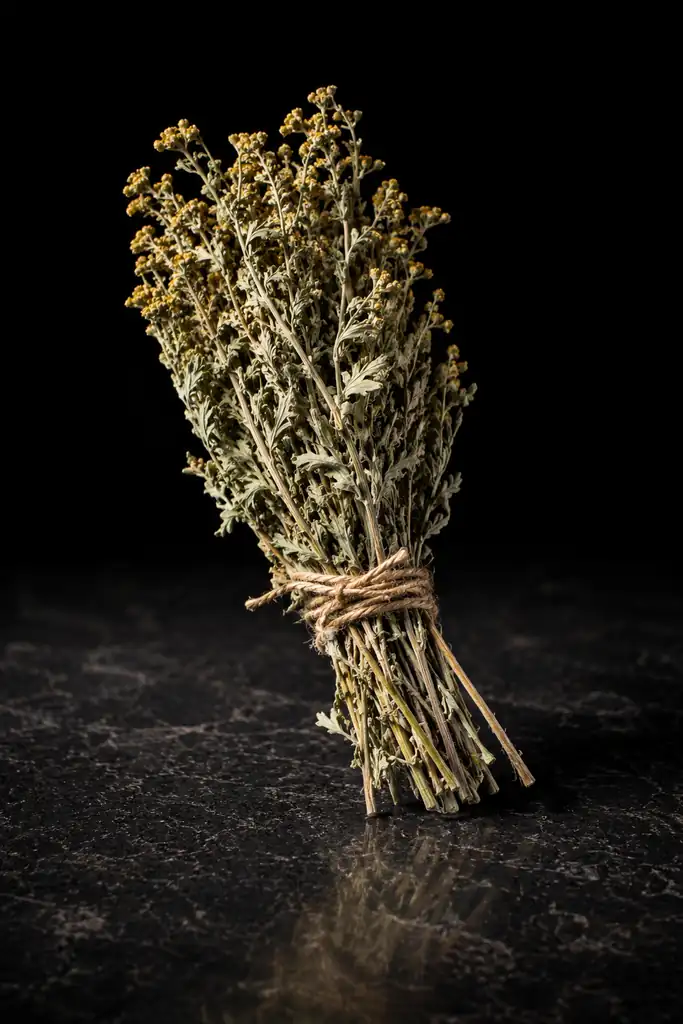
Quick overview
In tradition, mugwort is regarded as travel protection when it is sewn into the belt or the shoes, as an incense plant for purifying rooms and as a threshold plant against harmful influence from outside.
Harvested in particular at Midsummer or in the Midsummer night, the herb is considered at its most potent. In East Asia mugwort is also known as mugwort in moxibustion, but in that context as a ritual means rather than a means of protection.
Origin and tradition
The tradition of mugwort as a protective plant can be traced in Europe at least to the early Middle Ages.
In the Anglo-Saxon Nine Herbs Charm, preserved in the Lacnunga manuscript of the 10th century, mugwort (mucgwyrt) stands in first place: “Remember, Mugwort, what you made known, what you established in your greatest power.” The charm calls it the eldest of the herbs and the oldest protection against exhaustion and evil spirits on journeys.
In German folk tradition the name girdle herb derives directly from the protective practice: travellers, pilgrims and soldiers sewed mugwort into their belts to ward off exhaustion and to protect themselves against the dangers of the road.
In times when roads were regarded as dangerous places where highwaymen and spirits lay in wait alike, this practice combined physical protection with protection against unseen threats.
In Scandinavia mugwort belongs to the Midsummer plants that were gathered on St. John’s night and are said to unfold their highest protective effect at the turn of the year. In Swedish and Norwegian folk-custom literature it appears as a plant that was tied to stable doors and house entrances.
In Japan and China mugwort is known as yomogi and mugwort and holds a strong ritual function in popular belief. In the Japanese tradition mugwort is used on roofs and in the bath at Tango no Sekku (5 May).
In China bundles of mugwort and calamus are hung over doors at Duanwu (the Dragon Boat Festival) to keep away evil spirits and disease demons.
Principle of effect according to tradition
In tradition, mugwort is regarded as a plant of strengthening and of boundary-drawing. The two together explain its broad protective function.
As a strengthening plant it is considered especially for travellers: sewn into the belt or the shoes, it is said, according to the Anglo-Saxon and German sources, to ward off tiredness and exhaustion, but also to stabilise the inner strength of the bearer against external influence.
Whoever is strong, so the folkloric logic runs, can less easily be attacked by beings that exploit weakness.
As an incense plant, mugwort works through its intense, somewhat bitter smoke. In incense tradition, scent counts as a boundary marker: that which smells strongly and is not pleasant but tart and earth-bound drives out the fine and the unseen.
Mugwort smoke is said to purify burdened rooms and to remove harmful attachments from the energy field of a place, an idea that runs from European folk tradition into East Asian practice.
Used at thresholds and doors, mugwort takes on the function of a boundary plant: like St. John’s wort and rowan, it marks the transition between inside and outside as a protected area.
Cross-cultural spread
The protective function of mugwort is attested in a remarkable number of cultures independently of one another.
In north-western Europe, particularly in the British Isles and Germany, mugwort is documented as travel protection and a St. John’s plant. The Anglo-Saxon Nine Herbs Charm makes it the oldest of the protective herbs.
In Scandinavia it belongs to the Midsummer plants that are hung on doors.
In Eastern Europe, from Poland to Ukraine, mugwort is attested as an incense plant and protective plant for house and stable.
In Japan yomogi is regarded as a sacred protective plant that keeps misfortune away at certain festivals and is tied to doors and windows.
In China, mugwort as ai (艾) is the central protective-bundle plant of the Dragon Boat Festival, often tied together with the sword-shaped calamus and hung over entrances.
What it is used against
According to traditional accounts, mugwort protects above all against:
Against exhaustion and its supernatural causes: in traditions that describe exhaustion as the work of beings that draw strength from the traveller, mugwort is regarded as a direct remedy.
Against general harmful influence at thresholds: tied as a threshold plant to door and window, mugwort keeps harmful beings away in general, without being specialised against a particular class of beings.
Against disease demons and evil spirits at the turning points of the year: especially in East Asian tradition, but also in the European St. John’s custom, mugwort serves as protection in the dangerous transitional moments of the year.
Against burdened rooms and attachments: as an incense plant, mugwort is regarded as suitable for loosening and driving out whatever has settled in a room after illness, quarrel or unclear burden.
Application and limits
For travel protection mugwort is sewn into the belt or shoes. For threshold protection dried bundles are hung over doors and windows or wedged into door frames. As an incense plant dried mugwort is burned on glowing coals or directly as a bundle; the smoke fills the room and is meant to purify it.
Tradition recommends St. John’s Day or the Midsummer night as the gathering time, when the plant is said to have its highest power. Mugwort gathered outside this period is regarded, on a strict interpretation, as weaker, but in practice it is also used all year round.
The protective effect of incense is regarded as temporary: after a room has been smoked, it should be re-smoked regularly if the burden persists.
No medical claims of effect are connected with this tradition.
Literature (selection)
Related key terms: mugwort protection incense girdle herb mugwort.
iWell Guard and protective traditions
Mugwort shows that, in tradition, protection does not always target a threat but rather the strengthening of the person or the place.
This idea, of carrying preventive protection that reinforces resilience, finds its counterpart in the concept of the iWell Guard, a protective object that takes up various strands of tradition from the human protective heritage.
Personal experiences may vary. Not a medical device. No promise of healing.