The Triquetra: the Celtic trinity knot as a protective sign
By Ralf Ittermann · last reviewed on
The Triquetra is a sign of three interlaced arcs that is closely associated with the Celtic world. As an endless, self-contained line, it stands for threeness and cohesion and is among the best-known knot signs of Europe.
Classification
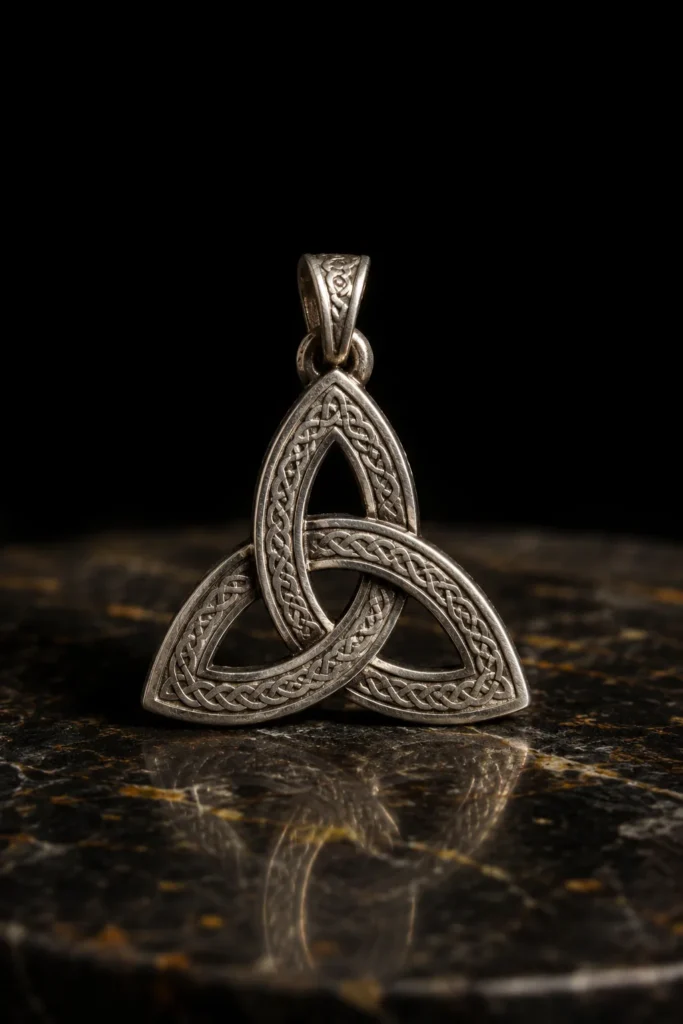
The Triquetra is a sign of three identical, interlaced arcs. Each arc forms a pointed loop, and the three loops interlock in such a way that a balanced, threefold pattern emerges. Often the Triquetra is additionally enclosed by a circle. It is among the best-known signs associated with the Celtic world.
The name Triquetra comes from Latin and means roughly the triangular or the three-cornered. In German usage the sign is often called the trinity knot. Both names emphasize the same thing, namely the number three and the interlacing. The Triquetra is a sign of threeness in the form of a knot.
In religious studies and in art history, the Triquetra is classified with care. It is well attested, yet its history is layered. The sign was interpreted differently in different periods and by different groups. This shifting interpretive history belongs to a complete account.
As a knot sign, the Triquetra follows a working principle known to many cultures. An unbroken, self-contained line was regarded as a protective form. The Triquetra is a particularly balanced expression of this idea. It combines the protective closed line with the meaningful number three.
The name and the form
The form of the Triquetra can be derived from a single basic figure. This basic figure is the pointed loop that arises when two arcs of a circle intersect. Three such loops, evenly arranged around a center and interlaced with one another, yield the Triquetra.
The interlacing is decisive. The three arcs are guided so that they run alternately over and under one another. As a result, none of the arcs can be removed without moving the others. The three parts are inseparably joined. It is precisely this inseparability that is important for the interpretation.
The Triquetra can be formed from a single, continuous line. This line interlaces threefold and returns at the end to its beginning without leaving a gap. The sign is thus an endless line. It has neither a visible beginning nor a visible end.
The Latin name refers to the triangular overall shape of the sign. Indeed, an imagined triangle can be placed around the three arcs. Form and name therefore agree. The Triquetra is a triangular, threefold, endlessly interlaced sign, and each of these traits contributes to its meaning.
The Triquetra in Insular art
The Triquetra has its most important historical home in Insular art. With this term, art history designates the art of the British Isles and Ireland in the early Middle Ages. In this art, interlaced ribbon work played an outstanding role.
The Triquetra appears especially impressively in the decorated manuscripts of that period. In the great illuminated gospel books, above all in the famous Book of Kells, the pages are covered with intricate interlace and knot work. The Triquetra is a recurring element of this decoration.
The sign also appears on stone monuments. Early medieval crosses and gravestones of the Insular world bear carved knot work in which the Triquetra has its place. It was thus not a rare special sign but a familiar component of the visual language of this epoch.
In all of these contexts the Triquetra stands within a Christian setting. The manuscripts were gospel books, the stone crosses were Christian monuments. The attested early history of the Triquetra is thus closely bound to the Christianity of the British Isles and Ireland. This is the secure starting point of any consideration.
The Christian sign of the Trinity
In the Christian context the Triquetra received an obvious interpretation. The sign consists of three identical parts joined into an inseparable unity. This structure could be related to the Christian doctrine of the Trinity.
According to this doctrine, God is one and at the same time threefold, namely Father, Son, and Holy Spirit. The Triquetra renders this idea vividly. Three equal arcs that interlace into a single sign show threeness and unity in one figure. For this reason the Triquetra is also called the Trinity knot.
This interpretation made the Triquetra a fitting ornament for Christian manuscripts and monuments. It was not merely an ornament but could at the same time express a truth of faith. Form and doctrine fit together. The sign was both beautiful and meaningful.
As a sign of the Trinity, the Triquetra has endured into the present. It is used in Christian contexts, on objects of piety, and in ecclesiastical design. This Christian interpretation is the best-attested meaning of the Triquetra. It stands at the beginning of its tangible history.
Pre-Christian traces
The Triquetra is often presented as an ancient pre-Christian sign of the Celts. This notion deserves close examination. It is widespread, yet it cannot be readily attested from the sources.
Threefold and interlaced signs are indeed old and can be found in several cultures. Signs resembling the Triquetra also appear on objects of the Germanic and Norse world. A pure, clearly formed Triquetra as a meaning-bearing symbol, however, is securely attested above all from the early medieval, Christian-shaped Insular art.
Whether the Triquetra was used in pre-Christian Celtic times as an independent symbol with a fixed meaning cannot be said with certainty. The source situation here is thin. Much of what is held to be an old Celtic meaning was only attributed to it in more recent times.
An honest account therefore holds both points firm. The number three was significant in Celtic thought, and interlaced signs are old. The Triquetra as a fixed symbol, however, is first graspable in Christian Insular art. The popular notion of an ancient pagan Celtic sign goes beyond what can be attested.
The working principle of the endless line
As a protective sign, the Triquetra follows the working principle of the endless line. This principle is widespread in many cultures. It is based on the idea that an unbroken, self-contained line forms a secure boundary.
A line without beginning and without end offers harmful powers no point at which they could take hold. Widespread was the notion that an evil being must trace every line of a sign and becomes entangled in an endless figure. The Triquetra, formed from a single closed line, corresponds to this pattern exactly.
With this principle the Triquetra stands in a line with other signs. The drawn protective circle, the pentagram, and the endless knot patterns of many cultures follow the same idea. They all form a boundary that cannot be overcome. The Triquetra is a particularly clear and balanced form of this idea.
The interlacing of the three arcs reinforces this impression of closedness. The sign appears firmly joined and resting within itself. This quality makes the Triquetra, beyond its Christian interpretation, a sign to which a protective, ordering power is attributed. Beauty and the idea of protection coincide in it.
The Triquetra and Celtic knot art
The Triquetra is only one sign within a whole world of knot patterns. Insular art developed interlaced ribbon work to extraordinary maturity. Whole pages of manuscripts and whole surfaces of stone crosses are covered with intricate interlace.
Within this knot art the Triquetra holds a special position. It is one of the few knot patterns that at the same time form a clearly outlined, independent sign. While much ribbon work is pure decoration, the Triquetra has a fixed form and a meaning of its own. It is both ornament and symbol.
The Triquetra is related to further Celtic signs, for example to the continuous Celtic knot and to the triskele, the threefold spiral sign. With the triskele it shares the meaningful number three. With the Celtic knot it shares the principle of the endlessly interlaced line.
This classification shows that the Triquetra is not an isolated sign. It belongs to a rich artistic tradition that loved the interlace, the knot, and the entanglement. Within this tradition the Triquetra is perhaps the best-known and most clearly outlined single sign.
Modern interpretations
In more recent times the Triquetra has received additional interpretations. Especially in neo-pagan and nature-religious movements the sign is taken up and given meanings of its own. These interpretations are young, even though they often invoke a distant past.
A widespread modern interpretation links the three arcs to a triple goddess. The three parts then stand for three phases of life or for three aspects of the feminine. Other interpretations assign to the arcs the realms of earth, water, and sky, or body, spirit, and soul.
These interpretations are coherent in themselves and meaningful for many people. They belong to the present of the Triquetra and shape its use today. They should not, however, be confused with the historically attested meaning. The triple goddess is a modern notion, not a demonstrated content of the early Triquetra.
Popular culture has also contributed to its dissemination. In films and series the Triquetra has appeared as a mysterious sign and has thereby become very well known. A factual account honors this modern world of interpretation, yet classifies it clearly as recent and separates it from the attested history of the sign.
Reception today
The Triquetra is today an extraordinarily widespread sign. It appears on jewelry, on clothing, and in design, and it is a popular motif for tattoos. Its balanced, clear form contributes substantially to this popularity.
The meanings with which the Triquetra is worn today are manifold. For some it is the Christian sign of the Trinity. For others it stands for a connection to the Celtic world or for one of the modern, nature-religious interpretations. Still others value it simply as a beautiful knot pattern.
This diversity of meanings is not unusual for an old sign. It shows that the Triquetra has remained adaptable across the centuries. Different periods and groups were able to recognize something of their own in it. The clear basic form provided the connecting hold for this.
The Triquetra thus remains an instructive example. It is a well-attested sign of early medieval Christian art, a knot sign according to the principle of the endless line, and at the same time a symbol that continually attracts new interpretations in the present.
A complete account keeps these layers apart and honors each on its own terms.
Literature (selection)
Related key terms: Triquetra trinity knot Trinity knot Insular art Book of Kells knot sign endless line Celtic.
iWell Guard and protective traditions
iWell Guard stands in the cultural-historical line of wearable protective objects, to which the Triquetra also belongs. A modern companion for people who live with protective symbols: made in Germany, 41 layers of genuine gold, platinum, and silver, with a 30-day right of return.
Personal experiences may vary. Not a medical device. No healing promise.