The triskele: the three-armed spiral sign
By Ralf Ittermann · last reviewed on
The triskele is a three-armed sign whose arms radiate from a central point as spirals or as curved limbs. It is among the oldest geometric signs in Europe and stands for threefoldness and movement.
The triskele is a triple spiral sign attested long before the Celtic period.
Classification
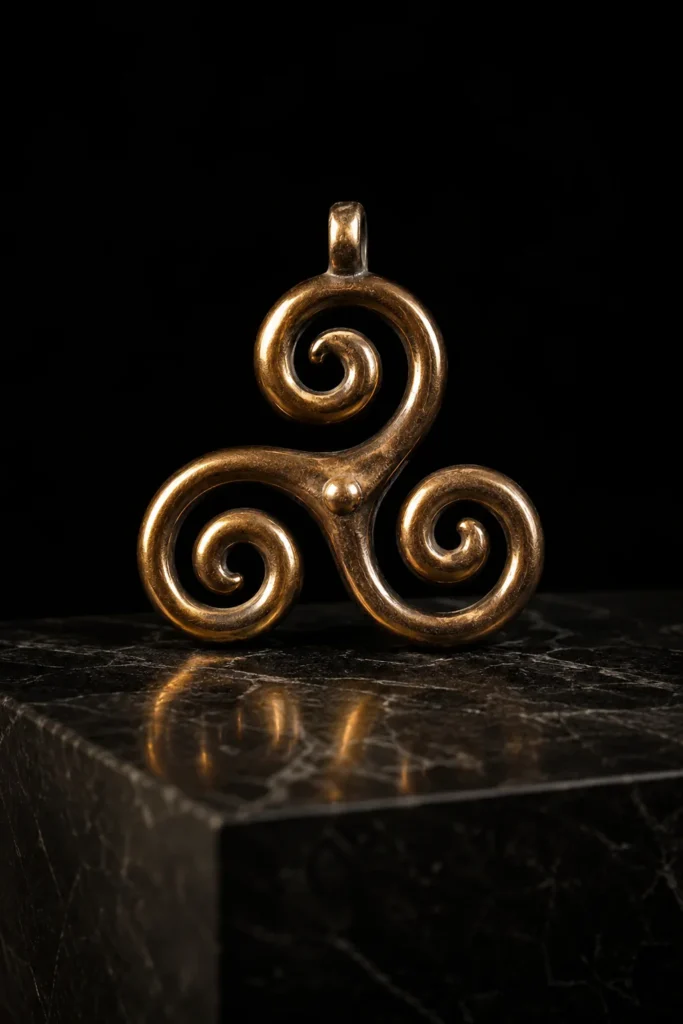
The triskele, also called the triskelion, is a three-armed sign. Three identical arms radiate from a common central point and are curved in such a way that the sign appears to turn.
The arms can be designed as spirals or as curved lines, in some cases even as bent legs. Common to all forms is the number three and the circling movement around the centre.
The triskele is frequently associated with the Celtic world. In fact, however, it is a very old and widespread sign that appears in many cultures.
As a sign of protection and meaning, the triskele stands for threefoldness, for movement and for the course of things. It is less a warding amulet than a sign of order and of cycle.
In religious studies and in art history, the triskele is a good example of a sign whose form is old, but whose detailed interpretations stem in part from more recent times.
An accurate account therefore separates what is well attested from what was read into it later. The old form of the triskele is secure, while its present-day meanings are partly old and partly modern.
The name and the form
The name triskele comes from Greek and refers to the number three. It denotes a sign with three legs or three arms. The name triskelion is also in use.
The basic form is easy to describe. Three identical elements are arranged evenly around a central point and curved in the same direction. This curving gives the impression of a rotation.
The three elements can be designed in different ways. In one form they are spirals that wind out from the centre. In another form they are curved lines or arcs.
One particular form shows three bent human legs. This leg form of the triskele is known from a number of coats of arms and flags and is among the most striking variants of the sign.
Common to all forms remains the number three and the circling movement. The triskele is always a threefold, turning sign. By this basic structure it can be recognised.
From the triquetra, the Celtic knot of threefoldness, the triskele differs clearly. The triquetra is an interlaced knot, the triskele a turning spoked or spiral sign. Both belong to the signs of threefoldness, but they are not the same.
A very old sign
The triskele is among the oldest geometric signs that humankind has produced. Its traces reach far back before the Celtic era.
Especially well known is the triple spiral sign from the monument of Newgrange in Ireland. This great tomb dates from the Neolithic and is thus thousands of years older than Celtic culture.
At the entrance of Newgrange a triple spiral is carved into the stone. It is among the most famous prehistoric signs in Europe and shows how old the motif of the triple spiral is.
In antiquity too the three-armed sign was known. The triskele appears on Greek vessels and on coins, and it was associated with various meanings.
In Celtic art, above all in the art of the Iron Age, the three-armed, turning motif is likewise widespread. Here the triskele joins with Celtic art’s preference for sweeping, dynamic forms.
The triskele is therefore not a purely Celtic sign. It is a very old, widespread motif that appeared in many cultures, independently or in connection with one another. The Celtic world is only one of its many waypoints.
The triskele in Celtic art
Although the triskele is not a purely Celtic sign, it holds an important place in Celtic art. There it fits well into the general style.
Celtic art, especially the art of the Iron Age, loved the sweeping, dynamic line. Spirals, whirls and winding patterns are among its characteristic features.
The triskele with its three turning arms fits perfectly into this style. It is a sign of movement, and movement was a fundamental trait of Celtic visual language.
In the later Insular art, the Christian-shaped art of the British Isles and Ireland, the spiral motif lived on. In the decorated manuscripts and on the stone crosses, spirals and triskele-like patterns appear.
The triskele thus belongs to the continuous visual tradition of these regions, from prehistory through the Celtic Iron Age into Christian Insular art.
This long presence in the art of the Celtic-shaped world explains why the triskele is today so closely associated with the Celtic. It has been present there over many centuries.
Meanings of threefoldness
The triskele is a sign of threefoldness. The number three held a special meaning in many cultures, and this is also true of the Celtic-shaped world.
In Celtic tradition the number three occurs strikingly often. There are threefold deities, narratives arrange things in groups of three, and threefoldness appears as a favoured pattern of order.
The triskele can therefore be read well as a sign of this preference for threefoldness. Its three arms form a threefoldness that is at the same time a unity, for they proceed from a common central point.
Which threefoldness the triskele denoted precisely in ancient times is, however, not recorded. The sources do not explain the sign. Much of what is said today about its meaning is inferred or read into it.
Widespread modern interpretations assign the three arms, for example, three realms of the world, or three stages of life, or the movement of becoming, being and passing away. Such interpretations are coherent in themselves, but they are of modern times.
An honest account holds that the triskele is an old sign of threefoldness, but that its precise ancient meaning is not secure. The detailed present-day interpretations are to be marked as modern readings.
Movement and the course of the sun
Alongside threefoldness, movement is the second great theme of the triskele. The sign appears to turn, and this rotation is an essential part of its meaning.
A turning sign is easily linked with the course of things, with the passing of time, with the cycle of the year and with recurrence.
The triskele is frequently associated with the sun. As the sun travels its path, so the triskele turns. In this interpretation it belongs to the signs of the sun and of movement.
In this respect the triskele stands close to other turning signs, such as the Slavic sun wheel. The motif of the turning wheel or star as an image of the sun and of time is widespread.
As a sign of protection, the triskele works less through warding off than through the depiction of an order. It shows the reliable, circling movement of life and of time.
In this regard the triskele resembles the kolovrat and other signs of the sun and of movement. Its protection lies in the image of an ordered, reliable movement, not in the warding off of a single danger.
Triskele and triquetra
The triskele is frequently confused with the triquetra. Both are Celtic-shaped signs of threefoldness, yet they are clearly to be distinguished.
The triquetra is a knot sign. It consists of three interlaced arcs that join into a closed, inseparable knot. Its nature is interlacing.
The triskele, by contrast, is a spoked or spiral sign. Its three arms radiate from a centre and are not interlaced with one another, but turn around the central point. Its nature is rotation.
Both signs carry the number three, and both belong to the visual world of Celtic-shaped culture. In this they are related. Yet their form and their underlying idea are different.
The triquetra follows the principle of the endless line and of interlacing. The triskele follows the principle of threefoldness and of rotation. On the page about the triquetra the knot sign is presented in more detail.
For an accurate account the distinction is important. Triskele and triquetra are often conflated in everyday usage, yet they are two different signs, each with its own form and meaning.
Triskele in coats of arms and flags
The triskele is not only an old sign, it is also alive into the present as a sign on coats of arms and flags. In this use it is above all the leg form of the triskele that comes to the fore.
Well known is the triskele of three bent legs from the flag of the Isle of Man. There the three-legged sign is the official emblem of the island and has long been in use.
The island of Sicily likewise bears a triskele in its flag. Here the three-legged sign joins with the triangular shape of the island itself.
In these coats of arms and flags the triskele is not a sign of protection but a sign of belonging and of identity. It stands for a particular island and its inhabitants.
This use shows how adaptable the triskele is. The same three-armed basic pattern could be a sign of meaning in prehistory and a sovereign emblem in the present.
For an accurate account the context is important here too. A triskele on a flag is a sovereign emblem, a triskele as a pendant of jewellery can be a sign of meaning and of protection. Form and meaning are not the same.
Present-day reception
The triskele is today a widespread sign. It appears as jewellery, as a tattoo and as a motif in design. Especially in connection with Celtic culture it is popular.
For many people the triskele is a sign of connection to the Celtic world. It is worn as an emblem of threefoldness, of movement and of the cycle of life.
In Neopagan and nature-religious currents the triskele holds a firm place. There it is given its own interpretations, which mostly emphasise the threefoldness of the world or of life.
In all these uses the distinction is important that this page stresses. The form of the triskele is very old and well attested. Its detailed present-day interpretations are partly old, partly modern reading.
The triskele is thus an instructive sign. It joins one of the oldest geometric forms of humankind with a rich world of interpretation that is still growing into the present.
At its core the triskele remains a sign of threefoldness and of movement. From the triple spiral sign of Newgrange to the present-day pendant of jewellery, this basic meaning runs through its long history.
References (selection)
Related key terms: triskele triskelion spiral sign threefoldness Newgrange Isle of Man Celtic movement.
iWell Guard and protective traditions
iWell Guard stands in the cultural-historical line of portable protective objects to which the triskele also belongs. A modern companion for people who live with protective symbols: made in Germany, 41 layers of solid gold, platinum and silver, with a 30-day right of return.
Personal experiences may vary. Not a medical device. No healing promise.