The Isis Knot: the Tyet Amulet under the Protection of Isis
By Ralf Ittermann · last reviewed on
The Isis knot, known in the Egyptian language as the tyet, is a protective amulet bearing the sign of the goddess Isis. Its looped form and red color are associated with protection and with the power of this great goddess.
Classification
The Isis knot is a protective amulet from ancient Egypt. In the Egyptian language it bears the name tyet. It belongs to the widely used amulets of Egyptian protective practice.
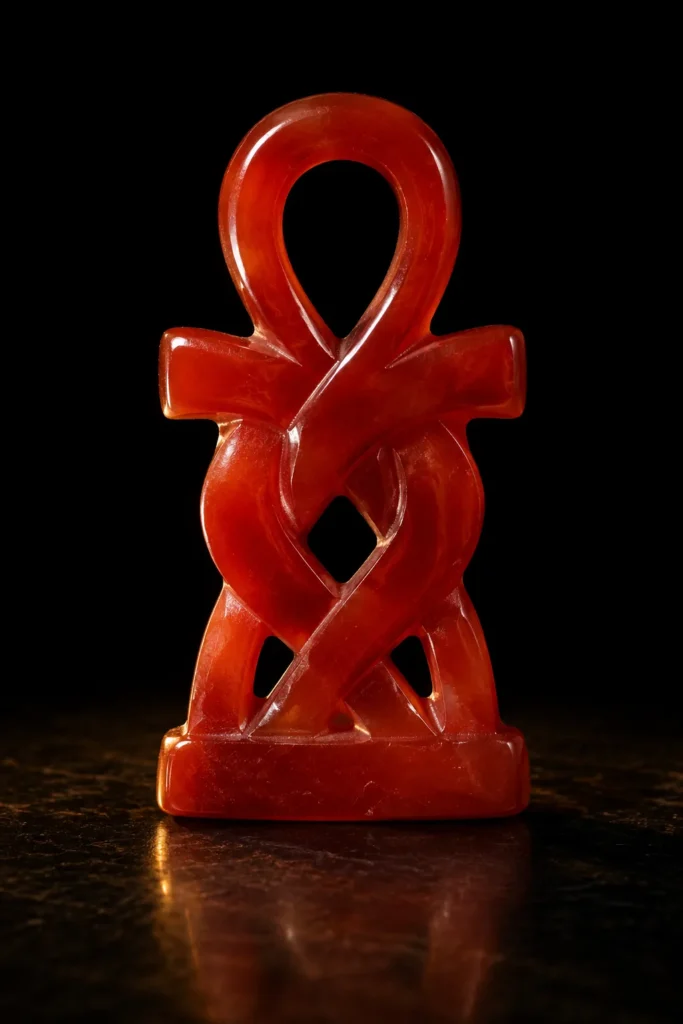
The amulet displays a looped sign resembling a bow or a knot. This form gave it the German name Isisknoten, for the sign is closely associated with the goddess Isis.
The Isis knot stood under the protection of Isis, one of the greatest and most widely venerated goddesses of Egypt. Anyone who wore the amulet placed themselves under the protection of this powerful goddess.
The Isis knot played a particular role in the funerary cult. There it had a precisely defined function connected with the protection of the deceased.
In religious studies, the Isis knot is a clear example of an amulet closely tied to a specific deity and to a specific color. Both the goddess and the color contribute to its meaning.
The Isis knot also belongs to a group of related Egyptian signs. It is most closely linked to the ankh and to the djed pillar. This relationship is explained below.
Tyet: the Knot of Isis
The Egyptian name of the amulet is tyet. The exact original meaning of this word is not fully established in every respect, but the sign is clearly associated with the goddess Isis.
The name Isis knot describes the sign vividly. It looks like a looped band or a knot. This knotted form is the most distinctive feature of the sign.
Knots carry a protective meaning in many cultures. Tying and binding are regarded as actions through which protection is secured. A knot sign can therefore represent bound, contained protective power.
In the Isis knot, this general meaning of the knot is combined with the figure of Isis. The sign is the knot of this particular goddess. Her protective power is, in a sense, bound within it and made present.
The connection with Isis gives the amulet its significance. Isis was not a minor deity, but one of the most powerful goddesses of Egypt, renowned for her protection and healing power.
The Isis knot is therefore the wearable sign of a great goddess. Anyone who put it on connected themselves with Isis and with everything she represented, above all with her protection.
Form and Relationship to the Ankh
The Isis knot resembles in form another, very well-known Egyptian sign: the ankh. This resemblance is striking and important for understanding the sign.
The ankh, the Egyptian symbol of life, consists of a cross with a loop in place of the upper bar. The Isis knot likewise has a loop in the upper area.
The difference lies in the arms. While the ankh has horizontal side arms extending outward, the arms of the Isis knot curve downward. The arms of the tyet hang down, as though bound toward the bottom.
From this closeness to the ankh arises a connection of meanings. The ankh represents life; the Isis knot belongs in the same sphere of life and protection. Both signs are closely related.
Egyptian visual language knew several such related loop signs. They complemented each other and could be used together. The Isis knot and the ankh belong to this group.
The relationship with the ankh shows that the Isis knot is not an isolated sign. It stands within an interconnected system of Egyptian protective and life symbols, in which every sign has its place.
The Blood of Isis
An important characteristic of the Isis knot concerns its color. The tyet amulet was preferentially made from red material. Carnelian, red jasper, and red glass were all common choices.
This red color is not incidental. It connects the amulet with blood. Egyptian texts explicitly associate the Isis knot with the blood of Isis.
The blood of Isis represented her vital force and her protective power. A red tyet amulet therefore carried not merely a color but a meaning. It bore the power of the goddess within it.
The red color also linked the Isis knot to protection more broadly. Red was regarded as a powerful, protective color in many cultures, including Egypt. This general significance of red contributes to the Isis knot as well.
Several meanings thus reinforce one another in the Isis knot. The knotted form, the connection with Isis, and the red color as the color of blood and protection all work together.
The red tyet amulet is therefore a clear example of how closely material, color, and meaning can be bound together in a protective object. The color here is not decoration but part of the message.
Isis as Protective Goddess
The significance of the Isis knot can only be understood when one knows the status of Isis. Isis was one of the most important deities of Egypt and above all a great goddess of protection and healing.
In mythology, Isis is the wife of Osiris and the mother of Horus. The narratives show her repeatedly as the one who protects and saves. She preserved her son Horus from his enemies.
Isis was regarded as exceptionally skilled in the effective power of spoken words and magical utterances. Her spells could heal and avert danger. In healing texts, such as those on the Cippus of Horus, Isis is a central figure.
This combination of motherliness, protection, and healing power made Isis a goddess to whom people entrusted themselves with particular willingness. Her protection was seen as reliable and caring.
The Isis knot is the wearable sign of this goddess. Anyone who wore it placed themselves under the protection of Isis and under all that she represented: her maternal care and her saving power.
The veneration of Isis later extended far beyond Egypt. In the Greco-Roman world she became one of the best-known deities. With her, knowledge of her knot spread as well.
The Amulet in the Funerary Cult
The Isis knot had a fixed and precisely defined place in the Egyptian funerary cult. There it was one of the important amulets provided for the equipment of the deceased.
The Egyptian Book of the Dead, the collection of spells for the afterlife, contains a dedicated spell that belongs to the Isis knot. This spell associates the amulet with protection by Isis.
According to this spell, the tyet amulet was to secure the protection of Isis for the deceased. The goddess was to enfold the dead with her arms and preserve them on their journey into the afterlife.
The amulet was placed at the neck of the mummy. This position was designated for several amulets of the funerary cult. The Isis knot at the neck placed the deceased under the protection of the goddess.
The Isis knot thus fulfilled a role similar to other amulets of the funerary cult. Just as the ankh secured life and the djed pillar provided stability, the Isis knot secured the protection of Isis.
The Isis knot thereby illustrates once more a fundamental feature of Egyptian protective practice. Care for the deceased was considered as important as care for the living. Both domains had their own protective amulets.
Isis Knot and Djed Pillar
The Isis knot frequently appears not alone but together with the djed pillar. These two signs form a pair that often appears side by side in Egyptian art.
The djed pillar is the sign of stability and is associated with the god Osiris. The Isis knot is the sign of Isis. In mythology, however, Osiris and Isis are a couple: husband and wife.
The pair of signs thus mirrors the divine couple. The djed pillar of Osiris and the knot of Isis belong together just as the two deities belong together.
In funerary equipment and in art, the two signs therefore often appear alternating or side by side. They form a sequence and complement each other in meaning.
Together they stand for the protection and stability that the divine couple provides. The djed gives support and permanence; the Isis knot gives the protection of Isis. Together they encompass a complete protective promise.
This pairing is a good example of the ordering of the Egyptian symbolic world. The signs did not stand alongside one another without relation, but formed groups and pairs that corresponded to each other.
Material and Color
The Isis knot was, as already noted, preferentially made from red material. This choice of material is closely connected with the meaning of the amulet as a sign of the blood of Isis.
Carnelian, a red semi-precious stone, was a favored material. Red jasper and red glass were also used. All of these substances carried the red color that was central to this amulet.
Isis knots in other materials also exist, for example in faience. However, the red version was considered the proper one, the one that best corresponded to the meaning of the sign.
Isis knots varied in size. As an amulet, the sign was generally small and compact, suited to being worn on the body or inserted into mummy bandages.
The Isis knot was frequently worn together with other amulets or incorporated into jewelry. By combining several signs, the protective effects were intended to be concentrated.
The material of the Isis knot demonstrates the precision of Egyptian protective practice. Not only the form, but also the substance and color of an amulet were meaningful and chosen with care.
Contemporary Reception
The Isis knot is today less well known than the ankh or the Eye of Horus. It belongs to the Egyptian signs familiar primarily to those with a particular knowledge of Egyptian culture.
The Isis knot is well represented in museum collections of Egyptian artifacts. Numerous tyet amulets, many of them made of red stone, are preserved and attest to the widespread use of the sign.
With the extensive veneration of Isis, which extended into the Greco-Roman world, knowledge of her knot also spread. The Isis knot thus belongs to the visual world of a goddess who was known far beyond Egypt.
The Isis knot is occasionally adopted as a decorative motif, mostly by people with a particular interest in Egypt or in the figure of Isis. In this use it draws on its ancient meaning.
For the study of Egyptian religion, the Isis knot is an informative sign. It shows how closely an amulet could be bound to a specific deity, a color, and a material.
The Isis knot is thus a compelling example of a well-considered Egyptian protective amulet. In it, the knotted form, the red color of blood, and the protection of the great goddess Isis converge in a single, meaningful sign.
Selected Bibliography
Related key terms: Isis knot tyet Isis blood of Isis carnelian ankh djed Book of the Dead ancient Egypt.
iWell Guard and Protective Traditions
iWell Guard stands in the cultural-historical line of wearable protective objects, to which the Isis knot also belongs. A modern companion for people who live with protective symbols: made in Germany, 41 layers of genuine gold, platinum, and silver, with a 30-day right of return.
Individual experiences may vary. Not a medical device. No therapeutic claims.