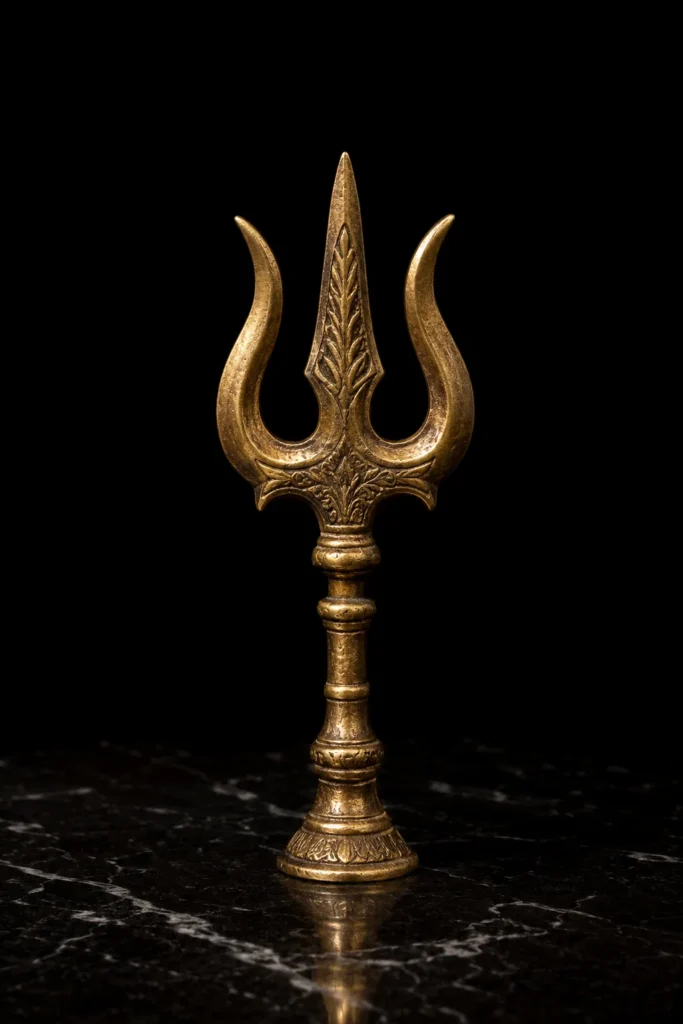
The Trishula is the trident of the god Shiva. It is the most important sign of this god and stands for his power. As a sign of Shiva it is at the same time understood as a defensive protective sign that keeps misfortune and harmful powers away.
The Trishula is a trident, that is, a weapon with three points. It belongs to the tradition of Hinduism and is inseparably connected with the god Shiva.
The word Trishula comes from Sanskrit. It is composed of a word for three and a word for point or spear. Trishula therefore means literally the three-point or the trident.
The Trishula is the most important sign of Shiva. Wherever this trident appears, it points to Shiva. Images of Shiva often show him with the Trishula in his hand.
As a sign of Shiva, the Trishula stands for the power of this god. It is a sign of his strength and his rule and at the same time a sign of the three great forces that are connected with Shiva.
Beyond its meaning as a sign of a god, the Trishula is understood as a defensive protective sign. As Shiva’s weapon, it is regarded as a means of keeping misfortune and harmful powers away.
In religious studies, the Trishula is a good example of a sign that arises from the weapon of a god and combines veneration, divine sign and protection.
The Trishula is inseparably connected with Shiva. Shiva is one of the great gods of Hinduism and is venerated by countless people.
Shiva is a many-sided god. He is depicted at once as the great ascetic who remains in deep contemplation and as the mighty lord who commands the great transformations of the world.
Belonging to Shiva is the idea of the three great forces that determine the becoming of the world: bringing forth, preserving and dissolving. Shiva is especially connected with the dissolving, transforming force.
In the Hindu understanding, this dissolution is not merely destruction. It is at the same time the precondition for a new beginning. Shiva is therefore not a mere god of annihilation, but a god of transformation.
The Trishula belongs to this image of Shiva. It is his weapon and his emblem. Wherever the Trishula appears, Shiva is present or implied.
The worshippers of Shiva also bear the trident as their sign. Some ascetics who have consecrated themselves to Shiva carry a Trishula with them. The trident is thus a sign of the god and of his worshippers at the same time.
The Trishula is a weapon with three points set on a shaft. This unmistakable form is the decisive feature of the sign.
The three points are the most striking element. They make the trident more than an ordinary spear. A single point pierces, but three points form an impressive, internally articulated sign.
The middle prong often projects the furthest, the two outer ones are somewhat shorter and curve slightly outward. This produces the characteristic, fan-like form of the trident.
The three points are interpreted in many ways. A widespread interpretation relates them to the three great forces of bringing forth, preserving and dissolving. Other interpretations connect them with further triads of the Hindu world of ideas.
Caution is appropriate here. Such interpretations are meaningful and widespread, yet they are later readings. The original meaning of the three points is not in every respect clearly fixed.
What is certain is that the threefold point makes the Trishula unmistakable. It sets the trident apart from ordinary weapons and marks it as the particular sign of Shiva.
An important meaning of the Trishula is power. As Shiva’s weapon, the trident stands for the strength and the rule of this god.
A weapon is a means of power. It can attack and it can defend. The Trishula in Shiva’s hand is therefore a sign that Shiva is mighty and that his power reaches far.
In the Hindu understanding, this power is not arbitrary. It is the power with which Shiva commands the great transformations of the world, the dissolving and the enabling of a new beginning.
The Trishula thus stands for an ordering, world-determining power. It is not the sign of raw violence, but the sign of the power of a god over the great processes of becoming and passing away.
Whoever uses the Trishula as a sign calls upon this power of Shiva. The sign recalls that above all change in the world stands a divine power.
The Trishula is thus a sign of divine power. In it is concentrated the idea of Shiva as the lord of the great forces and the great transformations.
Beyond its meaning as a sign of power, the Trishula is understood as a defensive protective sign. In religious studies, such a defensive sign is called an apotropaion.
The protective meaning of the Trishula derives from its form as a weapon. A weapon wards off. It keeps the attacker away and defends the one who wields it.
As a sign, the Trishula is a symbolic weapon. It is not used as a real weapon against people, but as a sign meant to keep misfortune and harmful powers away.
A defensive force is therefore ascribed to the trident. Where the sign of Shiva is placed, the location is regarded as protected, for according to this idea harmful powers shun the sign of the mighty god.
In this sense the Trishula is placed at temples, at entrances and at dwellings. There it stands as a guardian sign that places the location under the protection of Shiva.
The Trishula thus belongs to the defensive protective signs. Its protection is defence, the keeping away of misfortune through the symbolic weapon of the mighty god.
The Trishula has a firm place in the veneration of Shiva and of the deities connected with him. It is encountered at the temples and in the hand of the worshippers.
At the temples of Shiva, the Trishula is often set up or attached. It marks the location as a place consecrated to Shiva and at the same time places it under the god’s protection.
Some ascetics who have consecrated themselves to Shiva carry a Trishula with them. For them the trident is at once a sign of their devotion to Shiva and an object that makes their particular status visible.
The Trishula is also connected with the veneration of the goddess. In her powerful, warlike form, the goddess too is often depicted with a trident. The trident is then her sign of victorious power.
In domestic veneration the Trishula appears as an image and as a pendant. In this form it accompanies the worshippers of Shiva in everyday life and places them under the god’s protection.
Veneration shows that the Trishula is more than a mere pictorial motif. It is a venerated sign that has a firm and living place in religious practice.
The Trishula can be considered in the larger context of the trident as a sign. The trident is not limited to Hinduism.
In Greek and Roman tradition too, the trident is a divine sign. There it is the weapon and the emblem of the sea god and stands for his rule over the water.
The trident is thus a sign of divine power in several cultures. In each of these cultures it belongs to a mighty god and marks his domain of rule.
It is honest to say, however, that this correspondence does not allow one to infer a common origin. The trident is an old and widespread form of weapon, and various cultures have made it a divine sign independently of one another.
The Trishula of Hinduism and the trident of the ancient Mediterranean world resemble each other in form and in their meaning as signs of power. Yet they are each their own sign of their own tradition.
The Trishula is thus the Hindu form of the trident as a divine sign. Its particularity lies in the connection with Shiva and in the rich symbolic interpretation of its three points.
The Trishula unites several meanings that belong closely together. It is at once a divine sign, a sign of power and a protective sign.
As a divine sign, the Trishula points to Shiva. Wherever the trident appears, Shiva is present or implied. The sign connects the viewer with the god and with his veneration.
As a sign of power, the Trishula stands for the strength and the rule of Shiva. It is the weapon of the god and thus the sign of his power over the great forces of the world.
As a protective sign, the Trishula wards off. As the symbolic weapon of the mighty god, it keeps misfortune and harmful powers away, according to this idea.
These three meanings cannot be strictly separated. They merge into one another. Protection arises from power, and power belongs to Shiva, to whom the divine sign refers.
The Trishula is thus a many-layered sign. In it are joined the veneration of Shiva, the idea of his world-determining power and the desire for protection that arises from this power.

In Hinduism the Trishula is extraordinarily present to this day. At the temples of Shiva, in the hand of the ascetics and in the images of the god, the trident is a familiar sight.
As a pendant and as jewellery, the Trishula is worn by many worshippers of Shiva. In this form it combines veneration of the god with the desire for his protection.
In the Hindu diaspora too the Trishula is carried onward. It belongs to the visible signs by which the veneration of Shiva remains recognisable across the borders of countries.
In art and in design the Trishula is a frequent motif. Its unmistakable form with the three points makes it an easily recognisable sign.
A factual presentation names the Trishula as what it is in its tradition: the trident of the god Shiva, a sign of his power and at the same time a defensive protective sign.
The Trishula is thus an impressive example of a sign that arises from the weapon of a god. In it are joined the veneration of Shiva, the idea of his world-determining power and the defensive force that is ascribed to such a sign.
Related key terms: Trishula trident Shiva apotropaion sign of defence three points divine sign power Hinduism.
iWell Guard stands in the cultural-historical line of wearable protective objects to which the Trishula also belongs. A modern companion for people who live with protective symbols: made in Germany, 41 layers of solid gold, platinum and silver, with a 30-day right of return.
Personal experiences may vary. Not a medical device. No healing promise.