iWell Guard

The Bujeok: The Korean Talisman of Script and Signs

The bujeok is a Korean protective talisman placed on houses, doors, and clothing to ward off misfortune and illness. The bujeok is the traditional talisman of Korea.

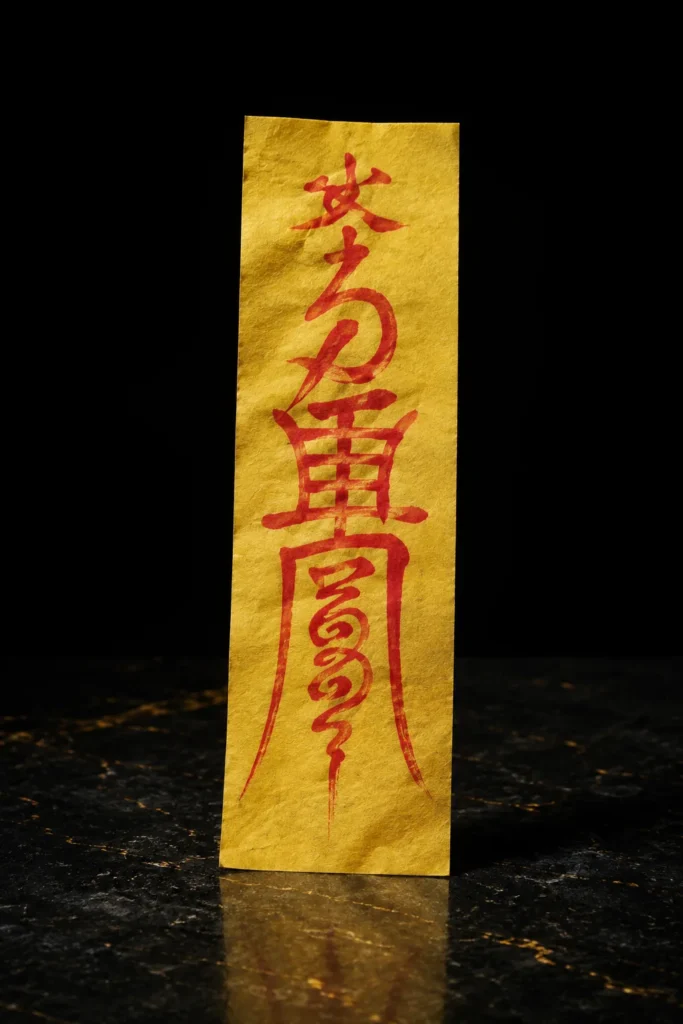
Rendered in red script on yellow paper, it is meant to repel misfortune and attract good fortune. It belongs to the most enduring protective customs of Korean folk religion.

Protective SymbolKoreaTalisman
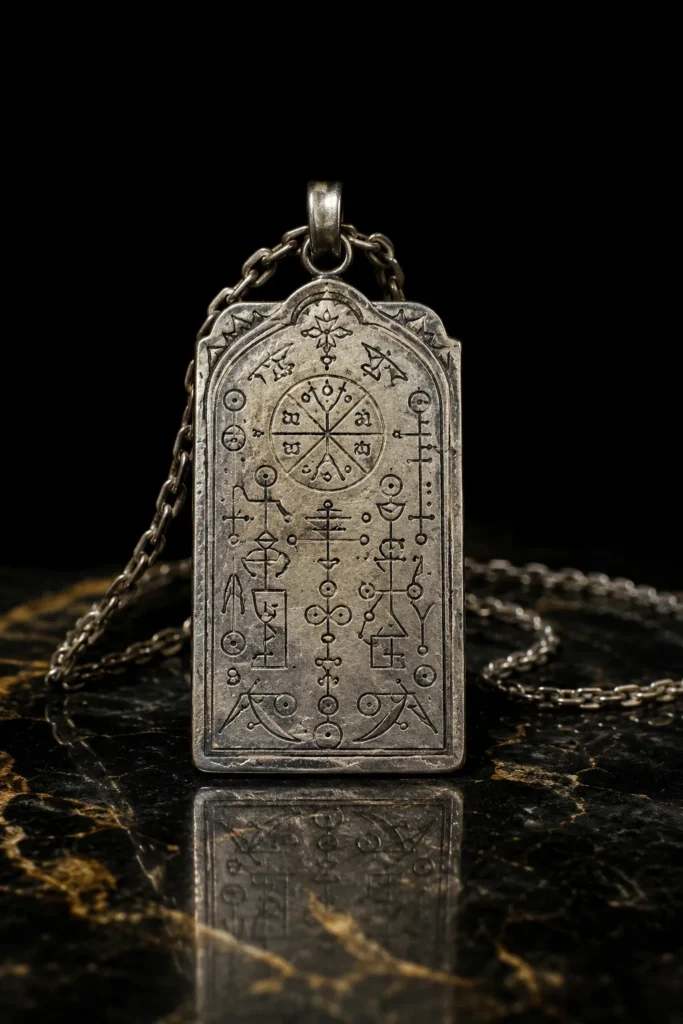
Bujeok - protective symbol, museum-style illustration

Classification

The bujeok is the traditional talisman of Korea. In its most common form, it is a strip or sheet of yellow paper covered with signs and script in red.

The bujeok is meant to repel misfortune and draw good things near. It is directed against harmful spirits, against illness, and against bad luck, while at the same time promoting good fortune, health, and well-being. It thus covers both fundamental directions of the protective tradition.

The bujeok is used in a variety of ways. It is attached to doors and walls, worn on the body, or kept close at hand. In some customs it is also burned, and the ash is put to its own use.

In religious studies, the bujeok is a clear example of a scriptural talisman. Its efficacy is closely bound to the written signs it bears. It belongs to that large group of protective objects in which script and symbols play the central role.

The bujeok is deeply rooted in Korean folk religion. It brings together ideas from several religious currents and remains to this day one of the living protective customs of Korea, making it an important source for the country’s lived religion.

Name and Material

The term bujeok refers in Korean to the talisman as a physical object. In English, the bujeok is usually described simply as a Korean talisman or as a protective sign.

The standard material of the bujeok is paper. Traditionally, paper made from mulberry fibers is used, which has a long history in Korea and is valued for its durability.

The paper is typically yellow. The yellow color is not chosen arbitrarily. In East Asian color theory, yellow is associated with the center and with the earth, and is regarded as a significant and orderly color.

The signs are applied to this yellow paper. The bujeok is therefore a comparatively simple object. Its efficacy rests not on precious material but on the paper, the color, and the signs recorded on it.

Bujeok vary in size and shape. There are narrow strips as well as larger sheets. The form depends on the purpose for which the talisman is intended and where it is to be placed or worn.

Red Script on a Yellow Ground

The most striking feature of the bujeok is the red script on a yellow ground. This combination of yellow and red is characteristic and makes the bujeok immediately recognizable.

The color red carries a protective significance. In the East Asian tradition, as in many cultures, red is regarded as a color that wards off misfortune and harmful spirits. The very color of the script thus contributes to the bujeok’s protective quality.

The signs on the bujeok are varied. They may include written characters alongside special symbols, line patterns, and stylized figures. Some of these signs are intelligible only to the knowledgeable.

The signs are often crafted with skill and rendered in a dense arrangement. They fill the sheet in an ordered, often interlaced manner. This dense composition makes the bujeok appear as a self-contained, forceful sign.

What matters most is that the script and signs are regarded as effective. The bujeok is not merely a piece of inscribed paper. The applied signs are, according to the tradition’s understanding, the actual bearers of its protective power.

Who Produces the Bujeok

A bujeok is not produced arbitrarily by anyone. Its creation is generally reserved for specific persons to whom a particular competence is attributed.

One important group is the shamans of Korean folk religion, known as mudang. In the Korean tradition, they mediate between people and the world of spirits. Producing bujeok is one of their tasks.

Buddhist monks also make bujeok. In temples, talismans are produced and passed on to the faithful. The bujeok thus holds an established place within Korean Buddhism as well.

The making of a bujeok is frequently linked to rituals. The writing of the signs takes place in a specific state of concentration or within the framework of a ceremony. Only through this process, according to the tradition’s understanding, does the sheet acquire its efficacy.

The fact that the bujeok is created by particular persons and within a ritual framework is important for understanding it. Its power rests not on the signs alone, but also on who writes them and on the manner in which they are written.

The Range of Purposes

The bujeok is not a single, uniform sign. There are, rather, different bujeok for different purposes. The signs and design depend on what the talisman is intended to accomplish.

A common purpose is the warding off of harmful spirits and malign influences. Such bujeok are meant to protect the house and its occupants from destructive forces. They belong to the category of apotropaic protective signs.

Other bujeok are directed toward health. They are meant to keep illness at bay or to support a sick person’s recovery. Still others relate to luck, success, a favorable examination result, or prosperity.

There are also bujeok for particular life situations: for safe travel, for a happy marriage, or for the protection of a newborn. For almost every important concern in life, the tradition knows an appropriate talisman.

This variety shows that the bujeok is a flexible, adaptable means of protection. It is not fixed to a single danger but can be tailored to a person’s particular concern. This is one reason for its enduring widespread use.

Placement and Use

The bujeok is used in several ways, and the form of use depends on the purpose. A common form is attaching it to doors, walls, and entrances.

Placed at the door, the bujeok secures the threshold of the house. It repels whatever might harm the house from outside. The bujeok thus belongs to the signs of threshold protection recognized across many cultures.

Another form of use is wearing it on the body. A small, folded bujeok can be carried in clothing, in a pouch, or in a wallet. In this way, protection accompanies its bearer throughout the day.

In some customs, the bujeok is burned. The ash is then placed in water and drunk, or used in other ways. In this form, the power of the signs is meant to be taken in directly, for instance to support one’s health.

These various forms of use, attaching, carrying, and burning, demonstrate the versatility of the bujeok. Depending on the purpose and the custom, the talisman is used in the manner considered most effective for its aim.

Roots in Multiple Traditions

The bujeok is not the product of a single religion. Several religious currents that have shaped Korean culture over a long period converge within it.

An important root is Korean folk religion: shamanism. Central to it is the idea of an animated world full of spirits, with the mudang mediating between people and these powers. The bujeok is one instrument of that mediation.

A further root is Buddhism, which has a long history in Korea. In Buddhist temples, talismans are produced and passed on. The bujeok thus has its place within Korean Buddhism as well.

In addition, there are influences from Daoism and from knowledge transmitted from China concerning signs, script, and their powers. These influences have helped shape both the form and the conceptual world of the bujeok.

The bujeok is therefore a sign in which different traditions meet. This convergence is characteristic of Korean religious history, in which shamanism, Buddhism, and Daoist thought coexisted and interpenetrated over a long period.

The Bujeok and the Chinese Fu Talisman

The bujeok stands in close relationship to a related sign, the Chinese Fu talisman. Both belong to the same large family of East Asian scriptural talismans.

The Fu talisman is the Daoist paper talisman of China. It, too, typically consists of a strip of paper covered with signs and script in red. The resemblance to the Korean bujeok is evident.

This resemblance is not coincidental. Korea and China maintained close cultural exchange over a long period. Ideas about script, signs, and their power traveled between the two countries. The bujeok and the Fu talisman are branches of a shared tradition.

Despite this relationship, the bujeok has its own distinctly Korean character. It is embedded in the particular religious world of Korea, above all in Korean shamanism. The bujeok is therefore not simply a borrowing but an independent form.

The comparison with the Fu talisman is instructive. It shows that the scriptural talisman is a fundamental East Asian pattern that has taken distinct forms in different countries. The bujeok is Korea’s answer to the same underlying idea.

Present-Day Reception

The bujeok remains alive in Korea today. It belongs to the protective customs that have persisted despite the sweeping changes in Korean society. It can still be found on many doors and in many homes.

The bujeok is especially sought at particular occasions. At the turn of the year, before important examinations, or during illness, people turn to mudang or to temples to obtain an appropriate talisman.

At the same time, the way the bujeok is handled has changed. Alongside traditionally handcrafted talismans, pre-printed forms are now available. For part of the bujeok market, this shifts the character from a ritually produced individual piece to a readily available protective sign.

Within Korean folk religion itself, the bujeok produced by a mudang or monk retains its special status. There, the ritual production continues to be regarded as integral to the talisman’s efficacy.

The bujeok is thus a compelling example of a living protective custom. As a scriptural talisman on yellow paper, it combines the power of signs, the protective color red, and roots in multiple religions into a single sign that has accompanied Korean folk religion into the present day.

Selected Bibliography

  • Laurel Kendall: Shamans, Housewives, and Other Restless Spirits (1985)
  • Boudewijn Walraven: Songs of the Shaman. The Ritual Chants of the Korean Mudang (1994)
  • Antonetta Bruno: The Gate of Words. Language in the Rituals of Korean Shamans (2002)
  • James H. Grayson: Korea. A Religious History (2002)
  • Hwang Rushy: Studies on Korean Folk Religion

Related key terms: Bujeok talisman Korea mudang scriptural talisman yellow paper red script Fu talisman shamanism.

iWell Guard and Protective Traditions

iWell Guard stands in the cultural-historical lineage of wearable protective objects, to which the bujeok also belongs. A modern companion for people who live with protective symbols: crafted in Germany, 41 layers of genuine gold, platinum, and silver, with a 30-day return policy.

Individual experiences may vary. Not a medical device. No health claims.