


Vodou Lwa, Gods and Spirits of Haitian Vodou
Beings from the Vodou tradition on iWell Guard. Haitian Vodou, a synthesis of West African (Fon, Yoruba) and New World (Catholic, Indigenous) elements. Lwa families (Rada, Petwo, Gede), houngan priesthood.
Vodou denotes the religious practice of lwa and rite from Haiti.
Contents of this page:
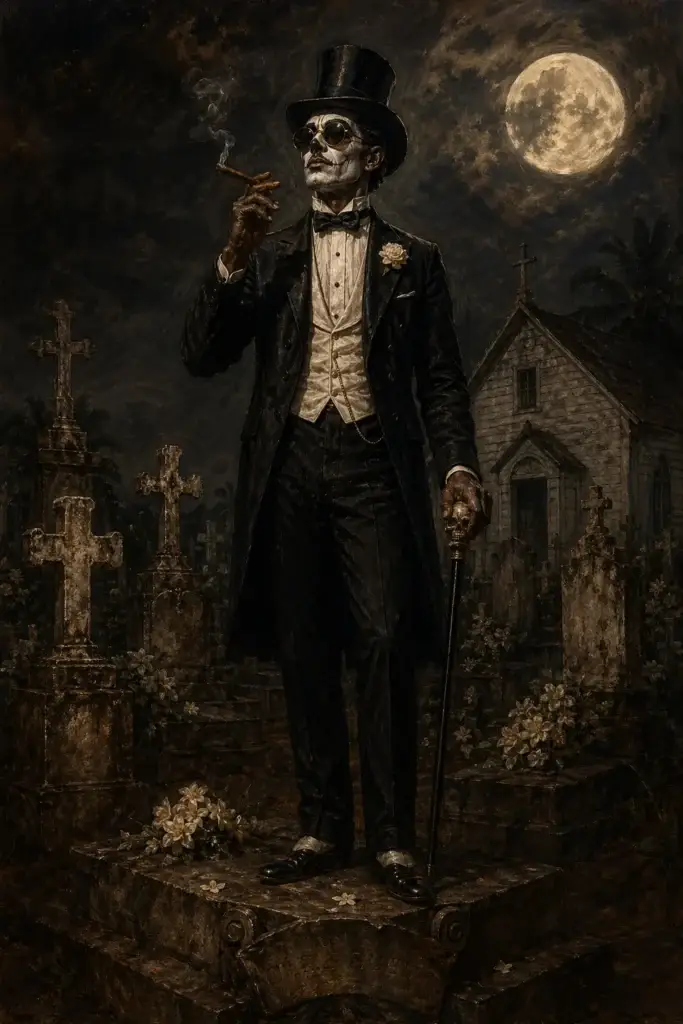
Lwa, Rada and Petwo in the Haitian Rite
Vodou is the specifically Haitian synthesis of West African religions (above all Fon and Yoruba), Catholic popular piety and the experience of Atlantic slavery. The religion emerged on the plantations of Saint-Domingue in the 17th and 18th centuries and survived as the de facto religion of independent Haiti, even though it was repeatedly suppressed politically.
At its centre stand the lwa (also loa), not gods in the Hellenistic sense but mediating spirit beings who descend through possession rituals. They are organised into two large families: Rada (cool, regular, often traditionally African: Damballa, Erzulie Freda, Papa Legba) and Petwo (hot, fast, often Creole and revolutionary: Erzulie Dantor, Baron Samedi).
Characteristic is the Catholic and African dual identity. Each lwa has a Catholic saint as a visual and onomastic disguise: Damballa is depicted as Saint Patrick with serpents, Papa Legba as Saint Peter with keys.
This doubling is not superficial syncretism but a deliberate survival strategy under Christian rule. The scholarly literature (Deren, Brown, Davis) has by now freed Vodou from its sensationalist reception.
Overview
Period: West African roots since around 1500, the Haitian synthesis since the 17th century, the New World form since the French colonial era.
Distribution: Haiti, the Haitian diaspora (USA, France, Canada).
Sources: ethnographic studies (Maya Deren, Karen McCarthy Brown), the folk houngan/manbo tradition.
Pantheon and classes of beings: lwa families: Rada (celestial, calm), Petwo (fierce, New World), Gede (death, Baron Samedi). Houngan (priest), manbo (priestess), bokor (sorcerer).
History and Pantheon
Vodou emerged through the synthesis of West African religions (Fon, Yoruba, Kongo), Catholic piety and Indigenous Caribbean traditions during the period of the slave trade (16th to 19th centuries).
Haiti became the centre of Vodou’s development after the revolution of 1791. The pantheon comprises the universal principle Bondye (the supreme power) and the lwa, powerful mediating spirits organised into families (Rada the gentle, Petwo the intense, Gede of death).
Important lwa include Damballa (grandfather, serpent), Papa Legba (gatekeeper), Erzulie (love, warrior) and Baron Samedi (death, laughter). Belief in the power of the dead and the ancestors is central. Vodou is not monolithic; Haitian, Louisiana, Dominican and Cuban variants exist. Colonial suppression and modern criminalisation have stigmatised Vodou. The diaspora has spread the tradition globally.
Beings in Everyday Life
Vodou practice is ecstatic and mediumistic: serviteurs (devotees) pray to the lwa to receive blessing, healing and protection. Possession by a lwa is central; a devotee becomes the lwa and conveys its messages. Houngan (male priest) and manbo (female priest) lead the rituals. Altars bearing lwa symbols, candles and offerings serve as household shrines.
Gris-gris (an amulet) and magical practices are part of daily life. Conjurations against malevolent sorcery (vaudoux noir) are routine. Drum music and dance are ritual.
Funerals and ancestor veneration are central. Healers and herbalists hold specialised roles. Initiation into the Vodou brotherhood requires lengthy training. Public festivals (such as Kanaval) carry Vodou elements.
Significance Today


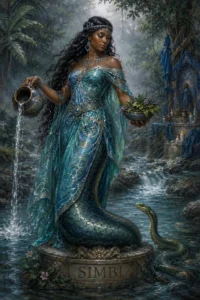


Frequently Asked Questions about Vodou and the Lwa
How many Vodou lwa are there?
The Vodou pantheon comprises hundreds of lwa, with estimates ranging from 200 to 1,000. The most important divide into two nations: Rada lwa (cool, friendly, from Dahomey/Benin: Damballa, Legba, Loko, Ayizan) and Petwo lwa (hot, fast, sometimes aggressive, of Creole origin: Ezili Dantor, Marinette).
In addition there is the Gede family (the dead), the Lwa Ginen (the old Africans) and countless local spirits.
Who is the most important lwa?
Papa Legba is always the first; he opens the gates to the spirit world. Without his permission no other lwa can appear. Damballa Wedo is the creator lwa. Erzulie Freda is the most venerated female lwa (love, beauty).
Baron Samedi is the head of the family of the dead. Ogou is a warrior and political patron. Which one counts as the “most important” depends on the matter at hand and on regional tradition.
What is Vodou and where does it come from?
Vodou (also Voodoo, Vodoun) is an Afro-Caribbean religion that arose in Haiti out of West African religions (above all Fon from Dahomey/Benin, Yoruba from Nigeria and Kongo-Bantu) and Roman Catholicism, a syncretism that was fostered under slavery (16th to 19th centuries) by the need for disguise.
Enslaved Africans venerated their lwa under the names of Catholic saints. Today around 60% of Haitians practise Vodou.
What is possession (riding the lwa)?
Possession (cheval, the mount) is the central Vodou rite: a lwa descends into the body of an initiate and uses it as a mount.
The person is in trance, and their behaviour becomes that of the lwa: Damballa hisses like a serpent, Baron Samedi smokes cigars and makes obscene jokes, Erzulie Freda weeps and perfumes herself. After the ceremony the rider has no memory of it. This practice links Vodou with other trance religions worldwide.
What is the difference between Vodou and Hollywood voodoo?
Hollywood voodoo (voodoo dolls, pins, zombies) is a racist caricature that has little to do with the actual religion. In real Vodou there are no dolls used for harmful magic; that would be bokor magic (black magic, condemned by genuine Vodou priests).
Zombies are a folkloric phenomenon, probably traceable to tetrodotoxin paralysis rather than to religion. Real Vodou is a community religion of healing, dance and ancestor veneration.
What distinguishes Vodou, Santería and Candomblé?
All three are Afro-Caribbean religions with Yoruba/Fon roots and Catholic syncretism, but of differing geography: Vodou in Haiti, Santería in Cuba, Candomblé in Brazil (with the variant Umbanda). They share many gods: Ogou (V) = Ogún (S) = Ogum (C).
Yet Vodou stands closer to its Dahomey-Fon roots, Santería to the Yoruba Orisha, and Candomblé to Yoruba with more African rites. All three are recognised by UNESCO as intangible cultural heritage.
Protective Objects in This Cultural Tradition
Vodou and related Afro-Caribbean traditions protect with wanga sachets, paquets of consecrated materials, and images of the lwa worn on the body and kept in the home.
iWell Guard takes its place in this cultural-historical line of wearable protective objects, in a contemporary material architecture, made in Germany. 41 layers, solid gold, platinum, silver. 30-day right of return.
Personal experiences may vary. Not a medical device. No promise of healing.
Protective Symbols from Vodou
The lexicon of protective symbols covers several signs and objects from Vodou on their own pages: Vèvè. A cross-cultural overview is provided on the page about protective symbols.