iWell Guard

The Veve: the Ritual Signs of the Lwa in Vodou

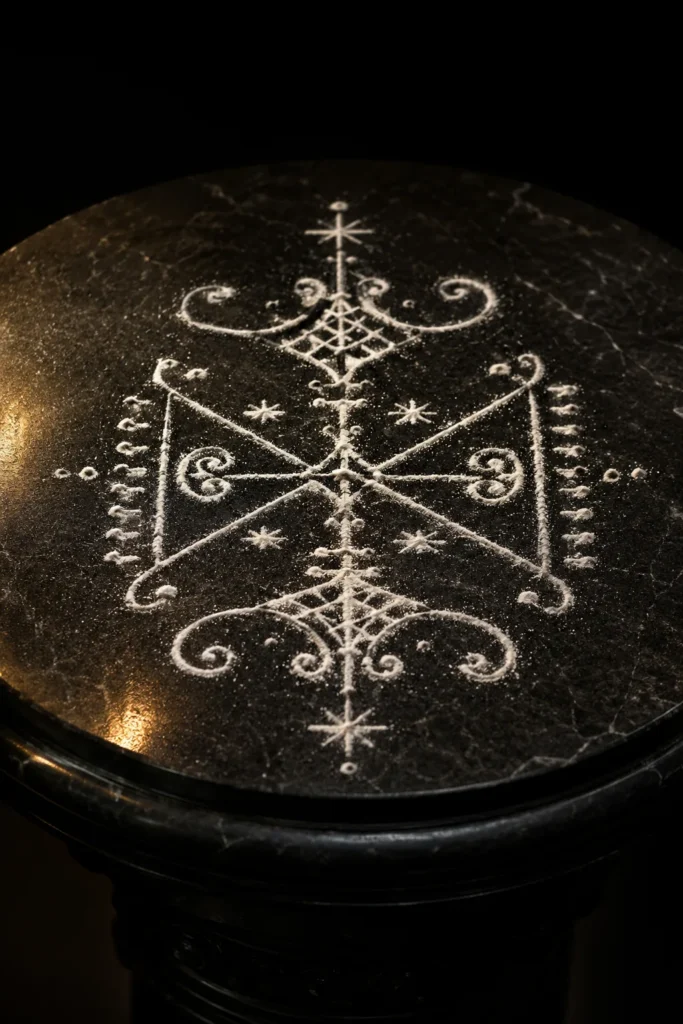
The veve is a ritual sign of Haitian Vodou. During a ceremony it is drawn on the ground to invoke a specific lwa. Every lwa has its own distinctive veve.

Protective symbolVodouRitual sign
Veve - protective symbol, museum-style illustration

Classification

The veve is a ritual sign from the world of Vodou, the religion that developed primarily in Haiti. It is a symbolic, often artfully interwoven pattern used in the context of a religious act.

Unlike a worn amulet, the veve is not a lasting object. It is drawn on the ground during a ceremony and dissolved again as the act proceeds. The veve is a transient sign that exists only for the duration of the ritual.

Each veve belongs to a specific lwa, one of the spirit beings of Vodou. The sign serves to invoke that lwa and to direct its presence to the site of the act. It is, in effect, a call in pictorial form.

In religious studies, the veve is a good example of a sign that does not ward off but invites, and that is not worn permanently but is ritually created and dissolved again. It broadens the picture of what a protective and salvific sign can be.

The veve belongs to those signs that exist only in the act of performance. It is not an image one keeps, but an event that takes place in the ritual and then passes away.

In this way the veve expands the understanding of what a sacred sign can be. It shows that a sign can also be fleeting and bound to a single moment. This transience is not a deficiency; it belongs to its very nature.

Vodou and the Lwa

To understand the veve, you need to know the world of Vodou. Vodou is a religion that arose in Haiti from West African roots, from the heritage of enslaved people, and from Catholic influences. It is an independent, multi-layered religious tradition.

At the centre of Vodou are the lwa, sometimes also spelled loa. The lwa are powerful spirit beings who mediate between human beings and a distant supreme deity. Each lwa has its own character, its own preferences, and its own domain of responsibility.

There are numerous lwa, and many of them are widely known. They include, for instance, the lwa who guards the crossroads and passages, the lwa of love and beauty, and the lwa connected with death and the underworld. They are described in more detail on the page about Vodou.

The relationship between human beings and the lwa is cultivated in the ritual. In the ceremonies the lwa are invoked, honoured, and petitioned. The veve is one of the most important means by which this invocation takes place.

Vodou has long been misunderstood and distorted in popular depictions. In reality it is a multi-layered, living religion with its own ethics, its own community, and a rich ritual life.

The lwa are not mere figures of dread, but beings with character, history, and defined domains. They are honoured, fed, and asked for assistance. The veve is a means by which people cultivate their relationship with these beings.

The Veve as the Sign of a Lwa

The defining characteristic of the veve is its bond to a specific lwa. Every lwa has its own veve, a distinctive sign that designates that lwa and no other. The veve is, in effect, the identifying mark of the spirit being.

The form of a veve points to the character and attributes of its associated lwa. The pictorial elements used, such as a cross, a heart, a ship, or a tool, stand for the domains that the respective lwa commands.

Whoever draws the veve of a lwa thereby invokes that lwa. The sign is not merely a depiction but an effective call. It directs the attention and presence of the spirit being to the place where the sign comes into existence.

The veve thus has a precise, targeted function. It does not address the spirit world in general but turns to a specific being. Knowing the right veve for the right lwa and drawing it correctly is part of the knowledge mastered by the religious specialists of Vodou.

Because every lwa possesses its own veve, the totality of all veve forms an extensive pictorial system. Whoever reads the veve reads the entire world of the lwa.

Knowing the correct veve and drawing it with confidence is part of the knowledge a religious specialist acquires over a long period. This knowledge is passed on not from books but through practice alongside experienced teachers. The veve is therefore part of an orally and practically transmitted tradition.

Form and Variety

Veve are elaborate, often densely interlaced signs. They combine lines, crosses, stars, plant forms, and small images into an ordered, symmetrical pattern. Many veve have a balanced, almost mirror-image form.

The motif of the cross and the crossing recurs frequently in veve. The crossing of paths carries a particular significance in Vodou, as it is a place of encounter between worlds. The cross motif of many veve alludes to this idea.

The number of veve is large, since there is a distinct sign for each lwa, and some lwa have several. The totality of all veve thus forms a rich pictorial system that covers the entire world of the lwa.

Despite their fixed basic features, veve are not entirely rigid. Different lines of tradition and different religious specialists may draw the same veve with slight variations. The veve lives in practice, and that practice allows a certain latitude.

The forms of the veve reflect the attributes of the individual lwa. The veve of a lwa connected with water may display sinuous lines, while the veve of a martial lwa may incorporate blades or weapons.

Each veve is thus a condensed image of its lwa. The symmetry found in many veve gives them an ordered, calm appearance. This ordered form suits their purpose: to create a clear, secure focal point for the presence of the lwa.

Drawing on the Ground

The veve is not fixed permanently on paper or cloth; it is drawn on the ground in the ritual. This takes place at the site of the ceremony, often in a consecrated space or at a location prepared for the act.

Powdered materials are used for the drawing. Cornmeal and wheat flour are common; ash, coffee grounds, brick dust, and other materials are also employed. The religious specialist allows the powder to flow out of the hand in fine lines.

Drawing a veve requires skill and practice. The lines must be set evenly and confidently so that the intricate pattern becomes clearly legible. The making of the veve is itself already part of the ritual act.

Because the veve consists of loose powder, it is transient. In the course of the ceremony it is walked across, danced over, and finally dissolved. This transience belongs to the nature of the veve. It is not a lasting image but a sign for the moment of the act.

Drawing with flowing powder requires a calm, practised hand. The specialist lets the flour pass between the fingers and guides the line in an even flow. A mistake can hardly be corrected without disturbing the whole sign.

For this reason, the drawing itself is already part of the ritual focus and attention. The effort and care invested in the veve form part of the honour shown to the lwa who is to be invoked.

The Veve in the Ritual

In the sequence of a Vodou ceremony, the veve has a fixed place. It is drawn at the beginning or in the course of the act to invoke the lwa who is to be honoured and petitioned. The veve thereby opens the encounter with the spirit being.

The completed veve serves as a focal point. You can think of it as a kind of beacon that draws the presence of the lwa to the site of the ceremony. Over the veve, the prayers, songs, and offerings intended for the lwa are gathered.

Offerings are often placed on or beside the veve, such as food, drinks, or objects associated with the particular lwa. Candles may also be lit on the sign. The veve thus becomes the focal point of ritual attention.

As the ceremony proceeds, the veve is dissolved by the events themselves. Dance and movement blur the lines. This dissolution is not damage but belongs to the sequence. The veve has fulfilled its task once the encounter with the lwa has taken place.

As the ceremony unfolds, the veve becomes the living centre. Around the sign the drums, the songs, and the dancers gather. Offerings are placed on the veve, candles are lit, and liquid is poured out.

When the lwa appears, this occurs, in the understanding of Vodou, within the circle of its veve. The sign has then fulfilled its purpose, and its lines may be blurred in the unfolding of the event.

Roots of the Veve

The veve, like Vodou as a whole, has flowed together from several sources. Its roots reach primarily back to West Africa and to the Congo region, from which many of the enslaved people who shaped Vodou came.

From the Congo region comes the tradition of symbolic ground and cosmos drawings that represent the order of the world and the connection between worlds. In these older signs, in which the cross and the crossing play a role, lies an important root of the veve.

Further influences were added. Pictorial elements from Catholicism and from European sign traditions entered into the design of the veve. Vodou absorbed such elements and incorporated them into its own world.

The veve is thus a sign of the encounter of several traditions. Within it, African heritage, the experience of abduction and enslavement, and influences from the new surroundings are combined. This multi-layered origin is characteristic of Vodou as a whole.

The history of the veve is inseparable from the history of enslavement. People were taken from Africa by force, and under inhumane conditions they preserved their religious ideas and gave them a new form.

From West African and Congolese heritage, from the forced encounter with Catholicism, and from life in the new world, Vodou emerged. The veve carries this history within it. It shows the resilience of a culture that endured under compulsion.

The Veve and the Sigil

The veve can also be considered in the broader context of sigil magic. It belongs to those signs that do not ward off but establish a connection and are meant to invoke a force or a being.

In this respect the veve is related to the sigil. A sigil is a condensed sign to which a specific effect or meaning is attributed. Working with such signs is known in many traditions and is treated in more detail on the page about sigil magic.

Like the sigil, the veve combines a precise meaning with an artful, condensed form. Both are signs whose form is not arbitrary but was shaped toward a specific aim. The veve is the sigil of a lwa.

Despite all the kinship, the veve has its own distinctive character. It is closely embedded in a living religion and in its ceremonies. It is not a sign used in solitude but part of a communal ritual. In this it differs from many other signs of sigil magic.

Like the sigil, the veve combines a clear intention with an artful, condensed form. Both belong to those signs that do not ward off but establish a connection. Yet the veve is never a sign used in solitude.

It is embedded in a community, in drums, song, and dance, and in the knowledge of a religious specialist. This embedding in a communal ritual distinguishes the veve from many other signs of sigil magic.

Contemporary Reception

Today the veve is known far beyond Haitian ceremonies. Its elaborate, symmetrical patterns are taken up as a motif and appear in design, in art, and in popular culture.

This spread comes with a shift. From the ground on which the veve exists only for the duration of a ceremony, it migrates to permanent supports. It is painted, printed, and presented as a fixed image. In doing so, it loses its original transience.

In popular culture, Vodou is frequently depicted in a distorted way, and the veve is drawn into that distorted picture as well. A factual account counters this by showing that the veve is a serious religious sign belonging to a living religion.

In Haitian Vodou itself, the veve remains unchanged as what it has always been: a ritual sign that invokes a lwa. There it remains bound to the ceremony, to the drawing on the ground, and to the encounter with the spirit world. In this living use lies its true significance.

In engaging with the veve, a mindful approach is called for. The veve is not a decorative pattern, nor the mysterious horror-sign it often appears to be in films.

It is a serious religious sign of a living faith community. Anyone who depicts it should know its origin and its meaning. A factual account helps to correct a long-distorted image of Vodou and its signs.

Selected Bibliography

  • Alfred Métraux: Le Vaudou haïtien (1958)
  • Maya Deren: Divine Horsemen. The Living Gods of Haiti (1953)
  • Milo Rigaud: Ve-Ve. Diagrammes rituels du Voudou (1974)
  • Karen McCarthy Brown: Mama Lola. A Vodou Priestess in Brooklyn (1991)
  • Leslie Desmangles: The Faces of the Gods. Vodou and Roman Catholicism in Haiti (1992)

Related key terms: Veve Vodou Lwa Loa ritual sign Haiti ceremony Congo sigil.

iWell Guard and Protective Traditions

iWell Guard stands in the cultural-historical line of wearable protective objects, to which the veve also belongs. A modern companion for people who live with protective symbols: crafted in Germany, 41 layers of genuine gold, platinum, and silver, with a 30-day return policy.

Individual experiences may vary. Not a medical device. No healing claims.