


Haunting: place-bound phenomena worldwide
Place-bound spirit phenomena. Recurring apparitions, knocking, movements, in old houses, at sites of misfortune, in specific families.
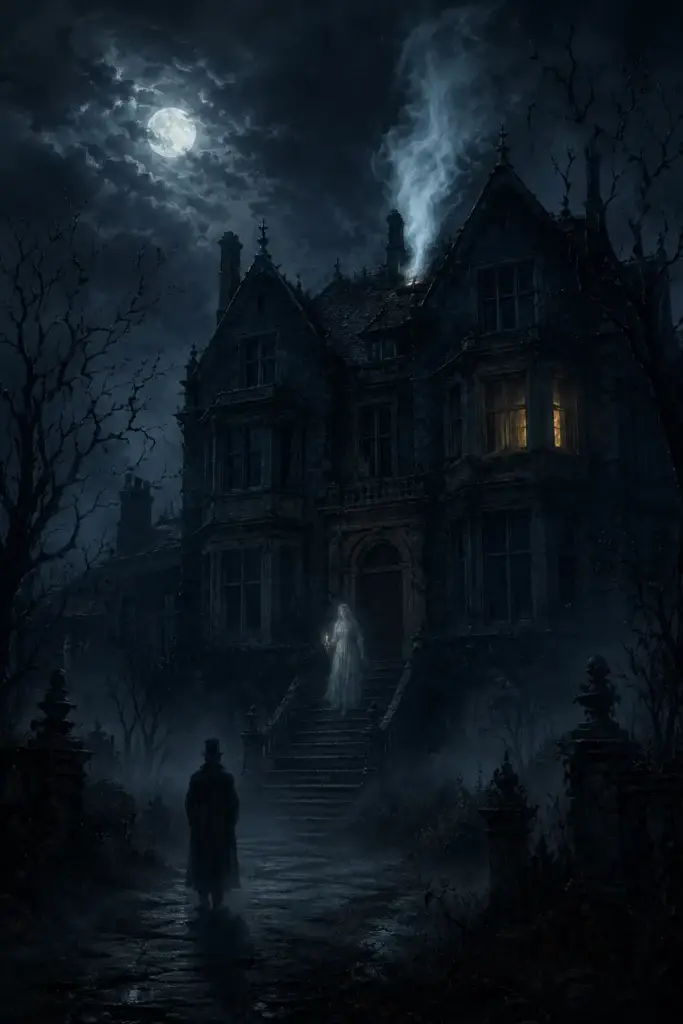
Haunted places include houses, cemeteries, or prisons where haunting phenomena concentrate.
Table of Contents
Quick overview (definition list)
Type: Spirit phenomenon / place manifestation Class: Haunting Distribution: Global, cross-cultural, particularly well documented in Europe and North America Main features: Place-boundness, repeated phenomena, sensorially perceptible, often enigmatic Related sub-categories: Spirits of the dead, poltergeist, vengeful spirits
Concept and Delimitation
Haunting is a collective term for all supernatural phenomena that haunt a specific place. The term differs from poltergeist, which denotes a more active, often destructive force with a possible psychokinetic component.
While a poltergeist is often bound to a living person (unconscious psychic projection), a haunting is classically bound to a place: an old house, a particular room, a cemetery.
A haunting can persist for decades or centuries, whereas poltergeist activity is often temporary. In contrast to direct spirit interactions (a spirit speaks or attacks), a haunting is more subtle and enigmatic.
Phenomenology and depth in the history of religion
In terms of the history of religion, the haunting is one of the oldest documented classes of paranormal phenomena.
Pliny the Younger reports, in his letter 7.27 (to Sura, early 2nd century CE), the case of the philosopher Athenodorus, who rented a haunted house in Athens and, after nocturnal apparitions, found the skeletal remains of a murdered man beneath the floor.
This episode is the earliest fully narrated haunting story in European literature and establishes the structural features of the genre: a place-bound phenomenon, acoustic and visual apparitions, an unresolved task from the past as the trigger, and resolution through ritual-pragmatic clarification.
Augustine discusses, in De cura pro mortuis gerenda (ca. 421/22), the theological question of whether the dead can continue to interact with the living after their death, arriving at a skeptical but not dismissive position.
Cultural-Historical Examples
Classic haunting cases
The haunting history of the English-speaking world has been densely documented since the 17th century.
Borley Rectory in Essex (under observation between 1862 and 1939) was presented by Harry Price (The Most Haunted House in England, 1940) as the best-attested haunting case; later research (Eric Dingwall, Trevor Hall, The Haunting of Borley Rectory, 1956) exposed a considerable part of the reports as fabrications by the rector Lionel Foyster and in part by Price himself, while another part remained unexplained.
Hampton Court Palace, the Tower of London, Glamis Castle in Scotland, and the Eilean Mòr Lighthouse off the Hebrides are further standard cases of the English haunting tradition.
In the German-speaking world, the Rosenheim haunting (1967, 1968 in the law office of Sigmund Adam) is the scientifically best-documented case.
Hans Bender of the Freiburg Institute for Border Areas of Psychology and Mental Hygiene (IGPP) investigated the case using physical measuring instruments and arrived at a poltergeist diagnosis, with the 19-year-old secretary Annemarie Schaberl as the psychokinetic carrier.
Friedrich Karger and Gerhard Zicha (Max Planck Institute for Plasma Physics) confirmed the electrical anomalies and were unable to explain the phenomena through conventional technical causes.
Scientific haunting research
The academic study of paranormal phenomena began with the founding of the Society for Psychical Research (SPR) in 1882 in London by Henry Sidgwick, Frederic Myers, and Edmund Gurney. Over five decades, the SPR systematically collected haunting reports and published them in the Proceedings and the Journal.
The standard study from this tradition is Gurney/Myers/Podmore, Phantasms of the Living (1886, 2 volumes, 702 cases).
William G. Roll of the Psychical Research Foundation in North Carolina (The Poltergeist, 1972) systematically recorded and documented the poltergeist subclass of the haunting; he coined the term recurrent spontaneous psychokinesis (RSPK) for cases in which a living person is unconsciously the trigger.
Source Situation
The haunting is documented in ancient written sources (Pliny, the Roman Naturalis Historia), in medieval chronicles, in English and European folklore collections of the 19th and 20th centuries, and in modern paranormal investigations.
The Victorian era was obsessively preoccupied with haunted houses; magazines reported regularly on new “cases.” The founders of the Society for Psychical Research (1882) systematically documented thousands of haunting reports.
Three explanatory models
Religious studies and parapsychological research recognize three non-coextensive explanatory models for haunting phenomena. The spiritualist model (since Allan Kardec, Le Livre des Esprits, 1857) understands the haunting as the effect of the deceased who have not passed into another form of existence and who remain bound to a place, a person, or an object.
This model has the longest tradition in the history of religion and corresponds to the assumptions of practically all folk-religious haunting doctrines worldwide.
The parapsychological model (Roll, Bender) understands at least a part of the haunting cases as unconscious psychokinesis of a living person, often an adolescent in a phase of emotional tension.
This explanation is phenomenologically grounded and has empirical support in the Rosenheim and Miami cases. It does not exclude the existence of spiritualist haunting cases but reinterprets a part of the reports.
The psychological-sociological model (Susan Blackmore, James Alcock) understands haunting experiences as the result of human perceptual distortions, suggestible expectation, pareidolia, and social dynamics. It explains a considerable part of the reports but leaves the scientifically established anomalies (Rosenheim, Cardiff) unexplained.
Significance Today / Related Beings
Haunting remains the most described and most investigated supernatural phenomenon. Paranormal research teams travel worldwide to notorious haunted houses with thermal cameras, recorders, and EMF meters. The television program “Ghost Hunters” and similar formats have popularized haunting investigation.
Psychologically, haunting experiences are often interpreted as a combination of psychological suggestion, unexplained physical phenomena (sound, electromagnetic fields), and a genuine poltergeist effect. Related beings are the poltergeist (more active, bound to a person), spirits of the dead (often personal), and vengeful spirits (specifically motivated).
Haunting in the iWell Guard mantra system
In the protection mantra, the haunting is explicitly addressed in point 3 (transformation of already established influences): haunting apparitions, place-bound spirits, and similar phenomena are addressed with the clause that black-magical and energetic influences that have reached the wearer are diverted via the primal source to Gaia and transformed there.
The self-applicant clause (point 10) covers the case where the wearer themselves evokes haunting phenomena through their own necromantic or black-magical practice.
In practice, wearers work with haunting experiences on two levels. First, through the invocation of the primal source as the highest authority of protection, which is in any case continuously active in the mantra.
Second, through place-related clearing practice: when a haunting phenomenon is bound to a place, the place itself can be energetically cleared through a cleansing practice (smudging with mugwort or incense, salt water, contemplative light visualization). A detailed functional overview of the mantra layers can be found under Functional overview of the protection mantra.
Haunting Phenomena, Typology and Forms of Appearance
Common haunting apparitions
Among the most frequently documented haunting apparitions are: repeated knocking in the same spot, the seemingly purposeful displacement of furniture or small objects, auditory hallucinations of individual voices or footsteps, sudden cold spots in an otherwise temperate room, light anomalies in the periphery of the visual field, as well as the feeling of being watched.
Such haunting apparitions generally occur in a place-bound manner and recur according to recognizable patterns: this distinguishes them from one-off sensory illusions.
In Depth
Phenomenology of the Haunting
Haunting denotes the recurring, place-bound occurrence of phenomena that are not explained by everyday perception. Classic haunting markers are: footsteps without a cause, doors that open, objects that move, cold spots in the room, voices or music from empty rooms.
Unlike apparitions of individual deceased persons, the haunting is not directed at a particular person but at all inhabitants and visitors of a place.
Historical Haunting Cases
Reports of haunting phenomena have been handed down since antiquity. Pliny the Younger describes, in a letter to Sura, a haunted house in Athens, the first extensively documented haunting case of the Western tradition.
In the German-speaking world, the cases of Therese of Konnersreuth, the haunted house of Rosenheim, and older reports from monastery chronicles are significant. The parapsychological research of the 20th century (Hans Bender) attempted to investigate haunting cases methodically.
The spiritualist model sees the haunting as the working of the deceased who have remained connected to the place. The parapsychological model interprets the haunting as the unconscious psychokinetic activity of living persons, with the poltergeist agent as the source of energy.
The skeptical model traces haunting phenomena back to perceptual illusions, suggestive reinforcement in groups, technical causes, and fraud. At iWell Guard, we keep all three lines of explanation in parallel.
Dealing with Haunting
Further standard works in the literature index.
Frequently Asked Questions about Haunting
What is a haunting? Definition
Haunting is the collective term for place-bound supernatural phenomena that show themselves repeatedly at a particular building, room, or area. Unlike person-bound spirit apparitions, a haunting remains bound to the place even when the original inhabitants are long gone. Classic haunting reports include noises, object movements, visual apparitions, and atmospheric anomalies.
What haunting phenomena are there?
Religious studies and parapsychological research distinguish four main categories of haunting phenomena: acoustic (knocking, voices, footsteps), kinetic (object movements, poltergeist), visual (apparitions, silhouettes), and atmospheric (cold, sensations of pressure). Classic cases such as the haunting of Rosenheim or the Bell Witch reports usually combine several of these types of phenomena.
What to do about a haunting?
Anyone who has a presumed haunting experience should first document it soberly: date, time, place, exact perception. Second: rule out everyday causes (water pipes, animals, electrical installations, settling noises). Third: in the case of a recurring pattern, seek advice, from religious studies scholars, parapsychological research groups, or pastoral support, depending on your personal frame of reference.
iWell Guard and Protective Traditions
The haunting phenomena described here are situated, in religious studies and psychology, within several explanatory models.
iWell Guard ties into the millennia-old line of wearable protective objects, from Pazuzu pendants in Mesopotamia through Hamsa and evil-eye amulets in the Mediterranean region to the Mezuzah on Jewish doorposts and to Christian protective medals.
A contemporary form of this, manufactured in Germany, with a clearly documented material architecture (41 layers, real gold, platinum, silver). 30-day right of return.
Not a medical product. No promise of healing. Personal perceptions may vary.