Beings from the Chinese tradition on iWell Guard. Chinese folk religion, Daoist and Confucian traditions. A rich pantheon with a celestial bureaucracy, ancestor worship and nature spirits.
China’s folk-religious heritage combines Daoist, Buddhist and local traditions into a many-layered pantheon.
The Chinese religious tradition is institutionally a multi-layered construction: Daoism, Buddhism, Confucianism and the folk religion that pervades them all. A Chinese household could traditionally belong to all four at once: Confucianism for family ethics, Buddhism for death and rebirth, Daoism for healing and protection, folk gods for everyday needs.
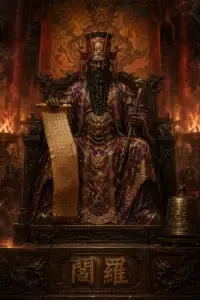
The pantheon is hierarchical, like a celestial system of officials. The Jade Emperor presides over a bureaucracy of city gods, earth gods, door gods and kitchen gods.
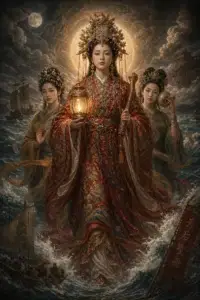
After death, mortals could be canonized and become gods; historical figures such as Guandi (the general Guan Yu) or Mazu (a protective goddess of seafarers) are the most important examples.
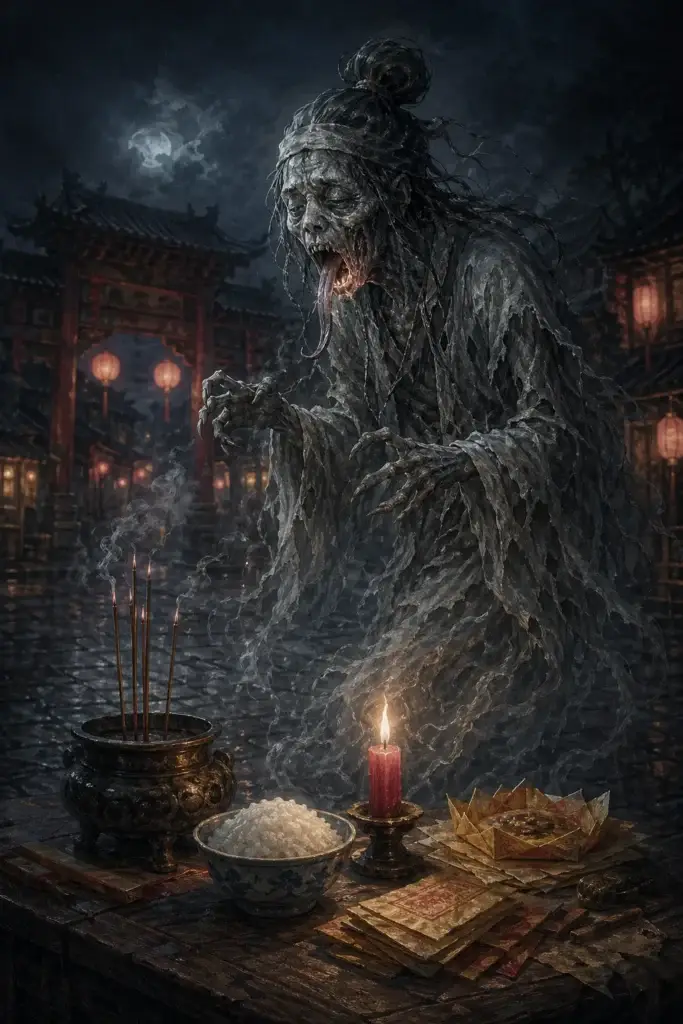
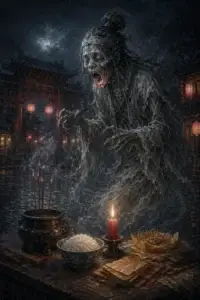
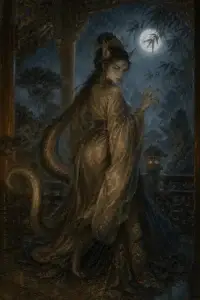
Alongside this, China knows a rich world of spirits and demons: gui are discontented souls, e gui are hungry ghosts, yaoguai are animal spirits that can take human form.
Unlike in the Western Middle Ages, the dragon is a positive symbol: the sphere of water, fertility, imperial power. The Chinese religious vocabulary draws finer distinctions between spirit, god and being than can be mapped onto European terms.
Period: from the Shang dynasty (1600 BCE) to the present, with Daoist, Confucian and Buddhist layers.
Distribution: folk religion throughout China, with regional variants and an overseas Chinese diaspora.
Sources: Shujing, Shijing, Liezi, Zhuangzi, Daodejing, Diyu texts, collections of folk tales.
Pantheon and classes of beings: the celestial bureaucracy under the Jade Emperor, city gods, ancestors, the Diyu kings of hell, nature spirits.
Chinese religion passed through several layers and syntheses: originally there existed an ancestor cult and a pre-Chinese veneration of nature and demons. With the historical period, the worship of Tianhuang (the Heavenly Emperor) and of local deities became established.
Daoism later formalized cosmological principles and shamanic practices. Buddhism arrived in the first century and merged with local traditions, especially in the conceptualization of the realms of hell (Diyu).
Confucian ethics overlaid liturgical practice. Folk religion integrated all the layers: gods, ancestors, household gods (Tu Di Gong), demons and spirits. The pantheon is not hierarchical but functionally ordered by domains (water, harvest, craft, protection). Syncretisms shape the tradition to this day; a single family might follow Daoists, Buddhists and Confucians alike.
Household worship is central to Chinese practice: the household lord (Tu Di Gong) and other household gods receive small daily offerings and larger weekly rituals. Protective rituals against evil spirits are part of everyday life; red cords, door amulets and firecrackers serve to ward them off.
Festival and new-year rituals (Lunar New Year, the Ghost Festival) are dedicated to the family and serve the veneration of ancestors. Priests and Daoists offer specialized rituals for healing, exorcism and spiritual purification.
The interpretation of omens and feng shui are widespread everyday practices. Mediumship and spirit possession are recognized phenomena that are treated through rituals.
Traditional Chinese folk religion lives on in families, temples and regional customs, especially in Taiwan, Hong Kong and among the Chinese diaspora. On the Chinese mainland it was suppressed under communism, but since the 1990s it has experienced a cultural revival.
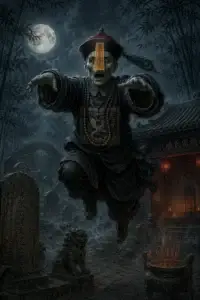
In academic study, Chinese religion is examined as a model of synthesis for religious plurality. Western esoteric circles have romanticized and simplified Daoism and feng shui. Popular culture draws on Chinese spirit and demon motifs (jiangshi, figures from classical literature) for horror and fantasy.


The Chinese pantheon is enormous; estimates range from 200 principal gods to hundreds of millions of local numina and spirits. In Daoism, the Three Pure Ones (San Qing) and the Jade Emperor stand at the top.
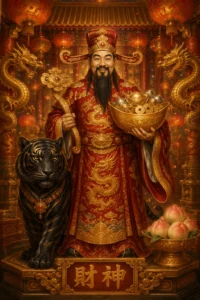
Added to these are folk gods such as Caishen (wealth), Guan Yu (loyalty, a deified general), Mazu (the sea) and Tudi (the village deity). Buddhist bodhisattvas such as Guanyin and Mile (Maitreya) are integrated into the pantheon.
In Daoism, Yu Huang Shangdi (the Jade Emperor) is the head of all gods, spirits and humans. He governs the celestial court from the Kunlun Mountains.
Above him, however, stand the three supreme Daoist deities, the San Qing (Three Pure Ones): Yuanshi Tianzun, Lingbao Tianzun and Daode Tianzun. In the Confucian state cult, Tian (Heaven) was the abstract supreme power, without human form.
The Eight Immortals (Ba Xian) are eight Daoist saints, each embodying a different aspect: Lü Dongbin (sword, scholar), Han Xiangzi (flute, youth), Cao Guojiu (nobility), Tieguai Li (crutch, poverty), Lan Caihe (basket, artist), He Xiangu (lotus, woman), Zhongli Quan (fan, maturity) and Zhang Guolao (drum, old man).
They travel together and bring immortality. The best-known motif: the Eight Immortals crossing the sea.
The Three Pure Ones (San Qing) are the highest gods of Daoism: Yuanshi Tianzun (the Primeval Pure One, the Dao itself), Lingbao Tianzun (the Pure One of the Numinous, of energy) and Daode Tianzun (the Pure One of the Dao and of virtue, the manifestation, sometimes identified with Laozi).
They dwell in the three highest heavens and are the source of all creation. In practice they are worshipped less than Yu Huang; they are too lofty and abstract.
Chinese dragons (Long) are completely different from European fire-breathing dragons; they are benevolent beings, guardians of water, rain and growth. They have a serpent’s body, four clawed legs, a deer’s head and shimmering scales.
There are four Dragon Kings (Long Wang) for the four seas. The imperial dragon with five claws was an exclusively imperial symbol. Together with the phoenix, the kirin and the tortoise it forms the Four Divine Animals (Si Ling).
The three teachings (San Jiao) shape Chinese religion together: Daoism emphasizes harmony with nature, immortality, magic and a rich pantheon of gods. Confucianism is more an ethical philosophy: filial piety, ancestor worship, social order, with a minimal pantheon.
Buddhism brought the concept of karma, nirvana and the bodhisattvas. In practice, many Chinese worship all three at once, a distinctive form of religious tolerance.

Chinese religion is traditionally understood as an interweaving of three teachings (san jiao): Confucianism, Daoism and Buddhism. These three currents coexisted and interpenetrated from the first millennium CE onward.
Alongside them stands a rich folk religion. Chinese religiosity is not organized along exclusive lines; a person can practice Confucian family ethics, Daoist geomancy and Buddhist sutra recitation without contradiction.
Daoism, founded on the Daodejing and the Zhuangzi, has two main currents: philosophical and religious Daoism. The Yin-Yang model and the Five Phases (Wu Xing) structure reality. The Jade Emperor (Yuhuang Shangdi) presides at the top of the celestial bureaucratic pantheon.
Ancestor worship is religiously more central than any pantheon. Deceased family members are provided for through rituals: incense sticks, food offerings, the burning of money.
The folk gods are often historically attested figures who were deified after their death: Guan Yu, Mazu, Caishen. The city god (Cheng Huang) of every city acts as a celestial mayor.
Further standard works in the literature index.
In the Chinese cultural sphere, bagua mirrors above doors, fu talismans on clothing and rooms, and jade objects protect the wearer; Daoist protective scrolls complement the practice.
iWell Guard places itself within this cultural-historical line of wearable objects of protection, in a contemporary material architecture, made in Germany. 41 layers, solid gold, platinum, silver. 30-day right of return.
Personal experiences may vary. Not a medical device. No promise of healing.
Chinese mythology is not a single unified narrative but a network grown from Daoist, Confucian, Buddhist and folk-religious strands.
It encompasses cosmogonies around Pangu and Nüwa, the line of the Three Sovereigns and Five Emperors, figures of the celestial bureaucracy such as the Jade Emperor, and regional beings from mountains, rivers and houses. Only this interplay yields what Western scholarship calls Chinese mythology.
The lexicon of protective symbols covers several signs and objects from China on their own pages: bagua mirror, coin amulet, coin sword, peachwood, Pixiu and door gods. For a cross-cultural overview, see the page on protective symbols.