E Gui, ghost of the Chinese tradition
By Ralf Ittermann · last reviewed on
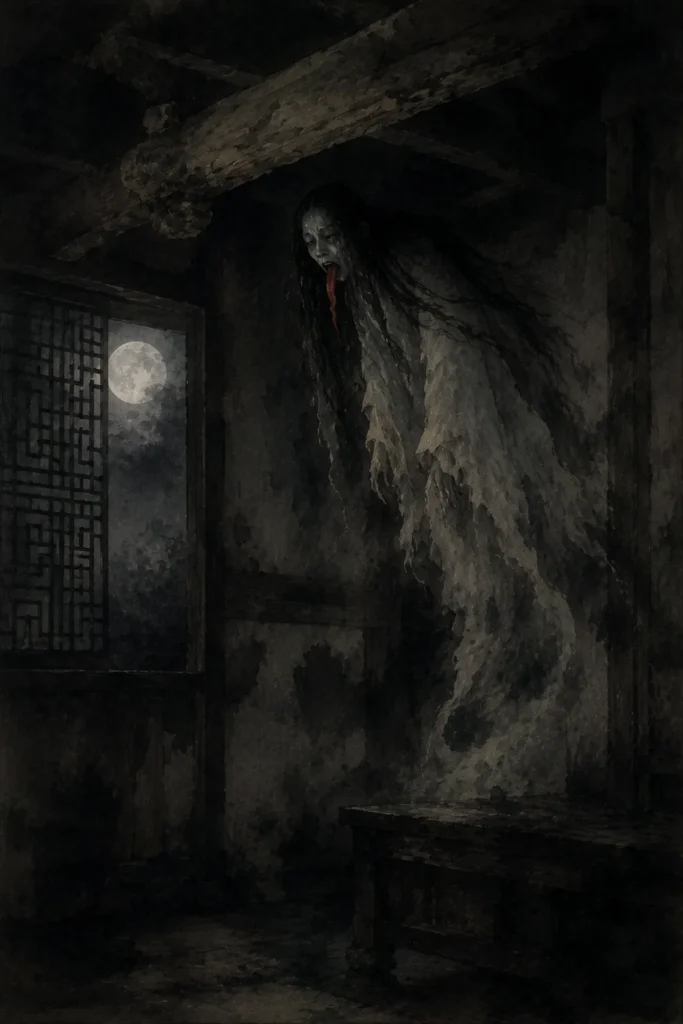
E Gui is a ghost of the Chinese tradition.
Hungry ghosts in the Chinese calendar and folk belief.
E-Gui (餓鬼, hungry ghosts) are a class concept of Chinese Buddhism with roots in the Indian preta doctrine. They appear with thin necks, enormous bellies, and insatiable hunger as a form of punishment for greed and stinginess in a previous life.
The Zhongyuan Festival (Ghost Month, 7th lunar month) is dedicated to remembering them, and during this period Buddhist temples hold offering rites to ease the suffering of these beings.
E-Gui in the Yulanpen ritual
E-Gui (餓鬼, “hungry ghost“) is a special level of existence in the Buddhist scheme of the six realms (liu dao).
Whoever is karmically burdened in a former life by stinginess, greed, or the theft of food is reborn in the Pretaloka, the realm of the hungry ghosts. Characteristics: swollen bellies, needle-thin necks, no gullet through which food can pass, suffering from hunger until the karma is exhausted.
The paradigmatic story of redemption is Mulian rescues his mother (Yulanpen sutra, ca. 270 CE): the Buddha’s disciple Mulian sees his deceased mother in the Pretaloka but cannot help her directly.
The Buddha advises him to feed the Sangha with food on the 15th day of the 7th lunar month; the transfer of merit frees the mother. From this developed the annual Yulanpen Festival (Japanese Obon, Korean Baekjung) with food offerings and lantern rituals for the hungry ghosts.
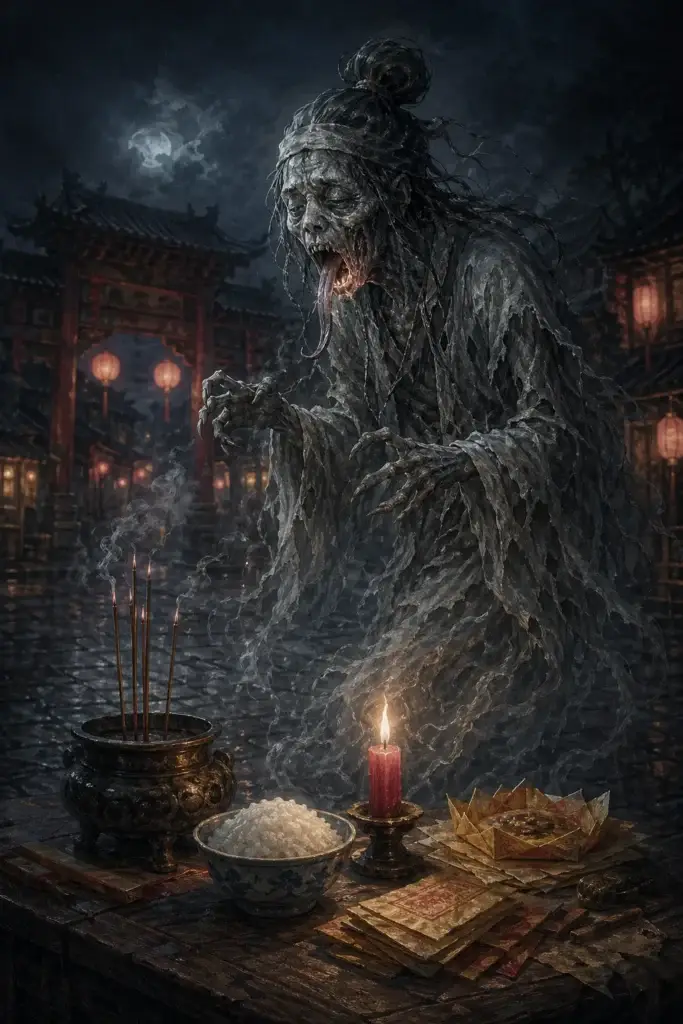
E Gui
E Gui (餓鬼), “hungry ghosts,” are the Chinese counterpart to the Buddhist Preta. Arriving in China from India through the Buddhist mission, they developed their own tradition there, one that merged with the Daoist and Confucian ancestor cult.
An entire month of the Chinese calendar is dedicated to them: the seventh lunar month, the “Hungry Ghost Month” (Yulan Yue).
During this month, especially on the 15th day (Yulanpen Festival), the gates of the underworld open according to tradition. E Gui come into the world of the living and seek food. Believers set up offering altars in front of their houses and in public places, burn paper money and paper gifts, and recite sutras.
In Hong Kong, Singapore, Malaysia, and Taiwanese cities, the festival is one of the most visible large-scale religious events of the year. The motif of the saving son-mother relationship (the Mulian legend) stands at its center and connects Buddhist teaching with the Confucian ethic of filial piety.
At a Glance: E Gui
Type: Hungry ghost, a rebirth sequence of karmic greed
Origin: Buddhist preta concept from India, integrated into Chinese culture
Texts: Ullambana sutra, Mulian bianwen texts, Yuli literature
Period: fully developed from the Tang era onward, up to the present
Central festival: Hungry Ghost Festival, 15th day of the 7th lunar month
Distinction from Gui: In contrast to Gui, the general Chinese collective term for ghosts of the dead, the E-Gui are the specific subclass of hungry ghosts, beings whose karmic burden condemns them to insatiable hunger; in the Buddhist-Chinese Yulanpen Festival they have their own ritual function.
Historical Context
Period of the Texts
The Ullambana sutra was translated into Chinese in the 3rd century CE. Mulian legends appear as bianwen texts from the Tang era onward (7th to 10th century).
The Yuli Bao Chao (Song era, 12th century) systematizes the hell and E-Gui cosmology. Folk tales of the Ming and Qing periods. Modern Hungry Ghost Festival practice across all of East Asia.
Area of Distribution
Hong Kong, Taiwan, Singapore, and Malaysia, with especially active festivals. The Japanese Obon as a sister festival (with the gaki concept). The Korean Baekjung tradition. The Chinese diaspora in North America and Europe celebrates it locally.
State of the Sources
The Ullambana sutra, Mulian bianwen collections (Dunhuang manuscripts), the Yuli Bao Chao, Gui Yuan Liu Zhi literature (Tang-era notebooks), and modern ethnography on Hungry Ghost festivals.
Name and Spellings
Chinese: 餓鬼 (è guǐ, “hungry ghost“).
Sanskrit: preta (basic term).
Japanese: Gaki.
Korean: Agwi.
Distinction from Gui in general: E Gui is a specific class, a hungry ghost, not simply a phantom or ancestor.
The Chinese translation 餓鬼 makes the central characteristic, hunger, into the name. While in India “preta” originally referred to all the deceased and was only later narrowed to the hungry-ghost class, the Chinese translation goes directly to the specific meaning.
Characteristics
Appearance
Like the preta: a bloated belly, a throat as thin as the eye of a needle, a flaming mouth, thin limbs.
Especially vivid in Chinese iconography, panoramas of hell show throngs of E Gui around offering tables, unable to eat. The iconographic tradition remained stable from the Tang through the Song and into the Ming and Qing periods.
Behavior
Hungry until the karma is exhausted, constantly searching for food. It comes to offering altars but can eat nothing, taking in only smell and smoke. In the seventh lunar month, E Gui leaves the underworld and roams the world of the living.
Sphere of Action
The realm of hell (Di Yu) as its location. Swarming out onto the earth in the seventh lunar month. Especially at the places of the deceased: cemeteries, cremation sites, former homes. Gathered at offering altars during the festival days.
Mythological Context
Karmic rebirth out of stinginess, the misuse of alms, and religious unfaithfulness. The duration in the Pretaloka can be very long. The only hope: the offerings of the surviving relatives, especially through the Sangha (the Mulian model).
Profile: E Gui
The most important aspects of E Gui at a glance.
A karmic rebirth sequence stemming from stinginess, greed, and the misuse of alms. In the Chinese reception of the Buddhist preta concept, merged with the local ancestor cult.
The deceased with corresponding karma; in the festival context, all the uncared-for dead of the surrounding area. Indirectly also the living, as an admonition to generosity.
A bloated belly, a throat as thin as the eye of a needle, a flaming mouth, thin limbs. Classical Chinese paintings of hell depict the figure in great detail.
Torment of hunger and thirst until the karma is exhausted. Unable to eat, even though food seems within reach. Swarming out to offering altars during the festival season.
Not defense, but feeding and rite: offerings, the burning of paper money, the recitation of sutras, Sangha offerings. The Ullambana Festival as the institutionalized large-scale form.
Festival and Practice
Yulanpen / Hungry Ghost Festival
The 15th day of the seventh lunar month. Families set up offering tables with rice, fruit, tea, and wine. Paper money (zhi qian) and paper gifts are burned.
Public places have stages for “ghost operas” (stands without seats for spectators, since the ghosts sit in front). Buddhist and Daoist temples offer rituals with mass appeal.
The Mulian legend
The central myth: Maudgalyayana (Chinese Mulian) sees his mother in the preta state with supernatural sight. He tries to bring her food, but it burns in her mouth. The Buddha teaches him that only the collective power of the Sangha’s offerings can save her. From this comes the Ullambana Festival.
Everyday Practice
Outside the festival: an ancestor table at home with a daily preparation of tea. At the edge of the family meal, a small plate for the E Gui. No paper gifts are left inside one’s own home (they are taken outdoors).
Reception and the Present
Regional festival practice: Hong Kong with huge offering altars along the roadsides and parades of paper figures. Singapore with ghost operas in all districts. Taipei with state promotion of the festival as cultural heritage. Each region has its own emphases.
Tourism and change: The Hungry Ghost Festival is increasingly marketed for tourism, yet it remains religiously central. Younger generations maintain it with new forms (online gifts, digital alternatives to paper money). Folk religion in dialogue with modernity.
Popular culture: Modern Taiwanese and Hong Kong horror films adapt E-Gui motifs. The Japanese gaki appears in anime (Hozuki no Reitetsu as a comedy of hell). International horror literature takes up the hunger motif.
E Gui in the Buddhist System of Rebirth
The E Gui, the “hungry ghost,” was shaped and systematized in Chinese religious history above all by Buddhism. In the Buddhist worldview, it denotes one of the six realms of existence into which a being can be reborn according to its karma.
The realm of the hungry ghosts, in Sanskrit preta, lies below human existence but above the hells. Rebirth as an E Gui is regarded as the consequence of greed, stinginess, and avarice in a former life.
The suffering of the E Gui consists in an insatiable, never satisfied craving. Buddhist iconography has coined a striking image for this: a being with an enormous, distended belly and a tiny, needle-thin neck or mouth through which hardly any food can pass.
In some descriptions, food that an E Gui reaches turns into fire, pus, or excrement as soon as it tries to eat it. The hungry ghost is thus the embodiment of a greed that cannot satisfy itself.
This system has a clear ethical sense. The E Gui is not someone arbitrarily damned, but the result of a moral connection of cause and effect. Moreover, existence as a hungry ghost is not eternal; once the corresponding karma has been worked off, rebirth into a higher realm can take place.
The E Gui thus stands within a didactic context that is meant to guide its hearers toward moderation and generosity. Buddhism also knows related ideas in the Tibetan and Southeast Asian traditions.
Mulian Rescues His Mother: The Key Myth
The most important narrative about the hungry ghost for China is the story of Mulian, a disciple of the Buddha who frees his mother, reborn as a hungry ghost, from her suffering.
The narrative goes back to the Yulanpen sutra and became extraordinarily popular in China; in the Tang era, extensive popular versions arose, the so-called bianwen, transformation texts, which are among the earliest narrative texts of Chinese literature in vernacular language.
The content: Mulian, endowed with supernatural abilities, searches for his deceased mother and finds her among the hungry ghosts, where she suffers severe hunger because she was stingy and unloving during her lifetime. Mulian tries to give her food, but the food burns in her mouth.
He turns to the Buddha, who explains to him that he cannot redeem his mother alone. Instead, on the fifteenth day of the seventh month, he is to present gifts to the monastic community; through this communal transfer of merit, the mother is freed from her ghostly state.
This narrative has a twofold meaning. Religiously, it establishes the concept of the transfer of merit: the living can influence the fate of deceased relatives through pious works. Culturally, the story connected the Buddhist idea with the central Confucian virtue of filial piety, xiao.
Mulian is the exemplary son who does everything even for his mother suffering in the beyond. It was precisely this connection of the Buddhist doctrine of redemption with Confucian family ethics that made the narrative so enduringly successful in China and firmly anchored the E Gui in the Chinese religious consciousness.
The Ghost Festival and the Feeding of the Hungry Ghosts
Out of the Mulian complex and related ideas, the Zhongyuan Festival, the Ghost Festival, developed in China and is observed on the fifteenth day of the seventh lunar month; the entire month is regarded as the “Ghost Month.” During this time, according to the widespread belief, the gates of the underworld open, and the dead, among them especially the hungry ghosts, are permitted to return to the world of the living.
At the center of the festival stands the provision for these ghosts. Families set out food, fruit, and drinks, and burn incense and symbolic money. Particular attention is given to the hungry ghosts without descendants, the “ownerless” dead, whom no family cares for and who are therefore regarded as especially dangerous.
Public offering tables are set up for them, sometimes with large quantities of food.
In some regions this includes the ritual feeding, in which monks transform the food through recitation and mudras so that it can pass through the narrow gullet of the E Gui; these rites draw on Buddhist texts for the liberation of the hungry ghosts.
The festival has a balancing purpose. The hungry ghosts are considered unhappy and potentially harmful, because their want drives them to encroach. By providing for them abundantly for a limited period, the living ease their suffering and at the same time ward off misfortune from themselves.
It is a regulated encounter between the worlds: the dead are admitted, hosted, and, after the month has passed, sent off again.
The E Gui is thus not only a didactic figure of the texts, but the addressee of a broad, annually recurring ritual practice that remains alive to this day in mainland China and in the Chinese communities of Southeast Asia.
Hungry Ghosts Between Buddhism, Daoism, and Folk Religion
The E Gui is a good example of how various religious traditions overlap in China without the faithful seeing any contradiction in it. The hungry ghost is originally a Buddhist concept that came to China with the Sanskrit term preta and was translated with the Chinese word gui.
Gui, however, is an older, broader Chinese term that generally denotes ghosts of the dead and phantoms and is deeply rooted in the native religion.
Through this translation, the Buddhist preta merged with the Chinese idea of the discontented dead. In the native logic, a person becomes a dangerous ghost if they are not properly buried, have no descendants to make offerings to them, or have died a violent death.
The hungry ghost understood in this way has fallen into this state less through their own karma than through the failure of the living.
Daoism, for its part, developed its own rituals for the redemption of the suffering dead and held its own ceremonies at the Ghost Festival, so that Buddhist and Daoist rites were practiced side by side or interwoven with one another.
For a precise understanding, it is therefore important to distinguish the layers. There is the sharply defined Buddhist E Gui of the teaching texts, with the logic of rebirth and the ethical justification through greed.
Alongside it stands the folk-religious hungry ghost, who is above all a neglected, ownerless dead person. Both bear the same name and are provided for at the same festivals, yet belong to different systems of thought.
Scholarship describes this intermingling as typical of Chinese religiosity, in which Buddhist, Daoist, and folk elements are experienced not separately but as a practical unity. The E Gui thus stands at the intersection of three traditions, and it is precisely this multilayered quality that makes it so revealing for the history of religion.
Further Links
Sources and Literature
Further standard works in the literature index.
The protective practice described here is a religious-studies appraisal of historical traditions. iWell Guard ties in with this cultural-historical line of wearable protective objects and represents a contemporary form of it. More about the iWell Guard →