iWell Guard

Edimmu, Spirit of the Mesopotamian Tradition

Edimmu is a spirit of the Mesopotamian tradition.

A restless spirit of the dead that appears when the burial was neglected.

Table of contents

Edimmu - spirits from the Mesopotamian tradition, historical-illustrative

Edimmu

In Mesopotamian demonology, the Edimmu is not a created figure but the consequence of human neglect. It arises when a deceased person was not properly buried, was not regularly honoured with offerings for the dead, or was torn from life violently and forgotten. The soul, the eṭemmu, Sumerian gidim, then becomes a threat.

This places the Edimmu in a particular social role: it makes the failure of the surviving relatives visible. Its defence therefore does not lie only in ritual and amulet, but above all in proper burial and in the continuous care of the dead, the kispu.

Quick overview: Edimmu

Type: restless spirit of the dead (Mesopotamian)
Origin: Akkadian edimmu, Sumerian gidim
Function: haunts the living when burial is neglected
Invocation: kispu rite, offerings of water and flour for the dead
Central sources: Maqlû series, Utukkū lemnūtu, Gilgamesh Epic Tablet XII

Historical classification

Period of the texts

Evidence for the Edimmu ranges from early Sumerian texts into the Neo-Assyrian and Neo-Babylonian periods. The complex of care of the dead, spirit of the dead, and belief in the afterlife is thus one of the most enduring elements of Mesopotamian religion.

Mythological classification

Edimmu, the spirit or soul of the deceased, is not a single entity in Mesopotamian mythology, but a class of supernatural beings, the spirits of the dead. Edimmu are the incorporeal remains of deceased people who wander in the underworld.

They can be evil or neutral, depending on how they lived and how they were buried. Edimmu are bound to the physical world by emotional or physical anchors, unresolved matters, poor burials, or strong feelings. They are neither gods nor full demons, but something in between.

Area of distribution

The idea was widespread throughout the Mesopotamian cultural sphere. Functional parallels can also be found far beyond it, in ancient Mediterranean cultures, East Asian folk religions, and European folk-belief traditions.

Source situation

Central sources are the incantation series Maqlû and Šurpu, Tablet XII of the Gilgamesh Epic with its instruction for appeasing the unburied dead, as well as the canonical collection Utukkū lemnūtu (“Evil demons”).

Editions and translations are owed substantially to M.J. Geller (Brill, 2007 and 2016) and R. Borger; the kispu practice has been systematically worked out by Akio Tsukimoto (1985).

Name and variants

Akkadian: eṭemmu, in older transcriptions also edimmu, etimmu, ekimmu.
Sumerian: gidim.
Literally: “spirit“, “soul of a dead person”.

An important distinction: in principle every deceased person has an eṭemmu. But it becomes a threat only when the care of the dead is neglected, when the death was violent, or when the corpse remained unburied.

The “Edimmu” as a demonological term therefore denotes the derailed, restless spirit of the dead, not the soul as such.

Characteristics

Appearance

Shadowy, without a fixed iconographic programme. It is experienced acoustically (wailing, moaning), in dreams, or as a presence felt in the house at night. Akkadian scholarly logic distinguishes between Edimmu that become visible (rare) and those experienced only indirectly (the usual case).

Behaviour

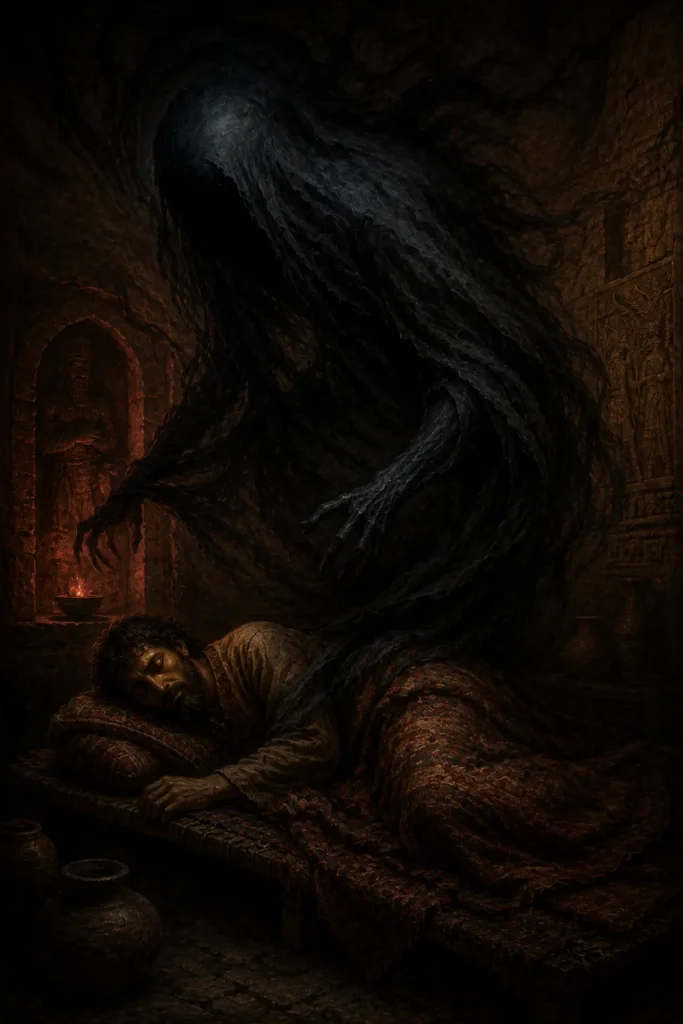
Edimmu come at night into the houses of their surviving family. They demand attention, neglected mourning rites, missed offerings of water and flour. If they are not appeased, they cause illness, nightmares, and misfortune. The threat is persistent: a single neglected rite can entail years of being haunted.

Sphere of effect

Sleep disturbances, nightmares, headaches, melancholy, illness in the family, infertility, failure in business. Mesopotamian diagnosis potentially assigned a broad range of nonspecific complaints to the Edimmu complex, comparable to Jewish-rabbinic Lilith diagnostics.

Appearance and symbolism

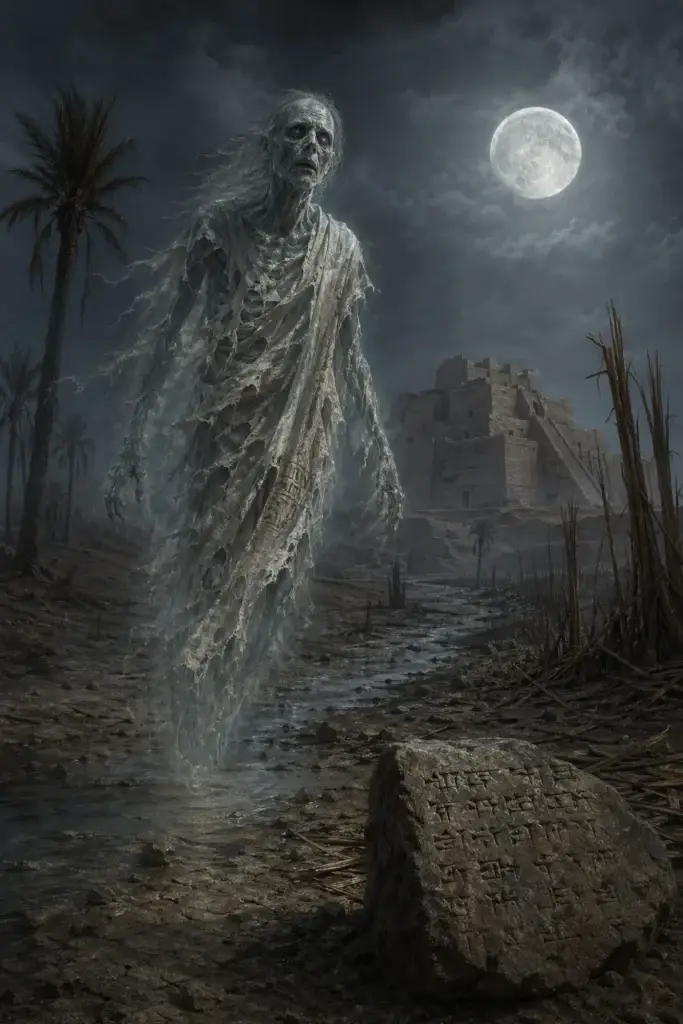
Edimmu are depicted as human figures, but ethereal, grey, or transparent, with a spirit-like glow. They carry the clothing or features from their life with them into the underworld, but these fade in the transition. Their eyes are empty or full of sorrow.

Sometimes only a black or grey silhouette is visible. Edimmu do not have the substantiality of physical bodies; they can pass through walls and vanish. Their presence is often accompanied by cold or a kind of dread.

Profile: Edimmu

The most important aspects of the Edimmu at a glance. The detailed treatment of name, description, defence, and parallels can be found in chapters 2, 3, 5, and 6.

Tradition

A former human who was not properly buried, whose care of the dead was neglected, or who died violently and forgotten. In other words: not a creation, but the consequence of a neglect.

Edimmu's target group

Above all relatives who neglected the burial or the kispu. In addition: travellers who pass places of improper burials or of violent death.

Edimmu's appearance

Shadowy, pale, gaunt, human-like. Not a hybrid being. Its presence shows itself more in symptoms and dreams than in clear images.

Edimmu's effect

Exhaustion, chronic illness, nightmares, inexplicable suffering among family members. More a lasting affliction than a sudden attack.

Protection

A belated burial or a substitute ritual, regular kispu offerings for the dead, incantations for appeasement and for the return to the underworld.

Edimmu's parallels

Lemures (Roman), Keres and the unburied souls in Homer (Greek), hungry ghosts (Chinese-Buddhist), revenants (Germanic), modern poltergeist motifs.

Defence in everyday life

Rituals of defence

The central rite is the kispu, the regular feeding of the dead with water, bread, and flour, monthly at the new moon and on the annual day of remembrance. Together with this came the oral invocation of the dead by name.

In cases of acute haunting, incantation texts from the Maqlû series were used: the burning of clay figurines, incense offerings of juniper, protective circles around the house. Tablet XII of the Gilgamesh Epic gives a detailed instruction for appeasing the Edimmu of an unburied fallen warrior.

Cult and veneration

The “cult” of the Edimmu was practised through ancestor veneration and rites for the dead. Families would honour their deceased relatives with offerings and prayers in order to keep their Edimmu calm and content in the underworld.

Priests performed rituals to ward off or appease evil Edimmu. Graves were supplied with offerings to nourish and pacify the Edimmu. Improperly buried or cursed Edimmu were a source of great fear and required specialist powers to be driven off.

Edimmu, parallels in other cultures

The Greco-Roman world

The Keres in Homer and above all the Roman Lemures, restless souls that arise from unburied or angry dead, correspond largely in function to the Edimmu. The festival of the Lemuria in Rome is an institutionalised response to this motif.

East Asia: The Buddhist-influenced “hungry ghosts” (preta, egui) of the Chinese-Japanese-Korean tradition arise from unfulfilled bonds and improper rites. The Hungry Ghost Festival regularly restores the ritual provision for the dead.

Europe (folk belief): Revenant and poltergeist motifs in Germanic and Slavic folk belief take up the same basic idea: a deceased person returns because rite, justice, or farewell were incomplete. The defence is in turn at the same time a form of restitution.

The restless dead: causes and logic

The eṭemmu (Sumerian gidim, often written edimmu in the older research literature) is at first nothing threatening in Mesopotamian thought. The word denotes quite generally the spirit of the dead, the spirit of a deceased person.

Every human becomes an eṭemmu after death. In the normal case this spirit descends into the underworld, finds its place there, and is supplied through the regular offerings made for the dead by its descendants.

The eṭemmu becomes dangerous only when this orderly transition fails.

The texts name the causes precisely: a person who was not properly buried, whose corpse remained unburied or drifted in the water; a person who left no descendants and therefore receives no care of the dead; a person who died a violent, premature, or unnatural death.

Such dead find no rest. Their spirit remains bound to the world of the living and returns.

The restless eṭemmu then haunts the living. It afflicts a person, enters them through the ear, and causes illness, headache, weakness, mental confusion.

This idea is consistent from a religious-studies perspective: the spirit of the dead wants what it lacks, burial and provision, and it obtains it by pressing upon a living person until that person or their family provides relief.

The belief in the eṭemmu turned the social duty of proper burial and care of the dead into a matter of one’s own health. Whoever neglected the dead risked their return.

Treatment in the healing arts: diagnosis and incantation

The eṭemmu is one of the most frequent causes of illness in Mesopotamian medicine and magic.

The diagnostic texts, above all the great series Sakikkū (“Symptoms”), associated in research with the work of Nils Heeßel, list complexes of symptoms that were interpreted as the “hand of a spirit of the dead” (qāt eṭemmi).

The incantation priest, the āšipu, determined from the signs of illness whether an eṭemmu was at work, and derived the treatment from this.

A separate group of texts, compiled in an edition by JoAnn Scurlock under the title of “ghost-induced illnesses”, documents the therapy in detail. It included incantations, ointments, potions, amulets, and ritual acts.

An important procedure was to identify the spirit of the dead and then to appease it through ritual and offering or to send it back to the underworld.

Sometimes the spirit was given retroactively the burial or the care of the dead that it had lacked; sometimes it was bound to a substitute, for example a figurine, and thereby detached from the patient.

These sources are especially valuable for the history of religion because they show how closely medicine, magic, and the cult of the dead were interwoven in Mesopotamia. The treatment of the sick person was at the same time the treatment of a disturbed relationship between the living and the dead.

The āšipu was not an exorcist in the later sense, who drove out an enemy, but rather a mediator who restored a fractured social relationship, except that one of the parties was already dead. Related illness-causing powers, against which the same specialists acted, were the Rabisu and the utukku demons.

The kispu offerings and the care of the dead

The most effective precaution against a restless eṭemmu was the regular, proper care of the dead, the kispu. This term denotes the offerings for the dead and the commemorative rites that descendants had to perform for their deceased ancestors.

The kispu consisted at its core of the presentation of food and above all of water for the dead, combined with the speaking of their names.

These rites had a fixed place in the calendar. There were regular, often monthly days of remembrance, and the month of Abu in high summer was regarded as a special time of commemoration of the dead, in which the connection between the worlds was thought to be permeable.

The care concerned not only the recently deceased but reached back across generations; in the royal houses, long lists of ancestors were read out at the kispu.

The logic behind this is clear: a dead person who is supplied through the kispu, whose name is spoken and whose thirst is quenched, remains content in the underworld and does not return.

A dead person who is forgotten, whose family has died out or has neglected the care, becomes a hungry, thirsty, restless eṭemmu.

The care of the dead was thus not mere piety, but a contract between the generations with immediate consequences. The living supplied the dead and thereby bought themselves peace from them; the dead, for their part, could also be well disposed towards the living when they were satisfied.

The eṭemmu belief and the kispu ritual are the two sides of the same relationship to the world of the deceased.

Research literature

  • Bottéro, Jean: Mesopotamia: Writing, Reasoning, and the Gods. University of Chicago Press, Chicago 1992.
  • Black, Jeremy / Green, Anthony: Gods, Demons and Symbols of Ancient Mesopotamia. British Museum Press, London 1992.
  • Wiggermann, Frans A.M.: Mesopotamian Protective Spirits: The Ritual Texts. Styx, Groningen 1992.
  • Scurlock, JoAnn: Magico-Medical Means of Treating Ghost-Induced Illnesses in Ancient Mesopotamia. Brill, Leiden 2006.
  • Foster, Benjamin R.: Before the Muses: An Anthology of Akkadian Literature. CDL Press, Bethesda 2005.
  • Heeßel, Nils P.: Babylonisch-assyrische Diagnostik. AOAT 43, Münster 2000.

The protective practice described here is a religious-studies classification of historical traditions. iWell Guard ties into this cultural-historical line of portable protective objects and represents a contemporary form of it. More about the iWell Guard →

Frequently asked questions about Edimmu

What were Edimmu in Mesopotamian religion?

Edimmu (Sumerian GIDIM, Akkadian eṭimmu) were, in Mesopotamian religion, the spirits of the deceased, specifically of those who received no proper burial or whose family brought them no offerings for the dead.

They are the Mesopotamian counterpart to the ghosts and haunting spirits that remain in this world to torment the living, through illness, nightmares, accidents, and misfortune. In the Gilgamesh Epic, the Edimmu of Enkidu returns from the underworld and tells Gilgamesh of the conditions among the dead.

How did people protect themselves against an Edimmu?

The most important method was proper burial and the regular offering for the dead (kispum), bread, beer, and water for the ancestors.

If an Edimmu returned nonetheless, incantation tablets helped, as did the namburbi ritual (a kind of dissolution ritual) and the invocation of the Mesopotamian gods, especially Šamaš (sun god and judge) and Marduk.

A typical ritual consisted of forming a clay figure of the Edimmu, inscribing it with the name of the spirit, and symbolically burying it or throwing it into the water.

Classification & Protection

IIILEVEL
The Protection Compass assigns this being to influence level III, Burdensome influence.

Against its influence, cross-cultural tradition names these protective means:

Compare in the Protection Compass →

Recommended protective means

iWell Guard

The simplest protective means in this collection: 41 layers of fine gold 999, platinum, silver and silicon, manufactured in Ruhla, Thuringia. It requires no activation, is bound to no person, and is effective within a radius of around 50 meters, even without being worn.

All protective means at a glance →