The Lamassu: the Winged Gate Guardian of the Ancient Near East
By Ralf Ittermann · last reviewed on
The Lamassu is the winged gate guardian of the Ancient Near East, a composite being consisting of a bull or lion, eagle wings, and a human head. As a colossal stone figure, it guarded the gates of Assyrian palaces.
Classification
The Lamassu is a protective figure from the Ancient Near East. It ranks among the most impressive testimonies of Mesopotamian culture and is known above all from the Assyrian empire.
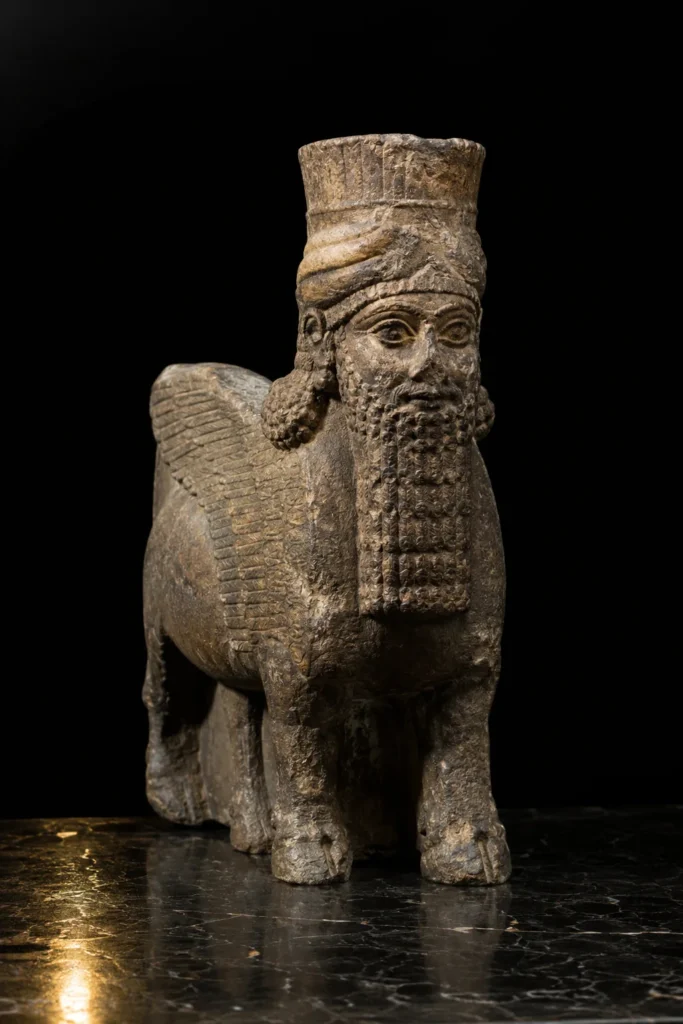
The Lamassu is a composite being. It unites the body of a bull or a lion with the wings of an eagle and the head of a human. From these parts arises a powerful, dignified form.
The Lamassu’s function was protection. As a colossal stone figure, it guarded the gates and entrances. It secured the threshold and kept harm away from what lay behind it.
Unlike a wearable amulet, the Lamassu is a monumental architectural work. The famous Lamassu figures of the Assyrian palaces stand several metres tall and are carved from large stone blocks.
In religious studies and in Assyriology, the Lamassu is a prime example of a protective figure that is at once architectural structure and guardian. It belongs among the great threshold guardians of world culture.
The Lamassu demonstrates that threshold protection could be exercised not only through small symbols but also through colossal figures. At the palace gates, it confronted those who entered in full stature.
Lamassu and Shedu
Several terms exist for the winged protective figures of the Ancient Near East. The names Lamassu and Shedu are both widespread, and both designate winged protective beings.
The precise distinction between the terms is not consistent in every respect. In one strand of the tradition, the Lamassu tends to be understood as a feminine protective power, the Shedu as a masculine one.
In general usage, the name Lamassu has become established for the large winged gate-guardian figures. Today this name is used primarily to refer to the monumental bull and lion figures.
Lamassu and Shedu belonged to the world of Mesopotamian protective spirits. That world encompassed a whole range of protective beings intended to preserve people and their buildings.
These protective spirits were regarded as benevolent powers. They assisted people and warded off harmful forces. The Lamassu belongs to this group of benevolent, protective beings.
In the following account, the widely used name Lamassu is employed in the sense of the large winged gate-guardian figure as known from the Assyrian palaces.
Form of the Composite Being
The Lamassu is a composite being. Its form combines parts of different creatures into a new, powerful appearance.
The body is formed by a powerful animal, most often a bull, in other cases a lion. Both animals stood for strength and defensive power. The animal body gives the Lamassu its imposing mass.
At the shoulders the Lamassu bears large wings, the wings of an eagle or a mighty bird. The wings point to the heavens and to a power that extends beyond the earthly realm.
The head of the Lamassu is a human head. It is depicted with dignity, featuring a carefully rendered beard and a crown that indicates the being’s high rank.
Each of these parts carries meaning. The animal body stands for strength, the wings for connection with the higher powers, the human head for reason and dignity. In the Lamassu, these qualities are united.
A distinctive feature of the large Lamassu figures concerns the number of legs. Viewed from the front, the Lamassu stands firmly on two legs; viewed from the side, it strides on four. Five legs are carved in all, so that the figure appears complete from every angle.
Guardian of the Gates
The Lamassu was a guardian of the gates. Its large figures stood at the entrances of Assyrian palaces, placed in pairs to the right and left of each passageway.
The gates were the decisive thresholds of a building. It was there that one passed from outside to inside. At precisely this point, at the boundary, the Lamassu stood.
Whoever passed through the gate walked between the two Lamassu figures. They encountered the colossal composite being directly and were, so to speak, scrutinized by it.
The Lamassu thereby had a twofold effect. It was meant to ward off harm and harmful powers, and at the same time to impress all who entered and inspire them with awe.
In this way the Lamassu was more than a protective sign. It was a guardian that occupied and secured the threshold of the palace. Its mere presence at the gate was the protective act.
The Lamassu thus belongs to the great family of threshold guardians. In a great many cultures, gates and entrances are secured by figures or symbols. The Lamassu is a particularly monumental expression of this idea.
Protection of the Palace
The large Lamassu figures belonged to the Assyrian palaces. These palaces served as the residences and seats of government of the Assyrian kings and were at the same time colossal monuments of self-representation.
The Lamassu protected the palace and its ruler. It warded off the harmful powers that might have posed a threat to the king and to the seat of his authority.
At the same time, the Lamassu was a sign of royal power. Its size, its elaborate craftsmanship, and its dignified form displayed the rank of the king whose palace it guarded.
Protection and the display of power went hand in hand with the Lamassu. Those who entered the palace were meant to perceive the protection that stood over it and simultaneously feel the power of its ruler.
The Lamassu figures bore inscriptions. These inscriptions often named the king who had the palace built and praised his deeds. Image and text thus belonged together here as well.
The Lamassu is therefore a protective object inseparably linked to kingship. It did not guard an individual house but a palace, the centre of power.
Protective Spirits of the Ancient Near East
The Lamassu was not the only protective spirit of the Ancient Near East. Mesopotamian conceptions included a whole range of protective beings intended to preserve buildings and people.
Among these protective spirits, alongside the winged gate guardians, were other figures as well, such as the Apkallu figures, which were buried beneath the floors of houses. These are described in more detail on the page about the Apkallu.
Together, these protective spirits formed a system of architectural protection. Different beings secured different positions: the gates, the walls, the floors, and the thresholds.
Within this system, the Lamassu was the guardian of the main entrance. Its function was the visible, monumental guarding of the gate.
The protective spirits were understood as benevolent powers acting on behalf of the gods or in accordance with their will. They stood on the side of order and against the forces of chaos.
The Lamassu thus belongs to a broader context. It is not an isolated being but part of an entire world of protective spirits with which the Ancient Near East surrounded its buildings.
From Palace to Small Replica
The Lamassu is known above all through the monumental gate figures. Yet the protective power attributed to the Lamassu was not limited to these colossal stone images.
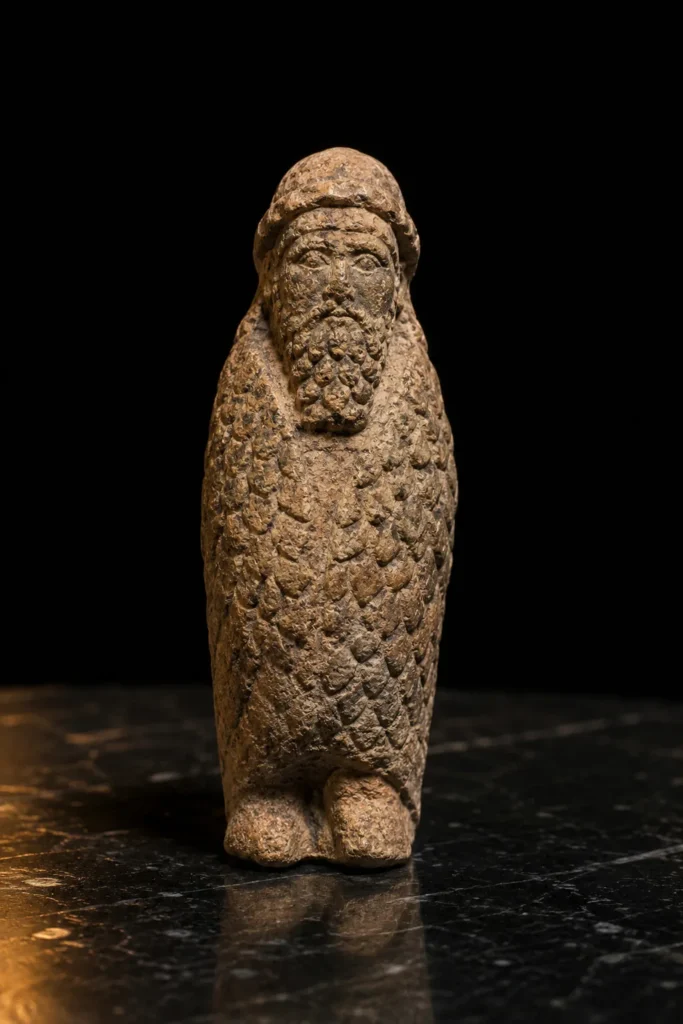
Small replicas of the Lamassu and related protective spirits also existed. Such small figures could be placed in a house or used in connection with buildings.
Particularly well attested is the custom of using small protective figures during the construction of a building. They were placed in the ground or within the walls to secure the structure from its very foundations.
In this way the protective function of the winged beings extended from the palace to the ordinary house. The large stone image at the palace gate and the small figure in the dwelling both followed the same idea of protection.
This range is a common feature of protective objects. A protective idea could be realized in monumental and in modest form alike, depending on the setting and the means available.
The Lamassu illustrates this range with particular clarity. It spans from the several-metre-tall gate figure of the royal palace to the small protective figure intended to safeguard an ordinary home.
The Legacy of the Lamassu
The winged protective figure of the Lamassu has had a long reception history. The pictorial motif of the winged composite being extended beyond Mesopotamia and influenced the art of neighbouring cultures.
Winged composite beings related to the Lamassu appear frequently in the art of the Ancient Near East and of the Mediterranean world. The motif of the winged protective figure was widespread.
The Lamassu has also retained its significance in later periods. Since the rediscovery of the Assyrian palaces in the nineteenth century, the large gate figures have numbered among the most celebrated works of Ancient Near Eastern art.
The monumental Lamassu figures can be seen today in several major museums. They are counted among the most impressive pieces in those collections and attract the attention of many visitors.
Some Lamassu figures have been lost in recent times through deliberate destruction, when important sites in Iraq were devastated. This loss has made the surviving figures all the more valuable.
The Lamassu is thus a protective figure that has endured across millennia. As a winged gate guardian it watched over the palaces of the Ancient Near East, and as a compelling work of art it remains to this day a symbol of that vanished world.
Contemporary Reception
Today the Lamassu ranks among the most celebrated works of Ancient Near Eastern art. The large winged gate guardians have become a compelling symbol of Assyrian culture.
In museums such as the British Museum in London, the Louvre in Paris, and other collections, monumental Lamassu figures are on display. They belong to the outstanding pieces of these institutions.
The image of the Lamassu continues to be taken up in the present day. It appears in design, in art, and as a sign pointing to the culture of the Ancient Near East.
For the study of Ancient Near Eastern culture, the Lamassu is of great value. Its figures, inscriptions, and placement at the gates provide insight into the protective thinking and the representation of power of the Assyrian kings.
The Lamassu demonstrates that threshold protection was a significant concern in the Ancient Near East. At the most important thresholds, the palace gates, stood the largest and most impressive protective figures.
The Lamassu is thus a striking example of a protective figure of monumental scale. It was guardian, architectural work, and emblem of power all at once, and it belongs among the great threshold guardians that humanity has produced.
Selected Bibliography
Related key terms: Lamassu Shedu gate guardian composite being Assyria threshold protection protective spirit Mesopotamia palace.
iWell Guard and Protective Traditions
iWell Guard stands in the cultural-historical lineage of wearable protective objects, to which the Lamassu also belongs. A modern companion for people who live with protective symbols: crafted in Germany, 41 layers of genuine gold, platinum, and silver, with a 30-day right of return.
Individual experiences may vary. Not a medical product. No claims of healing.