


Curse – black magic harm
The curse is a black magic intent to harm, a deliberate attempt to inflict misfortune on a person through ritual or symbolic action.
This page situates the phenomenon across cultures: from Old Mesopotamian clay tablets through Greco-Roman defixiones to modern folk magic traditions, covering form, function and defence in a religious-studies overview.
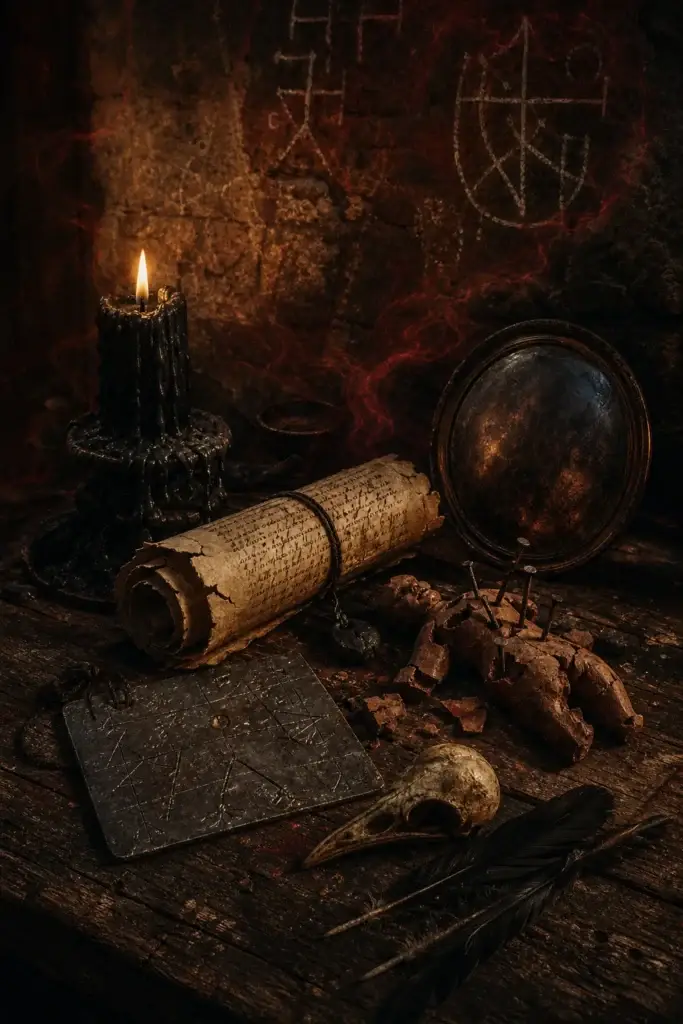
The curse in cross-cultural overview
The oldest form of harmful magic, compared across cultures.
This form of harmful magic appears in numerous cultures in comparable form.
Black magic harm comprises verbal curses and ritual practice.
Introduction
The curse is one of the oldest and most widely attested forms of magical action. It is a verbal or ritual promise of misfortune, bound to a specific person, group or thing by naming, inscription or gesture.
The etymological root of the German word “Fluch” lies in the Germanic “flokan” – to strike, lament, conjure.
Curse practices are not a marginal phenomenon of obscure cults. They are found in practically every high culture, from the Babylonian incantation series to the Greek curse tablets, the Roman defixiones, medieval grimoire literature and present-day Hoodoo rituals.
The defence against curses has been documented for millennia, by means of amulets, counter-formulas, purification rites and protective rituals.
The etymological root of the German Fluch lies in the Germanic flokan (to strike, lament, conjure) and is related to Old English flocan and Old Norse flokka. This etymology points to the ritual character of the act: the curse is not a mere insult but a performative speech act that constitutes an energetic deed.
In religious-studies terminology, the curse is therefore counted among the verba efficacia, those efficacious words whose utterance itself creates a fact (comparable to marriage, baptism or condemnation in law).
Quick overview
Type: Verbal or ritual harmful magic practiceEarliest evidence: Babylonian incantations (3rd millennium BC)Cultural breadth: All high cultures, almost all folk religionsMedium: Word, writing, image, bodily gestureDefence: Amulets, purification, counter-magic, protective field
Historical roots
Mesopotamia
The cuneiform series Maqlu (Akkadian “burning”) from the first millennium BC is the most extensive surviving collection of ancient anti-cursing rituals. It comprises nine tablets of incantations and rituals which the incantation priest (aashipu) performed to identify and avert a suspected curse.
Tzvi Abusch and Daniel Schwemer have critically edited the entire tradition in the three-volume Corpus of Mesopotamian Anti-Witchcraft Rituals (2011, 2020). In parallel, the series Surpu (“burning”, different signs) preserves rites for the resolution of unwitting curse-elements.
Antiquity in the Mediterranean world
From the sixth century BC onwards, curse tablets (katadesmoi) are attested in the Greek-speaking world. More than two thousand examples are catalogued today, primarily from Athens, Sicily and the Black Sea coast; the standard edition is Auguste Audollent’s Defixionum Tabellae (1904), expanded by David Jordan’s Survey of Greek Defixiones (1985).
The Roman tradition adopts the format as defixiones or tabellae devotionum; the British spring at Bath (Sulis Minerva) yielded over 130 lead tablets, edited by Roger Tomlin in 1988.
Judaism, Christianity and Islam
The Hebrew Bible contains the most extensive apparatus of curse formulas in the Old Testament in Deuteronomy 27 and 28. The rabbinic tradition discusses the legal effect of the curse in the Mishnah (Sanhedrin) and in the Babylonian Talmud.
From the third century onwards, Christian practice has known the formal anathema exclusion as an institutionalised curse; the canon law tradition elaborates this form down to the Codex Iuris Canonici (1917 and 1983).
In Islam, the laʿna tradition (cursing) permits the curse against hypocrites and transgressors in narrowly defined cases, but warns against unfounded cursing; the evil eye (al-ʿayn) functions in close proximity to the curse.
Middle Ages and Early Modern Period
The medieval grimoire literature contains curse rituals in the clerical-magical underground texts (the Munich Necromantic Manual, Liber Iuratus, Picatrix). From the late fifteenth century onwards, witch trials systematically argued from imputed curses on the part of the accused; the Malleus Maleficarum (1487) makes cursing a central point of accusation.
Historical research (Wolfgang Behringer, Hexen und Hexenprozesse, 1988; Brian Levack, The Witch-Hunt in Early Modern Europe, 1987) has worked out in detail the connection between the theory of cursing and the practice of persecution.
Typical application and technique
Curses follow three basic patterns:
Verbal formula. The direct curse in bound or poetic language, often with identification of the target person (“N, who has harmed me”), with concrete content of misfortune (illness, failure, death) and with a sealing formula (“So be it”).
In ancient and medieval practice frequently in a foreign or artificial language (Greek vowels, voces magicae, pseudo-Hebrew).
Written curse. The curse formula is written on lead, potsherds or paper and ritually deposited: in graves, wells, rivers, beneath thresholds. The medium binds the energy to the place; destruction of the writing often dissolves the curse.
Ritual curse. With object-analogues such as dolls, animal sacrifices, images of the target person. Breaking a wax figure, piercing a clay figure, burning a relic of hair or nails are regarded as a transfer of power.
The energy of the curse is regarded as persistent. In the esoteric view, a curse can endure for generations if it is not dissolved. The iWell Guard affirmation states that “black magic influences already set” are channelled away to Gaia or transformed into the light through Archangel Gabriel.
Structural logic of the curse formula
From a religious-studies perspective, curse formulas can be reduced to three structural components which recur in almost all traditions. First, the identification of the target person, often with name, patronymic, place of residence and bodily features.
Second, the specification of the harm, ranging from unspecified misfortune to detailed bodily symptoms, social consequences or manners of death.
Third, the confirmation formula, in which the binding force of the statement is sealed ritually (in the Mesopotamian tradition the invocation of the gods Šamaš, Ea and Marduk; in the Greco-Roman tradition the conjuration of the chthonic gods Hekate, Persephone, Hermes Chthonios; in the Christian-medieval tradition the Trinitarian formula or the names of the angels).
The iWell Guard position on curse-formula practice is clear: cursing as a deliberate intent to harm falls under the category of black magic and is rejected by the protective field.
The self-application clause of the mantra (see function overview) redirects self-imposed curses back to their originator. The sabotage protection clause addresses external attempts at cursing directed against the system.
Cross-cultural overview
Carrier beings and traditions described on our cultural pages:
- Detail on curse to follow
- Greece: Erinyes – deities of vengeance, often invoked through curse
- Rome: Dirae – Roman demonesses of vengeance
- Judaism: Lilith, Azazel – associated with curse and ban traditions
- Celtic: Banshee, Sluagh
- Slavic: Baba Jaga
- Japan: Yuurei, especially Onryo as curse spirits
- Korea: Cheonyeo-gwishin as a typical bearer of the curse
Defence and counter-magic
Purification rituals: salt baths, fumigations with mugwort, juniper and other apotropaic herbs; prayers to protective deities (Hekate, Hermes, Isis); wearing of amulets with symbols such as the Nazar (evil eye) or pentagrams were common counter-measures.
Modern religious-studies interpretation understands curse practices not as supernatural events but as cultural phenomena of fear management and the channelling of social conflict.
Modern reception
The notion of the curse has had a second flowering in popular culture: from the curse-of-the-mummy literature of the late Victorian period through Hollywood (Pirates of the Caribbean, Harry Potter) to contemporary horror literature and games.
At the same time it retains practical relevance in esoteric practice, the witchcraft movement, Wicca, chaos magic, light work. In the light-worker tradition the curse is not dismissed as superstition but understood as a real energetic influence against which one can protect oneself.
Further links
- Related practices: harmful magic, necromancy, blood magic, Voodoo magic
- Protection: Primal Source, Lichtkreuz, Archangel Michael
- Beings: Erinyes, Dirae, Baba Jaga
- Category hub: Demons
Literature
Further standard works in the literature index.
iWell Guard and protective traditions
The defensive practice gathered here documents in religious-studies terms how cultures deal with curse phenomena.
iWell Guard ties in with the millennia-old line of portable protective objects, from Pazuzu pendants in Mesopotamia through Hamsa and evil-eye amulets in the Mediterranean to the Mezuzah on Jewish doorposts and Christian protective medallions.
A contemporary form of this, made in Germany, with a clearly documented material architecture (41 layers, fine gold, platinum, silver). 30-day right of return.
Not a medical product. No promise of healing. Personal perceptions may vary.