Light Cross, beings of light
By Ralf Ittermann · last reviewed on
A spiritual protective symbol in the mystical Christian and esoteric tradition. Visualized as a cross-shaped column of light.
The Light Cross is the highest sign of protection in the iWell Guard system.
The Light Cross activates beings of light functions within the application scheme.
Quick Overview: Light Cross
Type: Energetic protective symbol, geometric structure Tradition: Christian mystical (Rosicrucianism), kabbalistic, universal esotericism Function: Highest protection, harmonization of the four levels, grounding in cosmic order Main attributes/symbols: equilateral cross, four cardinal directions, white and gold light Distribution: Christian mysticism, Rosicrucianism, Western high esotericism, iWell Guard
Classification
Tradition
The equilateral cross, the Light Cross, is in Western mysticism far older than Christianity; it represents the four cardinal directions and the four elements.
In Rosicrucianism (a Christian esoteric order of the Renaissance) the cross was understood not as a symbol of execution but as the union of the horizontal (matter, grounding) and the vertical (spirit, heaven).
In the Kabbalah the cross corresponds to the balance of the pillars (severity and mercy) around the middle pillar of wholeness. In iWell Guard the Light Cross is not religious but structural: it is the geometric basis on which all energies of the beings of light are organized and through which humanity is protected.
State of the Sources
Symbolic and historical sources: prehistoric sun-cross depictions, Celtic and Germanic cross symbols, Rosicrucian literature (especially the “Fama Fraternitatis” of the 17th century), kabbalistic texts on the cross as a structure of balance.
Christian mystics such as Meister Eckhart interpreted the cross as a symbol of transcendence, not of suffering. Modern esoteric literature on sacred geometry emphasizes the cross as a universal protective and organizing symbol, independent of religion.
Geometry and Distinction from the Latin Cross
The equilateral cross, called the Light Cross in the iWell Guard tradition, is a geometric form with four arms of equal length that meet at right angles.
It differs from the Latin cross (Latin crux immissa), which in the Roman Catholic tradition, with a length ratio of 1:1.6 (upper to lower beam), is established as a symbol of the Passion.
The equilateral cross is referred to in Christian symbolism as the crux quadrata and is, in terms of religious history, older than the Latin form.
It appears in pre-Christian antiquity, in early Christian pictorial art (catacombs, sarcophagi), in the Byzantine tradition as the standard form, and in the Coptic Orthodox tradition as the crux ansata (with a looped top that takes up the ankh symbol).
The symmetry of the equilateral cross is decisive in terms of religious semantics: whereas the Latin cross as a symbol of the Passion has a temporal dimension (heaven above, earth below, with Christ as mediator), the equilateral cross is spatially symmetrical, equally effective in all four directions.
This symmetry is the reason it is regarded as the supreme sign of protection in the protective-field tradition.
Appearance and Symbols
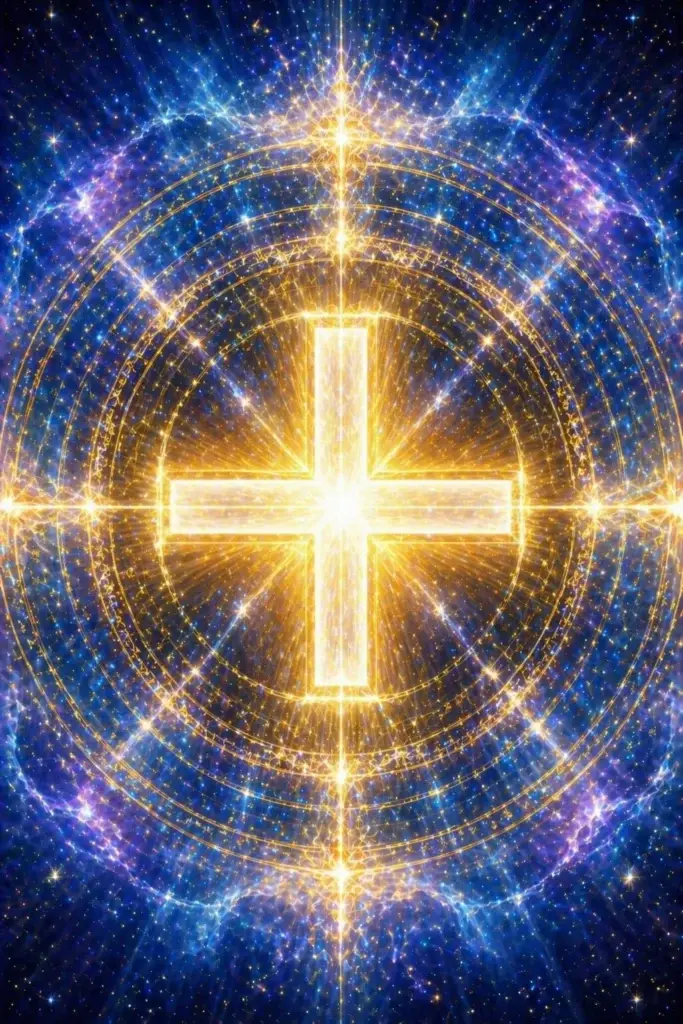
The Light Cross is visualized as two beams of light intersecting at right angles, often in a white and gold color, sometimes with colored rays at the four arms (North: blue, South: red, East: gold, West: green). The cross can be flat or three-dimensional, often with a radiant center where the arms meet.
In energetic practices the Light Cross is understood three-dimensionally: it extends upward (toward heaven), downward (into the earth), forward, and backward (into all dimensions). The center is the place of the person or the location being protected. The light acts unmoved, clear, and ordering.
Cross-Cultural Forms of Appearance
The equilateral cross appears in nearly all developed cultures with its own designations and semantic charges. The Celtic cross combines the equilateral cross with an enclosing circle and appears from the 8th century on Irish high crosses, Scottish Saint Andrew’s crosses, and Welsh stones.
The sun wheel (Germanic and Slavic tradition) combines the equilateral cross form with sun symbolism and is attested on Bronze Age rock carvings, in the Hallstatt and La Tene cultures.
The Hopi cross of the North American Pueblo tradition consists of an equilateral cross within a circle and is a sign of the four cardinal directions and the center.
In Tibet it corresponds to the Dharma chakra with eight spokes as the Eightfold Path of the Buddha; the form is attested earliest on the pillars of Ashoka (3rd century BCE).
In the Jewish tradition the equilateral cross is not found directly, but the related hexagram (Star of David) is, as two interlocking triangles displaying an analogous logic of symmetry.
Islamic visual culture does not know the equilateral cross as a religious symbol, but it does appear in the ornamentation of Maghrebi-Andalusian architecture (Alhambra, Alcazar) as a basic geometric figure.
Function and Meaning
The Light Cross is the structural basis of all iWell Guard protective work. It embodies the balance between four great forces: North (wisdom/darkness/consciousness), South (strength/sun/life), East (renewal/light/hope), West (ending/rest/completion). It harmonizes these polarities and creates a field of wholeness.
The cross also connects above (heaven/spirit) and below (earth/matter) in a single line of wholeness. In a psychological sense it embodies the integration of all parts of the self in harmonious order: not division, but unity in distinction.
Function in the Protective Mantra
In the iWell Guard mantra, the Light Cross is the supreme sign of protection against black magic. This position arises from three properties of the form. First, from the spatially symmetrical effect in all four cardinal directions, which produces a protective field without weaknesses or gaps.
Second, from the depth in religious history: the equilateral cross is older than any single religious tradition that uses it and is therefore not bound to a particular theology.
Third, from ritual-magical standardization: in the Golden Dawn tradition (Mathers, Westcott, Woodman; from 1888) the equilateral cross is the basic form of the Lesser Banishing Ritual of the Pentagram exercise, in which the four archangels (Raphael, Michael, Gabriel, Uriel) are assigned to the four cardinal directions.
The protective sequence built into iWell Guard activates the Light Cross as an energetic enveloping symbol that protects the bearer equally from all directions. The Light Cross is not an entity that must be invoked but a geometry that is established automatically through the mantra.
Whoever additionally wishes to work consciously with the Light Cross can visualize it as an equilateral cross in the chest, with the crossing point in the heart space.
Practice / Invocation / Meaning in the iWell Guard Context
In iWell Guard the Light Cross is the central, introductory practice. The Light Cross is visualized by positioning oneself at the center of a radiant cross; white and gold light expands toward the four cardinal directions, upward to heaven and downward to earth.
While drawing up the cross, words or intention are often used to place all four levels under the protection of the cosmic order.
The Light Cross is protection against the negative and at the same time a connection to the higher order and to universal love. All other beings-of-light practices build upon the Light Cross as their structural foundation.
The Light Cross and the Ritual-Magical Tradition
The ritual-magical use of the equilateral cross has been documented since late antiquity. In the Solomonic grimoires (Lemegeton, Sefer Raziel HaMalakh) it appears as the floor marking of the magic circle, often combined with pentagram and hexagram.
In John Dee’s Enochian tradition the equilateral cross is the basic structure of the watchtower sigil, which served as a receiving apparatus for angel messages. In the modern lightworker tradition (Elizabeth Clare Prophet, Geraldine Innocente, Saint Germain school) the Light Cross is used as a visual aid for the invocation of the violet flame.
The iWell Guard use stands in the line of the Golden Dawn tradition and the lightworker school without adopting their specific context.
It reduces the form to its essential function: a spatially symmetrical sign of protection that is effective without a cultic apparatus and remains compatible with any tradition. You will find a detailed functional overview of the mantra layers under Functional Overview of the Protective Mantra.
Parallels
Connection within iWell Guard
The equilateral Light Cross is, within iWell Guard, the central sign of protection on connection level 5, together with the Primal Source.
Directions of effect are described in purely functional terms. Not a medical product. No promise of healing.
Classification as a Brand-Specific Concept
The Light Cross is not a handed-down term from a historical religion or mythology, but a concept used within the framework of iWell Guard.
This origin is essential to understanding it. Unlike figures from ancient source texts, there are for the Light Cross no ancient writings, no archaeological findings, and no independent history of transmission on which one could rely.
iWell Guard makes this distinction deliberately transparent. Where the lexicon treats historical beings and practices, it relies on sources and research.
Where it uses brand-specific terms such as the Light Cross, these are terms of ordering and interpretation within its own presentation, not facts of religious history. This separation is meant to prevent a modern concept from falsely appearing as ancient knowledge.
It is therefore sensible to read the Light Cross not as a historical being but as a reference point defined within the brand.
Its meaning arises from the context of the other iWell Guard contents and not from a directly adopted tradition. Whoever wishes to classify the concept should consider it in relation to the contributions of the lexicon that are clearly designated as historical.
Distinction from the Cross Symbolism of Other Traditions
The word cross naturally evokes associations with religious symbols, above all with the Christian cross, but also with cross forms in other cultures, such as the ancient Egyptian ankh or various sun and wheel crosses.
These symbols each have their own well-documented history and meaning. The Light Cross of iWell Guard is to be distinguished from them explicitly.
The Light Cross stands in a mystical-Christian and esoteric tradition; a direct derivation from the Christian cross or from other historical cross symbols is, however, not claimed.
Whoever is interested in the religious-historical symbolism of cross forms will find reliable information in the corresponding specialist articles, for example in the context of the iWell Guard pages on protective symbols. There the origin and use of verifiable symbols are treated.
The use of the term Light Cross within the brand is thus to be kept deliberately separate from these traditions.
It is an independent, newly coined term. iWell Guard refrains from ascribing to it a pseudo-history and limits itself to its function within its own frame of presentation. This restraint corresponds to the lexicon’s aim of keeping historical and brand-specific contents clearly apart.