Archangel Gabriel, light-being
By Ralf Ittermann · last reviewed on
Messenger of God in the Jewish, Christian and Islamic tradition. He announced to Mary the birth of Jesus and dictated the Quran to Muhammad.
This page situates Archangel Gabriel as a light-being concept.
Gabriel’s specific role: the messenger of the Annunciation
Gabriel’s principal scene is the Annunciation (Lk 1:26-38). He appears to Mary in Nazareth and announces the conception of Jesus. Earlier he had already announced to Zechariah the birth of John the Baptist (Lk 1:11-20).
In the Book of Daniel (Dan 8:16; 9:21-27), Gabriel interprets the vision of the four kingdoms and the prophecy of the seventy weeks.
His name gabriʾēl means “man of God” or “hero of God.” In Islam he is Jibrīl, the angel of the revelation of the Quran.
In the Christian liturgy he is regarded as the messenger of the Good News, as the trumpet angel of the Last Judgment, and as the patron saint of diplomats, postal workers and telecommunications. His attributes are the lily, the scroll and the trumpet, and his feast day is 29 September.
Table of Contents
Quick Overview: Archangel Gabriel
Type: Archangel, messenger, conveyor of the divine message Tradition: Judaism (Talmud), Christianity (Annunciation to Mary), Islam (Quran, Jibrail) Function: communication, message, transformation, inner clarity Main attributes and symbols: white and silver flame, lily, bell, staff Distribution: central in Christian Mariology, Islamic as Jibrail, widely present in esotericism
Classification
Tradition
Gabriel (Gavriel, “strength of God”) appears in the Hebrew Bible in Daniel 8:16 and 9:21. In Christianity he is known above all as the angel who announces to Mary the birth of Jesus (Luke 1:26-38).
In Islam, Gabriel (Jibrail) is the angel who brought the Quran to the Prophet Muhammad. The Kabbalah assigns Gabriel to the sephirah Yesod or to the sephirah Hod (intellect), the place of communication. Western angelology venerated Gabriel as the angel of the Annunciation, of communication and of spiritual purification.
Sources
Biblical texts (Book of Daniel, Gospel of Luke, Book of Revelation). The Talmud and the Kabbalah name Gabriel as one of the four chief archangels in Hebrew angelology. There are Quranic references to Jibrail and his mission.
The Christian artistic tradition depicted Gabriel with the lily or the staff over the centuries. Modern esoteric and New Spirituality literature emphasizes Gabriel’s role as an inner counselor and bringer of clarity. Psychological interpretations see Gabriel as the embodiment of intuition and of authentic, courageous communication.
Sources in the Tanakh, the New Testament and the Quran
Apart from Michael, Archangel Gabriel is the only angelic figure of the Hebrew Tanakh who appears under his own name. He appears in Daniel 8:16 and 9:21 as the interpreter of Daniel’s visions.
In the Gospel of Luke he is the angel of the Annunciation, both to Zechariah (Lk 1:19) and to Mary (Lk 1:26, 38); this twofold annunciation makes him the central messenger of the New Testament.
In the Quran he is called Jibril or Jibra’il and is the conveyor of the revelation to Muhammad (Sura 2:97; 16:102; 26:193). This three-religion attestation is unique in the history of religion and places Gabriel in a special position within the Jewish, Christian and Islamic angel corpus.
Appearance and Symbols
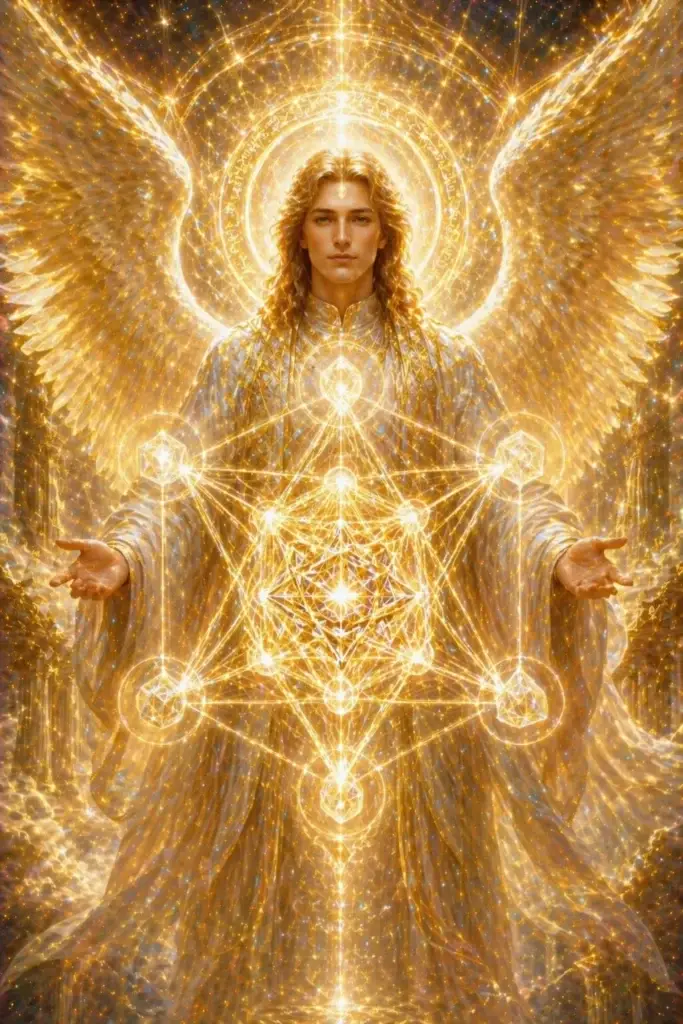
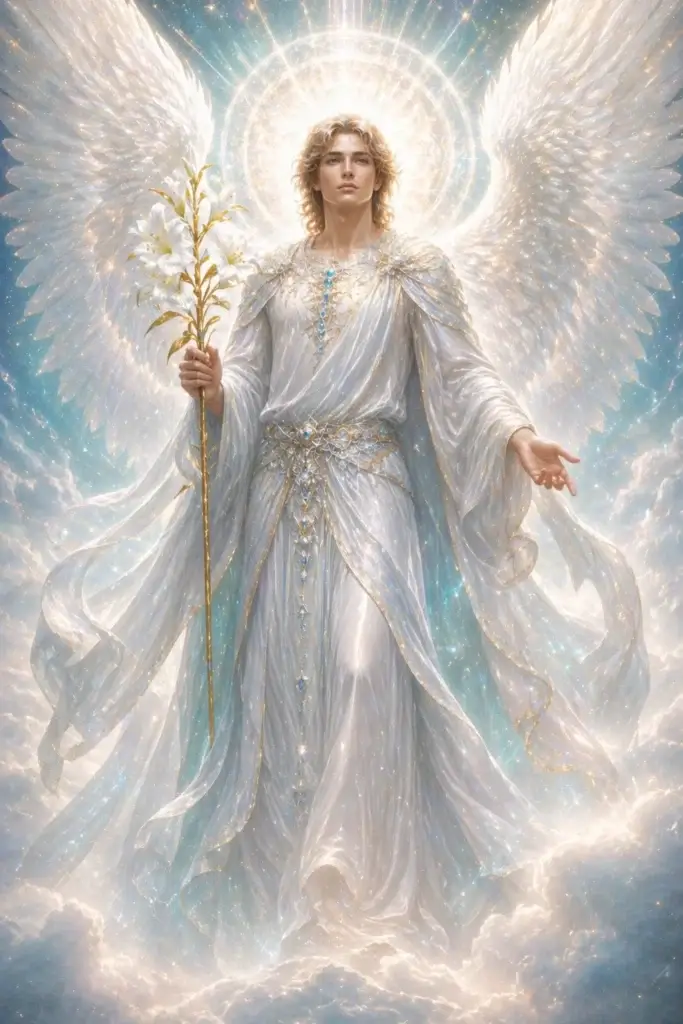
Gabriel is depicted as a slender, elegant light-being in a white-and-silver robe or in translucent light-cloth. His color is pure white or soft silver, sometimes interwoven with aquamarine or a delicate blue. He carries a staff, a white lily or a golden bell. The lily is the classic symbol of purity and of Mariology.
The bell symbolizes annunciation, clear sound, and the truth that rings out. Wings of precise, directed light surround him. Energetically Gabriel feels cool, clear and penetrating, like a pure crystalline tone or the strike of a bell. His presence evokes inner stillness and attentive receptiveness.
Function and Significance
Gabriel is the angel of the message and of inner clarity. Where Michael fights and protects, Gabriel brings communication and enlightenment. He stands for the ability to translate higher truth into comprehensible human language and consciousness.
He also symbolizes new beginnings; every message from Gabriel begins a new cycle of understanding and renewal. In psychological terms Gabriel embodies the intuitive channel that raises the unconscious into consciousness. His white-and-silver energy clears confusion and creates inner clarity, without judgment or coercion.
Function in the angelic hierarchy
In the Christian tradition since Pseudo-Dionysius, Gabriel is the angel of the Annunciation and is thus assigned to the choir of the archangels. In Jewish angelic magic he is the angel of the western direction, of the Moon and of the sphere Yesod in the kabbalistic Tree of Life.
In the Islamic tradition he is the foremost of the angels with a special closeness to God (in the Mi’raj tradition he accompanies Muhammad on his heavenly journey). This multiple assignment makes Gabriel a bridging figure between the three Abrahamic religions and their ritual-magical adaptations.
Practice, Invocation and Significance in the iWell-Guard Context
In iWell Guard, Gabriel is invoked to open inner communication and to receive higher guidance clearly. One practice is to light a white or silver candle and to ask Gabriel to clarify and strengthen the inner voice.
Gabriel’s power is used to clear up psychic or mental confusion, to understand dreams and to sharpen intuition. Gabriel also helps to transmit energetic messages more cleanly, without distortion by ego, fear or outside interference. His white-and-silver flame has a purifying effect on all communication channels of the protective field.
Gabriel in the iWell-Guard mantra system
In the protective mantra, Gabriel is positioned explicitly in point 3 (transformation of influences already in place) as guardian of the violet flame. When the energy of a black-magic attack cannot be absorbed by Gaia, Gabriel takes over its transfer into the light.
This construction connects Gabriel’s Jewish, Christian and Islamic function of annunciation and mediation with the theosophical light-worker tradition of the violet flame as a means of transmutation (cf. /violette-flamme/). A detailed functional overview of the mantra layers can be found at Functional Overview of the Protective Mantra.
Parallels
Gabriel in the Book of Daniel: the interpreting messenger
The oldest explicit mentions of Gabriel are found in the biblical Book of Daniel, which current scholarship largely dates, in its final form, to the second century before our era. There Gabriel appears twice.
In the eighth chapter he appears to Daniel after the latter has had a puzzling vision of a ram and a he-goat, and he is charged with explaining its meaning to the seer.
In the ninth chapter Gabriel comes again while Daniel is praying and expounds to him a prophecy concerning a certain number of periods of time.
What is remarkable about these passages is that Gabriel appears here as an interpreting angel. His task is not primarily to act, but to explain. He mediates between the heavenly world from which the vision comes and the human seer, who cannot understand it by his own power.
Gabriel thus belongs to a conception of angels that developed in the Jewish literature of the Hellenistic period: angels as mediators of knowledge and revelation, often with their own name and their own area of responsibility.
Apart from Michael, the Book of Daniel names only one further angel expressly by name. This sparseness is striking, for in the contemporary extra-biblical literature, for instance in the Enoch writings, numerous named angels appear.
Scholarship sees in Daniel an important junction: here an angel with a name and a function is firmly inscribed into a biblical text, and from here the figure continues to operate in the later Jewish, Christian and Islamic tradition.
The Annunciation: Gabriel in the Gospel of Luke
In the New Testament, Gabriel appears exclusively in the Gospel of Luke, in two closely related scenes of the first chapter. First he confronts the priest Zechariah in the temple and announces to him the birth of a son, the later John the Baptist.
When Zechariah doubts, he is struck mute until the announcement is fulfilled. A few verses later Gabriel is sent to Mary in Nazareth and announces to her the birth of Jesus. This second scene entered the Christian tradition as the Annunciation to Mary.
Luke portrays Gabriel here in exactly the role already laid out in the Book of Daniel: as a messenger who delivers and explains a divine communication. He introduces himself to Zechariah expressly by name and says that he stands before God.
The connection to the Book of Daniel is also underscored by Luke’s choice of the same angelic figure who appeared there as a mediator of revelation. For early readers, this established a line from the older prophetic tradition to the events surrounding Jesus.
The Annunciation scene became one of the most important pictorial themes of Christian art. From late antiquity into the modern period, painters and sculptors have repeatedly rendered Gabriel’s encounter with Mary, often with fixed attributes such as the lily as a sign of purity or the scroll bearing the angel’s greeting.
The liturgical tradition linked the event with a feast day of its own. The significance of Gabriel in Western culture rests essentially on these few verses of the Gospel of Luke.
Jibril in Islam: the angel of revelation
In Islam, Gabriel bears the name Jibril and holds a central position, for he is regarded as the angel through whom the Quran was conveyed to the Prophet Muhammad.
The Quran itself names Jibril by name and speaks of him as the one who brought the revelation into the heart of the Prophet. The Islamic tradition also associates other appearances with Jibril, such as the first revelation in the cave near Mecca and his role as companion on the Prophet’s heavenly journey.
In the Islamic tradition Jibril is understood as one of the highest-ranking angels, often named in first place.
He appears in the collections of tradition, the Hadith, also in human form, for instance when he visits the Prophet and his companions in the shape of a man in order to set forth basic teachings of the faith through questions.
This conception of an angel who mediates between the heavenly and the human sphere and conveys knowledge stands in clear continuity with the older Jewish and Christian images of Gabriel.
Gabriel is thus one of the few figures who play a significant role in all three Abrahamic religions, and everywhere his principal function is the same: the conveyance of divine revelation to human beings.
Religious studies sees in this an example of how a figure is transmitted across religious boundaries and fitted in each case into its own framework without losing its core. Related figures within angelic teaching include Michael and Raphael.
Frequently Asked Questions about Archangel Gabriel
Who is the Archangel Gabriel?
Gabriel (Hebrew Gavri-el, hero of God or God is my strength) is the messenger archangel in the three Abrahamic religions. In the Book of Daniel he interprets visions; in the Gospel of Luke he announces to Mary the birth of Jesus (Lk 1:26ff).
In Islam, Gabriel (Arabic Jibril) is the angel who reveals the Quran to the Prophet Muhammad. His feast day is 29 September.
What does the Archangel Gabriel stand for in esotericism?
In Western angelic esotericism, Gabriel is regarded as the archangel of messages, of dreams, of purity and of communication. He is associated with the element of water, the color white or silver, the Moon and the western direction.
Classic symbols: the white lily (the Marian lily from the Annunciation scene), the trumpet (for the Last Judgment) and the scroll-book.