iWell Guard

Roman Gods, Pantheon and the Capitoline Triad

Beings from the Roman tradition on iWell Guard. Mythology of the Roman Empire. Distinct archaic gods (Jupiter, Juno, Mars), the interpretatio Romana of the Greek gods, household cult, Lares and Penates.

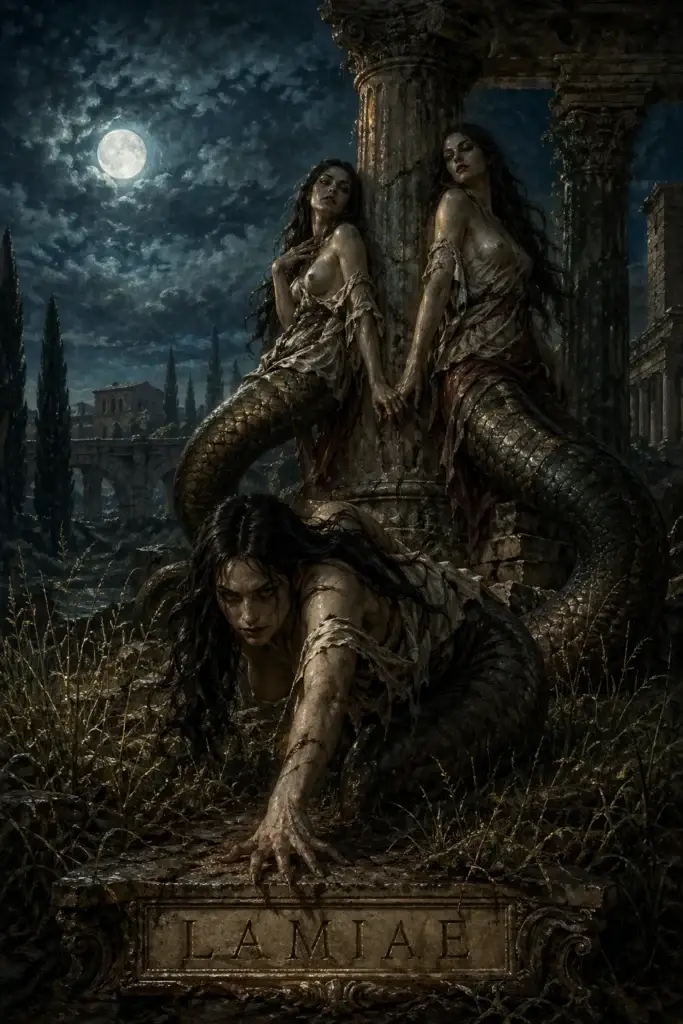
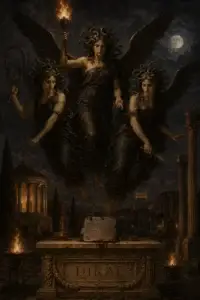
Lamiae - demons from the Roman tradition, historical and illustrative

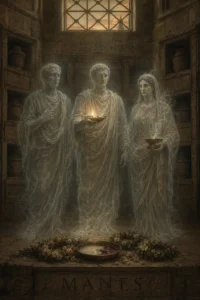
Roman mythology is not simply a translation of the Greek; it has its own numina (protective spirits), a strong household religion (Lares and Penates) and a specific cult of the dead (Lemures, Larvae).

Numina, Household Religion and Empire

Roman religion was less a narrative pantheon than a contractual order between human and god. The central terms are numen (divine power), pax deorum (peace with the gods) and do ut des (I give so that you may give). Myths were importable, and most Roman gods have Greek counterparts through interpretatio.

The household religion was more fundamental than the state religion. Every Roman household venerated the Lares (protective spirits), the Penates (gods of the storeroom) and the Genius (the personal life force of the pater familias).

The storeroom was as important as the household altar; bread, wine and salt were daily offerings. This popular piety persisted into the Christian late antiquity.

With imperial expansion came the eastern mystery cults (Mithras, Magna Mater, Isis), which spread especially among soldiers and officials.

Eventually Christianity took over the state framework; the old system was banned in the 4th and 5th centuries, yet many practices (the veneration of saints, the cult of Mary, protective invocations) carry Roman popular religion forward within them.

Classification

Period: Regal period (8th century BC) to the end of the empire (5th century AD).

Distribution: Italy and the Roman Empire (the Mediterranean, Western Europe, North Africa, the Near East).

Sources: Virgil (Aeneid), Ovid (Metamorphoses, Fasti), Livy, Pliny, inscriptions, household-cult reliefs.

Pantheon and classes of beings: the Capitoline Triad (Jupiter, Juno, Minerva), Penates, Lares, Genius, di indigetes (the native Roman gods).

History and Pantheon

Roman religion arose from archaic Italian cults (di indigetes) and was later structured by Greek mythology and the interpretatio Romana.

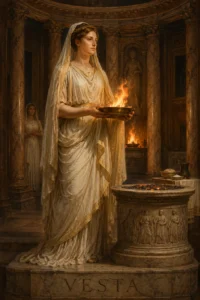
Central gods are Jupiter (sky, god of the state), Mars (war), Vesta (fire, the home) and Quirinus (civic order). The gods were organised functionally: not driven by human passions like the Greek gods, but as representatives of state powers and natural forces.

With its expansion Rome integrated foreign cults: the Egyptian Isis, the Phrygian Cybele, the Persian Mithras. The interpretatio Romana identified foreign deities with Roman equivalents. The religious system was decentralised and syncretistic.

Christianisation from the 4th to the 6th century displaced the classical religion. The emperor Diocletian, and later Theodosius, decreed Christian monopolies and the suppression of paganism.

Beings in Everyday Life

Roman religion was intensely ritualistic: daily household cults for the Penates (household gods) and Lares (household spirits). Public sacrificial rites (pax deorum, the peace of the gods) were regular. Augural priests interpreted omens through bird divination. Haruspices (an Etruscan tradition) read entrails. Mystery cults (Eleusis, Mithras) offered an esoteric hope of salvation.

Magic is documented but formally frowned upon. Fortune-telling and astrology were popular. Temples were places of worship and at the same time moneylenders and centres of administration.

Priests as a class of specialists administered the knowledge of the gods. Popular belief in the supernatural is less documented than elite religion. Protective amulets and incantations are attested archaeologically.

Significance Today

Roman religion is entirely extinct; no continuous tradition exists. Academically and in literature it is a foundation of Western education. The aesthetics of Roman architecture and art shape high Western culture. Neopagan movements attempt fragmentary reconstructions (Reconstructionist Polytheism), but these are speculative.

Popular culture uses Roman mythology for film and literature (Gladiator, HBO series). Political ideologies (fascism, colonialism) have instrumentalised Roman imperial mythology. Esoteric Western circles romanticise Roman magic and mystery cults. Church history and theology used Roman institutions as models for Christian hierarchies.

Frequently Asked Questions about the Roman Gods

How many Roman gods are there?

The Roman pantheon recognises twelve principal gods (Dii Consentes): Jupiter, Juno, Minerva, Mars, Venus, Vulcan, Apollo, Diana, Vesta, Ceres, Mercury and Neptune.

Alongside them are hundreds of lesser numen, ranging from local and household deities to personified virtues (Fides, Concordia, Spes). In total, scholarship counts several thousand Roman gods and numen, many attested only through individual inscriptions.

What is the Capitoline Triad?

The Capitoline Triad is the most important Roman divine triad: Jupiter (supreme god), Juno (his consort) and Minerva (his daughter). They were venerated together in the temple of Jupiter Optimus Maximus on the Capitol, the political and religious centre of Rome.

Before the Capitoline Triad there was an older archaic triad: Jupiter, Mars and Quirinus. The shift to the Capitoline constellation took place under Tarquinius Priscus in the 6th century BC.

Which Roman gods correspond to the Greek ones?

The most important equations are: Jupiter = Zeus, Juno = Hera, Minerva = Athena, Mars = Ares, Venus = Aphrodite, Vulcan = Hephaestus, Mercury = Hermes, Diana = Artemis, Apollo = Apollo (identical), Ceres = Demeter, Vesta = Hestia, Neptune = Poseidon, Pluto = Hades, Bacchus = Dionysus.

The interpretatio Graeca took place from the 4th century BC onward under Greek influence; the Roman gods often retained their older Italic functions but adopted Greek mythology.

Who is the supreme Roman god?

Jupiter (Iuppiter, formerly Diespiter) is the highest Roman god, god of the sky, the weather, thunder and the guarantor of oaths. His full name, Jupiter Optimus Maximus, expresses his pre-eminence.

In republican and imperial Rome his temple on the Capitol was the most important sanctuary. During triumphal processions, victorious generals drove to the Capitoline temple, where they gave thanks to Jupiter and presented the laurel wreath to the god.

What are the Lares and Penates?

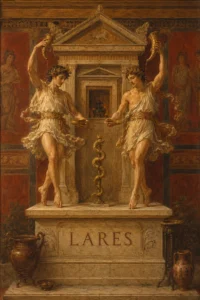
Lares and Penates are Roman household deities. The Lares (lares familiares) are protective spirits of the house and the family, often depicted as young dancing men holding up a drinking horn. The Penates (di penates) are protective gods of the storeroom and of the household’s well-being.

Both had their shrines (lararium) in every Roman house. At meals the first morsels were thrown into the fire for them. The Penates were also venerated in the state cult as penates publici, the guardians of Rome.

What distinguishes Roman from Greek religion?

Despite many divine equations, Roman religion differs fundamentally from the Greek: the Romans practised a contractual worship (do ut des, I give so that you may give) with precise rites and formulas. Myths mattered less to them than rites.

Greek religion was more strongly narrative, with a rich mythology. The Romans, in turn, integrated foreign gods more readily (Cybele, Isis, Mithras), as long as they did not disturb the state ritual. The Mos Maiorum (the custom of the ancestors) was the supreme religious principle.

In Depth

Independence and Syncretism

Roman religion is not simply a transfer of the Greek, even though the interpretatio romana equated many gods (Jupiter/Zeus, Juno/Hera, Minerva/Athena). Genuinely Roman are the multitude of functional gods, the pronounced system of ancestor worship (Manes, Lares, Penates) and the state-sustaining imperial cult of the late Republic and the imperial period.

Pontifices and Augures

Roman religion was organised in a more juridical and institutional way than the Greek. The college of the Pontifices watched over sacral law, the Augures interpreted the flight of birds and other omens, and the Vestals guarded the state fire.

Religion was a matter of state; the carrying out of the prescribed rites, the pax deorum, the peace of the gods, was central to political success.

Household Religion

In the Roman private home stood the lararium, a small household altar for the Lares (protective spirits of the home) and the Penates (gods of the storeroom).

Before every meal, and at births, weddings and funerals, the household gods were invoked. The genius of the father of the house and the iuno of the mistress of the house were regarded as personal protective spirits.

Mystery Cults and Provincial Gods

In the imperial period, oriental cults gained enormously in importance: the cult of Mithras (cult especially widespread among soldiers), the cult of Isis, the Phrygian Cybele and the Jewish-Greek syncretism from which Christianity emerged. These religions offered personal promises of salvation that the state cult did not provide.

Protective Objects in this Cultural Tradition

In Rome people wore the bulla, a pendant of gold or leather, to which a fascinus, a phallic protective sign, was often attached; Lares amulets protected the house.

iWell Guard fits into this cultural-historical line of wearable protective objects, in a contemporary material architecture, made in Germany. 41 layers, solid gold, platinum, silver. 30-day right of return.

Personal experiences may vary. Not a medical device. No promise of healing.

Protective Symbols from Ancient Rome

The encyclopedia of protective symbols covers several signs and objects from ancient Rome on their own pages: Abracadabra Triangle, Bulla, Fascinum, Roman Lunula and SATOR Square. A cross-cultural overview is provided by the page on protective symbols.