Lamiae, the child-stealing she-demons of Rome
By Ralf Ittermann · last reviewed on
The child-stealing she-demons of Rome, a class of female beings in the Roman afterlife of an ancient motif.
Lamiae
In Roman literature the Lamiae are usually plural: a class of female demons that lie in wait for children and young men.
From the single Greek figure of Lamia (beloved of Zeus, turned into a child-stealer through grief and revenge) Rome makes a group. Horace mentions them in passing, Apuleius uses them in narrative, and patristics takes them as an example of pagan demons.
Characteristic is the overlap with the striga: both figures suck children’s blood, enter houses at night, and seduce men. In late antique and medieval discourse they increasingly merge, until the term lamia becomes lexically almost synonymous with “witch”. The Italian strega and the medieval lamia of the theologians stand at the end of this development.
At a Glance: Lamiae
Type: class of child-killing female demons
Origin: adoption of the Greek Lamia, generalised into a class
Texts: Horace, Apuleius, Philostratus (translated into Latin), patristic literature
Period: late Republic to late antiquity
Distribution: Roman Empire, medieval reception
Means of protection: childbed amulets, rituals for infants, later invocation of saints
Classification
Period of the Texts
An individual Lamia as a mythical figure was already known in the Greek heritage. As a Roman class, the Lamiae appear from the late Republic onward and are developed further in the imperial period. Patristic authors (Jerome, Augustine) integrate the Lamiae into the emerging Christian conception of demons.
Mythological Classification
In Greek and later Roman mythology, the Lamiae are demonic or divine female beings that devour human children. Originally Lamia was a queen who became a she-demon. The Lamiae are not necessarily evil but tragic and dangerous beings. They embody the dark maternal.
Area of Distribution
Carried from the Greek-influenced East of the Empire into the Latin West. Medieval reception was especially strong in the western and central European area, where lamia became the theological term for child-killing demons and witches.
State of the Sources
Literary: Horace (Ars poetica), Apuleius (Metamorphoses), Petronius. Theological: Jerome, Augustine. In the Middle Ages: theological treatises on demons and witch-trial documents use lamia as a technical term.
Name
Latin: Lamia (singular), Lamiae (plural, more often used).
Distinction: the single mythical Lamia is still in the foreground in early reception; in later usage it is mostly a class.
Medieval: lamia becomes a theological technical term for a child-killing demonic woman, often synonymous with “witch”.
The movement from the individual case to the class is typical of folk-religious conceptions of demons. The single figure with biographical tragedy becomes a generic functional figure, and any experience of a child’s death or an infant’s death could be interpreted as a “Lamia attack”.
Characteristics
Appearance
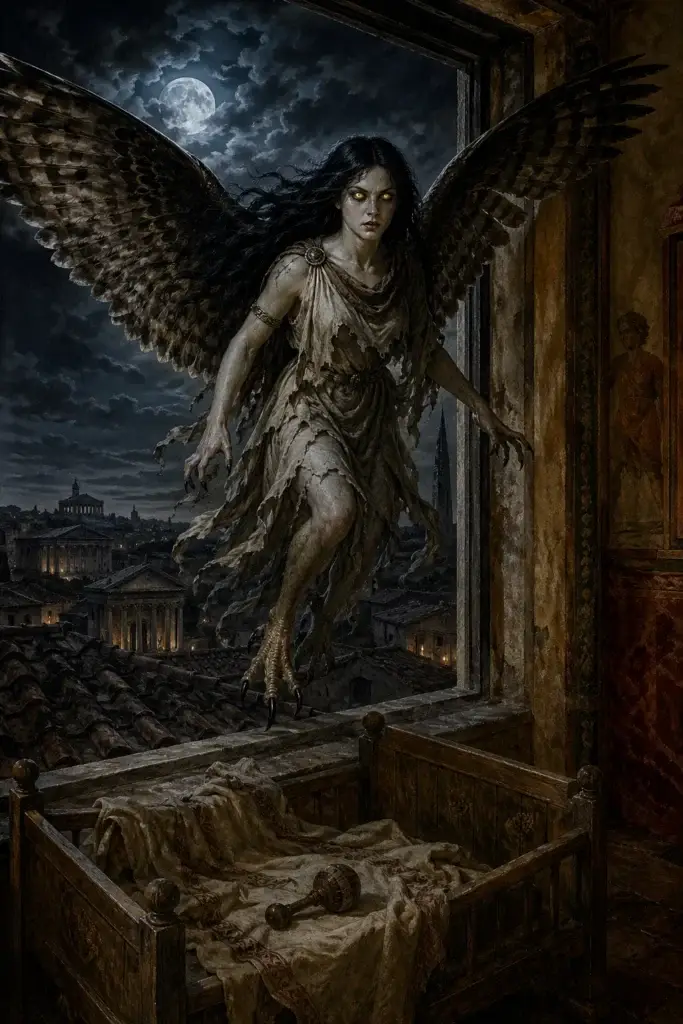
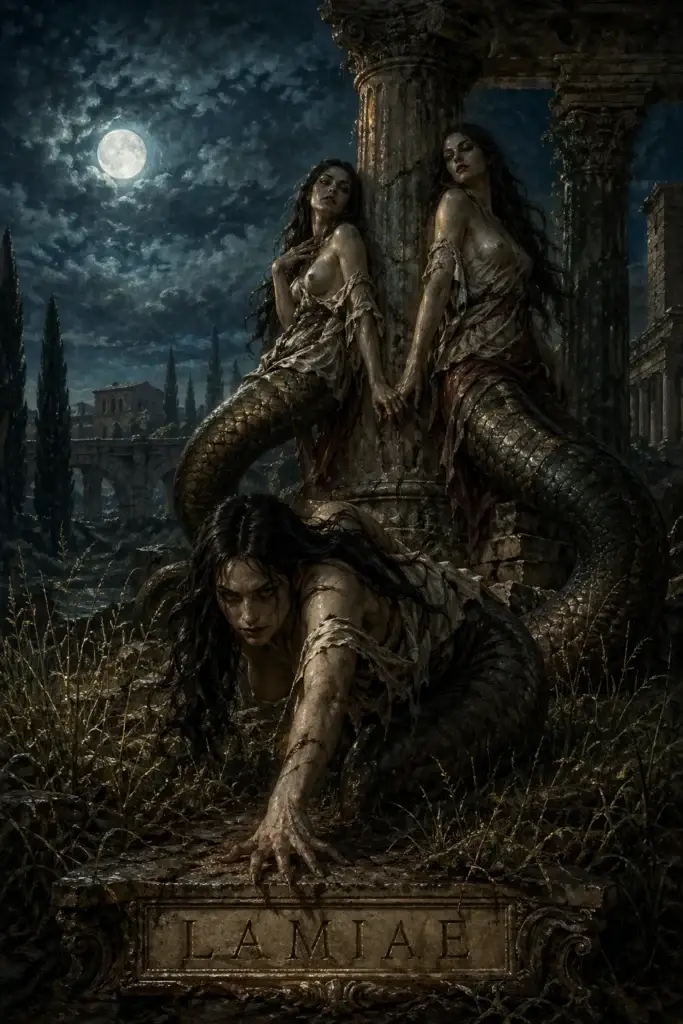
The figure of a woman, often beautiful and seductive at first. In the moment of attack she transforms, her features turn pale, her eyes freeze, and sometimes animal parts appear (a serpent’s lower body, claws). In medieval reception she becomes increasingly and unmistakably witch-like.
Behaviour
Nocturnal entry into houses, attacks on infants, the seduction of young men. The Lamiae act in secret, and their success is measured by the sudden death of the child or the gradual wasting away of the lover.
Sphere of Influence
The childbed, the sleep of infants, private living quarters, remote inns. Where protection is incomplete and the social space is confined, the Lamiae are at home.
Mythological Origin
As a class they have no unified genealogy. The Greek Lamia is the mythical primal mother; the Roman Lamiae are regarded as her sisters or descendants, sometimes as nameless sisters.
Appearance and Symbolism
The Lamiae are depicted with the upper body of a beautiful or terrible woman and the lower body of a serpent. Sometimes the whole being is serpentine. They have wings or claws. Their eyes are supernatural and hypnotic. Serpents and the dark maternal are their symbols.
Profile: Lamiae
The most important aspects of the Lamiae at a glance. You will find the detailed discussion of name, description, protection and parallels in the following sections.
From the Greek Lamia mythology, generalised in Rome into a class. There is no fixed Roman mythology of their own.
Infants and small children as the primary victims. Women in childbed indirectly, as the mothers of the threatened children. Secondarily, in the later tradition, young men in their sleep, parallel to the Lamia-Empusa fusion.
Variable: a beautiful woman on approach, changing form in the attack. In the later tradition with a distinct witch iconography.
Child-stealing, the death of children, the draining of vital force from those seduced. A slow harm, often experienced as inexplicable.
Childbed amulets, rituals during infant sleep, the invocation of saints in Christian times. In late antiquity, saints such as Sisinnios appear as conquerors of the Lamia, whose icons were meant to protect children.
Practices of Protection
Rituals of warding off. Around birth and infant sleep, apotropaic rites were carried out: marking thresholds with hawthorn or laurel, keeping lamps burning in the sleeping chamber, hanging a bulla around the infant. In Christianised times the sign of the cross was made over the child and saints were invoked.
Conjurations. In the late antique and Byzantine tradition an entire body of texts arose around Saint Sisinnios, who subdues Lamia-sisters. These “Sisinnios texts” are direct successors of the ancient conjurations against Lamia and travel as far as medieval Slavic and Romanian traditions.
Amulets and protective symbols. The bulla for Roman children, later cross amulets and medallions of saints. In Byzantine amulets the depiction of a rider-saint piercing a fleeing Lamia, the model for later dragon-slayer icons.
Cult and veneration. The Lamiae were not venerated but feared and warded off. Protective charms were widespread. Burial and welcoming rituals were meant to protect mothers. Wise people and magicians sought to banish them. In some mystery traditions they were understood as initiatory aspects.
Lamiae, Parallels in Other Cultures
Greek Lamia and Empusa. Direct predecessors. The single Greek figure Lamia becomes a class in Roman usage; a structural continuity across several centuries. Empusa adds the succubus-like component to the profile.
Mesopotamia and Judaism. The Akkadian Lamashtu is the older variant of the complex; her protective counter-figure Pazuzu has no direct equivalent in Rome, though the Roman cult of the Lares functionally takes on protective tasks for house and family.
In Jewish writings Lilith forms the parallel tradition; in the Vulgate Jerome translates lilith as lamia.
The Middle Ages. The term lamia becomes a theological technical term. Scholastics discuss the Lamiae as demonic beings; witch trials use the word synonymously with malefica. The Italian strega, the Spanish bruja and the Slavic vedma are vernacular successor terms for the same complex.
Modern reception. In modern fantasy and horror literature the Lamiae appear as a class of female vampires or as serpent-bodied hybrids. Pen-and-paper role-playing games (Dungeons & Dragons, Pathfinder) list them as a separate monster category. In Italian folk culture the term strega lives on to this day.
The Lamia in the Greek Authors: from Queen to Multitude
The Roman Lamiae have their origin in the Greek figure of Lamia. In the Greek sources she first appears as a single figure, a beautiful queen, often connected with Libya, who was loved by Zeus. Hera, out of jealousy, is said to have killed her children or to have forced Lamia to destroy them herself.
Out of grief and madness Lamia is then said to have become a being that steals and kills the children of others. Some traditions add that Hera took her sleep away, so that Zeus gave her the ability to remove her own eyes and put them back in.
Already in antiquity Lamia also became a plurality. From the one mythical queen there arose a species of terrifying figures, the Lamiai in Greek, the Lamiae in Latin. In this form they served above all as bogey figures used to keep children obedient.
Ancient authors mention this explicitly, for instance in contexts that speak of nursery tales and frightening children. The Lamia thus belongs to that group of figures rooted less in great literary texts than in oral everyday culture, mentioned only occasionally and in passing by educated writers.
Roman literature took up the figure and partly connected it with other harmful beings such as the striga, the malign night figure, and with notions of blood-sucking or child-stealing beings.
The boundaries between Lamia, striga, Empusa and similar figures are fluid in the sources, which scholarship interprets as a sign that this was a mobile field of popular notions of terror rather than a clearly defined mythology.
The Lamia in the Account of Apollonius in Philostratus
The most detailed ancient account of a Lamia is found in the Vita Apollonii of Philostratus, a biography of the wonder-worker Apollonius of Tyana from the third century of our era. It tells how a young man named Menippus encounters a beautiful woman who woos him and wants to persuade him to marry.
Apollonius sees through the woman and declares before the wedding party that she is a Lamia or Empusa, a being that wants to fatten the young man and finally devour him.
Under the pressure of questioning the figure at last admits what she is, and the feast laid out with all its splendour dissolves as an illusion.
This episode is important for several reasons. It shows the Lamia no longer merely as a frightener of children but as a seductive figure who endangers an adult man, a motif that was to become dominant in later reception.
It connects the Lamia with the theme of deception: beauty and wealth are appearances behind which a devouring being is hidden. And it assigns the unmasking to a wise man who destroys the illusion through knowledge.
Philostratus’s account had an influence far beyond antiquity. It is the main source for John Keats and his poem Lamia of 1820, which takes up the story and portrays the Lamia as a serpent woman who is at once alluring and tragic.
Through Keats and Romanticism the image of the Lamia as a beautiful, dangerous seductress entered the modern imagination, where it lives on to this day.
The Serpent-Bodied Lamia: an Image of Late Antiquity and the Modern Era
The notion that the Lamia has a serpent’s body is not necessarily attested in the early Greek sources. There the idea of a child-stealing woman or a female fiend is more prominent.
The connection with the serpent is seen in scholarship as a later development that arose from the blending of various terrifying figures and became established in late antiquity and above all in post-classical reception.
In medieval and early modern texts lamia appears partly as a learned word for a witch or a female demon. Bestiaries and natural-history works of the Renaissance occasionally depicted the Lamia as a hybrid creature, with a woman’s head and an animal’s lower body.
These depictions are less testimonies of a continuous tradition than constructions of learned authors who combined ancient mentions of the word with contemporary conceptions of demons.
In Keats, finally, the serpent form receives its own narrative function: his Lamia is originally a serpent and is transformed into a woman in order to win her beloved.
The tragedy of the poem lies in the fact that the unmasking of her true nature by a sober philosopher destroys her and with her the happiness of the beloved.
Later painting, for instance in the circle of the English Pre-Raphaelites, took up this image of the beautiful serpent woman.
The conception of the Lamia familiar today as a seductive serpent being is thus largely a product of the modern era, going back to a narrow and multiform ancient record. Anyone wishing to trace the ancient roots will find related figures, among others, in the Greek Empusa.
Further Links
Literature (Selection)
A selection of central works on the Lamiae and related figures:
- Resnick, Irven M. / Kitchell, Kenneth: “The Lamia in Medieval Thought.” In: Traditio 62 (2007).
- Spyridakis, Georgios: “Saint Sisinnios Texts.” In: Laographia 23 (1965).
- Blécourt, Willem de / Davies, Owen (eds.): Witchcraft Continued. Manchester 2004.
Further standard works in the literature index.
The practice of protection described here is a religious-studies classification of historical traditions. iWell Guard ties in with this cultural-historical line of wearable protective objects and represents a contemporary form of it. More about the iWell Guard →