Cacus, the monster of the Aventine
By Ralf Ittermann · last reviewed on
Cacus is a demon of the Roman tradition.
The fire-breathing giant of the Aventine, slain by Hercules.
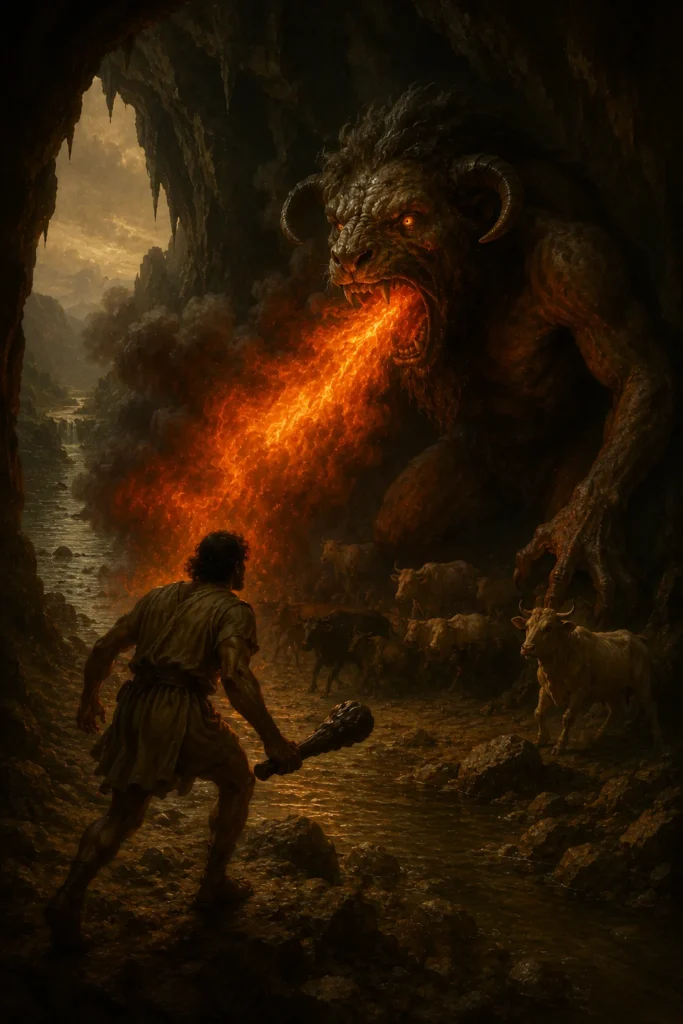
In Roman legend, Cacus is a fire-breathing giant who dwells in a cave on the Aventine and terrorises the surrounding area. He steals part of the cattle of Geryon from Hercules and is slain by the hero.
His story is elaborated at length by Virgil, Livy and Ovid, and it establishes one of the oldest cult sites of Rome: the worship of Hercules at the Ara Maxima on the Forum Boarium. As the son of the fire god Vulcanus, Cacus embodies raw, destructive fire, the counterpart to the guarding hearth fire of his sister Caca.
Type: Fire-breathing giant of the Roman origin legend
Origin: Early Rome, cave on the Aventine
Texts: Virgil’s Aeneid, Livy, Ovid’s Fasti
Period: ancient Roman legend, elaborated in literature in the 1st century BC
Appearance: gigantic, half-animal monster that breathes fire and smoke
Textual history
Period of the Texts
The legend is ancient Roman and was elaborated at length by Virgil in the Aeneid, by Livy, and by Ovid in the Fasti.
Area of Diffusion
Early Rome: the setting is the cave on the Aventine, the reference point is the cult of Hercules at the Forum Boarium.
Sources
Good: the narrative stands within a firm literary tradition from Virgil through Livy to Ovid.
Name and variants
Latin: Cacus. The name is often linked to the Greek kakos, meaning bad, but is probably of older, Italic origin. Caca is the name of his female counterpart, his sister.
Appearance and behaviour
Appearance
Cacus is depicted as a gigantic, half-animal monster that breathes fire and smoke from its throat. His cave is hung with the skulls and limbs of the slain.
Effect
Cacus steals livestock and murders travellers. When Hercules passes by with the cattle of Geryon, he steals part of the animals and drags them backwards into his cave to disguise their tracks; the bellowing of the cattle betrays him, and Hercules slays him.
Profile: Cacus
The key aspects of the fire-breathing giant at a glance.
Figure of the Roman origin legend, embodying raw, destructive fire; firmly established in literature since Virgil.
Travellers and livestock owners of the surrounding area, whom he robs and kills; in the legend, finally Hercules himself.
Gigantic and half-animal, breathing fire and smoke; his cave is hung with the skulls of the slain.
Cattle theft, murder and terror on the Aventine, until Hercules slays the monster and restores order.
Cacus himself has no cult; his death establishes the worship of Hercules at the Ara Maxima on the Forum Boarium.
The cattle theft on the Aventine
The name Cacus is often linked to Greek kakos, bad, but is probably of older, Italic origin. The tale is elaborated at length by Virgil in the Aeneid, by Livy, and by Ovid in the Fasti. Cacus is regarded as the son of the fire god Vulcanus, which explains his fiery nature.
The story itself is simple and effective: when Hercules passes by with the cattle of Geryon, Cacus steals some of the animals and drags them backwards into his cave so that the tracks lead away from the hiding place. The bellowing of the cattle betrays him, Hercules slays him, and order replaces terror: the death of Cacus establishes the worship of Hercules at the Ara Maxima, one of the oldest cult sites in Rome.
From Virgil to the Renaissance
The tale of Cacus is firmly established in literature through Virgil and Ovid and was taken up in the art and sculpture of the Renaissance and Baroque periods, for instance in Florence. There, Cacus symbolises the raw brutality subdued by the hero.
From a religious-studies perspective, Cacus is a classic example of destructive fire portrayed as a monster overcome by the culture hero. The tale subordinates wild fire to order and links this to the founding of a cult site; the pair Cacus and Caca show the dual nature of fire.
No cult for the monster
Cacus himself has no cult; he is the defeated adversary. His death, however, establishes the worship of Hercules at the Ara Maxima at the Forum Boarium, one of the oldest cult sites in Rome. The tale served as an origin story for this cult and for the order that Hercules put in place of terror: it is not the monster that is worshipped, but its conqueror.
Fire monsters and their conquerors
Cacus corresponds to the type of the fire-breathing monster slain by a hero, a figure also known from the Greek battles against dragons and giants. As the son of Vulcanus, he stands in the fire lineage of the Roman fire god; his counterpart is the tended hearth fire of his sister Caca, who in the tale uncovers the theft of the cattle.
Frequently asked questions about Cacus
Who was Cacus?
A fire-breathing giant of Roman legend, son of Vulcanus, who lived in a cave on the Aventine and terrorised the surrounding area.
How did he die?
Hercules slew him after Cacus had stolen some of the cattle of Geryon; the bellowing of the animals had betrayed the hiding place.
What does he have to do with Caca?
Caca is his sister and a tending hearth goddess; she forms the counterpart to his destructive fire.
Further links
Literature (selection)
Further standard works in the bibliography.
As the fire-breathing giant of Rome and adversary of Hercules, Cacus remains the illustrative case of the tale: wild fire yields to order, and the place of terror becomes one of the oldest cult sites of the city.