Caca, Rome's forgotten hearth goddess
By Ralf Ittermann · last reviewed on
Caca is a goddess of the Roman tradition.
Rome’s early hearth goddess, displaced by the veneration of Vesta. The article recalls Caca as a largely forgotten figure, eclipsed early on by the rising cult of Vesta.
Caca is an ancient Roman hearth and fire goddess and the sister of the fire-breathing monster Cacus. In the legend, she reveals to Hercules the hiding place of the cattle stolen by her brother, thereby contributing to the restoration of order.
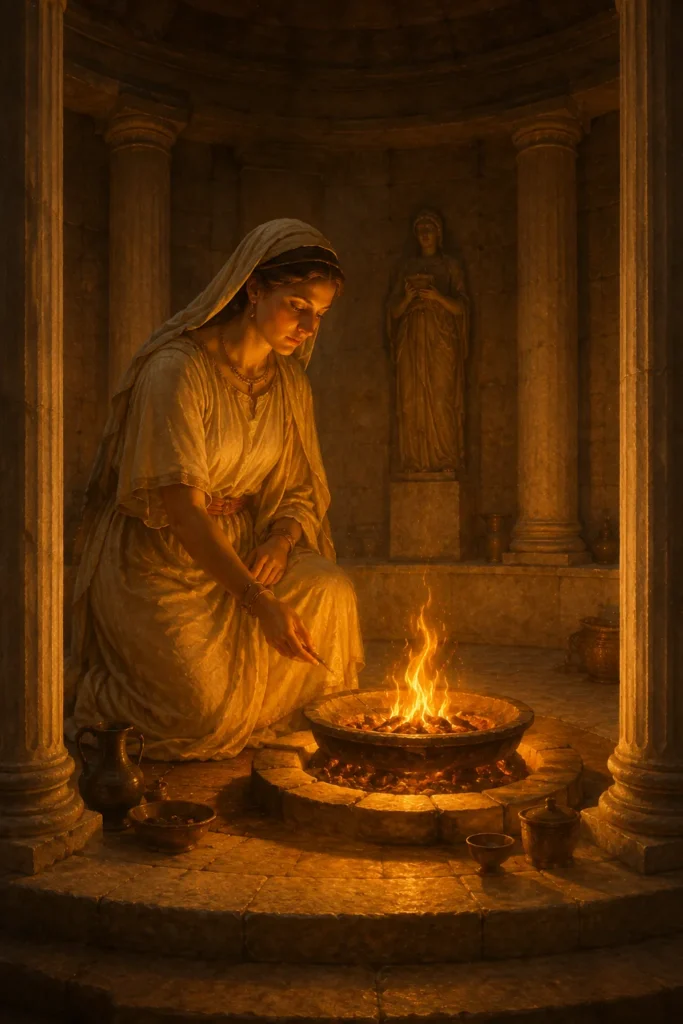
Ancient antiquarians report that she was granted her own cult in Rome with a perpetual fire, similar to that of Vesta. Caca is thus regarded as an early hearth deity, whose worship was later overshadowed and displaced by that of Vesta, so that only traces remained.
Type: Early hearth and fire goddess
Origin: Early Rome, environs of the Aventine
Texts: Notes by ancient antiquarians, including Servius
Period: ancient Roman
Appearance: barely captured pictorially, her sign is the tended hearth fire
Source context
Period of the Texts
Ancient Roman: Caca belongs among the oldest, barely traceable deities of early Rome; she is recorded by Servius and other antiquarians.
Area of Diffusion
Early Rome, particularly the environs of the Aventine, where the legend of her brother Cacus also takes place.
Sources
Thin: only a few ancient notes. A secure history of her cult cannot be reconstructed from these.
Name and variants
Latin: Caca, the female counterpart to the name Cacus. Already the name binds the goddess to her brother; the sibling pair embodies the two faces of fire.
Nature and effect
Appearance
Caca is not preserved pictorially; her nature can only be gleaned from textual notes. Her sign is the tended hearth fire.
Effect
As hearth goddess, Caca tends the fire. Opposite the destructive side of fire, embodied by her brother Cacus, she represents its benevolent, ordering side; in the Hercules legend she acts helpfully by revealing the cattle theft.
Profile: Caca
The key aspects of the early hearth goddess at a glance.
Early Roman hearth deity from the oldest, barely traceable layer of the pantheon, later overshadowed by the worship of Vesta.
The hearth fire and its tending; her audience is the early Roman hearth cult.
No surviving pictorial form; known only through textual notes, her sign is the tended hearth fire.
Mistress of a hearth fire and forerunner of the worship of Vesta; in legend the helper of Hercules.
A continuous fire in Rome said to have been tended by virgins, comparable to the cult of Vesta; the precise rites are not reliably recorded.
From Caca's hearth fire to the cult of Vesta
Caca is the female counterpart to the name Cacus. Ancient antiquarians, including the Virgil commentator Servius, report that a separate cult with a continuous fire was dedicated to her in Rome, similar to that of Vesta. This places her among the oldest, barely traceable deities of early Rome.
In the legend of Hercules she appears as a helper: she reveals to the hero the hiding place of the cattle stolen by her brother Cacus, thereby contributing to the restoration of order. Her own cult was overshadowed and displaced early on by the worship of Vesta, leaving only traces behind.
Classification of a displaced goddess
Outside the field of classical studies, Caca is almost unknown; there she serves as an example of an early, displaced hearth deity. She plays no role in popular culture.
From a religious studies perspective, Caca reveals an older layer of the Roman hearth cult that was overshadowed by the institutionalised worship of Vesta. The pairing of Caca and Cacus illustrates the two-faced nature of fire as both guarding order and destructive plunder. Regarding the source material, it should be noted: only a few ancient notes survive, and a reliable cult history cannot be reconstructed.
A continuous fire for Caca
Tradition holds that a continuous fire was maintained for Caca in Rome, said to have been tended by virgins, comparable to the cult of Vesta. This cult was early and was overshadowed and displaced by the worship of Vesta; the precise rites are not reliably recorded. Anyone wishing to approach the goddess will therefore find her less in ritual prescriptions than in the image of the tended, pure hearth fire itself.
Caca, Vesta and Hestia: the hearth lineage
Within Rome, Caca corresponds directly to Vesta, the goddess of the state hearth fire, and beyond that to the Greek Hestia; as a guarding hearth fire she stands alongside the hearth deities of other cultures. Her counter-image remains her own brother: the destructive fire of Cacus, whose crudeness stands opposed to her ordering flame.
Frequently asked questions about Caca
Who was Caca?
An ancient Roman hearth and fire goddess and the sister of the fire-breathing Cacus. She is regarded as an early hearth deity later overshadowed by the worship of Vesta.
What did she do in the legend of Hercules?
She revealed to Hercules the hiding place of the cattle stolen by her brother, thereby contributing to the restoration of order.
What became of her cult?
It was overshadowed and displaced by the worship of Vesta, leaving only traces behind.
Further links
Further reading:
- Rome – all beings of Roman religion
- Cacus – the fire-breathing brother
- Vesta – the goddess of the state hearth fire
- Protective candle, salt, amulet – traditional protective means
- Protection Compass – protective means at a glance
Literature (selection)
Further standard works in the bibliography.
As a Roman fire goddess of the oldest layer and an early hearth goddess of Rome, Caca is a reminder that before the state cult of Vesta a simpler, domestic fire was venerated, of which she was the keeper.