iWell Guard
Mercury - gods from the Roman tradition, historical-illustrative

Mercury: god of commerce, of messengers, and of travelers

GodRomeMessenger deity

For the Romans, Mercury was the god of commerce, of messengers, and of travelers. His cult was closely tied to merchants and to the profit gained from the movement of goods.

Overview

Mercury is among the best known deities of Roman religion. He was the god of commerce, of the movement of goods, of messengers, and of travelers. In him converged ideas of movement, exchange, and profit, that is, of spheres that held great importance for a trading city such as Rome.

In the history of religion, Mercury is an example of a deity strongly shaped by Greek influence. He was identified early on with the Greek Hermes and took over his myths and pictorial motifs to a large extent.

An old, independent Roman cycle of myths surrounding Mercury is barely tangible. His core lies rather in his function, his responsibility for commerce and traffic, which is already expressed in his name.

His most important temple in Rome stood near the Circus Maximus and, according to tradition, was consecrated in the early fifth century before our era. Responsibility for his cult lay with the merchants, who were organized in an association of their own.

Mercury was therefore less a god of the state cult in the narrower sense than a god of a particular professional class, whose concerns were profit, good fortune in business, and safe travel.

The veneration of Mercury was bound up from the outset with a concrete professional class. On the day the temple was consecrated, the association of merchants, the collegium mercatorum, was established at the same time.

The cult was thus less a concern of the community as a whole than the religious home of an economically active group whose interests were profit, sales, and safe travel.

Name and etymology

In scholarship, the name Mercurius is connected with the Latin word group around merx, meaning goods, and mercari, meaning to trade. Words such as mercator, the merchant, and merces, wage or payment, are also derived from it. The name thus marks Mercury directly as the god of the trade in goods.

This transparent derivation fits the finding that Mercury was by nature a functional deity. His name names his sphere of responsibility, and this sphere, commerce and the profit gained from the movement of goods, forms the fixed core of his veneration, while the mythical elaboration came largely from outside.

Unlike Hermes, whose Greek name has a different history of meaning, the Latin name is therefore closely bound to the economic function.

This explains why Mercury appears in Rome from the very beginning as the god of merchants, and why his festival was connected with customs that referred to honest or successful trade. The etymology is thus an important indication that the Roman Mercury, despite the Greek overlay, had a starting point of his own.

Description and iconography

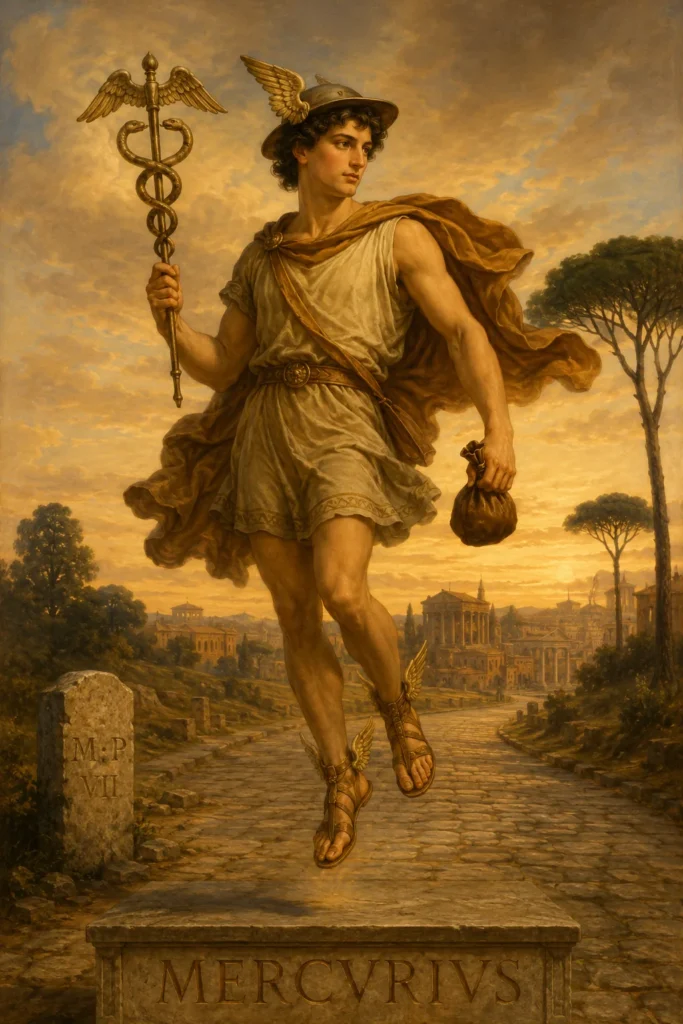
The pictorial depiction of Mercury follows the model of the Greek Hermes to a large extent. He usually appears as a youthful, athletic man, often unclothed or with a short cloak over his shoulder.

His most important attributes are the winged hat, the petasus, the winged shoes or wings at the ankles, and the herald’s staff, the caduceus, a staff with two intertwined snakes.

Mercury also frequently holds a money pouch in his hand. This attribute is especially revealing, because it emphasizes his specifically economic role.

While the wings on hat and shoes stand for speed and the errands of a messenger, and the caduceus points to his function as intermediary and herald, the money pouch makes him unmistakably the god of profit and commerce.

Mercury appears on reliefs, wall paintings, statuettes, and very frequently on coins. In the provinces, especially in the Celtic and Germanic regions, he was one of the most often depicted Roman deities.

There he was identified with native deities, which led to a great number of dedications and images. The iconography remained stable at its core: the youthful messenger with winged hat, caduceus, and money pouch is recognizable across the entire Roman West.

Mythological narratives and tradition

The mythical tradition of Mercury derives almost entirely from the Greek material concerning Hermes.

Stories of the cunning birth of the god, of his theft of Apollo’s cattle, of the invention of the lyre, and of his role as escort of souls to the underworld are present in Roman literature, but are recognizable as adaptations of Greek myths.

In Roman poetry, Mercury appears as an acting figure in several passages. In Virgil’s Aeneid he is sent by Jupiter as a messenger to Aeneas, to drive him away from Carthage and to remind him of his task.

This scene shows Mercury in his classic role as the conveyor of the divine will. In his works, Ovid takes up the myth of the birth and the theft as well as the story of Lara and the begetting of the Lares, in which Mercury also plays a part.

An independent ancient Roman cycle of myths surrounding Mercury, by contrast, can hardly be demonstrated. This fits his character as a functional god, whose significance lay in the practice of commerce and not in a rich native narrative tradition.

The literary tradition is therefore above all a testimony to how readily the educated Romans took up the Greek mythical material and incorporated it into their own poetry.

Horace too turns to Mercury in his Odes and places himself under the god’s protection, describing himself as a poet bound to the god. With this, Mercury also takes over in Roman poetry the connection to language, eloquence, and mediation inherited from Hermes, which reaches beyond the narrower sphere of commerce.

Cult and veneration

The cult of Mercury in Rome was closely tied to the merchants. His temple in the area of the Circus Maximus was regarded as the sanctuary of this professional class.

The merchants were organized in an association, and their religious affairs were tied to the cult of Mercury. The concerns of the veneration were good sales, good fortune in business, and safe journeys.

The annual festival was the Mercuralia in May, on the same day on which, according to tradition, the temple had also been consecrated. On this occasion the merchants offered sacrifices and carried out a special custom.

They drew water from a spring consecrated to Mercury, the aqua Mercurii, and sprinkled themselves and their goods with it. As they did so they spoke prayers in which they asked forgiveness for earlier dishonest trade and for future profit.

This custom is revealing for the history of religion, because it makes clear the tension between economic self-interest and religious obligation.

In the provinces, the cult of Mercury experienced a strong spread. In the Celtic and Germanic regions he was identified with native principal deities and venerated on heights, along roads, and in sanctuaries.

Numerous dedicatory inscriptions and pictorial works testify to this popularity. Mercury was thus at once a god of the urban merchant class in Rome and one of the most important reference figures of religious fusion in the provinces.

According to tradition, the temple of Mercury was consecrated in the year 495 before our era on the slope of the Aventine near the Circus Maximus, and the Mercuralia fell each year on the same day, the fifteenth of May.

Livy reports disputes over who was permitted to carry out the consecration of the temple, which shows the early recognized standing of the sanctuary.

The spring consecrated to the god, the aqua Mercurii, lay according to the sources outside the Porta Capena. From it the merchants drew water with a laurel branch on the festival day, with which they sprinkled their goods and themselves.

In the Fasti, Ovid records the prayer that was spoken on this occasion, in which the traders asked the god to overlook past and future perjuries and to grant them profit.

This open request for indulgence toward dishonest trade is revealing for the history of religion, because it shows how business life was embedded in an ordered religious relationship without concealing its own interests.

Protective practice and the apotropaic

The protection that Mercury offered was related above all to movement and exchange. Travelers and messengers placed their journeys under his protection, merchants their business and their goods.

The god was regarded as the one who lets ways succeed, mediates encounters, and brings commerce to a good conclusion. He was thus a reference figure for all those areas of life connected with being on the road and with the risk of business.

One particular protective practice is the sprinkling of goods with the water of the Mercury spring at the Mercuralia. This act was intended to secure a good course for business and at the same time to make amends for earlier misconduct.

It combined the request for future profit with the admission of past dishonesty, and thus established an ordered religious relationship between merchant and god.

Mercury also had a connection to the world of the dead, since in the conception taken over from Greece he was regarded as the escort of souls. In this function he was a mediator between the realms, who ordered the transition.

Here too the emphasis lies less on warding off evil powers than on mediation and the securing of transitions, whether between places, between business partners, or between the realms of life and death. The protection of Mercury was therefore less defensive than ordering and enabling.

The escort service for souls, which fell to Mercury from the Greek inheritance, made him a figure at the threshold between the realms.

In this role as Mercury who escorts the dead, he occasionally appears on grave monuments. His protection thus related not only to ways and business among the living, but also to the final transition.

Parallels in other cultures

The closest parallel to Mercury is the Greek Hermes. The identification was so far-reaching that Mercury took over almost the entire cycle of myths and the iconography of Hermes. Nevertheless there is a difference.

By his name, the Roman Mercury is more strongly fixed on the economic sphere, while Hermes had a broader range of responsibilities. The attribute of the money pouch in Roman iconography underscores this shift.

In the provinces, Mercury was connected with a number of native deities. In the Celtic region he was identified with a native deity regarded as especially important, in the Germanic region with a principal deity there.

These identifications are an important example of the process of religious fusion, in which Roman and native conceptions merged into one another.

In terms of religious studies, Mercury belongs to the widespread type of messenger and mediator deities, who mediate between realms, places, and persons and often also play a role in the transition to the world of the dead.

Such deities are encountered in many religions. The Roman form is particularly well documented through its strong attachment to commerce and through the broad veneration in the provinces.

Present-day reception and research

In research on Roman religion, Mercury is treated above all under two aspects. On the one hand there is interest in the question of what about him is ancient Roman and what is a Greek adoption, and on the other hand in his outstanding role in the religious fusion of the provinces.

Georg Wissowa and Kurt Latte placed him within the Roman world of gods; more recent works, for example by Jörg Rüpke, emphasize his function within particular social groups.

Provincial Roman religious research has dealt intensively with the numerous dedications to Mercury in the Celtic and Germanic regions. These testimonies allow insights into the way in which Roman and native religion interacted, and Mercury is regarded here as one of the most important examples.

The Mercuralia and the custom of sprinkling the goods are also drawn upon as a source for the relationship between religion and economy.

In present-day general culture, Mercury is present in several ways. His name stands for the planet closest to the sun, and his image with winged hat and caduceus still appears today as a symbol for commerce, traffic, and messenger service.

For religious studies, Mercury remains an instructive example of how a functional deity is enriched by foreign myths and can at the same time become a key figure of the religious encounter of different cultures.

A further focus of more recent research lies on the role of Mercury in the professional associations. The collegia of merchants and craftsmen who referred to Mercury are regarded as an example of how religious obligation and economic organization permeated one another in the Roman city.

The numerous dedicatory inscriptions from the provinces also make it possible to determine more precisely the social composition of his worshippers.

Literature (selection)

  • Georg Wissowa: Religion und Kultus der Römer (1912)
  • Kurt Latte: Römische Religionsgeschichte (1960)
  • Mary Beard, John North, Simon Price: Religions of Rome (1998)
  • John Scheid: An Introduction to Roman Religion (2003)
  • Jörg Rüpke: Die Religion der Römer (2001)

Related key terms: Mercury Mercuralia Hermes caduceus commerce merchants messengers travelers.

iWell Guard and protective traditions

iWell Guard ties into the cultural-historical tradition of portable protective objects, in the tradition of Rome and many other cultures worldwide. 41 layers, solid gold, platinum, silver, manufactured in Germany. 30-day right of return.

Personal experiences may vary. Not a medical device. No healing claims.