Beings from the Slavic tradition on iWell Guard. Slavic mythology of Eastern and Central Europe. Principal sources: the Hypatian Codex, the Tale of Igor’s Campaign, oral tradition.
Slavic folk religion knows witches, household spirits and protection in many forms.
This page documents the Slavic religion of the pre-Christian East Slavs.
Slavic mythology survives largely through oral tradition, and written sources from the pre-Christian period (before 988 for Kievan Rus) are rare. It was only the ethnographic collecting activity of the nineteenth century that recorded household spirits, water spirits and forest demons systematically.
Slavic religion has been reconstructed above all from folk tradition. The pre-Christian Slavs had no writing; what we know about their gods comes from Byzantine and Arabic travel accounts, Christian sermons against idolatry, and the ethnographic collections of the eighteenth and nineteenth centuries.
The gods Perun, Veles and Mokosh can be reconstructed only in outline.
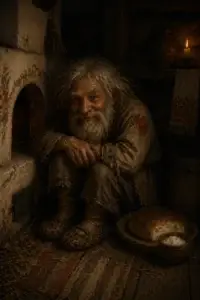
The true wealth lies in folk religion: household spirits (Domovoi, Domovik), spirits of the terrain (Leshy in the forest, Vodyanoy in the water), spirits of disease (Kikimora, Mara), and beings of the dead and the ancestors.
This layer outlasted Christianization and merged with the veneration of saints, so that Saint Elijah took the place of Perun and the Mother of God assumed the functions of Mokosh.
The academic treatment (Gieysztor, Mańczak, Jakobson) has drawn methodically above all on comparison with Baltic and Indo-European mythology. Much remains uncertain, and precisely for that reason the Slavic tradition is an interesting borderline case for the discussion of the history of religion, situated between a reconstructible high religion and an ethnographically tangible folk culture.
Period: Prehistoric and early historical times (Slavic migration, 5th to 7th centuries) up to Christianization (10th to 13th centuries), and folk tradition continuing to the present day.
Distribution: Eastern and Central Europe, the Balkans.
Sources: the Hypatian Codex, the Tale of Igor’s Campaign, the Primary Chronicle, folk narratives, ethnographic collections.
Pantheon and classes of being: Perun (thunder), Veles (the underworld and cattle), Mokosh (earth, woman), Marena (death), Svarog (the forge), Domovoi and Bannik (household spirits).
Slavic religion has come down to us in fragmentary form, through oral tradition and late written sources (the Hypatian Codex of the twelfth century, Saxo Grammaticus).
The original pantheon structure comprised deities such as Perun (thunder, war), Veles (the underworld, prosperity), Mokosh (earth, fertility) and Stribog (wind). The Christianization of the 9th to 12th centuries was intensive and displaced the tradition.
Folk tradition with its household spirits, forest demons and water beings nonetheless survived in folklore. The system was less extensively documented in writing than the religions of Western Europe; the written sources arose after Christianization and are ideologically distorted.
Regional variation was considerable (East Slavs, West Slavs, South Slavs). Modern sources for its reconstruction are speculative. Slavic nationalists romanticized and politicized the tradition in the 19th and 20th centuries.
Slavic practice is sparsely documented, but was presumably structured along ritual lines: sacrificial rites for the gods and spirits, and protective practices against evil spirits and supernatural threats. The Domovoi (household spirits) were popular and required respectful treatment. The Leshy (forest spirits) and the Rusalka (water nymphs) were part of everyday belief.
Folk medicine using herbs and incantations is documented. Shamans and wise men (often repurposed as priests with Christianization) administered contact with the spirits. Priests presided over public sacrifice.
With Christianization, many practices were reshaped into Christian forms (for example, Christmas replaced a fire festival). Popular piety within Christianity retained a belief in spirits. Pagan practices judged sinful continued underground.
Slavic religion no longer exists as an organic faith tradition. In academic terms it is less well documented than the religions of Western Europe or of the East.
Folklore and fairy tales preserve fragmentary remnants. The modern Rodnovery movement (pagan, Slavic, nationalist) has attempted a reconstruction since the 1980s, but is ideologically right-leaning and speculative.
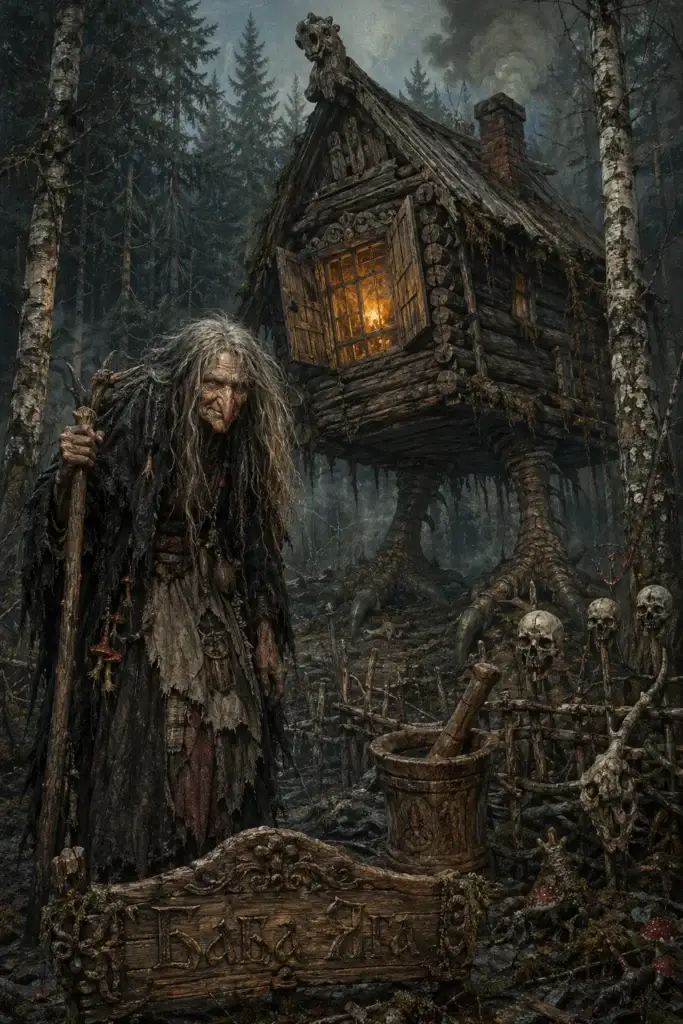
Popular culture (Slavic fantasy, video games) draws on Slavic mythology for its aesthetic. Western esoteric circles have ignored or marginalized the Slavic tradition. Literature and folk tradition (Russian fairy tales, Baba Yaga) are cultural treasures. Nationalist politicization has compromised the tradition. Scholarly reception remains cautious and fragmentary.
The Slavic pantheon is transmitted less systematically in the sources than the Greek or the Germanic one, since written sources arose only after Christianization.
Some thirty principal gods are known (Perun, Veles, Svarog, Dazhbog, Stribog, Mokosh, Khors, Simargl, Lada, Jarilo, Marena, Triglav, Sventovid and others), together with hundreds of local and nature beings (Leshy, Domovoi, Rusalka, Vila). In all, roughly 100 to 150 gods are transmitted by name.
Perun is the chief god of the East Slavs, a god of thunder, patron of warriors and guardian of oaths, comparable to Zeus or Thor. Among the West Slavs (the Rugians on Rügen), Sventovid was the most important god.
In all Slavic tribes the triad of Perun (sky and thunder), Veles (earth, cattle and the underworld) and Mokosh (mother, water and women) appears as the core structure. The assembly of the pantheon under Vladimir in Kiev in 980 placed Perun at the head.
The Vladimir pantheon (980 to 988) was the last pagan assembly of gods in Kievan Rus.
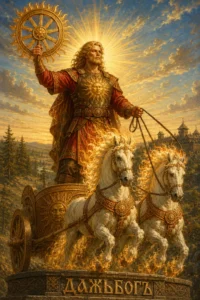
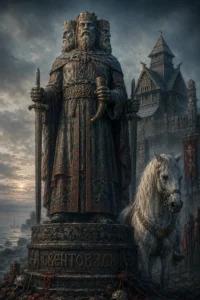
Grand Prince Vladimir Sviatoslavich (before his conversion) had six idols erected before his palace in Kiev: Perun (with a silver head and a golden moustache), Khors (sun), Dazhbog (a giving god), Stribog (wind), Simargl (an enigmatic being) and Mokosh (mother).
In 988, after his baptism, he had all the idols destroyed, and Perun was cast into the Dnieper. The Primary Chronicle records these events.
Gods (bog in general) were venerated in larger sanctuaries and had cosmic functions: thunder (Perun), the sun (Dazhbog), the earth (Mokosh).
Spirits (dukhi, demoni), by contrast, are beings close to everyday life: the Domovoi (household spirit), the Leshy (forest), the Vodyanoy (water), the Bannik (bathhouse), the Polevoi (field), the Rusalka (a deceased young woman by the water).
The spirits are ambivalent, can help or harm, and were still appeased with food offerings in peasant traditions into the twentieth century.
Belobog (the white god) and Chernobog (the black god) form a divine pair in some West Slavic traditions, light and good against dark and evil. This dualistic conception may be Iranian (Zoroastrian) or Christian in its influence. Helmold of Bosau (12th century) reports a Chernobog cult among the West Slavs.
In terms of the study of religion, the existence of Belobog is disputed, and he may have been derived secondarily from Chernobog (who is clearly attested), much as the Devil exists without a clear counterpart in a White God.
After 988 (the Kievan baptism), the official veneration of the gods was forbidden, the idols destroyed and the temples demolished.
The gods nonetheless survived in popular belief: Perun became Saint Elijah (who rides over the clouds in his chariot of thunder), Veles became Saint Blaise (patron of cattle, owing to the similarity of the syllables Veles and Vlas), and Mokosh became the veneration of the Mother of God.
This synthesis with Christianization (the Slavic dual faith, dvoeverie) was preserved in rural areas into the nineteenth century.

In mythological terms, Slavic religion is one of the most poorly transmitted in Europe. There are no Slavic Eddas, no theogonies, no systematic registers of the gods.
What we have are: Byzantine and Western European outside accounts, chronicles from the Christianized period (the Primary Chronicle, Saxo Grammaticus’ description of the temple of Arkona), archaeological finds, and above all the folk tradition, with its songs, customs and fairy tales.
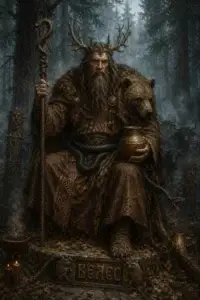
At the head of the discernible pantheon stand Perun (god of thunder and the oak, the high god), Veles (god of cattle, the underworld and magic, and Perun’s antagonist), Svarog (god of the sky and the forge) and Mokosh (Mother Earth).
Alongside them stands the lower mythology: Domovoi, Leshy, Vodyanoy, Rusalka, Bannik, Kikimora. These beings shaped the everyday life of the peasant population over centuries.
The Christianization of the Slavs proceeded very differently from region to region (Bulgaria in 864, Russia in 988). Instead of complete displacement, a merging took place: Perun became Saint Elijah, Veles became Saint Blaise, and Mokosh became Paraskeva-Pyatnitsa.
Folk customs such as the Maslenitsa festival and Ivan Kupala outlasted these changes under a Christian overlay and persist to this day.
Scholarly documentation began in the nineteenth century: Alexander Afanasyev collected fairy tales, and later Vladimir Propp analyzed their structures. The post-Soviet reconstructed folk religion (Rodnovery) is a modern movement, not evidence of historical practice.
On iWell Guard we work cautiously with the sources, since precisely here the risk of nationalist myth-construction is high, both historically and at present.
Standard literature (Slavic):
Slavic folk tradition combined the protection of the home and of the body: customs surrounding the Domovoi, symbolic embroidery on clothing and wall hangings, and thread amulets against the evil eye.
iWell Guard takes its place within this cultural-historical line of wearable means of protection, in a contemporary material architecture, manufactured in Germany. 41 layers, fine gold, platinum, silver. A 30-day right of return.
Personal experiences may vary. Not a medical device. No promise of healing.
The encyclopedia of protective symbols treats several signs and objects from the Slavic world on their own pages: the thunder mark, the Hand of God, the Kolovrat, the Obereg and the Slavic lunula. A cross-cultural overview is offered by the page on protective symbols.