Svetovid, Slavic god of war and oracles
By Ralf Ittermann · last reviewed on
Svetovid is a four-headed Slavic god of war and oracles who was worshipped as the chief god of the West Slavs in the temple of Arkona on Rügen.
Svetovid (also Svantovit, Sventovid, Latin Svantovithus or Suantevit) is the central deity of the Elbe Slavic and Baltic Slavic pantheon of the High Middle Ages and one of the few Slavic gods whose temple, statue and cultic practice are described in detail by contemporary sources.
His principal sanctuary stood until 1168 on the island of Rügen at Arkona; its destruction by the Danish king Valdemar I is one of the best documented events in the history of Slavic religion.
Svetovid was a god of war, a god of oracles and the chief god of the Rani, the Baltic Slavs of the island of Rügen.
Profile: Svetovid
Svetovid: the most important aspects at a glance. The following fields summarise origin, function, appearance, veneration, symbols and parallels.
Svetovid was the central deity of the Elbe Slavs and Baltic Slavs among the West Slavs and chief god of the Rani on Rügen; his main sanctuary at Arkona existed until 1168. The name is composed of Proto-Slavic “svętъ” (holy) and “vitъ” (lord, victor or apparition of light).
Svetovid was god of war, god of oracles and chief god of the Rani; Helmold calls him the foremost among the gods of the Slavs, to whom the others were only demigods. Before military campaigns the horse oracle was consulted, and one third of every war booty went to Svetovid.
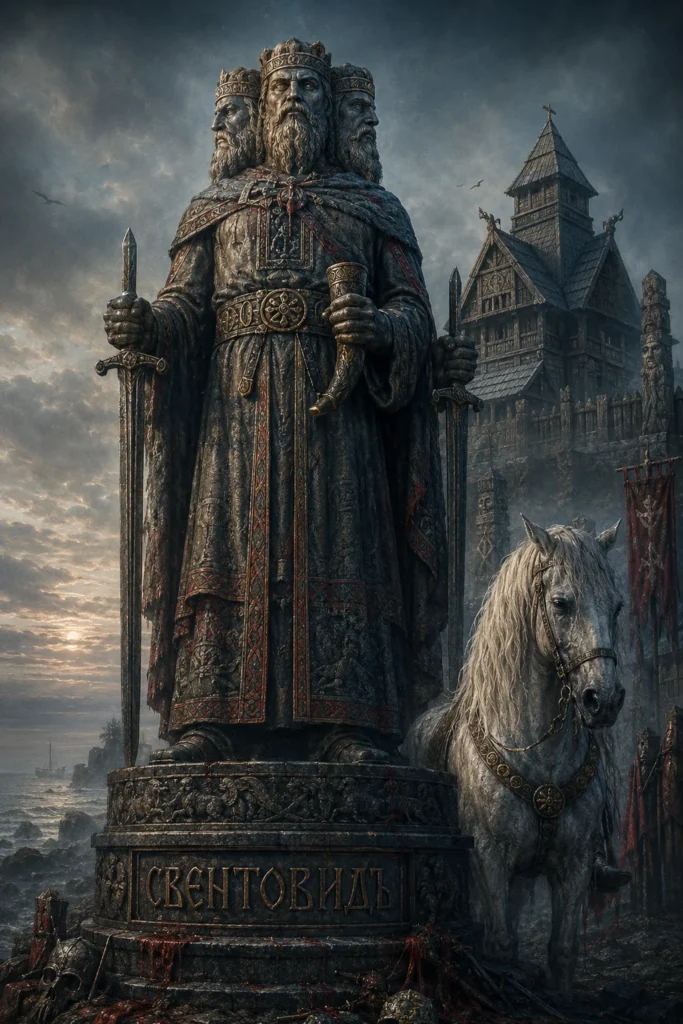
According to Saxo, the statue at Arkona was larger than human size and made of wood, with four heads looking in the four directions of the sky. In his right hand the god held a drinking horn, and with his left he leaned on a bow. On the wall hung a saddle, bridle and a sword with silver fittings.
In the temple of Arkona, at the annual harvest festival the priest looked into the drinking horn filled with wine and read the coming harvest year from the level. The horse oracle decided on campaigns. Every Rani paid a fixed sum to the temple each year. In 1168 Valdemar I destroyed the complex.
The four heads are regarded as a cosmological symbol: the god surveys the whole world. The drinking horn serves the oracle; bow and sword are warrior attributes. The white horse of the temple is the central companion animal; the color white is sacred.
The Zbruch idol, a limestone pillar with divine reliefs and four faces, shows a similar depiction; whether it shows Svetovid is disputed. The horse oracle is related to horse oracles among the Hittites, Scythians, Germanic peoples and Persian magi. Aleksander Brückner regarded Svetovid as a variant of the thunderer Perun.
Sources and Earliest Attestations
The most important source for Svetovid is the “Gesta Danorum” of Saxo Grammaticus (around 1200), Book XIV, Chapter 39, in which the Danish conquest of Arkona in 1168 is described at length. Saxo, who as a Danish court cleric questioned eyewitnesses, gives a detailed description of the temple, the statue and the cultic practice.
This source is especially valuable for the history of religion for two reasons: it is close in time, and it comes from the camp of the victors, who saw the statue and the temple with their own eyes before they destroyed them.
The second principal source is the “Chronica Slavorum” of Helmold of Bosau (around 1170), which arose at the same time as the conquest and rests on direct information from missionary circles.
Helmold describes Svetovid as the “foremost among all the gods of the Slavs”, to whom the other gods were merely demigods. The third source is the “Knytlinga saga” (13th century), the Danish royal saga, which likewise deals with the conquest of Arkona.
Further mentions are found in Adam of Bremen (“Gesta Hammaburgensis ecclesiae pontificum”, 1075), in Thietmar of Merseburg (concerning the early phase of Elbe Slavic paganism, though without an explicit reference to Svetovid) and in Danish annals of the 12th and 13th centuries.
The Temple and Cult Complex of Arkona
The temple stood on a promontory at the northeastern tip of Rügen, protected by a semicircular earthen rampart that sealed off the landward side; the steep coast protected the seaward side.
The archaeological excavations since Carl Schuchhardt (1921) and especially Joachim Herrmann (1962 to 1971) have reconstructed the complex: a sacred precinct of about 4 hectares, in the interior of which stood the temple building itself.
The temple was a square wooden construction with red wall hangings and an inner sanctum separated from the outer space by curtains.
Inside stood the main statue of Svetovid. According to Saxo’s description it was of superhuman size, made of wood, with four heads or faces that looked out toward the four cardinal directions. Two faces pointed forward, two backward, with one pair oriented to the left and the other to the right.
The god held a drinking horn in his right hand; with his left hand he leaned on a bow. On the wall hung his saddle, his bridle and an enormous sword whose blade was adorned with silver fittings.
Iconography and Symbols
The most distinctive iconographic feature of Svetovid is his four heads. This “four-facedness” is generally interpreted as a cosmological symbol: the god looks in all cardinal directions and surveys the whole world.
A similar four-faced depiction of a god is known from the famous Zbruch idol (recovered in 1848 in Galicia, today in the Archaeological Museum of Kraków), a limestone column with four reliefs of gods on a cube-shaped head.
Whether the Zbruch idol represents Svetovid or another deity is disputed; the formal kinship is nonetheless evident and supports the assumption that multi-headedness was a typical feature of West and East Slavic divine iconography.
The drinking horn in the right hand plays a central role in the oracle ritual (see below). Bow and sword are warrior attributes. The white horse that belonged to the temple is the central companion animal. The colour white is sacred and was associated in the Baltic Slavic pantheon with the highest gods.
Oracle and Cultic Practice
Saxo Grammaticus describes two principal practices of the Arkona cult. The annual harvest festival took place after the grain harvest: the priest looked into the drinking horn of the statue, into which wine had been poured the previous year.
If the wine level had not changed, this promised a good harvest year; if it had fallen, famine threatened.
The horn was then emptied and filled with fresh wine; the priest drank the first draught, spoke a blessing over the Rani, and the festival ended with the consumption of an enormous round honey cake, behind which the priest hid in order to ask whether the assembled could see him.
The most famous oracle was the horse oracle. A white horse was kept in the temple, which only the high priest was permitted to touch. Before military campaigns, three rows of two crossed lances each were thrust into the ground; the horse was led three times over these lances.
If the horse began with its right foreleg, this foretold victory; if with the left, the campaign was cancelled or postponed.
This practice is especially interesting for the history of religion because it is structurally connected with the hippomanteia complex of the Indo-European horse oracle, which is also attested among the Hittites, Scythians, Germanic peoples (Tacitus, “Germania”, Chapter 10) and Persian magi.
Treasure and Tribute
The temple of Arkona was immensely rich. Saxo describes vast quantities of gold, silver, fabrics and precious stones that lay in the treasury as spoils, tribute or votive offerings. Every Rani had to pay a fixed sum to the temple each year; a third of all booty from military campaigns was handed over to Svetovid.
The temple possessed its own soldiers and cavalry (three hundred horsemen according to Saxo), who stood under the supreme command of the high priest. This military-religious connection is a unique trait of Elbe Slavic religion and shows how far Svetovid had grown beyond the function of a mere tribal god.
The Destruction of Arkona in 1168
In the Danish conquest under King Valdemar I and Bishop Absalon of Roskilde in June 1168, Arkona was besieged and, after a short defence, taken. Saxo Grammaticus, whose account rests on the eyewitness testimony of Absalon, describes the destruction of the statue: it was overturned, hacked to pieces and burned.
The treasury was emptied and the temple precinct torn down. The Rani were forced to baptism on the spot; the region was placed under the bishopric of Roskilde and incorporated into the Danish sphere of rule.
With this destruction the pagan religion on Rügen officially ended, even though folk customs and folklore lived on for a long time.
Classification within the History of Religion and Identity
Svetovid has repeatedly been placed in relation to other Slavic gods in scholarship. Helmold of Bosau emphasizes his pre-eminence over other gods, which argues for a henotheistic structure of the Rani pantheon: a supreme god with subordinate demigods.
Aleksander Brückner held Svetovid to be a regional variant of the general Slavic thunderer Perun, a view that current scholarship largely rejects. Aleksander Gieysztor (“Mitologia Słowian”, 1982) saw in Svetovid an independent chief deity of the Baltic Slavs with a cosmological function, indicated by the four-facedness.
Etymology
The name “Sventovit” is composed of Proto-Slavic “svętъ” (holy) and “vitъ” (lord, victor or luminous appearance). The meaning would accordingly be “holy lord” or “holy radiant one”. Whether the second component is connected with the Old Russian “vit” (to see, to look), which would additionally motivate the four-facedness, is linguistically debated.
Later East Slavic tradition merged the name with Saint Vitus; the island of Rügen and the town of Sankt Veit (Slovenia, Croatia) link the Christian saint with the old god in a syncretistic way.
Afterlife
After the destruction of Arkona the official Svetovid cult disappeared completely. Traces in folk tradition are thin but present: a few Rügen legends about a “Swantewit” on the Witower Berg, narratives about sunken temples and about the white horse of the pagan age.
In the 19th century Svetovid became a figure of identification for Polish and Czech Romanticism; Aleksander Brückner, Ján Kollár and other pan-Slavic thinkers referred to him as a symbol of an independent Slavic high culture.
Today Arkona is an archaeological park, the hill-fort relic accessible, the temple itself reconstructable only through foundations and finds. In the contemporary Rodnovery and neo-pagan movement of Central and Eastern Europe, Svetovid plays an important role as a reconstructed chief god; this modern veneration is, in terms of the history of religion, a new construction.
Sources
Saxo Grammaticus, “Gesta Danorum”, Book XIV (around 1200), critical edition by Karsten Friis-Jensen, Oxford 2015. Helmold of Bosau, “Chronica Slavorum” (around 1170), translation by Heinz Stoob, Darmstadt 1963. “Knytlinga saga” (13th century). Adam of Bremen, “Gesta Hammaburgensis ecclesiae pontificum” (1075). Thietmar of Merseburg, “Chronicon” (early 11th century). Danish annals of the 12th and 13th centuries.
Carl Schuchhardt, “Arkona, Rethra, Vineta”, Berlin 1926. Joachim Herrmann, “Die Slawen in Deutschland”, Berlin 1985. Joachim Herrmann (ed.), “Slawische Burgen in Deutschland”, Berlin 1976. Aleksander Brückner, “Mitologia słowiańska”, Kraków 1918. Aleksander Gieysztor, “Mitologia Słowian”, Warsaw 1982. Henryk Łowmiański, “Religia Słowian i jej upadek”, Warsaw 1979. Vladimir Toporov and Vyacheslav Ivanov, “Issledovaniya v oblasti slavyanskikh drevnostey”, Moscow 1974. Leszek Słupecki, “Slavonic Pagan Sanctuaries“, Warsaw 1994.
The Source History of Saxo and Helmold
The “Gesta Danorum” of Saxo Grammaticus is the most important but not unproblematic source for Svetovid. Saxo was court cleric of Bishop Absalon of Roskilde, who had led the conquest of Arkona militarily. His description of the temple and of the cultic practice rests directly on eyewitness reports of the Danish victors.
Saxo’s account, however, is throughout marked by a Christian polemical tendency: the pagan religion is presented as erroneous, foolish and devilish, its rituals characterized as superstition. The analysis within religious studies must take this tendency critically into account and attempt to separate the polemical colourings from the ethnographic facts.
Helmold of Bosau’s “Chronica Slavorum” (around 1170) is a second principal source, written from the perspective of the North German mission to the Slavs. Helmold was a priest in Bosau in Holstein and worked for the missionary Bishop of Lübeck.
His description of Svetovid is likewise overlaid by Christianity, but contains valuable details about the standing of the god in the Rani pantheon and about the cultic practice.
Helmold emphasizes that the Rani regard Svetovid as the “highest god” and offer him sacrifice before all other gods. This henotheistic characterization is significant for the history of religion and possibly distinguishes the Rani pantheon from the polytheistic East Slavic pantheon of Kievan Rus.
The Archaeological Investigation of Arkona
The archaeological investigation of Arkona began as early as the 19th century with the first excavations. The main work was carried out by Carl Schuchhardt between 1921 and 1925, whose work “Arkona, Rethra, Vineta” (Berlin 1926) remains an important reference to this day.
Schuchhardt identified the rampart remains, surveyed the fort precinct and uncovered the foundations of several wooden buildings. Because of the erosion of the steep coast, a large part of the former fort complex had already broken off and sunk into the sea by that time.
The second great excavation period under Joachim Herrmann between 1962 and 1971 produced additional finds and a more differentiated stratigraphy. Herrmann’s publications (“Die Slawen in Deutschland”, Berlin 1985; “Slawische Burgen in Deutschland”, Berlin 1976) have remained the standard work of Baltic Slavic archaeology.
They have broadly confirmed Saxo’s description of the temple, with finds that allow the rectangular building described by Saxo and the inner sanctum to be demonstrated.
The erosion of the coast continues steadily. Today (as of the 2020s) only about 60 percent of the original fort precinct is preserved; the remaining 40 percent have fallen into the sea over the last two centuries. A complete reconstruction is therefore not possible; today’s investigation rests largely on the finds of Schuchhardt and Herrmann.
The Zbruch Idol and the Four-Faced Divine Iconography
The most important object of comparison with the Svetovid statue is the Zbruch idol, a limestone column with a four-faced divine relief, which was discovered in 1848 in the Zbruch river in Galicia (today Ukraine).
The idol measures roughly 2.67 metres in height and shows on each of its four sides different reliefs of gods in three tiers stacked one above the other. On the cube-shaped head are four faces that recall Saxo’s description of Svetovid.
The identification of the individual reliefs with specific Slavic gods is disputed. Boris Rybakov attempted to identify all the figures depicted with known gods (Perun, Mokosh, Lada, Dazhbog); these identifications are, however, not convincingly secured.
Only the formal kinship of the four-faced composition with Saxo’s description is certain. In “Slavonic Pagan Sanctuaries” (Warsaw 1994) Leszek Słupecki evaluated the Zbruch idol and other Slavic divine idols comparatively and pointed to the general significance of multi-headedness for Slavic divine iconography.
Other Multi-Headed Gods of the Baltic Slavs
Besides Svetovid, the Baltic Slavs worshipped further multi-headed gods. Triglav (three-headed) was worshipped in Stettin (today Szczecin) and in Brandenburg; his main cult site in Stettin was destroyed in the 12th century by Bishop Otto of Bamberg.
Svarozhich (son of Svarog) had a sanctuary in Rethra (possibly in present-day Mecklenburg), which is described by Adam of Bremen and Thietmar of Merseburg. Rugievit (seven-headed) and Porevit (five-headed) were likewise worshipped on Rügen, in Garz or Charenza; their sanctuaries were destroyed in 1168 at the same time as Arkona.
The high concentration of multi-headed gods among the Baltic Slavs is a peculiarity of this region. The East Slavic tradition knows no comparable multi-headedness; the Vladimir pantheon of Kievan Rus shows single-headed gods.
Multi-headedness is therefore a West Slavic and Baltic peculiarity, to be interpreted in the history of religion as a tradition of its own.
The Horse Oracle Tradition
The horse oracle of Arkona is especially revealing for the history of religion because it continues an Indo-European tradition attested in numerous other cultures.
Tacitus describes in “Germania”, Chapter 10, a similar horse oracle of the Germanic peoples: sacred white horses were consulted in royal elections and decisions of war, and their neighing and snorting was interpreted. Among the Scythians, the Hittites and the Persian magi, similar horse oracles are attested.
The hippomanteia (horse divination) belongs to the oldest Indo-European religious techniques. Vladimir Toporov evaluated this tradition systematically in Indo-European comparative mythology and pointed to its significance for royal election and decisions of war in Indo-European societies.
The Svetovid oracle of Arkona is therefore not an isolated phenomenon but a late and especially well documented version of a widely distributed religious complex.
The Economic and Political Significance of Arkona
Arkona was not only a religious centre but also an economic and political power of the first rank in the western Baltic. The Rani, the Slavic tribe that inhabited the island of Rügen, conducted far-reaching maritime trade and dominated the Baltic amber trade.
The temple treasure of Arkona was so legendary that German and Danish sources too speak of it. Saxo describes vast quantities of gold, silver, fabrics and precious stones that lay in the treasury as tribute, spoils or donations.
The temple had its own soldiers and cavalry (three hundred horsemen according to Saxo), who stood under the supreme command of the high priest and undertook military campaigns in the name of the god.
This interweaving of the military and the religious is unique within the Slavic sphere and recalls the temple states of the ancient Near Eastern high cultures (Sumer, Babylon) more than the pantheon structures of the rest of the Indo-European world. It makes Arkona a case of particular interest for the history of religion.
The Destruction and Its Long-Term Consequences
The destruction of Arkona on 15 June 1168 by the Danish-Pomerelian army under Valdemar I and Bishop Absalon marks the definitive end of the pagan religion of the Baltic Slavs.
While other West Slavic gods (Triglav in Stettin, Svarozhich in Rethra) had already disappeared decades earlier, Arkona was the last great pagan stronghold of Central Europe.
Its destruction is treated in Danish historiography as an epochal date and is, for the history of religion, a turning point: with Arkona, Slavic pagan religiosity ended as an official practice.
In the following decades the Rani population was forcibly Christianized. The island of Rügen was placed under the bishopric of Roskilde, later under the bishopric of Schwerin.
Until the 15th century the Rani language remained alive in some places, but then disappeared completely in favour of German. The pagan religion survived in traces in some folk customs but no longer had any institutionalized form.
Svetovid in Modern Perception
With the rise of Slavic national Romanticism in the 19th century, Svetovid became a figure of identification. Czech, Polish and Ukrainian writers referred to him as a symbol of an independent Slavic high culture that had been destroyed by German and Danish expansion.
Ján Kollár, Aleksander Brückner and other pan-Slavic thinkers repeatedly took up Svetovid in their works. In the contemporary Rodnovery and neo-pagan movement, Svetovid is one of the most important chief deities of the reconstructed pantheon, often portrayed as a pan-Slavic chief deity.
Today Arkona is an archaeological park and is among the most visited cultural-historical sites of Rügen. The Cape Arkona lighthouses stand on the former pagan precinct; the hill-fort remains are partly accessible.
Whoever looks out from the steep coast onto the Baltic Sea sees the place where in 1168 the last pagan stronghold of Central Europe was destroyed.