Dazhbog, Slavic sun god
By Ralf Ittermann · last reviewed on
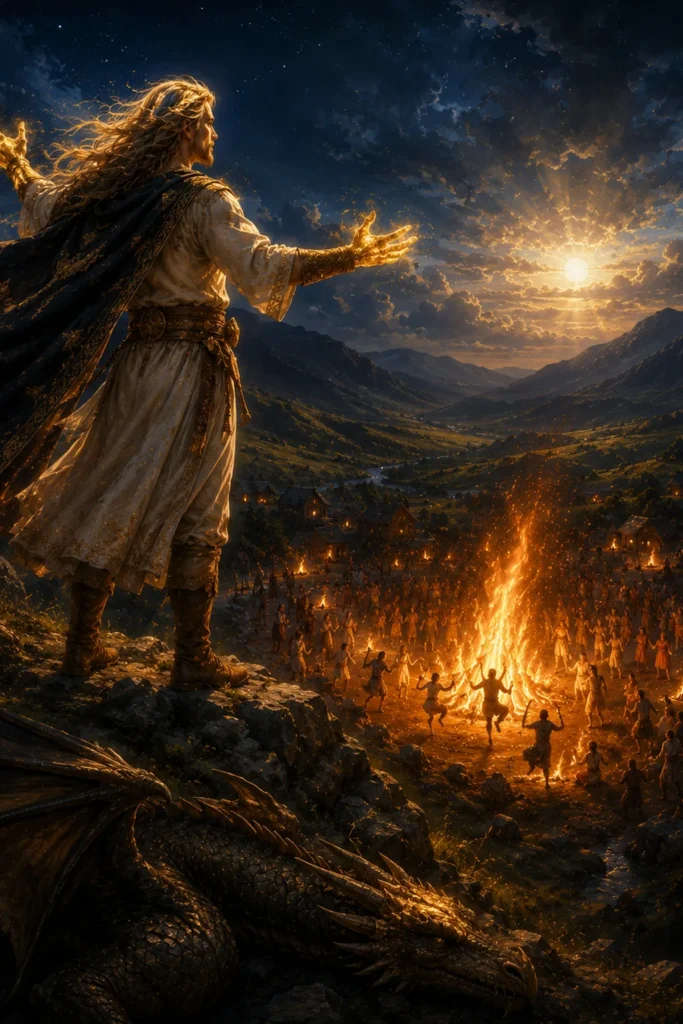
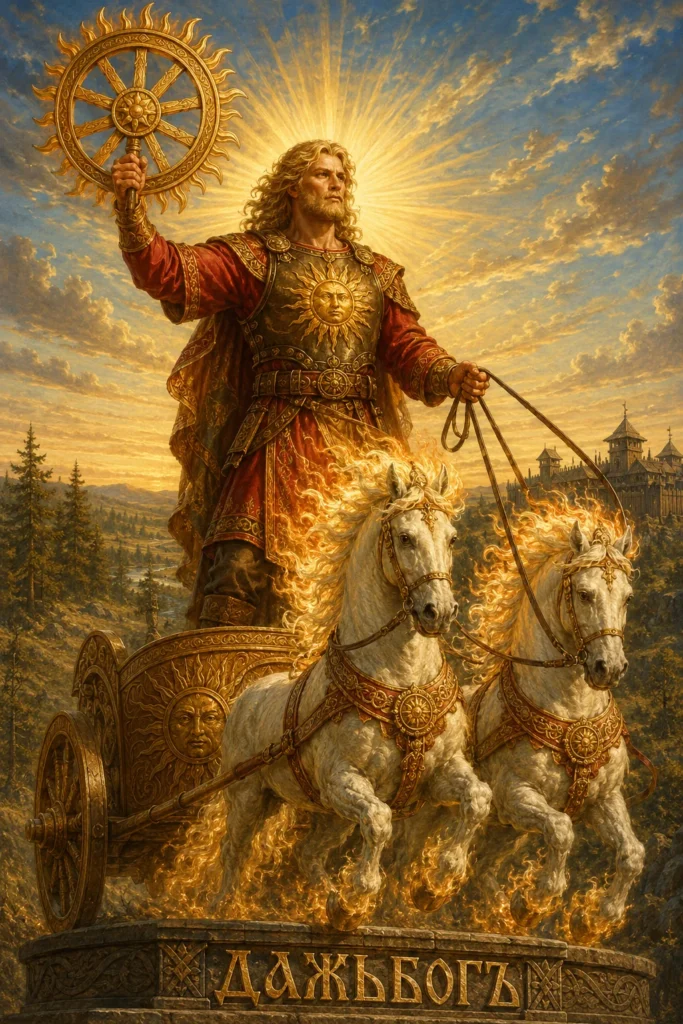
Dazhbog is a Slavic sun god who appears in the tradition as a giver of light, warmth and prosperity.
Dazhbog (also Dažbog, Dažboh, in Old Russian spelling Дажьбогъ) is a deity of sunlight and prosperity in the Slavic pantheon. His name is traditionally interpreted as “giver god”, from Proto-Slavic “dati” (to give) and “bogъ” (god, share).
Compared with Greek, Roman or Germanic gods, the source material is thin: Dazhbog appears in only a few written sources, above all from Kievan Rus, and his reconstruction relies heavily on indirect evidence from language history, folk tradition and comparison with the Indo-Iranian pantheon.
Table of Contents
Source Material and Etymology
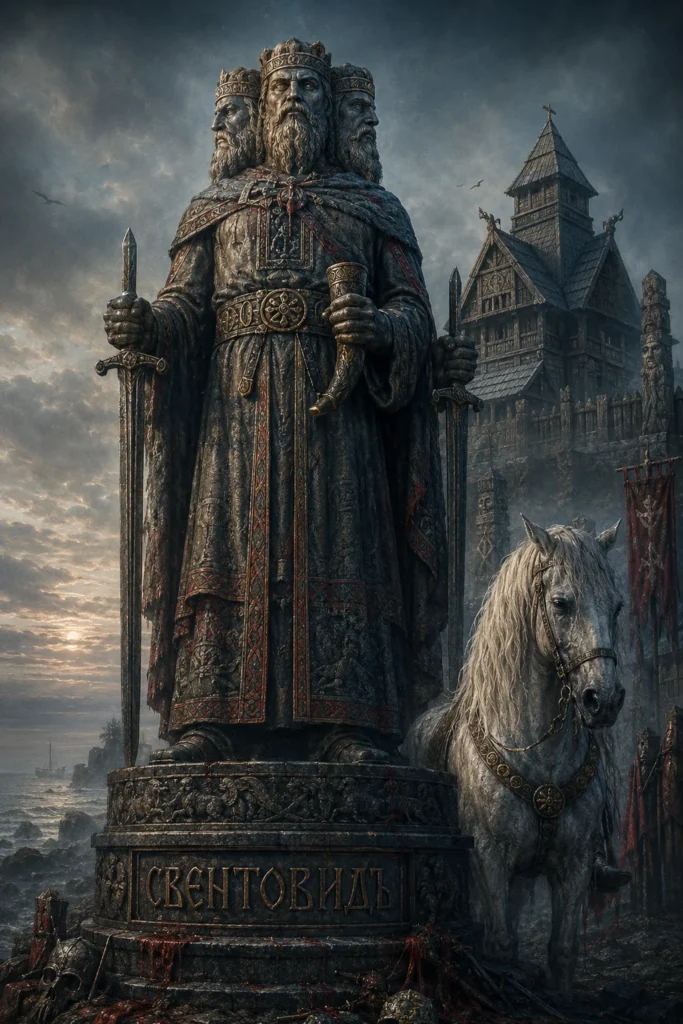
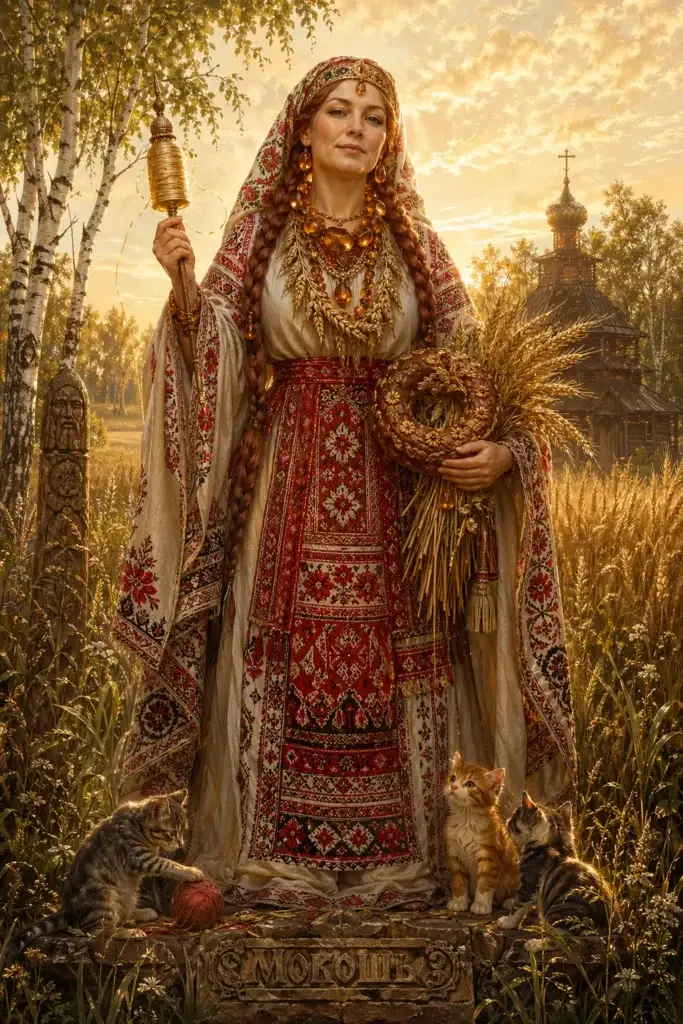
The most important source for Dazhbog is the “Nestor Chronicle” (also “Povest’ vremennych let”, composed between 1110 and 1118) in the entry for the year 980. It reports that Grand Prince Vladimir I of Kiev, during his pagan phase, had six images of gods erected on the castle hill above Kiev: Perun, Khors, Dazhbog, Stribog, Simargl and Mokosh.
This so-called “Vladimir’s group of six” is regarded as the most important testimony for an official pantheon of the pre-Christian East Slavs.
A second central source is the “Slovo o pluku Igoreve” (“Tale of Igor’s Campaign”, late 12th century), in which the Rus are called “Dazhbog’s grandsons” (“Dazhbozi vnutsi”). This genealogical self-description is especially important for the history of religion, because it shows that Dazhbog was conceived as the progenitor or ancestor of the Russian warriors.
A third source is the “Malalas Chronicle” in Old Russian translation (Hypatian manuscript, 15th century), in which a gloss identifies Dazhbog with the Greek Helios and names him as son of Svarog.
This passage is the most important genealogy of Slavic paganism, but its historical reliability is disputed: Boris Rybakov took it as authentic testimony, while Aleksander Gieysztor saw it as a later construction that integrated Slavic gods into the Greek divine family tree.
Myth and Function
The mythical narrative world of Dazhbog can be grasped only in fragments. From the Malalas gloss it follows that he was conceived as son of Svarog (the smith god) and thus son of Hephaestus (according to the Greek identification).
In Ukrainian and Belarusian folk tradition he appears as the bringer of summer, of wealth and of sunshine. His counterpart is the night and winter; some folk traditions connect him with vegetation mythology and have him reborn in spring.
Vladimir Toporov and Vyacheslav Ivanov reconstructed Dazhbog in their structuralist works (especially “Issledovaniya v oblasti slavyanskikh drevnostey”, 1974) within the framework of an Indo-European inherited principal myth: as son of a sky god who stands in a structural relationship to the thunderer Perun. This reconstruction is, however, hypothetical; the direct sources do not support it.
Worship and Cult Sites
Specific cult places of Dazhbog are not clearly attested archaeologically. The group of statues of Vladimir mentioned in the Nestor Chronicle was destroyed in 988 during the Christianization of the Rus and thrown into the Dnieper.
Whether there were fixed temple buildings beforehand or merely open-air groves with statues is disputed; archaeological finds from Zbruch (recovered in 1848 in Galicia, a four-faced pillar) and Arkona (Rügen) suggest that at least in some regions there were cult complexes.
For the East Slavs the body of evidence is thinner than for the West Slavs.
Folkloric references to Dazhbog are found in the Ukrainian winter solstice tradition (“Kolyada”), in harvest festivals and in songs in which the sun is invoked as a “fatherly” power.
The connection of these songs with the old Dazhbog cult is, however, a hypothesis of the romantic folklore studies of the 19th century, especially of Oleksandr Famintsyn and Aleksandr Afanasyev; the methodological criticism of it has been sharp since the 1970s (Henryk Łowmiański, “Religia Słowian i jej upadek”, 1979).
History of Research and Points of Contention
Dazhbog research is a classic example of the difficulties of Slavic religious history. Aleksander Brückner (1856 to 1939) held a minimalist position in his works: Dazhbog was barely more than a name attested in literature, and the Slavs never had a pantheon of their own.
Boris Rybakov (1908 to 2001) went to the other extreme and, in “Yazychestvo drevnikh slavyan” (1981) and “Yazychestvo Drevney Rusi” (1987), reconstructed a complex pantheon with numerous layers, which current scholarship largely rejects.
Aleksander Gieysztor (“Mitologia Słowian”, 1982) sought a middle path and emphasized methodological caution: what we know with certainty is limited to the mentions in the Nestor Chronicle and in the Igor Tale. Everything that can be reconstructed beyond that remains hypothetical. This position is largely adopted by more recent scholarship (Jiří Dynda, Michael Shkapa).
Placement in the History of Religion
If Dazhbog’s connection with the sun and his position as son of Svarog are taken as secure, parallels emerge with the Indo-Iranian complex of the “sons of heaven”: Mitra (India, Iran) and Surya (India) as solar deities, Helios and Apollo (Greece), Sol Invictus (Rome).
The designation of the Rus as “Dazhbog’s grandsons” finds its parallel in the Germanic “sons of Tiu” and in the Aryan genealogy of the Iranian aristocracy as “sons of Mitra”.
In the phrase “Dažь-bogъ” (give-god) Toporov sees an archaic imperative that may originally have been a formula of invocation: “Give, God!” It would thus be a rare surviving trace of a Proto-Slavic prayer tradition.
Christianization and Afterlife
With the baptism of the Rus in 988 the official Dazhbog cult was extinguished; his statue was thrown into the Dnieper together with the others. The veneration of the sun as a fatherly power survived, however, in folk religion.
In Ukrainian wedding songs the sun appears into the 20th century as “father”, in Russian fairy tales as “red Solnyshko”. Whether these traces derive directly from the Dazhbog cult or reflect universal solar language remains open.
In Ukrainian nationalism of the 19th and 20th centuries Dazhbog was rediscovered as a symbol of the pre-Christian heritage. The neo-pagan Rodnovery movement (since the 1980s) has made him the central figure of a reconstructed pantheon, with its own festivals and liturgies.
This modern worship is to be assessed in the history of religion as a new construction and not to be confused with historically attested practice.
Cross-References
In the Slavic pantheon Dazhbog stands alongside Perun (thunder), Veles (cattle and the underworld), Stribog (wind), Svarog (sky and the forge), Mokosh (earth and weaving), Khors (the solar disc) and Simargl (a winged hybrid being of Iranian origin).
The relationship between Dazhbog and Khors is unclear; some sources seem to treat both as solar deities, others as a father-son connection or a doubling. Henryk Łowmiański held Khors to be an Iranian loan-name variant of the same function; Gieysztor saw both as deities with distinct profiles.
Sources
“Povest’ vremennych let” (Nestor Chronicle), entry for the year 980, critical edition by Dmitrij Likhachev, Moscow 1950. “Slovo o pluku Igoreve” (late 12th century), translation by Dietmar Endler, Leipzig 1971. “Chronicon Ioannis Malalae” in Old Russian translation (Hypatian manuscript, 15th century).
Aleksander Brückner, “Mitologia słowiańska”, Krakow 1918. Aleksander Gieysztor, “Mitologia Słowian”, Warsaw 1982, 3rd edition 2006. Boris Rybakov, “Yazychestvo drevnikh slavyan”, Moscow 1981. Boris Rybakov, “Yazychestvo Drevney Rusi”, Moscow 1987 (to be received critically).
Vladimir Toporov and Vyacheslav Ivanov, “Issledovaniya v oblasti slavyanskikh drevnostey”, Moscow 1974. Henryk Łowmiański, “Religia Słowian i jej upadek”, Warsaw 1979. Jiří Dynda, “Slovanské pohanství ve středověkých latinských pramenech”, Prague 2017. Michael Shkapa and other recent contributions in “Studia Mythologica Slavica”, Ljubljana since 1998.
Linguistic Distribution of the Attestations
The distribution of the Dazhbog attestations across the Slavic language area is uneven. In the East Slavic area Dazhbog is directly attested in the principal sources named. In the South Slavic area (Bulgarian, Serbian) the name appears in late medieval Church Slavonic translations as “Dabog” or “Daba”.
In Serbia a folk tradition exists about a “Dabog” as a chthonic ruler of the underworld, which represents a shift of function compared with the East Slavic sun god.
Henryk Łowmiański argued that the South Slavic variant is a secondary, Christianized tradition in which the pagan god was devalued into the dark adversary. In the West Slavic area (Polish, Czech) direct Dazhbog attestations are lacking. Vladimir Toporov advanced the thesis that Dazhbog was a specifically East Slavic principal god.
Folk-Religious Solar Invocations
The folk religion of the eastern and southern Slavs knows a multitude of solar invocations that could be indirectly connected with the Dazhbog complex. In Ukrainian wedding songs the sun is addressed as “father” or “grandfather”; in the Russian fairy tale the “Krasnoye Solnyshko” appears as a benevolent power.
In Serbian songs the sun is invoked as “Sunce djede” (sun-grandfather). These invocations are popular in character; their connection with a historically attested Dazhbog cult remains a hypothesis.
In the 19th century Aleksandr Afanasyev attempted to interpret these invocations systematically as remnants of a pre-Christian sun cult. This “solar mythology school” was critically questioned in the 20th century by Henryk Łowmiański and others; current scholarship often sees in such invocations generic religious language.
Christian Overlay
After the Christianization of Kievan Rus in 988 the old gods were officially banished, but their functions were in part transferred to Christian saints.
In the case of Dazhbog this transfer is less clearly demonstrable than with other deities (such as Perun and Saint Elias). Some researchers have established connections to the saints Boris and Gleb, others to the archangel Michael. These identifications remain hypothetical.
A clearer line runs to the Byzantine-Orthodox “Christos Pantokrator” depiction. In some East Slavic churches of the 11th and 12th centuries Christ was depicted with a halo of rays, an iconography that connects in the history of religion to the ancient sun cults (Sol Invictus, Helios).
That this pictorial tradition was taken up especially intensively in Slavic churches may have had to do with the population’s familiarity with solar religiosity.
Boris Rybakov and the Maximal Reconstruction
Boris Rybakov (1908 to 2001) is among the most controversial figures in Slavic religious history. In “Yazychestvo drevnikh slavyan” (1981) and “Yazychestvo Drevney Rusi” (1987) he reconstructed a highly complex pre-Christian pantheon in which Dazhbog plays a central role as sun god and patron of the warriors.
In doing so Rybakov relied on a very far-reaching interpretation of archaeological finds, on folkloric materials and on linguistic-historical speculation. His maximal position was criticized as excessive by Henryk Łowmiański, Aleksander Gieysztor and especially by more recent scholarship.
Despite this criticism, Rybakov’s work remains an important reference because of its wealth of material. More recent scholarship (Jiří Dynda, Michael Shkapa, “Studia Mythologica Slavica”) has tried to find a reasonable middle path: it adopts the collection of material but rejects the far-reaching reconstructions and places more weight on the directly attested sources.
Dazhbog in National Romanticism
With the rise of Ukrainian and Russian national romanticism in the 19th century, Dazhbog was rediscovered as a symbol of the pre-Christian heritage.
Taras Shevchenko and other Ukrainian poets refer to the “Dazhbozhij vnuk” (“Dazhbog grandson”) from the Igor Tale and make him a symbol of Ukrainian identity. In Russian symbolism of the early 20th century (Vladimir Solovyov, Alexander Blok) too, allusions to the pre-Christian sun god appear.
In the contemporary Rodnovery movement (Slavic neo-paganism, since the 1980s) Dazhbog is one of the central principal deities. The reconstructed liturgy comprises solar invocations, annual festivals at the solstices and equinoxes, and a writing system of its own. This modern worship is to be assessed in the history of religion as a new construction.
Comparison with the Indo-Iranian Solar Complex
Vladimir Toporov and Vyacheslav Ivanov compared Dazhbog with the Indo-Iranian solar complex. In the Indian pantheon he corresponds to functions performed by Surya (the sun as a cosmic power) and Mitra (the sun as orderer of society and guarantor of oaths).
In the Iranian pantheon he corresponds to Hvar (the sun) and Mithra. The designation of the Rus as “Dazhbog’s grandsons” has structural parallels in the Iranian aristocracy, which understood itself as “sons of Mitra”, and in the Germanic warrior class, which understood itself as “sons of Tiu” (sons of Tyr).
The etymological form “Daž-bog” (give-god) finds a parallel in the Iranian “Dāhē-baga” (“giver god”). Both forms are linguistically related and could go back to a common Indo-Iranian-Slavic layer.
In 1985 Roman Jakobson worked out this parallel in detail and thereby supported the hypothesis of an Iranian-Slavic layer of divine names in the early Slavic religion, which would also be at work in Simargl (clearly Iranian) and possibly in Khors.
Khors and Dazhbog: Doubling or Division of Function
An important question in the history of religion is the relationship between Dazhbog and Khors, both of whom appear in the Nestor Chronicle as members of Vladimir’s pantheon.
Both are associated in scholarship with the sun: Khors is frequently interpreted as the solar disc (from Old Iranian “hvarah” or “xšaeta”), Dazhbog as solar power and giver of prosperity. This doubling is unusual and has led to several explanatory models.
Henryk Łowmiański held Khors to be an Iranian loan-name variant of the same solar function that Dazhbog took on in popular belief. Aleksander Gieysztor saw in the two gods two aspects with distinct profiles: Khors as the visual phenomenon of the sun, Dazhbog as its effective power upon growth and prosperity.
Boris Rybakov reconstructed a more complex theology in which Khors and Dazhbog appear as a father-son pair. In his comparative Indo-European mythology, Vladimir Toporov pointed to the Vedic pair Surya and Savitar, who likewise represent two solar aspects.
Linguistic-Historical Derivations
The etymology “Daž-bog” (give-god) is today largely accepted. It is composed of the Proto-Slavic imperative “*daj-” (give) and “bogъ” (god, originally also “share, wealth”).
In 1985 Vladimir Toporov proposed that “bogъ” did not originally mean “god” but “share that is apportioned”; the principal religious meaning would be a secondary specialization. In this case “Daž-bog” would literally be “give-share”, that is, the god who apportions the share of life.
This linguistic-historical depth connects Dazhbog with the Indo-Iranian “baga” and “bhaga” complex. In the Persian pantheon “Baga” is an epithet of various gods; in the Vedic pantheon “Bhaga” is a god in his own right who allots the share of life.
Roman Jakobson used this etymology for an Indo-Iranian layer in the stock of Slavic divine names, which could also be at work in Simargl (clearly from Old Iranian “Senmurv”) and perhaps in Stribog.
Dazhbog in the Mythical Corpus of Folklore
The popular narrative tradition knows a series of stories in which the sun appears as a fatherly power. These narratives are not necessarily specific to Dazhbog, but they could preserve traces of an older sun cult.
In the East Slavic tradition the sun appears as “little red sun” (Krasnoye Solnyshko), often as a person who rides across the sky in a chariot, sinks in the west in the evening and rises again in the east the next morning.
In some narratives the sun has a son and a daughter. This family constellation recalls, structurally, Indo-Iranian conceptions.
In the Serbian folk tradition the sun is connected with Dabog, who, as mentioned, carries a dark coloring.
This chthonic turn is unusual in the history of religion and is interpreted by scholarship as a Christian overlay of an originally positive sun cult: with Christianization the pagan principal god was reinterpreted as the dark adversary of the Christian God, a pattern frequently observed in religious change.