Mokosh, goddess of the Slavic tradition
By Ralf Ittermann · last reviewed on
Mokosh is the earth goddess and household protectress of Slavic religion. She governs moisture, the fertility of the soil, women’s crafts and the safety of the family. Attested in the Nestor Chronicle and in church prohibition texts, and active in folklore down to the present day.
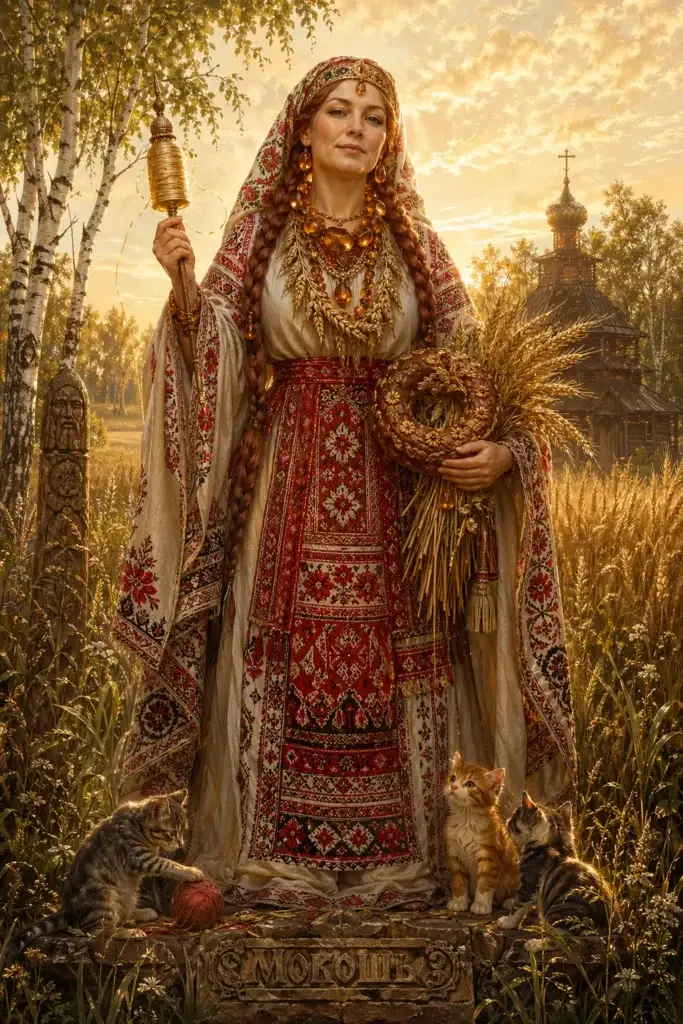
Mokosh
In primary sources (the Nestor Chronicle), Mokosh is described simply as a ‘goddess’ without further attributes. She protects spinning, weaving and women’s crafts; her sacred sign is the moist earth. In many Slavic cultures she lives on as ‘Mokosha’ or ‘Mara’ in folk tales.
At a glance: Mokosh
Type: Principal Slavic goddess, goddess of earth, motherhood and spinning
Pantheon: Slavic (especially East Slavic)
Function: earth, female fertility, the spinning of fate, household protection, water aspect
Principal attributes: spinning wheel, distaff, horns (sometimes), moist earth, water springs
Principal place of worship: Kiev (Vladimir’s pantheon before 988, the only female deity in the list)
Christian reattribution: St. Paraskeva Pyatnitsa (“the Friday saint”)
Historical Context
Period of the Texts
Mokosh (Russian Mokosh’, Polish Mokosza) is the most important female Slavic deity. In Vladimir’s pantheon (980 in Kiev) she appears as the only woman alongside Perun, Khors, Dazhbog, Stribog and Simargl. Her name derives from mokr- (“moist”); she is the moist mother earth.
Main period of flourishing: pre-Christian times. Christianization saw her cult survive as Paraskeva Pyatnitsa (the Friday saint in Russian Orthodox folk belief), who is likewise patroness of spinners and guardian of springs. Documented ethnographically in the 19th and 20th centuries; venerated again in the modern Rodnovery tradition.
Area of Distribution
Principal place of worship: Kiev (Vladimir’s pantheon, 980-988). Beyond that, local sanctuaries at springs, wells and old oak groves. In Russian Orthodox folk belief she remains present to this day under the name Paraskeva Pyatnitsa, with her day (Friday) and her spring sanctuaries.
In the modern Rodnovery tradition (the Russian, Polish and Ukrainian Slavic pagan movement) she is once again venerated as central, especially in women’s initiation rituals.
Source Situation
Central sources: the Nestor Chronicle (Vladimir’s pantheon list), Russian folk songs and ethnographic collections of the 19th century (especially Afanasev), folk customs surrounding Paraskeva Pyatnitsa.
Secondary literature: Váňa, Mythology of the Slavic Peoples; Ivánov/Toporov; Hubbs, Mother Russia. The Feminine Myth in Russian Culture; Pittner, Slavic Mythology; Rybakov, Pagan Worldview of the Ancient Slavs.
Designation and Spellings
Mokosh is depicted as a full, fertile woman, broad-shouldered, with an erotic and generative emphasis on belly and breasts, a symbolic image of nourishment and life. Long blond or reddish hair, often gathered into braids or plaits. Her hands are active and practical, often shown in the motions of spinning or weaving.
The sacred symbols are flax, water (especially river springs and wells), the full or waxing moon, and the spinning spindle.
Characteristics
Mokosh presided over all the work of women: spinning, weaving, sewing, the manual arts that sustained and adorned life.
Her offerings were modest and humble: bundles of flax, cheese, milk, bread.
Rich harvests and successful births were attributed to her and thanks were rendered to her. The cult was primarily female in character: women led the rites, and men deliberately kept their distance.
After Christianization, Mokosh was transformed into the holy Friday (in some traditions) or into the birth of Mary, yet beneath the Christian surface she remained alive: older women prayed to her when the umbilical cord was cut, and whispered her name over flax.
Profile: Mokosh
The most important aspects of Mokosh at a glance. The fields below summarize origin, function, appearance, veneration, symbols and cultural parallels.
Mokosh's Origin
Mokosh is the moist mother earth (Mat’ Syra Zemlja, “Mother Moist Earth” in Russian folk formulas, often used synonymously).
Her genealogical position within the Slavic pantheon is not consistently fixed; in some theories she is the consort of Perun (a complementary thunder-and-earth pairing), in others the consort of Veles (a chthonic and moist pair). Mother of several demigoddesses (Dolja and Nedolja, “fortune” and “misfortune”).
Mokosh's Audience
Mother earth and patroness of female fertility. Spinner of fate, she spins the yarn of every human life (similar to the Moirai or the Norns). Patroness of spinners, weavers and embroiderers (a central importance in traditional Slavic women’s domestic work).
Patroness of springs and wells. In personal folk worship she was invoked during labor pains, before marriage, and in female life crises. In modern Rodnovery she is the principal goddess of women’s blót gatherings.
Depiction
Characteristically depicted as a matronly female figure with long dark hair, in Slavic courtly dress with rich embroidery (she is patroness of the art of embroidery). Frequently a spinning wheel or distaff in her hand.
In very old depictions with horns (presumably bull’s horns, a symbol of the earth’s fertility, a link to the Indo-European mother goddess tradition). Brown skin color (an earth symbol). In modern Rodnovery imagery typically as a matronly queen of the earth with a sheaf and a distaff.
Function
Sphere of action: Mokosh was invoked daily in the Old Slavic household cult; every spinner prayed to her before beginning her work. Friday was her sacred day (in many Slavic regions it was taboo to spin on Friday, because that would disturb Mokosh’s yarn).
Folk customs surrounding Paraskeva Pyatnitsa (the Christian reinterpretation) were documented well into the 20th century: pilgrimage to springs, the consecration of embroidery, invocations at birth. In the modern Rodnovery tradition there are women’s initiation blót and house consecrations.
Forms of Protection
Spinning wheel, distaff, yarn, horns (in old depictions), richly embroidered courtly dress, moist earth, spring, well. Sacred plants: flax (the material of her spinning), hemp, barley. Sacred animals: sheep (wool), spider (spinning). Sacred day: Friday.
Related Beings
Paraskeva Pyatnitsa (Russian Orthodox, the Christian reinterpretation), Mat’ Syra Zemlja (Russian, the “Mother Moist Earth” concept, often identified with Mokosh), Demeter (Greece, mother earth), Ceres (Rome), Gaia (Greece, the primordial earth), Pṛthivî (Hinduism, mother earth), Frigg (Germanic, a spinner aspect), Inari (Japan, rice goddess, a partial parallel), Pachamama (Inca).
Functionally, all earth and spinner goddesses share aspects of Mokosh.
Mokosh, Parallels in Other Cultures
Mokosh corresponds to the Greek Demeter (goddess of grain) and Gaia (earth goddess), the Germanic Nerthus and the Roman Tellus. The female mother earth is a universal archetypal pattern; Mokosh’s distinctiveness lies in her direct coupling with craft: she is not abstractly maternal but concretely active.
Jewish tradition: Lilith and the Shekhinah share with Mokosh aspects of femininity, of the household and of earthly grounding, although Shekhinah corresponds more to the transcendent dimension.
Greco-Roman world: Demeter and Hera embody earth and household; Demeter through agriculture and fertility, Hera through familial authority, both united in Mokosh.
Germanic tradition: Frau Holle and Frigg govern the household, the art of spinning and the blessing of the earth, functions that Mokosh shares. Folk-etymological continuities point to an Indo-European earth goddess.
Hinduism: Prithvi, the earth goddess, and Lakshmi, the goddess of prosperity, combine Mokosh-like functions: earth, fertility, blessing for household and craft.
Mokosh in the Chronicle and in the Idol Statue of Kiev
Mokosh is the only female deity named by name in the most important written source on the pre-Christian religion of the East Slavs.
The Nestor Chronicle, also called the Tale of Bygone Years, reports that the Kievan prince Vladimir, in the year 980, that is, shortly before his own conversion to Christianity, had idols set up in Kiev. In the enumeration of these gods, Mokosh appears alongside Perun, Khors, Dazhbog, Stribog and Simargl.
This mention carries great weight, because it shows that Mokosh was not merely a figure of peasant superstition but was taken up into the official state cult of the gods of Kievan Rus.
At the same time, the source is problematic: the chronicle was composed by Christian monks in the twelfth century, that is, more than a century after the events described. The authors had no interest in a favorable portrayal of paganism, and it is not certain how accurately they still knew the older religion.
About Mokosh’s position within this pantheon the chronicle says nothing further. Scholarship has drawn inferences from her position in the enumeration, from later ecclesiastical prohibition texts, and from folk tradition.
Ecclesiastical penitential books and sermons of the following centuries repeatedly name Mokosh among the forbidden forms of veneration, which suggests that her cult long lived on after Christianization, above all among women and in the rural sphere.
Etymology and Spinning as a Theme of Life
The name Mokosh is linguistically contested, and scholarship has proposed several interpretations. A widespread explanation connects it with the Slavic word root for “wet” or “moist,” which would make Mokosh appear as a deity associated with moisture, earth and fertility.
Another interpretation, advanced by the linguist Roman Jakobson, links the name with words for spinning and plaiting, that is, with the activity of processing flax and wool.
The two interpretations are not mutually exclusive, for in Slavic folk tradition Mokosh appears closely bound up with spinning and weaving. She was regarded as the protectress of women and their handwork and at the same time as a strict overseer.
A well-known popular notion holds that on Friday, the day assigned to her, one was not permitted to spin; if one did so anyway, Mokosh could come by night, tangle the yarn or punish the spinner. In some regions it was said that an invisible woman touched the work left lying overnight.
Spinning is, in many cultures, connected with the notion of fate, because the thread is an old image for the course of life.
Whether Mokosh was originally also a goddess of fate in the narrower sense cannot be proven beyond doubt from the sources, yet the close bond to thread and yarn suggests such a layer of meaning.
In terms of religious studies, Mokosh is thus an example of how a deity is defined through a concrete, everyday activity and precisely thereby remains anchored in lived piety. Related figures are found in the wider milieu of Slavic tradition.
From the Pagan Cult to Saint Paraskeva
One of the most illuminating developments in the history of Mokosh is her partial fusion with a Christian saint after the conversion of the East Slavs.
Scholarship observes that many functions and attributes of Mokosh passed over to Saint Paraskeva, who became known in Orthodox folk piety as Paraskeva Pyatnitsa. The epithet Pyatnitsa means literally “Friday.”
This transfer is readily understandable in terms of religious history. Mokosh was associated with Friday, with the protection of women, with spinning and weaving, and with water.
Saint Paraskeva took over almost the same domain: she too was regarded as protectress of women, of handwork and of Friday; springs and wells were consecrated to her as well, and with her too there held the prohibition against spinning on her day.
The Christian saint thus took the place of the pagan goddess without entirely supplanting her functions.
Such processes of transfer are attested several times in the Christianization of Europe and are regarded in scholarship as evidence that religious needs persist even when the official framework of belief changes.
For the reconstruction of Mokosh, the connection with Paraskeva is a valuable detour: since the direct sources are so sparse, the narratives and customs surrounding Saint Paraskeva permit indirect inferences about the original profile of the goddess.
At the same time, scholarship counsels caution, because notions that have nothing to do with Mokosh may also have mingled in the cult of the saint. The separation of the two layers remains an open methodological task.
Source Situation, Reconstruction and the Limits of Knowledge
Mokosh belongs to those figures with whom scholarly restraint is especially important. The secure foundation is slim: the single mention in the Nestor Chronicle, a few ecclesiastical prohibition texts that list her name, and a broad but late-recorded folk tradition concerning the Friday prohibition and spinning. Everything beyond this is reconstruction.
Part of the popular literature presents Mokosh as a great earth and mother goddess, as the Slavic counterpart to great female deities of other cultures. Such portrayals go far beyond what the sources yield. They rest partly on comparative mythology, partly on modern desires for a powerful female deity.
Serious scholarship, such as the work on Slavic religion in the circle of Aleksander Gieysztor or the critical overview accounts of more recent times, by contrast emphasizes that much remains uncertain about Mokosh’s exact rank, her relationship to the other gods and the extent of her cult.
The thesis, widespread since the twentieth century, of a Slavic central myth in which Mokosh plays a fixed role as the wife or adversary of Perun is likewise regarded as hypothetical. It was elaborated above all by Vyacheslav Ivanov and Vladimir Toporov, but is contested on account of its far-reaching assumptions.
In terms of religious studies, Mokosh is therefore a lesson in the limits of reconstruction: a deity whose existence and cultic significance are secure, but whose concrete profile can be drawn only in cautious outlines.
Anyone wishing to learn more about the difficult field of sources will find further examples of this problem in the area of Slavic mythology.