Svarog, god of the Slavic tradition
By Ralf Ittermann · last reviewed on
Svarog is the sky god and father of the gods in Slavic mythology, often interpreted as a smith or fire god. He represents cosmic order, the culture of craftsmanship, and the creative fire. His presence in early medieval sources is disputed, but later folkloristic texts attest to him enduringly.
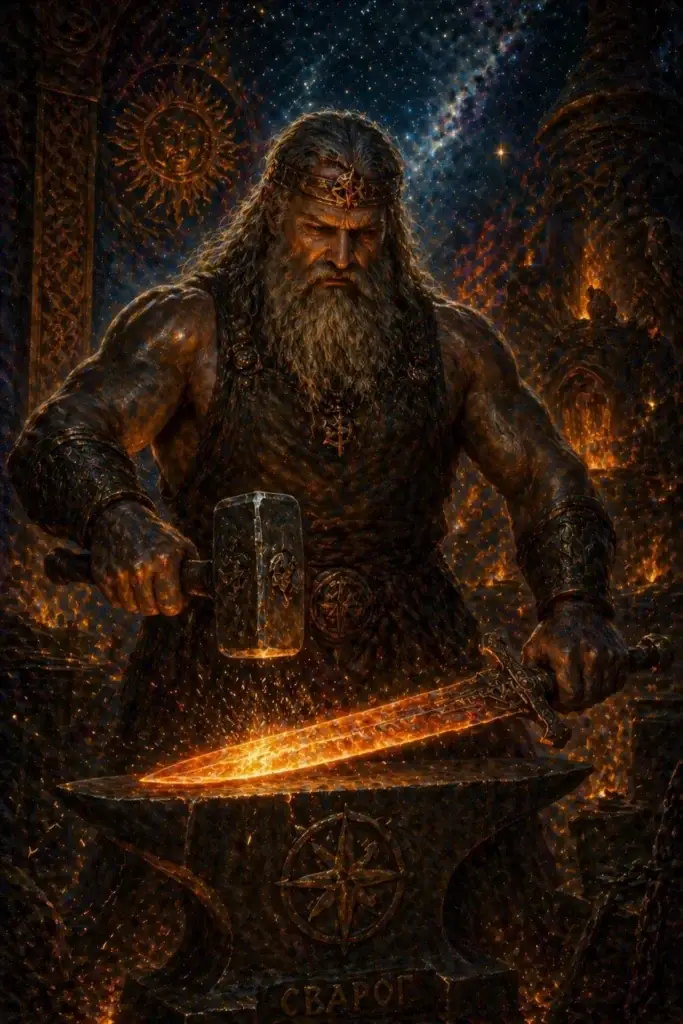
Svarog
Svarog is associated with the sky, fire, and the smith’s craft. The name is linguistically related to the Sanskrit word svar (sky). In folk texts he appears as the supreme god and father of Perun. His places of worship were elevated sites and fire altars.
Brief Profile: Svarog
Type: Slavic chief deity, smith and sun god, “father of the gods”
Pantheon: Slavic (East, West, and South Slavic)
Function: smith’s craft, fire, sun (in one tradition), creative role, father of Dazhbog
Main attributes: smith’s hammer, anvil, fire, sun disk
Main cult sites: Stettin (Pomerania), Rethra (land of the Lutici, mentioned by Thietmar), in Slavic smithing sanctuaries
Son: Dazhbog (sun god)
Historical Classification
Period of the Texts
Svarog (Russian Svarog, Polish Swarog) is a central Slavic creator deity. Main source: the Hypatian Chronicle (12th/13th century) interpolates a Greek chronicon with Slavic insertions, identifying Svarog with Hephaestus and his son Dazhbog with Helios.
Main period of prominence: pre-Christian times (until about 988). Thietmar of Merseburg mentions a temple of Svarozhich (son of Svarog) in Rethra in the land of the Lutici. Venerated again in the modern Rodnovery tradition, sometimes as the chief god (especially in Poland).
Area of Distribution
Main cult sites: Stettin in Pomerania (with the famous three-faced Triglav idol, in which some scholars identify Svarog), Rethra (the main Mecklenburg sanctuary of the Liutizians).
Slavic smithing sanctuaries in many regions. Venerated as the chief god in the modern Rodnovery movement (especially its Polish branch); in Russia regarded as one of the chief gods.
Source Situation
Central sources: the Hypatian Chronicle (12th/13th century, with the Svarog, Hephaestus identification), Helmold of Bosau, Chronica Slavorum, the Primary Chronicle. Folk tales, ethnographic collections of the 19th century. Secondary literature: Vana, Mythology of the Slavic Peoples; Ivanov/Toporov; Pittner, Slavic Mythology; Brueckner, Mitologia Slowianska.
Designation and Spellings
Svarog is depicted with certain iconographic elements that are symbolically encoded and carry deep meaning. These elements convey, in a central way, the functions, sources of power, area of responsibility, and cosmic role of this entity.
The visual system allows initiates and those culturally educated to grasp the deeper meaning. Colors, sacred objects or weapons, physical attributes, specific accessories, all are significant and traditionally transmitted. The system remains stable and recognizable across generations, which points to fundamental archetypal structures.
Description
Svarog was central to the religious practice and everyday understanding of the Slavs. People turned to this entity in critical situations or at particular ritual times of the year, with structured rituals, prayers, or offerings. The practice was precisely transmitted and often led by priests or specialists.
The continuity of these practices across many generations shows that they were regarded as effective and necessary. The functions were varied: preventive (warding off misfortune), healing (alleviation of suffering), transformative (accompaniment through transitions), and protective (continuous watchfulness).
Appearance and Symbolism
Svarog is depicted as an aged, powerful man, often with a smith’s hammer. The heavenly fire and lightning belong to his attributes. Craftsmanship is his domain. Fire, gold, and smithing tools symbolize his power.
Profile: Svarog
The most important aspects of Svarog at a glance. The following fields summarize origin, function, appearance, veneration, symbols, and cultural parallels.
Origin
Svarog is the father of the gods in the Slavic creation tradition (according to some sources). Father of Dazhbog (“giver god,” sun god) and of Svarozhich (“Svarog’s son” = fire god).
His name derives from the Indo-European svar- (“sky,” compare Sanskrit svar = sun, sky). In the Hypatian Chronicle he is identified with the Greek Hephaestus, hence his smithing function. In modern Rodnovery theology he is often understood as the “uncreated creator.”
Associated With
Patron of smiths and god of fire. In the Hypatian tradition he teaches people the smith’s craft and the forging of iron, thereby bringing the technology of civilization. He grants humankind the right to property (through the definition of tools and weapons).
In some traditions a sun god (preceding his son Dazhbog), in others purely a smith god. In personal folk cult, invocation by smiths, metalworkers, and firefighters. In the modern Rodnovery tradition, invocation in the crafts trades.
Depiction
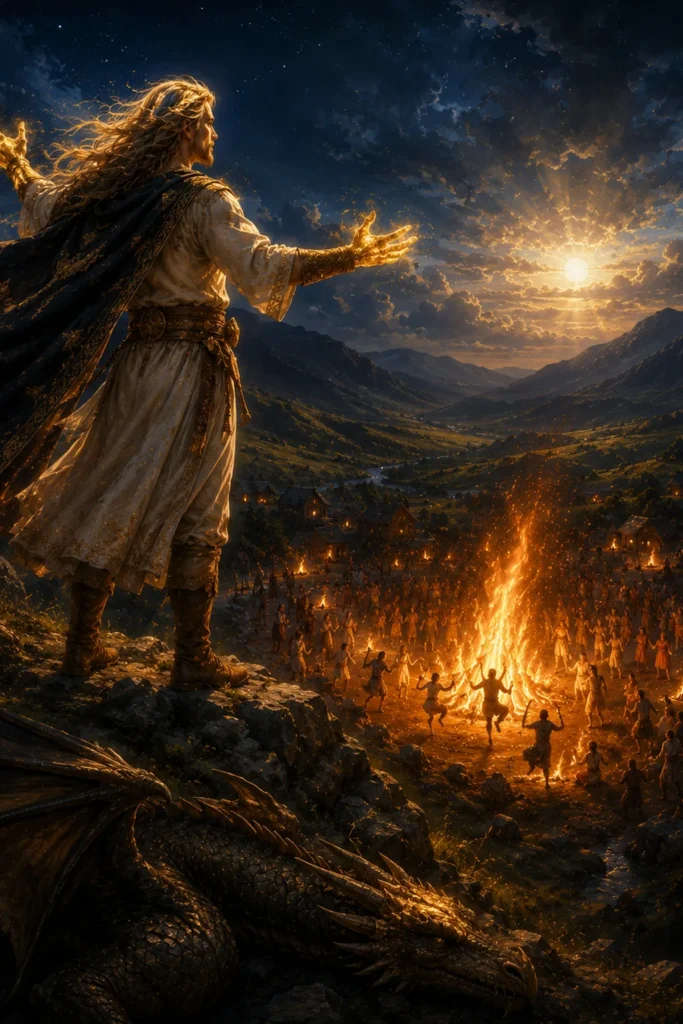
Characteristically depicted as a bearded, powerful smith in Slavic dress, with a leather apron, hammer, and anvil. Frequently shown before the forge fire.
In later Rodnovery pictorial art also as a sun god with a sun disk and a crown of rays. Sometimes with a long grey beard (an aged father figure). Skin reddened by fire and smithing work.
Activity
Sphere of effect: In the Old Slavic folk cult, smiths and metalworkers were invoked under Svarog’s patronage. Smiths themselves held a sacral status in the Slavic folk tradition (similar to many other archaic cultures); smithing was regarded as a magical art that transforms matter.
In the modern Rodnovery tradition (especially the Polish and Russian branches) he is the chief god of creation theology. Sacred weekday: in some traditions Wednesday (in others Sunday).
Protection
Smith’s hammer, anvil, fire, sun disk (in the sun function), leather apron, beard, tools (tongs, chisel). Sacred animals: horse (Hephaestus parallel tradition), eagle. Sacred plants: oak (source of firewood). Sacred element: fire. Sacred day: Wednesday (in some traditions).
Counterparts
Hephaestus (Greece, directly identified in the Hypatian Chronicle), Vulcanus (Rome), Tvashtri (Hinduism, Vedic smith god), Vishvakarman (Hinduism, architect of the gods), Goibniu (Celtic, smith), Ilmarinen (Finnish, creator-smith), Ptah (Egypt, creator and patron of craftsmen), Wieland (Germanic, mythical smith). The Indo-European smith-god tradition is widely attested; Svarog is the Slavic variant.
Svarog, Parallels in Other Cultures
Svarog parallels the Greek Hephaestus and the Germanic Wieland: smith god and cosmological ordering figure at once. In the Slavic system he appears as the father of Dazhbog together with the sun, a genealogical link between the smith’s craft and the solar fire, which in the classical pantheon would be separate figures.
Jewish tradition: YHWH as creator and heavenly god shares with Svarog the function of supreme lord of order and cosmic authority.
Greco-Roman world: Zeus/Jupiter as sky god and Hephaestus as smith god (comparable to the Roman Vulcan) share Svarog’s functions. The Indo-European sky-god genealogy is attested.
Germanic tradition: Odin and Wodan embody cosmic order and wisdom, similar to Svarog’s celestial function. The smith god Wayland shares the artisanal dimension.
Hinduism: Surya as sky god and Vishvakarman as cosmic craftsman and creator correspond to Svarog’s dimensions.
The Hypatian Chronicle: the narrow textual basis
We know surprisingly little about Svarog, and the little we have stems almost entirely from a single passage. The Hypatian Chronicle, an East Slavic historical compilation, transmits under the year 1114 an insertion that equates an Old Slavic deity with the Greek Hephaestus and with the sun.
This insertion is a translation, or rather adaptation, of the Byzantine chronicle of John Malalas, in which Egyptian kings were originally the subject.
The Slavic adapter replaced the foreign names with native ones: the sun king became Dazhbog, son of Svarog, who was identified with Hephaestus and understood as the god of fire and the smith’s craft. From this passage comes all the reliable information about Svarog. Everything further is reconstruction.
Scholarship has inferred from the patronymic Dazhbog Svarozhich, “Dazhbog, son of Svarog,” that Svarog may have been a father deity of the sky and of fire.
Linguistically, the name is often connected with a root said to be related to “radiance,” “sky,” or to the Sanskrit word svar for “sky.” This etymology is widespread but not undisputed, and it should be treated with caution.
Whoever speaks of Svarog speaks of a deity whose profile scholarship assembles from a single medieval text fragment and from linguistic indications.
Svarozhich: the son better attested than the father
It is remarkable that the sources report more about Svarog’s offspring than about him himself. The name Svarozhich, that is, “little son of Svarog” or “the Svarog son,” appears in two mutually independent witnesses from the West Slavic region.
Around 1018, Thietmar of Merseburg describes in his Chronicle the sanctuary of Riedegost in the land of the Lutizians, where a god named Zuarasici is said to have been venerated. Bruno of Querfurt names the same name in a letter to Emperor Henry II.
These West Slavic attestations raise a methodological problem. Is Svarozhich a proper name of an independent fire deity, or is it, as the East Slavic material suggests, a patronymic of Dazhbog? Scholarship debates this to this day.
Some Slavists hold Svarozhich to be an independent designation of the sacred fire, others a byname applied to various deities depending on the region.
What follows from this for Svarog himself must be formulated cautiously. The wide geographical spread of the name stem, from East Slavic to the Lutizians on the Baltic, argues that the underlying conception was old and supra-regional. But it does not permit a detailed mythology.
Later Romantic and national-Romantic authors expanded Svarog into a powerful sky and creator god, often with invented details. Such embellishments belong to the history of reception, not to source criticism. A serious account must leave the gap open.