Veles, God of the Slavic Tradition
By Ralf Ittermann · last reviewed on
Veles is the god of the underworld, of cattle, of trade and of cunning in the mythology of the Slavs and part of the Slavic religion. He embodies the chthonic force, prosperity through possessions and the boundary between life and death. His iconography is not archaeologically secured and is reconstructed from folklore.
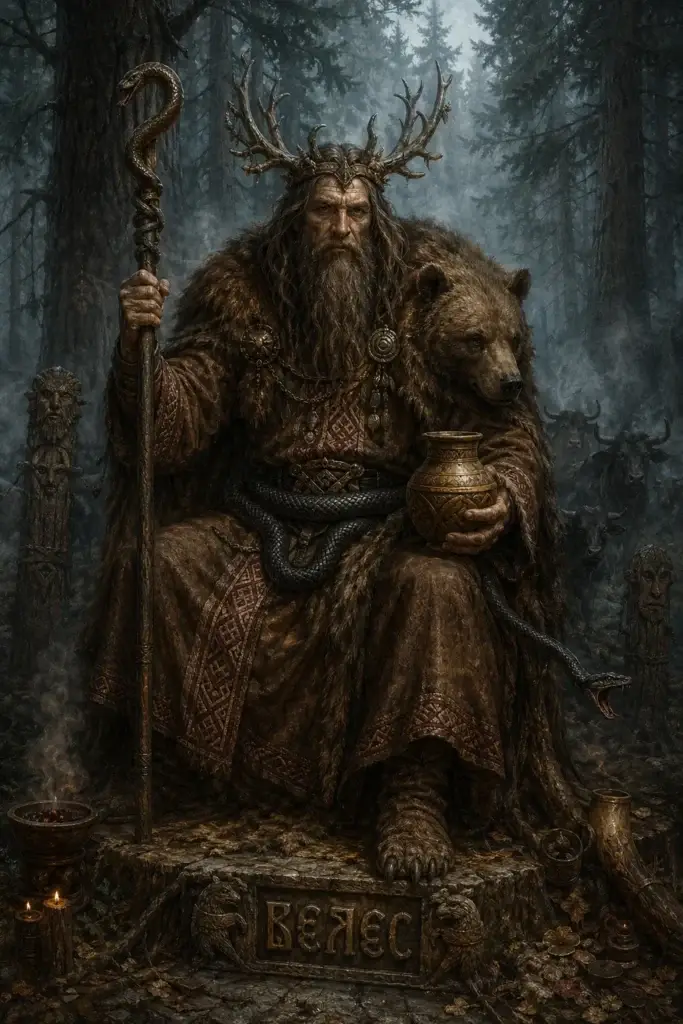
Veles
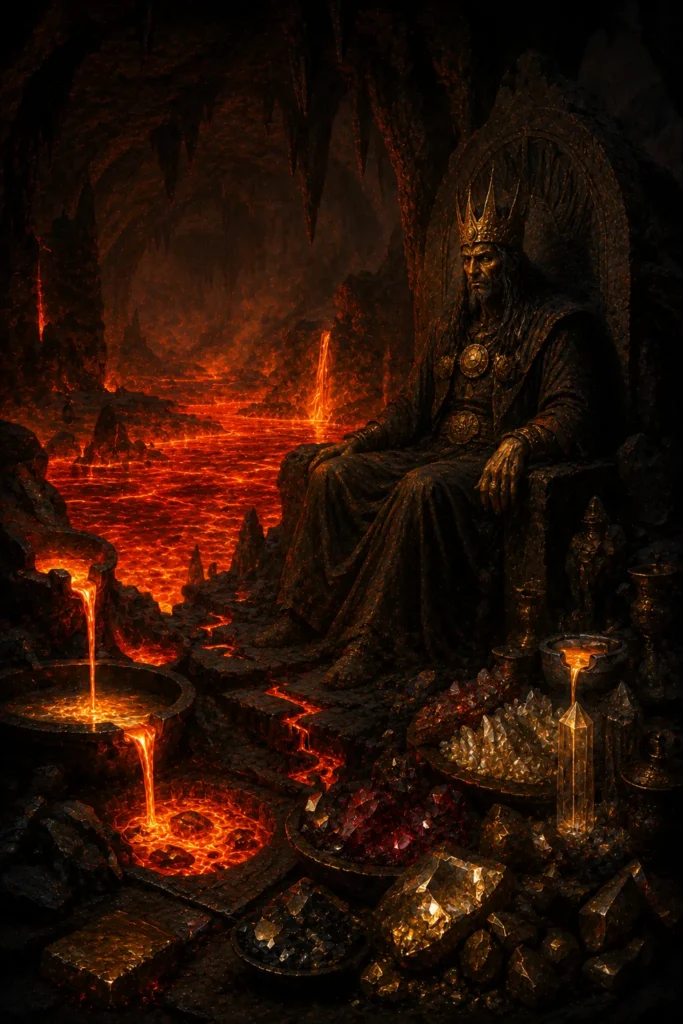
Veles is often portrayed as the antagonist or dual counterpart of Perun. He rules over forest springs, herds of cattle and underground treasures.
The act of swearing an oath before Veles is significant in the history of cult practice (the “oath upon the earth”). In folklore he lives on as a forest master, water spirit or devil.
Quick Overview: Veles
Type: Major Slavic deity, serpent god of the underworld, magic and cattle
Pantheon: Slavic (East, West and South Slavic)
Function: cattle, wealth, magic, poetry, contracts, the realm of the dead, eternal antagonist of Perun
Main attributes: serpent form, beard, horns, cattle, treasure
Main cult sites: Kiev (outside the city walls, in contrast to Perun’s temple within), bear caves, iron and ore mines
Indo-European kinship: the Indo-Iranian Vala serpent, the Baltic Velnias
Historical Classification
Period of the Texts
After Perun, Veles is the most important Slavic deity, attested in all three Slavic language groups. He is also called Volos in Russian sources.
Main period of flourishing: the pre-Christian era (until about 988). An important source: Russian oath formulas that invoke Volos and Perun together (treaties between Byzantine emperors and the princes of Kiev in 907 and 944).
In contrast to Perun, Veles typically had his sanctuaries outside the city walls or in the lower town; his chthonic character required separation from the heavenly sphere. He is venerated again in the modern rodnovery movement.
Area of Distribution
Main cult sites: in Kiev outside the city wall (at the Podol harbour, in contrast to Perun within the princely fortress), and in Novgorod likewise separate from Perun’s sanctuary.
Bear caves in the Slavic mountain regions were regarded as the sites of his manifestation. Iron and ore mines (his treasure aspect). He is venerated again in the modern rodnovery tradition, in Russia, Poland, Ukraine and the Czech Republic.
The Source Situation
Central sources: the Primary Chronicle (with Veles oath formulas), oath formulas from Byzantine treaties (907, 944), folk tales, folk songs, and the disputed Book of Veles (a modern 20th-century manuscript, classified by scholars as a forgery, yet widespread in rodnovery circles).
Secondary literature: Váňa, Mythology of the Slavic Peoples; Ivánov/Toporov; Belaj, Hod kroz godinu (Croatian, the standard work on Slavic mythology); Pittner, Slavic Mythology.
Name and Spellings
In the available sources Veles is often portrayed as a dragon-like being, a giant serpent or a wolf: a threefold shape that moves between the worlds and never remains fixed.
Sometimes he is described as an old man with a serpent in place of one leg, or as a being with goat-like features (horns, a bearded face).
His body is not human but hybrid and animal. His attributes are treasures, coins, gemstones and other precious hidden things.
In the repertoire of symbols the coiling spiral appears, a timeless pattern that signifies turning and transformation. The golden necklace of Veles, mentioned in various legends, was a sign of wealth and of magical binding to him.
Character Traits
Veles ruled over the invisible, hidden forces: sorcery, the art of healing, divination and the spirits of the dead. Shamans and magicians venerated him in whispers and in nocturnal rituals.
Merchants prayed to him for profit in barter and trade, especially on dangerous journeys. His offerings were subtle and indirect: bread placed in rivers, coins left in caves, quiet prayers without trumpets and dance such as accompanied the loud and joyful Perun.
After Christianization, the cult of Veles was the most stubborn to be suppressed, yet he lived on in the veneration of forest spirits (Leshy), in fairy tales of the dragon and the sorcerer, and in magical practices.
His connection to the dead and to the beyond made him a god to whom people turned in sickness, hardship and grief, with caution and respectful fear.
Profile: Veles
The most important aspects of Veles at a glance. The following fields summarize origin, function, appearance, veneration, symbols and cultural parallels.
The Origin of Veles
Veles is the chthonic antagonist of Perun, the eternal pair of conflict in Slavic mythology. In the central myth Veles climbs the world tree as a serpent, steals Perun’s cattle (or wife, or son) and hides. Perun pursues him, striking with thunder upon rocks, trees and earth, upon every one of Veles’ hiding places.
Veles is struck back down into the underworld, releases what he has stolen, and the rain brings fertility. This cyclical struggle explains thunder, rain and seasonal renewal. In Christianity he was reinterpreted as St. Blaise (Vlasij) (Slavic vlas = “hair”, a phonetic resemblance), the patron saint of animals.
The Audience of Veles
Diverse functions: patron of cattle (a key role in peasant tradition), patron of magic and soothsaying, patron of poets and skalds, patron of contracts and oath formulas, ruler of the underworld (Nav).
The oath “by Perun and Veles” means: by heaven and earth, by cosmic order and chthonic power. In the folk cult he was invoked for the health of cattle, a good harvest, financial success and magical abilities, an invocation for these ends.
The Appearance of Veles
He is characteristically portrayed in two main forms: (1) serpent or dragon shape, the principal mythic form in which he climbs the world tree; (2) anthropomorphic as a bearded man in shepherd’s garb or a black cloak, often with horns (bull or ram horns), a beard, a staff or a shepherd’s bag.
In some folk traditions he is depicted wearing a bear pelt (the bear being his sacred animal). In modern rodnovery imagery he is typically shown as a dark, powerful shaman with a serpent staff.
The Effect of Veles
Sphere of effect: Veles was invoked as patron of cattle in every farmhouse. His feast day in late February (in the Christian tradition the feast of St. Blaise, 11 February according to the Julian calendar, which corresponds to 24 February) is a day of protection for cattle. Shamanic practitioners (Slavic volchov) were regarded as his servants.
Before important contracts, the oath upon Veles was sworn. In peasant tradition there was the custom of the first sheaf being consecrated to Veles (“Velesov bart”). In modern rodnovery gatherings he is again central, especially in the shamanic line.
The Defence against Veles
Serpent shape, horns, beard, shepherd’s staff, bear pelt, treasure (gold and precious metal), the first sheaf (Velesov bart). Sacred animals: bear, serpent, wolf (in some versions), cattle in general. Sacred plants: oak (paradoxically also Perun’s, but in a different aspect). Sacred places: bear caves, mines, marshlands. Sacred day: 11 February according to the Julian calendar, which corresponds to 24 February.
Volos (Russian variant), Velnias (Baltic, a related serpent and death god), Vala (Hinduism, the Vedic demon serpent in the Indra myth, a shared Indo-European root), Vritra (Hinduism, another dragon antagonist of Indra), Apsu (Mesopotamia, chthonic fresh water), Hermes (Greece, patron of poets, of contract and of magic), Loki (Germanic, trickster, a similar antagonist of Thor).
Functionally, all serpent, trickster and magic gods share aspects of Veles. In a wider comparison: all antagonists of the thunder god (Vritra, Tiamat, Yamata-no-Orochi, Apophis).
Veles, Parallels in Other Cultures
Veles corresponds to the Baltic Vėlinas (god of the underworld), the Vedic Valas (demon and guardian of treasure), and, more distantly, the Greek Hades and Pluto.
The dragon aspect connects him with the Germanic Jörmungandr and the Egyptian Apep. His duality, evil and yet necessary, destructive and generative, wealth and ruin, is a recurring pattern of Indo-European mythologies.
Jewish tradition: Samael and the demonic lords of the underworld share with Veles the chthonic power and the role of opposition to a higher deity, a structural dualism pattern.
Greco-Roman world: Hades and Pluto rule the underworld and its riches like Veles. Hermes, as a god of boundaries and of trade, shares Veles’ functions in mediation and the increase of prosperity.
Germanic tradition: Loki and Odin share with Veles traits of cunning, of magic and of chthonic, boundary-crossing power, an Indo-European counterpart to the dual deity structure.
Hinduism: Yama, the lord of the dead, and Kubera, the god of wealth, in a certain sense combine Veles-like functions, the underworld and transition together with the administration of prosperity.
Veles and Perun: the Fundamental Mythological Conflict
The most influential modern interpretation of Veles is connected with the hypothesis of the Slavic basic myth.
In the 1960s and 1970s the Russian scholars of language and religion Vyacheslav Ivanov and Vladimir Toporov developed the thesis that at the centre of Slavic mythology stands a conflict between the thunder god Perun and his antagonist Veles.
According to this reconstruction, Perun is the heavenly god of the storm, while Veles is a deity of the underworld, of water, of cattle and of the dead, often with serpent-like or dragon-like features.
The myth describes how Veles steals Perun’s cattle or his wife, or holds back the heavenly waters. Perun pursues him, hurls his lightning bolts, and Veles hides successively in trees, stones, animals and people. In the end Perun strikes him, the withheld waters are released, and it rains.
This reconstruction rests on comparison with other Indo-European myths, especially on the widespread motif of the struggle between the storm god and the serpent, as well as on traces in folk songs, fairy tales and popular custom. It is, however, not undisputed.
Critics point out that there is no coherent Slavic source that tells this myth, and that the reconstruction relies heavily on analogical inference. The hypothesis should therefore be treated as a plausible but unproven model. It has nonetheless profoundly shaped scholarship and remains the most important point of reference for any engagement with Veles.
The Written Traces: Treaties, Chronicles, the Tale of Igor
Veles is one of the few Slavic deities whose name is actually attested in contemporary written sources, if only briefly. The most important source is the Old Russian Primary Chronicle, the “Tale of Bygone Years”.
It reports on treaties between the Kievan Rus and Byzantium in the 10th century, in which the Rus affirmed their oaths by swearing upon Perun and upon Volos, the “cattle god”.
This passage is illuminating in several respects. It attests, first, to the existence of the god under the name Volos; second, to his connection with cattle; and third, to his being named together with Perun, which fits the thesis of the antithetical pair.
It is notable that Volos, unlike Perun, does not appear in the chronicle among the idols that the Kievan prince Vladimir had erected. Scholarship debates whether this points to a different position in the official cult or to gaps in the transmission.
Another frequently cited passage stands in the Tale of Igor, an Old East Slavic heroic poem whose dating and authenticity were long disputed. There the singer Boyan is called the “grandson of Veles”.
From this scholarship has concluded that Veles may also have been connected with poetry, magical incantation and the ecstatic word, similar to what is attested for other deities of the “dark” sphere.
On the whole the written source situation remains thin, yet it is comparatively good for a Slavic deity, and it secures at least the basic outlines: cattle, oath, opposition to Perun, and a connection to the word.
Veles, the Sacred Beard Sheaf and Christianity
The veneration of Veles left traces in peasant popular custom, some of which were recorded by folklorists as late as the 19th and early 20th centuries. Especially well known is the custom of leaving a small group of uncut ears of grain standing in the field at the end of the harvest.
In several Slavic regions this tuft was called a “beard”, and in some areas explicitly the “beard of Volos” or, after Christian reinterpretation, the “beard of St. Nicholas” or of other saints.
Such customs are interpreted in scholarship as a possible echo of the cult of Veles. The stalks left standing were regarded as a gift to the power responsible for the fertility of field and cattle, and were meant to secure the yield of the coming year.
The connection to Veles cannot, however, be proven with certainty; it rests on the coincidence of name and function.
After Christianization, the functions of Veles were transferred to Christian saints. A widespread assumption in scholarship connects him with St. Blaise, whose name is phonetically close to Volos and who likewise was regarded as the patron saint of cattle. St. Nicholas too took on, in popular piety, traits that fit Veles.
This process, in which a pre-Christian deity continues to act under a Christian name, can be observed several times in Slavic religious history.
At the same time it makes reconstruction more difficult, because pagan and Christian layers can scarcely still be cleanly separated in the transmitted popular custom. Anyone seeking more about the antagonist will find further references in the entry on Perun.