iWell Guard

Dogoda, the mild west wind at second hand

Dogoda is allegedly a god of Slavic tradition.

The mild west wind that scholarship regards as a pseudo-deity.

Table of Contents

Dogoda, the disputed west wind of the Slavs
Dogoda

Dogoda is a supposed Slavic deity of the mild west wind and fine weather. Honestly and importantly: in scholarship, Dogoda is considered a pseudo-deity, probably a secondary reshaping of the already dubious chronicle name Pogoda through the Romantic mythography of the 19th century.

The early 16th-century chronicles consistently name Pogoda, Pochwist or Pogwizd, never Dogoda. The figure is thus above all an object lesson in how an invented layer of gods becomes supposed tradition through copying.

At a glance: Dogoda

Type: Supposed deity of the mild west wind, pseudo-deity
Origin: Romantic mythography of the 19th century
Texts: no old primary source; chronicles name only Pogoda, Pochwist or Pogwizd
Period: 19th century to present
Appearance: no traditional depiction, only modern fantasy imagery

Source context

Period of the Texts

The form Dogoda belongs to the Romantic mythography of the 19th century; no old primary source for the name exists.

Area of Diffusion

Allegedly Polish-Slavic. In reality Dogoda is found only in popular mythology and modern Paganism, not in historical folk belief.

Sources

Very weak: the 16th-century chronicles by Miechowita, Kromer, Stryjkowski and Gwagnin name Pogoda or Pogwizd, never Dogoda; the name is also absent in Długosz.

Name and variants

Polish: dogodny means pleasant or favourable and sounds close to pogoda, fine weather. This is exactly the crux of the matter: the form Dogoda is probably a late reshaping of the chronicle name Pogoda, arising within the Romantic-reconstructionist strand of the 19th century.

Nature and effect

Appearance

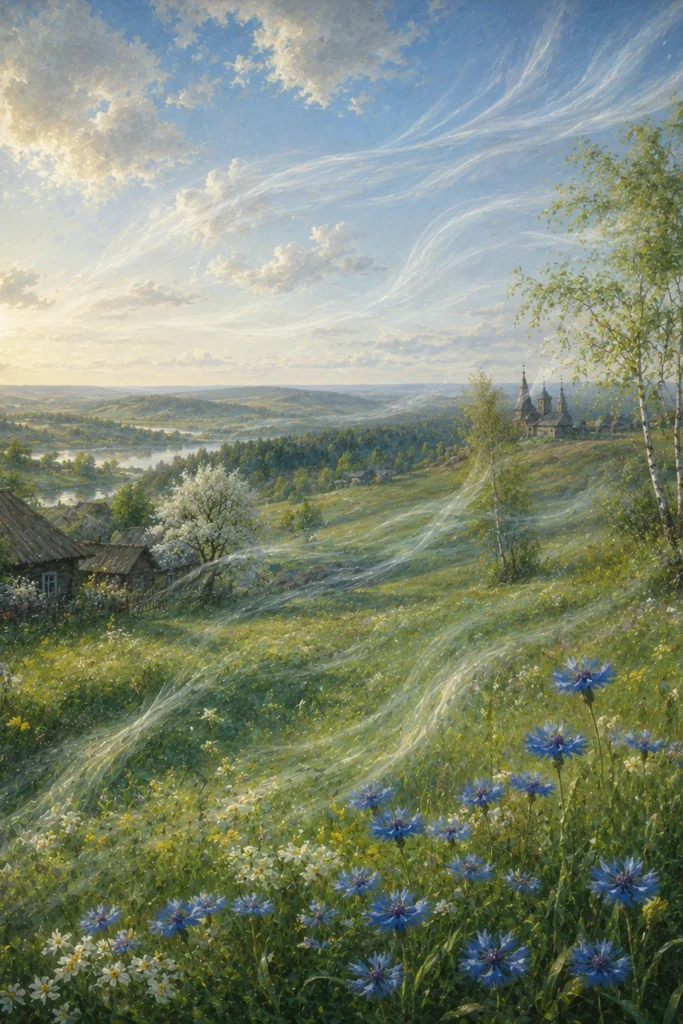
No traditional appearance exists. The circulating images of a blond youth with a wreath of cornflowers and butterfly wings are pure modern fantasy without source value.

Effect

Dogoda is allegedly the mild west wind, spring weather and kindness, a son of Stribog and counterpart to the stormy Pochwist. This genealogy is a modern invention.

Profile: Dogoda

The key aspects of the disputed figure at a glance.

Cultural Context

A product of 19th-century Romantic mythography; Aleksander Brückner exposed this constructed layer of gods as armchair mythology.

Relates To

Popular mythology and modern Paganism: there, Dogoda is firmly established as the god of the mild west wind and fine weather.

Depiction

No traditional iconography exists. The blond youth with a wreath of cornflowers and butterfly wings is modern fantasy.

Function

Allegedly the mild west wind, spring weather and kindness; the attributed genealogy as a son of Stribog is a modern invention.

Cult

No cult or protective practices have been handed down; any such details would be invented.

Distinctions

The genuine chronicle figure is called Pogoda or Pogwizd; the equation with Zephyros is part of the classicising construction.

From Pogoda to Dogoda: a history of a name

Polish dogodny means pleasant or favourable and sounds close to pogoda, fine weather. This is exactly the crux of the matter: the early 16th-century chronicles consistently name Pogoda, Pochwist or Pogwizd, never Dogoda, as in Miechowita, Kromer, Stryjkowski and Gwagnin; Dogoda is also absent in Długosz.

The form Dogoda belongs only to the Romantic-reconstructionist strand of the 19th century. Aleksander Brückner exposed this constructed layer of gods as armchair mythology: gods devised at the desk, to which no folk tradition corresponds. The fact that the underlying chronicle name Pogoda itself is dubious makes the evidence for Dogoda doubly thin.

Reception and assessment

Dogoda is a firm fixture of modern popular mythology, Polish neopaganism and fantasy; in academic Slavic studies he is absent or listed as a pseudo-deity.

From a religious-studies perspective: Dogoda is not an attested pre-Christian deity but, with high probability, a late reshaping of the already dubious chronicle name Pogoda, Brückner’s armchair mythology. The equation with Zephyros and the winged iconography are likewise modern inventions.

Cult forms: an honest assessment

No cult or protective forms are recorded for Dogoda; this must be stated honestly. Any such details would be invented. Those interested in historically attested protective customs against wind and weather will find them among the well-documented figures of Slavic wind belief, not in this nineteenth-century desk invention.

Zephyros, Pogoda and the real winds

As a mild west wind, Dogoda is equated with the Greek Zephyros, but this equation is itself part of the classicist construction. Factually closer is the genuine chronicle figure Pogoda or Pogwizd. A parallel case in the same problematic field is Varpulis, another supposed Slavic wind spirit without an old source.

Frequently asked questions about Dogoda

Is Dogoda a genuine Slavic god?

According to current research, no. Dogoda is considered a pseudo-deity, a late reshaping of the chronicle name Pogoda.

Where does the name come from?

Probably from the resemblance of dogodny, pleasant, to pogoda, good weather; the old sources write Pogoda.

Is the iconography old?

No. The fair-haired youth with wings and the equation with Zephyros are modern inventions.

Further links

Recommended internal links:

Literature (selection)

A selection of key sources and studies:
  • Brückner, Aleksander: Mitologia słowiańska i polska. Warsaw 1918.
  • Gieysztor, Aleksander: Mitologia Słowian. Warsaw 1982.
  • Gwagnin, Alexander: Sarmatiae Europeae descriptio. Kraków 1578.

Further standard works in the bibliography. Note: the old sources name Pogoda or Pogwizd, not Dogoda; no primary source for Dogoda exists.

As a Polish west wind of the Romantic era, Dogoda serves above all as a lesson in source criticism: what circulates today as a mild weather god derives from the armchair mythology of the nineteenth century, not from ancient Slavic belief.

Classification & Protection

ILEVEL
The Protection Compass assigns this being to influence level I, Minor influence.

Against its influence, cross-cultural tradition names these protective means:

Compare in the Protection Compass →

Recommended protective means

iWell Guard

The simplest protective means in this collection: 41 layers of fine gold 999, platinum, silver and silicon, manufactured in Ruhla, Thuringia. It requires no activation, is bound to no person, and is effective within a radius of around 50 meters, even without being worn.

All protective means at a glance →