Beings from the Greek tradition on iWell Guard. Mythology of ancient Greece from the Mycenaean period (1600 BC) to late antiquity. The central pantheon of the twelve Olympians plus chthonic and nature deities.
The gods of Greece shaped the cult, poetry and worldview of the ancient Mediterranean.
In Greek religion, gods, spirits and heroes appear within a complex pantheon.
Greek mythology encompasses the gods of Olympus, the chthonic powers of the underworld and a dense web of heroes. Its sources range from Hesiod’s Theogony (8th century BC) to the Hellenistic mythographers.
Greek antiquity still forms the foundation of the European understanding of myth today; its gods, demons and spirit beings are documented in literature, theatre and cult as extensively as almost no other tradition of the ancient Mediterranean world.
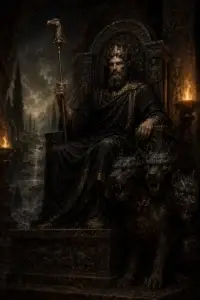
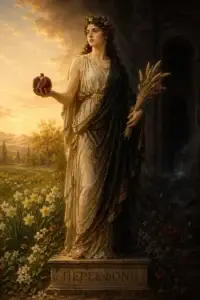
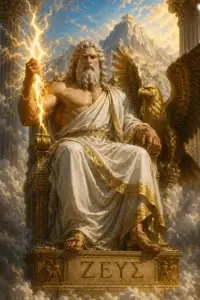
Greek mythology knows two worlds: the Olympian pantheon with Zeus, Hera, Apollo and Athena as principal deities, and the chthonic powers of the underworld surrounding Hades, Persephone and the Erinyes.
The most important sources are Hesiod’s Theogony (8th century BC) and Homer’s Iliad and Odyssey. Later mythographers such as Apollodorus and Pausanias systematise the material.
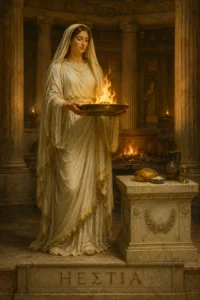
In everyday life, polis cults and household religion shaped the relationship to the gods: every home had a Hestia altar, every city its own civic god.
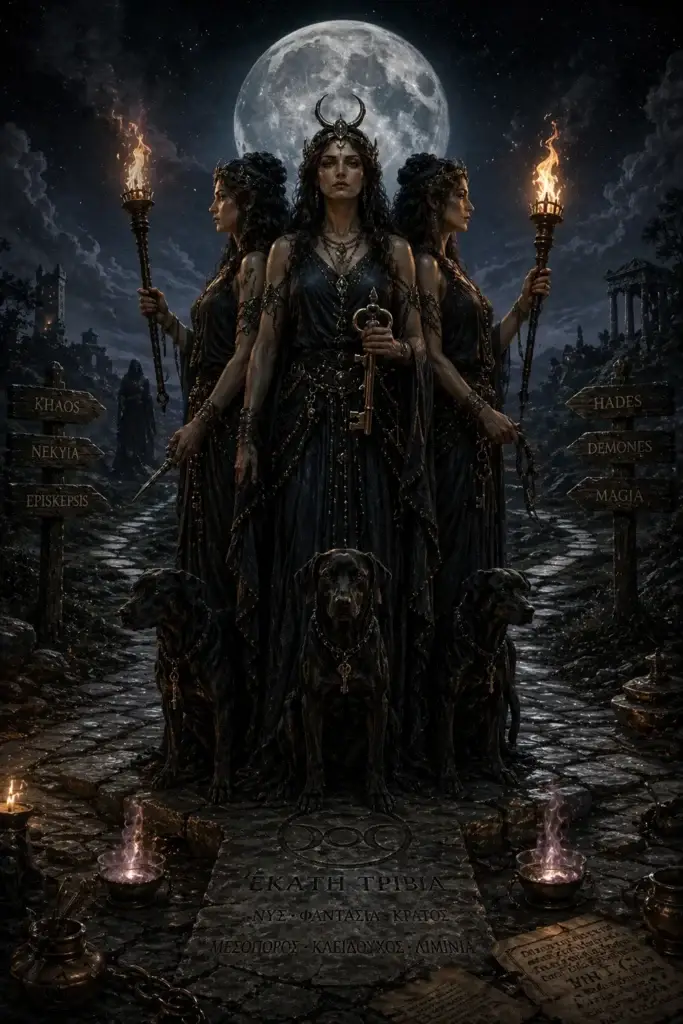
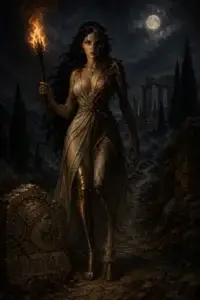
Greek religion is not a single system, but an open, polytheistic practice that changes over a thousand years. At its centre stands the Olympian pantheon with Zeus at the head, yet in parallel there exist chthonic powers, Hecate, Persephone and the Erinyes, who are concerned with death, magic and avenging justice.
The source situation is dense: Homer and Hesiod provide the mythological foundations from the 8th century BC onward.
Tragedians and lyric poets expand them, and Pausanias still documents local cult sites in the 2nd century AD. Inscriptions, vase painting and archaeological finds supplement the written tradition. The academic tradition (Burkert, Bremmer, Versnel) has worked through this material in detail.
Characteristic is the tension between polis religion and mystery cults. The official gods were worshipped within the framework of the city, with temples, sacrifices and a festival calendar.
Alongside these stood mystery communities, Eleusis, Orphism and the Dionysian cult, which offered individual experiences of salvation and initiation. Many of the more ambivalent beings derive from this second strand.
Period: Mycenaean period (1600 BC) to the Roman-Byzantine late antiquity (5th century AD).
Distribution: the Aegean region, Greek colonies around the Mediterranean and Black Sea, the Hellenistic world after Alexander.
Sources: Homer (Iliad, Odyssey), Hesiod (Theogony), the tragedians, Pindar, Pausanias, Apollodorus.
Pantheon and classes of beings: twelve Olympians, chthonic gods (Hades, Persephone), heroes, demons, nature spirits (nymphs, satyrs).
Greek religion encompasses several historical phases: the archaic (Homer, Hesiod), classical (Athenian and Spartan cults) and Hellenistic period (after Alexander). The pantheon of the Twelve Olympians is structured by Homer, but varies regionally and over time.
The gods were not omnipotent or omniscient, but powerful beings with human passions. Central to it are cosmic cycles (the Titanomachy) and mythological narratives.
Mystery cults such as the Eleusinian Mysteries and Orphic traditions offered esoteric teachings on the afterlife and the transmigration of souls.
With the Hellenistic expansion came an interpretatio Romana: Greek gods were syncretised with Roman ones (Zeus = Jupiter, Aphrodite = Venus). The cult was decentralised and polymorphous; each city-state had patron deities and local variants.
Greek everyday life was permeated by ritual: daily sacrifices to household and civic guardians, public processions and games in honour of the gods (the Olympic Games for Zeus). Priests and seers (especially the oracle of Delphi) mediated contact with the gods. Incense, animal sacrifices and libations were everyday practices.
Mystery cults offered personal experiences of initiation and the hope of redemption in the afterlife. Protective amulets and incantations against the evil eye were widespread. The veneration of heroes and ancestors complemented the worship of the gods. The interpretation of omens through birds, entrails and dreams structured decisions.
Greek religion was supplanted by Christianity and no longer exists as a living form of belief. Archaeologically and in literature it remains a foundation of Western education and philosophy. The modern Hellenism movement attempts a fragmentary reconstruction, but has only a marginal number of adherents.
Popular culture makes intensive use of Greek mythology for literature, film and games (Percy Jackson, Wonder Woman). Academically, the Greek gods and myths serve as metaphors for psychological archetypes and cultural patterns. The aesthetics of the Greek art form shape Western ideals of beauty.


The number varies depending on the tradition. The principal Olympian gods are classically twelve (the Dodekatheon): Zeus, Hera, Poseidon, Demeter, Athena, Apollo, Artemis, Ares, Aphrodite, Hephaestus, Hermes and Dionysus or Hestia.
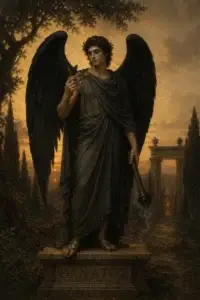
In addition, there are hundreds of chthonic gods (Hades, Persephone), nature deities (Pan, nymphs) and deified abstractions (Eros, Thanatos, Hypnos). Hesiod’s Theogony lists around three hundred deities named by name.
The number twelve differs slightly across the sources. A common list names Zeus (sky), Hera (marriage), Poseidon (sea), Demeter (grain), Athena (wisdom), Apollo (light, music), Artemis (the hunt, the moon), Ares (war), Aphrodite (love), Hephaestus (the craft of the forge), Hermes (messengers) and Dionysus (wine) or Hestia (the hearth).
Hades is usually not counted among them, since he rules the underworld.
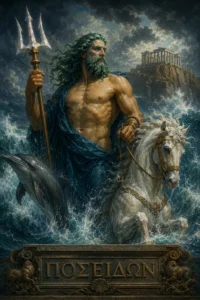
Zeus has two brothers: Poseidon, god of the sea, and Hades, ruler of the underworld. All three are sons of the Titans Cronus and Rhea.
After the division of the world following the fall of the Titans, Zeus controls the sky, Poseidon the sea and Hades the underworld; the earth is regarded as common ground. His sisters are Hera (at once Zeus’ wife), Demeter and Hestia.
At the beginning stand the primordial gods Chaos, Gaia (Earth), Tartarus (the underworld) and Eros. From Gaia and Uranus (the sky) emerge the Titans, among them Cronus and Rhea.
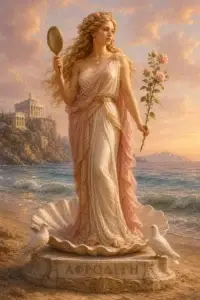
Their children are the first Olympians: Zeus, Hera, Poseidon, Hades, Demeter and Hestia. From Zeus’ unions descend Athena, Apollo, Artemis, Ares, Hephaestus, Hermes, Dionysus and Aphrodite (in one tradition, from the foam of the sea).
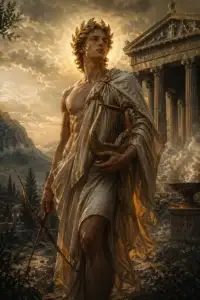
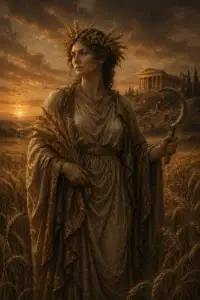
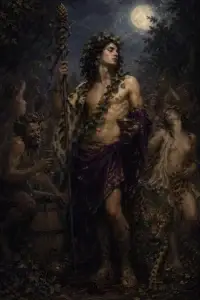
Zeus rules the sky and the gods; Hera is the patroness of marriage; Poseidon reigns over the sea; Demeter is the goddess of grain; Athena stands for wisdom and strategy; Apollo for light, music and the art of healing; Artemis for the hunt and the moon; Ares for war; Aphrodite for love and beauty; Hephaestus for the craft of the forge and fire; Hermes for messages and trade; Dionysus for wine, ecstasy and theatre.
Hestia tends the hearth fire and was regarded in older lists as the twelfth Olympian.
Gods are immortal, omnipotent within their domain and worshipped in temples. Heroes are deceased mortals of divine or royal descent (Heracles, Achilles, Theseus) and are honoured cultically at their graves.
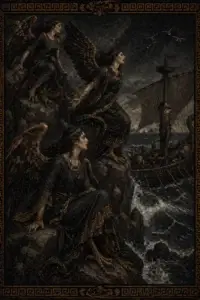
Spirits comprise demons (daimones) as ambivalent intermediary beings, spirits of the dead (psychai), earth spirits (nymphs) and avenging spirits (the Erinyes). The boundaries are fluid: Asclepius begins as a hero and rises to become a god.

Greek mythology is not a uniform doctrinal edifice, but a collection of local traditions, panhellenic hymns and literary adaptations that grew over the centuries.
Hesiod’s Theogony (around 700 BC) provides the earliest systematic register of the gods; Homer’s epics, the Iliad and Odyssey, convey the image of the gods of the archaic period. The Homeric Hymns, Pindar’s odes, the Attic tragedians and later the Hellenistic mythographers (Apollodorus, Hyginus) build out the system.
Olympia, Delphi, Eleusis, Dodona and the Asklepieion of Epidaurus formed the religious heart of the Greek world. Each sanctuary pointed to a particular divine function: Olympia to Zeus’ kingship, Delphi to Apollo’s oracular voice, Eleusis to Demeter’s mysteries, Dodona to the oldest Zeus oracle, Epidaurus to Asclepius’ art of healing.
The annual Panhellenic Games bound the Greek world together religiously and politically long before it was united as city-states.
Alongside the high religion documented in literature, there existed a broad popular religion with household gods, threshold spirits and chthonic rites at crossroads.
The Greek Magical Papyri (PGM) of late antiquity give insight into an extensive magical practice that interwove gods, demons and angels. This popular tradition shaped later Western magic more deeply than the writings of the philosophers.
Further standard works in the literature index.
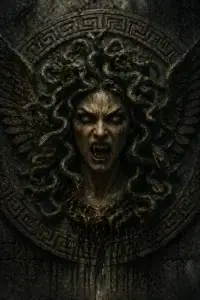
Greek antiquity knew apotropaia in many forms: the gorgoneion on shields and doors, bullae around children’s necks, magical gemstones and phylakteria amulets.
iWell Guard takes its place within this cultural-historical line of wearable means of protection, in a contemporary material architecture, made in Germany. 41 layers, solid gold, platinum, silver. 30-day right of return.
Personal experiences may vary. Not a medical device. No promise of healing.
The lexicon of protective symbols treats several signs and objects from ancient Greece on their own pages: Gorgoneion. The page on protective symbols offers a cross-cultural overview.