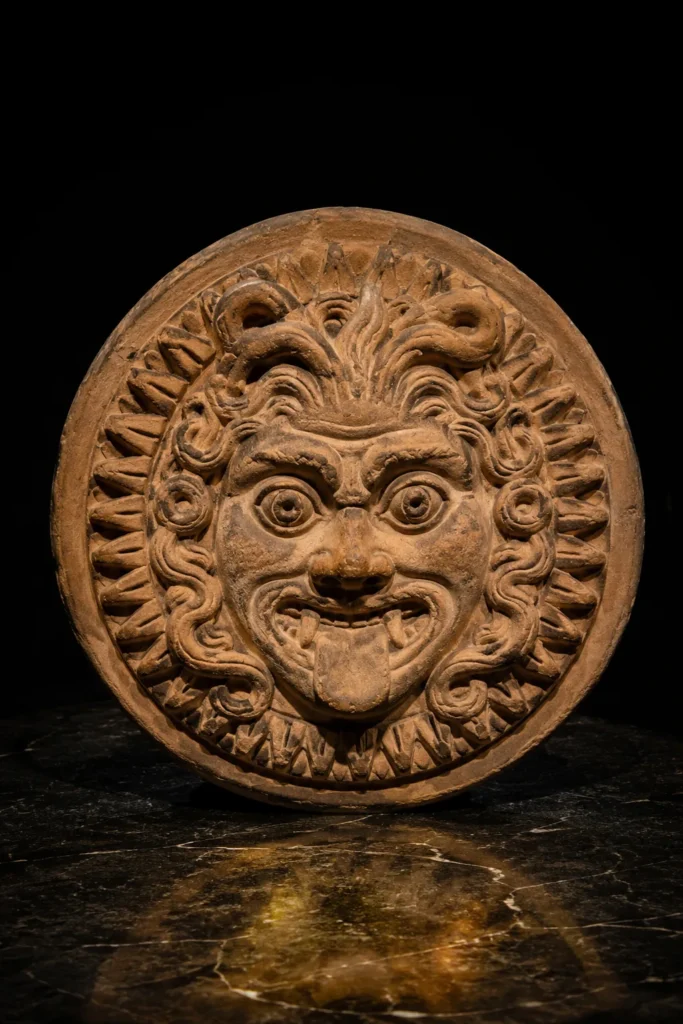
The Gorgoneion is the head of the Gorgon, Medusa. In Greek antiquity, this terrifying face was placed on shields, temples, and house gables to ward off harm and enemies through its very appearance.
The Gorgoneion is a representation of the head of the Gorgon. The best known of the Gorgons is Medusa, and so the Gorgoneion is most often referred to as the head of Medusa. It ranks among the most widespread protective signs of Greek antiquity.
The Gorgoneion shows a face seen from the front. It gazes directly at the viewer. This frontal, staring representation is unusual in Greek art and makes the Gorgoneion immediately recognizable.
The function of the Gorgoneion is protection through warding off. Its terrifying face is meant to keep harm, enemies, and hostile powers at a distance. It does not ward off through a plea or a blessing, but through the dread its appearance inspires.
In religious studies, the Gorgoneion belongs to the apotropaia, the objects of harm-averting. It is one of the clearest examples of a particular operative principle: defense through a frightening image.
The Gorgoneion was omnipresent in the ancient world. It appears on weapons, on buildings, on vessels, on coins, and on countless other objects. This wide distribution makes it an important source for understanding ancient protective thinking.
The head of Medusa thus links myth and everyday life. It derives from a well-known story and was at the same time a familiar sign of daily life. Both dimensions belong to any complete account of it.

The Gorgoneion derives from the figure of the Gorgon. The Greek tradition knows three Gorgons, of whom Medusa is the best known and the only mortal one. Her gaze was held to be so terrible that it turned the beholder to stone.
The most famous myth tells of the hero Perseus. He received the task of retrieving the head of Medusa. Because her gaze was lethal, he approached her only via the reflection in his polished shield and struck off her head.
According to the story, the severed head retained its petrifying power. Perseus could use it as a weapon. The Gorgoneion is therefore, within the myth, an object of dangerous, warding power.
At the end of the story, Perseus gave the head to the goddess Athena. She placed it on her shield or on her breastplate, the aegis. In this way the head of Medusa became part of the equipment of a powerful deity.
This myth supplies the rationale for the protective function of the Gorgoneion. The head of Medusa is an object whose appearance paralyzes and petrifies. Whoever uses it as a sign directs that power against their enemies.
A more detailed account of the figure of Medusa can be found in the beings lexicon. For the Gorgoneion as a protective sign, what matters above all is the core of the myth, namely the warding, petrifying power of the head.
The early, archaic Gorgoneion shows a deliberately terrifying face. It is broad and round, with wide-open, staring eyes. These eyes are the most powerful element, for they gaze at the viewer inescapably.
The mouth is wide open and shows teeth, often with protruding tusks or canines. A tongue frequently hangs from the mouth. This gaping, grimacing mouth intensifies the terrifying expression.
The hair of the Gorgoneion is in many depictions formed from snakes or interwoven with them. The snake is a dangerous creature that inhabits the boundary between worlds. Its connection with the head heightens the threatening effect.
All these features work together. The fixed stare, the grimacing mouth, and the snakes produce a face that repels at first sight. The Gorgoneion is designed to inspire fear.
This frightening form is not accidental but intentional. The Gorgoneion is meant to look terrifying, for that is precisely where its protective function lies. Form and purpose correspond perfectly.
Over the centuries the representation changed. The early Gorgoneion is crude and rough, the later one more refined. Yet the terrifying quality remained with the sign for a long time.
The Gorgoneion follows a clear operative principle: defense through deterrence. The terrifying image is meant to repel hostile powers and enemies before they can cause harm.
Behind this principle stands a simple idea. What looks frightening keeps other things at a distance. A terrifying face at a place that needs protection acts as a warning to anyone who approaches.
It is important that the frightening image works for the bearer or owner, not against them. Whoever carries a Gorgoneion on their shield does not fear it. The dread is directed outward, against enemies.
This principle is widespread in the ancient Near East and in antiquity. The Gorgoneion shares it with other deterrent signs, such as the Mesopotamian Pazuzu amulet, which likewise places a terrifying face against harm.
The Gorgoneion is a particularly clear expression of this idea. In it the entire sign is nothing other than a terrifying face. Defense through deterrence is not a secondary feature here but the whole purpose of the sign.
The operative principle of deterrence thus stands in contrast to the principle of attraction, by which, for example, the blue eye amulet works. The Gorgoneion pushes harm back; other signs absorb it. Both approaches belong to the world of protective signs.
An important place for the Gorgoneion was the shield. Warriors placed the head of Medusa on their shields, and the custom is attested in art and poetry many times over.
On the shield the Gorgoneion had a dual effect. It was meant to frighten the enemy and thereby gain an advantage in battle. At the same time it was meant to protect the shield’s bearer from harm.
The Gorgoneion is especially closely associated with the goddess Athena. According to myth, she bore the head of Medusa on her aegis, a protective garment or shield. Athena is a warlike and protective goddess, and the Gorgoneion belongs to her equipment.
Zeus, father of the gods, is also linked to the aegis and thus to the Gorgoneion. The head of Medusa thus belongs to the equipment of the highest powers of the Greek divine realm.
This association with Athena and Zeus gave the Gorgoneion high prestige. It was not merely a popular apotropaic sign but a sign worn by the most powerful deities themselves.
From the shields of gods and heroes, the Gorgoneion spread into many further domains. What worked on the aegis of Athena could also protect the home and daily life of ordinary people.
The Gorgoneion was not confined to shield and aegis. It also found its place on buildings, above all on temples. There it adorned and protected the sanctuary.
The Gorgoneion was particularly common as a so-called antefix. Antefixes are decorative plaques at the edge of a roof. A Gorgoneion as an antefix gazed down from the eave of the temple and warded off harm from the sacred building.
The Gorgoneion was also placed on private houses. On doors, gables, and house walls it was intended to keep hostile powers away. It thus secured the threshold and the living space.
Beyond that, the Gorgoneion appears on countless objects of everyday life. It adorns vessels, jewelry, coins, and household goods. It was even placed on kilns to ensure that work turned out well.
This broad use shows that the Gorgoneion was an omnipresent protective sign. It belonged to the familiar picture of the ancient world, from the temple to the simplest utensil.
In this ubiquity the Gorgoneion resembles other great protective signs. Like the Egyptian Wedjat eye, it was a sign that could appear wherever protection was desired.
Over the course of Greek art history the Gorgoneion changed markedly. The early, archaic Gorgoneion is emphatically ugly and grotesque. Its primary purpose is to terrify, and it achieves this with crude, exaggerated means.
Over time the representation shifted. The Greek art of the classical period strove for beauty and balanced forms. The Gorgoneion too was caught up in this striving.
This gave rise to the image of the beautiful Medusa. The later Gorgoneion no longer shows a grotesque face of dread but a beautiful countenance, often with an expression of sadness or gravity. The snakes remain, yet the face is transformed.
This development is noteworthy. A sign whose power lay in terror became a thing of beauty. The warding significance receded; the aesthetic effect came to the fore.
The beautiful Medusa shows that a protective sign can change its form without disappearing entirely. The Gorgoneion remained a well-known motif, even as its terror gave way to beauty.
For an accurate account this development matters. The Gorgoneion is not a fixed sign but one with a history. It ranges from the crude archaic image of dread to the beautiful, grave Medusa of later times.
The Gorgoneion does not stand alone. The principle of warding off harm through a frightening image is found across many cultures. The Gorgoneion is the Greek expression of this widely distributed idea.
In the ancient Near East we encounter the Mesopotamian Pazuzu amulet, which shows the head of a feared demon. Here too a terrifying face is meant to keep harm away. The Pazuzu amulet and the Gorgoneion follow the same operative principle.
In East Asia, threatening grimaces on doors, roofs, and gates are widespread. Door-guardian figures and apotropaic faces are meant to frighten and repel hostile powers. They too belong to the family of deterrent signs.
In Europe, the Middle Ages knew repellent grimaces and figures on churches and buildings. Frightening faces also appear in folk art. The principle is present across cultures and across time.
All these signs share the same underlying idea. They ward off not through a plea, a blessing, or a material substance, but through the dread of their appearance. The frightening image is the weapon.
Within this family the Gorgoneion is a particularly clear and particularly well-attested example. It allows the principle of defense through deterrence to be studied in exemplary fashion.
The Gorgoneion and the figure of Medusa remain alive to this day. The head of Medusa is one of the best-known images of Greek antiquity and appears in countless contexts.
In the visual arts, Medusa has engaged artists repeatedly across the centuries. From the ancient Gorgoneion to works of the modern era, a long series of depictions of the head of Medusa can be traced.
The head of Medusa is present in contemporary culture as well. It appears in design, in heraldry, and in the insignia of institutions. In this use, the original protective meaning is often no longer apparent.
The figure of Medusa has also received new interpretations in recent times. The story of a woman whose gaze petrifies and who is ultimately beheaded has been reread in many ways.
For an understanding of the Gorgoneion as a protective sign, however, the ancient core remains decisive. In Greek antiquity, the head of Medusa was an apotropaic sign that was meant to keep harm at bay through its dread.
The Gorgoneion is thus a compelling example of an ancient protective sign. It demonstrates the principle of defense through deterrence in particularly clear form and links a well-known myth with an omnipresent sign of ancient daily life.
Related key terms: Gorgoneion Medusa Gorgon Apotropaion image of dread Athena aegis antefix Perseus.
iWell Guard stands in the cultural-historical lineage of wearable protective objects, to which the Gorgoneion also belongs. A modern companion for people who live with protective symbols: made in Germany, 41 layers of real gold, platinum, and silver, with a 30-day right of return.
Individual experiences may vary. Not a medical device. No healing claims.