


Shadow magic, hidden occult rituals
This overview gathers magical work with shadow, the hidden, and the unconscious, from hidden occult rituals to inner psychological reflection.
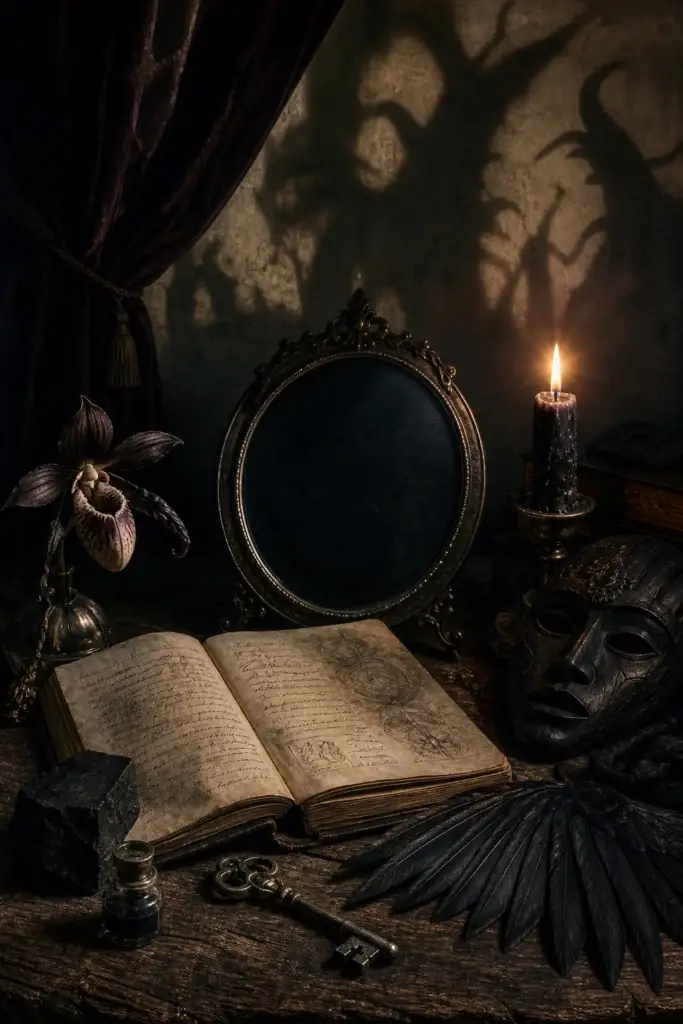
Shadow magic is an occult discipline that uses the shadow as a medium of action or as an object of working. It draws on animistic doctrines of the soul, Greco-Roman concepts of the psyche, and Southeast Asian shadow-theatre traditions.
Evidence comes from Egyptian ritual papyri, European witch traditions, and modern neopagan systems. It operates between psychological symbolism and the ontological recognition of the shadow as an independent entity or occult substance with agency. This application rests on concepts of soul, double, and occult substance-connection.
Table of Contents
Term and Definition
Shadow magic is not a single ritual, but a philosophy and a framing for many rites. It is not about specific rituals or substances, but about the attitude that everything which is tabooed holds potential and should be integrated.
A critical distinction from black magic: black magic is a term of disparagement (often used to designate evil or harmful magic). Shadow magic claims that this dichotomy is false: there is light and shadow, not good and evil.
Related concepts: chaos magic (amoral, pragmatic), the left-hand path (Tantra), sex-positive occultism. The difference from these: shadow magic is more strongly grounded in psychology (Jung) than in a philosophical-ethical neutrality.
Shadow magic encompasses hidden rites beyond the established schools of light magic.
Cultural-Historical Examples
Jungian psychology: Carl Jung and his concept of the „shadow“, the unconscious, repressed aspects of the personality, is the theoretical root. Jung treated this within analytical psychology, not as magic, yet modern magicians apply it.
Tantric left-hand paths: Tantrism (especially in Tibet and India) deliberately works with tabooed acts, sex, meat, alcohol, as a means toward enlightenment. This is an old cultural form of shadow integration.
Modern chaos magic (Austin Osman Spare, Peter Carroll): chaos magic is amoral and pragmatic, using any available technique without moral judgements. It is related to shadow magic, but less psychologically grounded.
Feminist and queer magic: modern witches and occult practitioners use the framing of shadow magic to reintegrate sexuality, aggression, and femininity, not as sin, but as power.
Neopagan movements: neopagan traditions (Wicca, Druidry, Heathenry) have diverged; some reject shadow magic (the Wiccan Rede: „Harm none“), others embrace it (the so-called „Red Witches“).
Jung’s Shadow Concept: Psychological Foundations of Shadow Work
Carl Gustav Jung coined the term shadow for the unconscious aspect of the personality that contains drives, repressed desires, and socially unacceptable traits.
In contrast to Freud’s unconscious, Jung’s shadow is not primarily instinctual but structural: whatever the conscious ego does not want to be or cannot be is deposited in the shadow. Individuation, Jung’s term for psychological maturity, requires the integration of the shadow, not its repression.
This happens through dreams, active imagination, and the recognition that the shadow also contains creative energy and authenticity. Jung’s work Psychology and Alchemy (1944) shows that alchemical texts unconsciously describe these processes of integration.
For Jung, the confrontation with the shadow is not magic, but analytical psychology; nonetheless, modern esoteric schools reinterpret this methodology as shadow magic.
State of the Sources
Psychological: Carl Jung (Collected Works, especially volumes 7 and 9), Robert Moore (studies on masculinity), Erich Neumann. Modern occult: Austin Osman Spare (Book of Lies), Peter Carroll (Liber Null, Psychonaut), chaos-magic zines. Feminist: Starhawk (critical of it), Pat Califia, modern witch writings. Academic: Ronald Hutton, Sarah Pike (studies on neopaganism).
Robert A. Johnson and the Integration Model
Robert A. Johnson, a Jungian analyst, popularized Jung’s teaching of the shadow in works such as Inner Work (1986) and Owning Your Own Shadow (1991).
Johnson stresses that the shadow is not evil, but represents a person’s split-off strength. A man who defines himself as gentle deposits aggression and wildness in the shadow; a woman who behaves submissively represses her authority and sexuality.
Shadow work according to Johnson means integrating these forces consciously, not in order to become destructive, but in order to become whole. Johnson was influential for the New Age audience and shaped the idea that self-knowledge as a confrontation with the shadow is a form of consciousness magic.
Significance Today / Related Beings
Connie Zweig and Modern Shadow Work
Connie Zweig, author of Meeting the Shadow (1991, edited with Jeremiah Abrams), developed practical methods of shadow work: journal writing, dialogue techniques, and ritual reintegration. Zweig distinguishes between the personal shadow (individually repressed contents) and the collective shadow (cultural taboos and archetypes).
Her work has had a strong influence on esoteric communities and led to activities such as shadow journeys (imaginative visualization), shadow rituals (burning symbols of repressed aspects to symbolize liberation), and shadow invocation (consciously calling on the shadow in order to listen to it).
This reinterpretation of Jung’s analytical psychology as a magic technology characterizes the modern New Age appropriation of depth-psychological concepts.
Further standard works in the literature index.
iWell Guard and Protective Traditions
Across all documented cultures, protective objects can be found that people carried on their bodies, from Pazuzu amulets in Mesopotamia, through the Hamsa in the Mediterranean region, to the Mezuzah on Jewish doorposts and Christian protective medallions. iWell Guard takes up this tradition in a contemporary material architecture, crafted in Germany, 41 layers, pure gold, platinum, silver. 30-day right of return.
Personal experiences may vary. Not a medical device. No promise of healing.