


Love potion, magical practice
This overview explains the preparation, cultural distribution and ritual context of classic love potion recipes.
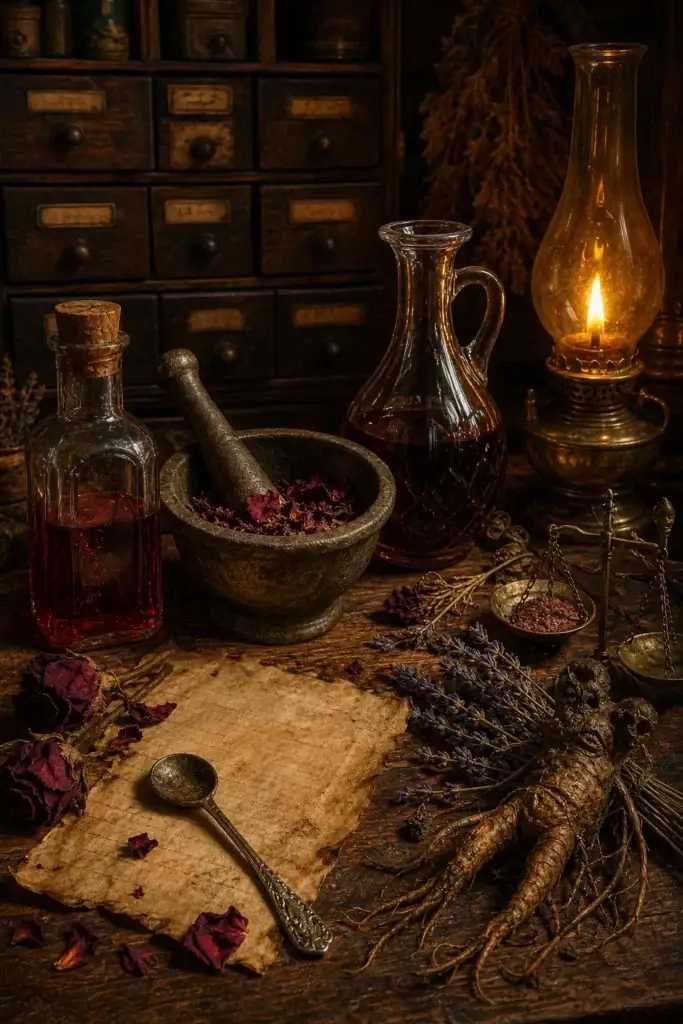
The love potion is a pharmaco-magical practice that, by means of a tincture, decoction or magically charged substances, is meant to produce affective bonding, attraction or libidinal submission.
Evidence ranges from ancient love spell papyri through medieval minnesang traditions to ethnographic fieldwork on Caribbean Obeah practices and African love spells. The practice oscillates between pharmacological effect, psychological suggestion, social performativity and ontological magical efficacy. Its efficacy can be grounded historically in pharmacological as well as in magical-psychological terms.
Table of Contents
Concept and Distinction
Love potions differ from love spells through their material component: a potion is drunk, a food is eaten. This allows for immediate physical action. They differ from aphrodisiacs in that aphrodisiacs merely heighten sexual arousal, whereas love potions are meant to produce affection, obsession or bonding.
A legal and ethical problem: love potions administered without consent are poisoning, whether magical or pharmacological. In witch trials this was a category of accusation: women who mixed potions into food or drink.
Related terms: love potion, philtre, elixir. In modern magical systems: herbal magic, potion magic.
The love potion has a rich history and symbolism, from ancient pharmaka through the medieval witch tradition to literary material such as Tristan and Isolde.
Cultural-Historical Examples
Medea’s love potion in Greek mythology (Apollonius Rhodius, Argonautica) is perhaps the most famous literary reference: Medea prepares a potion for Jason whose effect is meant to bring about love and fidelity. The potion is conceived as magical, not simply pharmacological.
Tristan and Isolde in the medieval legend: a love potion is prepared by Isolde’s mother so that Isolde will love King Mark, yet Tristan and Isolde drink it by mistake. The potion produces insurmountable mutual love and is thus central to the tragic plot. This motif appears in many medieval versions.
Early modern sorcerers’ dispensaries: in England and continental Europe, male and female sorcerers prepared love potions from herbs (lovage, damiana, St John’s wort), sometimes with bodily substances (blood, saliva, menstrual blood). Hundreds of recipes are preserved in folk handbooks.
Renaissance practices: Italian and French sorcerers concerned themselves with love potions, documented in maleficorum treatises and private sorcerers’ booklets. The substances were often exotic and expensive (spices, rare plants).
African and Afro-Caribbean traditions: in Hoodoo and Vodou, love potions continue to be practised, by means of herbs, body parts and ritual practices. Very much alive and commercialised (botanicas sell ready-made remedies).
Source Situation
Classical sources: Apollonius Rhodius, Ovid’s Metamorphoses, Medea dramas (Euripides). Middle Ages: Tristan romances (Thomas of Britain, Gottfried von Strassburg), Arthurian romances. Early modern period: sorcery trial records, folk handbooks (Flagellum Daemonum), dispensary books. Renaissance: Ficino (magical operations), Italian grimoires. Africa-America: ethnographic collections (Hurston), modern Hoodoo manuals.
Significance Today / Related Beings
Further standard works in the literature index.
iWell Guard and Protective Traditions
Across all documented cultures, protective objects can be traced that people carried on the body, from Pazuzu amulets in Mesopotamia through the Hamsa in the Mediterranean region to the Mezuzah on Jewish doorposts and to Christian protective medals. iWell Guard takes up this tradition in contemporary material architecture, manufactured in Germany, 41 layers, solid gold, platinum, silver. 30-day right of return.
Personal experiences may vary. Not a medical device. No promise of healing.