iWell Guard

Tibetan Gods, Vajrayana, Bon and Protector Deities

Beings from the Tibetan tradition on iWell Guard. The Tibetan Buddhist tradition (Vajrayana) with Bonpo substrata. Protector deities, wrathful Buddhas, Bardo beings.

As protectors of the Dharma, many Tibetan deities appear in wrathful form.

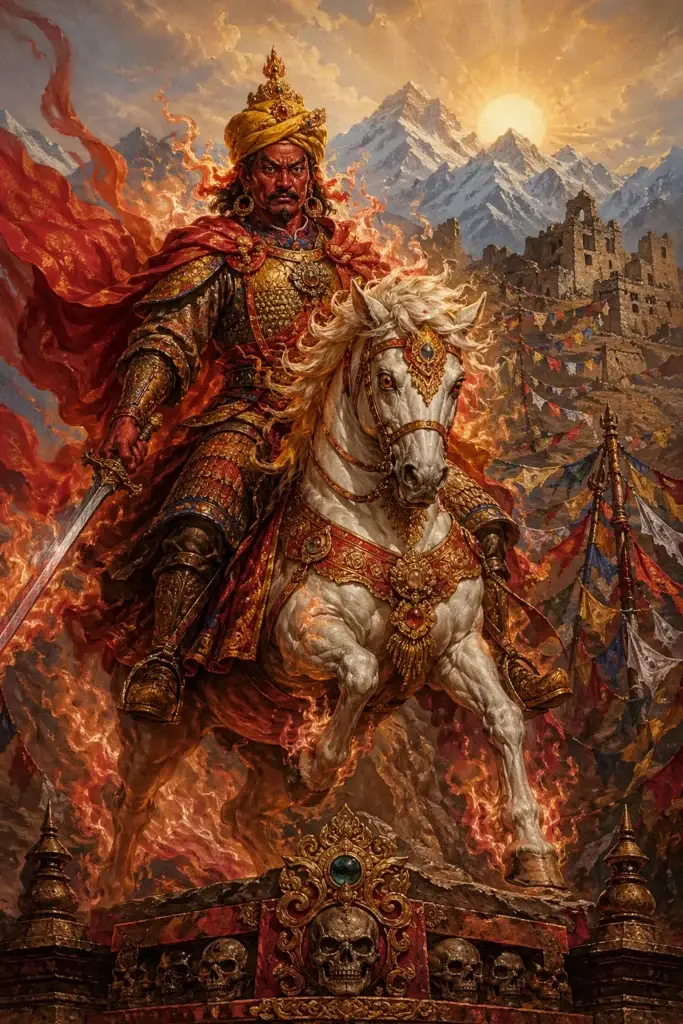
Gyalpo - Spirits from the Tibetan tradition, historical-illustrative

Bon, Vajrayana and Protector Deities

Religiously, Tibet is shaped by two currents: the indigenous Bon and the Buddhism imported from the 7th century onward, which took on a distinctive form in Tibet, the Vajrayana, the “Diamond Vehicle”. The two traditions have strongly influenced one another.

Tibetan Buddhism is exceptionally rich in classes of beings. Buddhas, bodhisattvas and meditative yidam deities belong to the enlightened sphere. Alongside them stand the dharmapalas, protector deities such as Mahakala, Palden Lhamo, Yamantaka and Pehar, who guard monastic lineages and Buddhist teachings. They may be depicted in peaceful or wrathful form.

From the Bon layer and folk religion come further beings: Klu (naga-like water spirits), Tsen (mountain spirits), Mamo (chthonic women), Bon gods such as Tonpa Shenrab. Tibetan cosmology thus possesses an exceptional density of protective beings and counter-powers, and in terms of the history of religions (de Nebesky-Wojkowitz, Tucci) a particularly rich tradition.

Classification

Period: Bonpo substratum (before the 8th c.), Vajrayana Buddhism since the 8th c. (Padmasambhava).

Distribution: Tibet, Bhutan, Sikkim, Ladakh, Mongolia, the exiled diaspora.

Sources: the Tibetan canon (Kangyur, Tengyur), the Bardo Thodol (Tibetan Book of the Dead), tantras, hagiographies.

Pantheon and classes of beings: Buddhas, bodhisattvas, dharmapala (protector deities: Mahakala, Yamantaka, Palden Lhamo), the Nechung oracle, Mamo, Tsen, Nyen.

History and Pantheon

Tibetan religion is based on Tibetan Buddhism (Vajrayana), but was shaped by the pre-Buddhist Bonpo religion. Buddhism arrived in the 7th century and synthesized with Bonpo elements.

The legendary figure Padmasambhava (8th century) is regarded as the founder of Tibetan Buddhism and integrated local demons and spirits as Buddhist protector deities. The pantheon is complex: Buddha forms, bodhisattvas, local protector deities (often fearsome), lamas as reincarnated beings (tulkus).

Tantric practice celebrates transgressive symbols and ecstatic techniques. The Bardo Thodol teaching describes the state between death and rebirth. Practice varies regionally (Gelug, Nyingma, Kagyu, Sakya schools). The Chinese invasion of Tibet (1950) and the Cultural Revolution (1966 to 1976) persecuted Buddhism intensely. The diaspora since 1959 preserves the tradition under difficult conditions.

Beings in Everyday Life

Tibetan everyday practice encompasses daily prayers, mantras and meditation. Protective rituals against evil spirits and harmful influences are routine. Mani wheels and prayer flags are everyday objects with spiritual effects. Lamas as spiritual teachers and healers are central. Monastic communities structure religious life.

Oracles and divination are practiced, especially by high-ranking lamas. Pilgrimages to sacred sites (Mount Kailash, Lhasa) are important. Trance states and supernatural experiences are sought in tantric practices. Folk belief in spirits, demons and local deities overlays Buddhism. Protective amulets and magical symbols are widespread. Temple cults and public ceremonies are central.

Significance Today

Tibetan Buddhism remains a living tradition among Tibetans and in the diaspora. China seeks control and secularization; young Tibetans are assimilated. Western reception romanticizes Tibetan Buddhism (the Dalai Lama cult, the Shangri-La myth). Popular culture (films, books) has aestheticized Tibetan mysticism.

Academically, Tibetan philosophy and practice are studied intensively. The exile system under the Dalai Lama (until 2011) created external authorities. New generations struggle with modern life versus traditional practices. Environmental and human rights questions complicate the reception. The tradition is global, but under political and cultural pressure.

Frequently Asked Questions about the Tibetan Gods

How many gods are there in Tibetan Buddhism?

The pantheon is vast: five Dhyani Buddhas, 1,000 Buddhas of the present world age, eight great bodhisattvas, 21 aspects of Tara, 8 great dharmapalas, plus hundreds of local protective spirits (Sadag, Lu, Tsen). Tibetan iconography distinguishes four main categories: peaceful (Buddhas, bodhisattvas), semi-wrathful (some yidams), wrathful (dharmapalas) and tantrically united (Yab-Yum depictions).

Who was Padmasambhava?

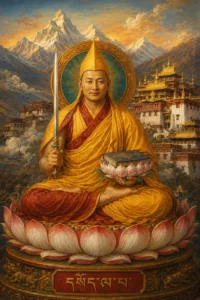
Padmasambhava (Guru Rinpoche, 8th c.) brought tantric Buddhism from India to Tibet. He subdued the indigenous mountain and demon deities and made them protectors of the Dharma.

For the Nyingma school he is a second Buddha. His eight manifestations (Guru Tsen Gye) show different aspects of his activity. His mantra Om Ah Hum Vajra Guru Padma Siddhi Hum is recited by millions daily.

What is the Bon religion?

Bon is the pre-Buddhist religion of Tibet, older than Buddhism, which arrived only in the 7th century. It has shamanistic features with its own gods (especially the creator god Shenrab) and nature spirits.

After the rise of Buddhism, Bon developed into Yungdrung Bon (Eternal Bon), which adopted many Buddhist elements. Today it is one of the five recognized schools of Tibetan Buddhism.

What are the four main schools of Tibetan Buddhism?

Nyingma (the oldest, 8th c., Padmasambhava), Kagyu (oral lineage, 11th c., Marpa and Milarepa), Sakya (grey earth, 11th c.) and Gelug (the virtue system, 14th c., Tsongkhapa, from which the Dalai Lamas descend).

All four share the Vajrayana teachings, but differ in their emphases of practice, teaching lineages and political history. Plus Bon as the fifth recognized tradition since 1978.

Who is the Dalai Lama?

The Dalai Lama is the spiritual leader of the Gelug school and, since the 5th Dalai Lama (mid-17th c.), also the secular head of Tibet. He is regarded as an incarnation of Avalokiteshvara (Chenresig), the bodhisattva of compassion.

The current (14th) Dalai Lama, Tenzin Gyatso (b. 1935), has lived in exile in Dharamsala (India) since 1959. In 1989 he received the Nobel Peace Prize.

What are mantras and mandalas?

Mantras are sacred syllables or sentences whose recitation releases transforming energy. Famous mantras: Om Mani Padme Hum (Avalokiteshvara), Om Tare Tuttare Ture Soha (Green Tara).

Mandalas are complex geometric diagrams, usually a square within a circle, that visualize a sacred space. They are used as a meditation aid in tantric initiations. Tibetan sand mandalas are created in days-long rituals and then destroyed, a symbol of impermanence.

In Depth

Bon and Buddhism

Tibet’s religious history begins with Bon, the pre-Buddhist religion. Buddhism reached Tibet in the 7th and especially in the 8th century (Padmasambhava). The second wave of dissemination (10th to 11th c.) led to the establishment of the four main schools: Nyingma, Kagyu, Sakya, Gelug (with the Dalai Lama as the most important teacher).

The Ngakpa Tradition and Yidam

Alongside the monastic centers exist the Ngakpa, married tantrikas who live in the world. Central to tantric practice is the yidam, an enlightened deity with which the practitioner builds a contemplative identification through visualization, mantra and mudra.

Protective Beings and Wrathful Deities

The Tibetan tradition knows a class of its own: the dharmapala (Dharma protectors), wrathful deities such as Mahakala, Palden Lhamo and Yamantaka.

They appear terrifying, with a diadem of skulls, an aureole of flames, and many arms holding ritual weapons. In terms of the history of religions, they integrate older Bon protective spirits and tantric Indian gods.

Exile and Globalization

The Chinese occupation of Tibet from 1950 onward, and especially the popular uprising of 1959 with the flight of the 14th Dalai Lama, changed the religious landscape. Tibetan monasteries and teaching centers arose in India, Nepal, Bhutan and the West. Today Tibetan Buddhism is a global tradition with Western practitioners in many countries.

State of Research

In the 20th century, the religious-studies research on Tibet was shaped above all by Giuseppe Tucci, David Snellgrove and Robert Thurman. A German-language overview is provided by Per Kvaerne, “The Bon Religion of Tibet” (1995).

The standard reference for the tradition of protective beings is Rene de Nebesky-Wojkowitz, “Oracles and Demons of Tibet” (1956); for the bodhisattva teaching, the English translation of the Bodhicaryavatara by Crosby and Skilton (1995).

Standard literature (comparative religious studies):

Further standard works in the literature index.

Protective Objects in This Cultural Tradition

Tibetan Buddhist practice protects through mantra cords (sungdu), reliquary containers (gau) and mandalas; consecrated protective cords are worn around the neck.

iWell Guard fits into this culture-historical line of wearable protective objects, in a contemporary material architecture, made in Germany. 41 layers, solid gold, platinum, silver. 30-day right of return.

Personal experiences may vary. Not a medical device. No promise of healing.

Tibetan mythology combines pre-Buddhist Bon conceptions with Indian Vajrayana Buddhism and knows a rich world of protector deities, local spirits and wrathful dharmapalas, who are invoked in monasteries and folk rituals to this day.

Protective Symbols from Tibet

The lexicon of protective symbols treats several signs and objects from Tibet on their own pages: Dzi beads, Gau, Phurba, protective knot, Vajra and wind horse. A cross-cultural overview is offered by the page on protective symbols.