Phurba: the Tibetan ritual dagger for binding
By Ralf Ittermann · last reviewed on
Phurba is the name for the three-sided ritual dagger of Tibetan Buddhism. Its blade has three edges and ends in a point, and the handle often bears an elaborate pommel. The phurba serves not as a weapon but as a ritual implement for binding and fixing harmful forces in place.
Classification
Phurba is the name for a ritual implement from the Buddhism of Tibet. It is a dagger or a stake used in certain rituals.
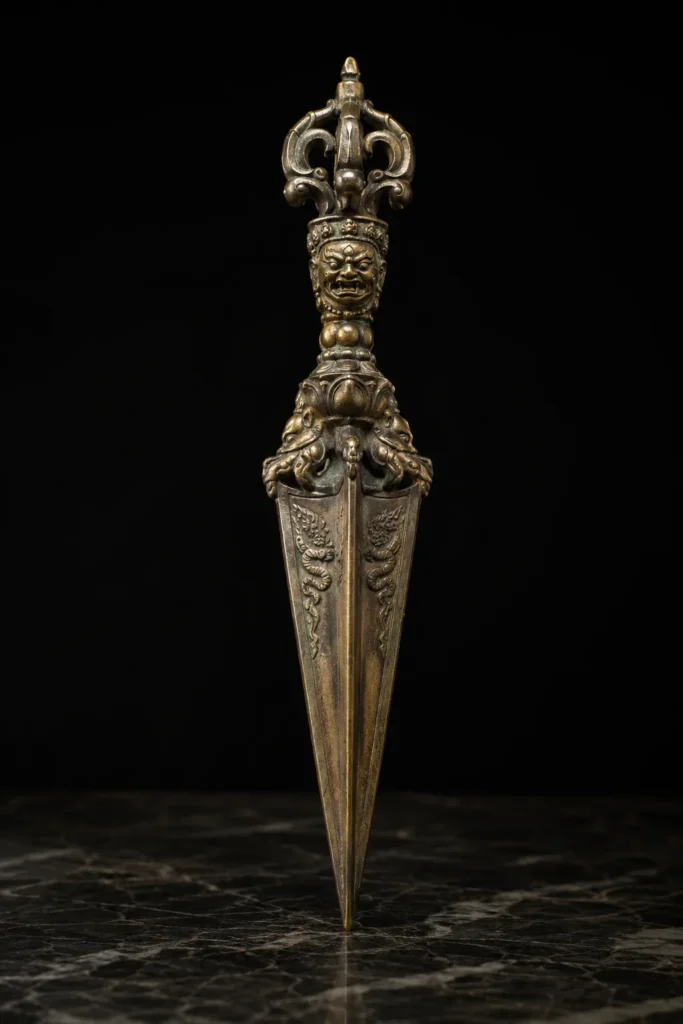
The defining feature of the phurba is its three-sided blade. Instead of a flat blade with two cutting edges, the phurba has a blade with three edges that converge in a point.
The phurba is not a weapon in the ordinary sense. It is not used for fighting or cutting. It is a spiritual implement that performs a specific task in rituals.
Its task is the binding and fixing in place of harmful forces. In the ritual the phurba serves to pin harmful forces, as it were, to a place and to render them harmless.
The phurba belongs to Tibetan Buddhism, especially to its older traditions. It is used by trained ritual specialists in precisely regulated actions.
In religious studies the phurba is a good example of a ritual implement whose form and use belong closely together. Its three-sided shape relates directly to its ritual task.
Origin of the ritual dagger
The origin of the phurba reaches far back and is not entirely clarified. Various roots are assumed for this implement.
One strand leads to the simple stake that was driven into the ground in India when a ritual site was being established. Such a stake fastened and secured the consecrated area.
From this ritual stake developed the idea of an implement that pins down and fixes in place. The phurba took up this idea of pinning down.
A further strand leads into the older religious world of Tibet before Buddhism. There too, notions of binding and pinning down harmful forces were known.
Tibetan Buddhism combined these roots and gave the phurba its developed shape and its precise ritual meaning. The older traditions in particular cultivated the handling of it.
The origin of the phurba thus shows the interplay of several strands. Out of the ritual stake and out of older Tibetan notions, Buddhism produced the fully developed ritual implement.
The three-sided blade
The most striking feature of the phurba is its three-sided blade. This form distinguishes it from any ordinary dagger and is essential to its meaning.
In cross section, the blade of the phurba has the shape of a triangle. Three faces meet in three edges and run out into a sharp point.
This three-sided form is interpreted. The three sides are connected with three harmful states of mind that, according to Buddhist teaching, form the root of suffering, namely greed, hatred, and delusion.
In the sense of the teaching, the phurba is thus directed not against human beings but against these inner evils. Its three edges stand for the overcoming of the three roots of suffering.
The point in which the three edges converge is the place with which the phurba pins down in the ritual. In it the effect of the implement is gathered.
The three-sided blade thus makes the phurba an implement whose shape carries its meaning. Already the form speaks of the task of binding and pinning down harmful forces.
Handle and pommel of the phurba
Above the three-sided blade rises the upper part of the phurba, the handle and the pommel. This part too is elaborately fashioned and carries a meaning.
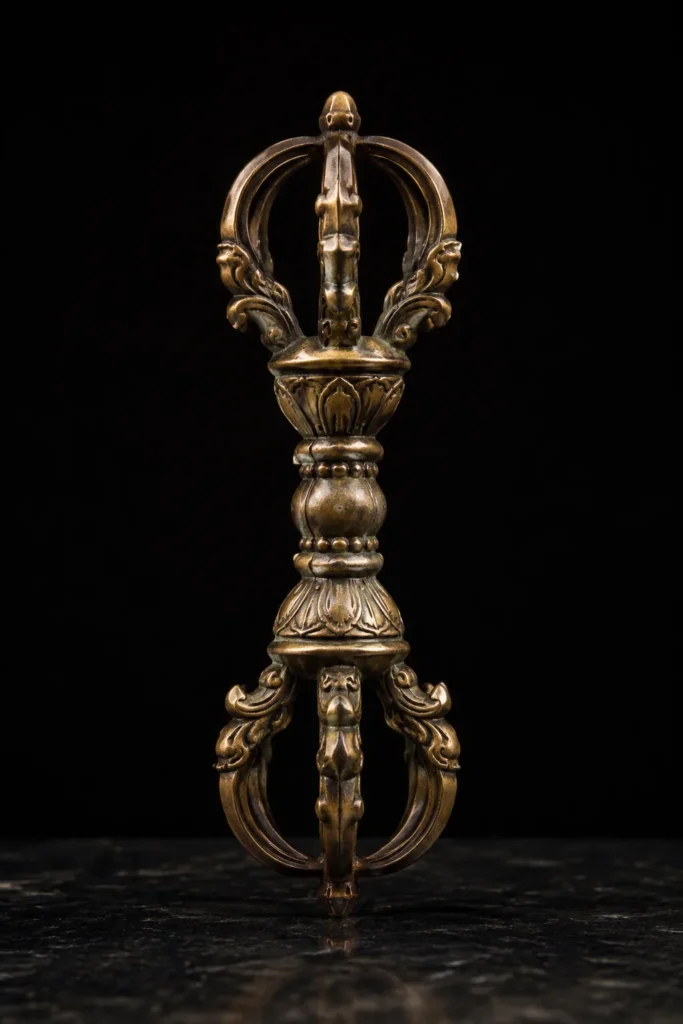
The handle is often articulated by ridges, knots, or ornaments. Often the head of an animal sits between blade and handle, with the blade emerging from its mouth.
The pommel that closes off the phurba at the top often bears a face or several faces. These faces are connected with a protective figure assigned to the phurba.
In some depictions the pommel bears three faces that look in different directions. They stand for the vigilance of the protective figure on all sides.
The upper finial is sometimes a small horse’s head or another sign. The material of the phurba, often metal or hard wood, is likewise regulated according to tradition.
The articulated structure shows that the phurba is a carefully conceived implement. Blade, handle, and pommel interlock, and each part contributes to the overall meaning of the ritual dagger.
The phurba in ritual
The phurba is a ritual implement, and its meaning unfolds only in the ritual. It is used by trained specialists in precisely regulated actions.
In the ritual the phurba serves to pin down a harmful force, as it were. The force is first summoned and bound through the ritual, then held fast with the phurba.
In doing so, the practitioner does not thrust the phurba into a human being. Often it is set into a vessel, into a prepared spot, or into a symbolic representation of the harmful force.
It is important that, according to Buddhist interpretation, the phurba is not used out of anger. The action takes place in the spirit of compassion and is directed against the evil, not against a being.
The ritual with the phurba is demanding and presupposes training. According to tradition, it may be performed only by people who have been instructed and empowered to do so.
The phurba thus shows that a ritual implement possesses its meaning only in the ritual. Outside the regulated action it is an object, but in the ritual it is an implement of binding and fixing in place.
Binding and fixing harmful forces in place
The actual task of the phurba is the binding and fixing in place of harmful forces. This task is the core of its meaning and its use.
By harmful forces the Tibetan tradition understands obstacles and disruptive forces that can stand in the way of spiritual practice and well-being.
The phurba binds these forces by pinning them down. Just as a stake holds an object to the ground, so the phurba is meant to bind the harmful force and prevent it from taking effect.
The fixing in place also has a preserving aspect. Because the harmful force is bound, the consecrated place, the ritual, or the practicing community is protected from it.
In the sense of Buddhist teaching, this binding is directed against the evil itself, not against beings. The three edges of the blade recall that the actual enemies are the inner evils.
The phurba is thus an implement that protects by binding. Its preserving effect lies in the fact that it pins down what is harmful and so secures the space for practice.
The phurba as a venerated sign
Beyond its task as a ritual implement, the phurba is also a venerated sign. It is regarded as a consecrated object and is connected with a protective figure.
A protective figure of its own is assigned to the phurba, an enlightened figure that stands for the activity of binding and fixing in place. The phurba is regarded as the implement-form of this power.
On altars and in temples phurbas are therefore kept and venerated as consecrated objects. They are not merely tools but bearers of a spiritual meaning.
Some phurbas are considered especially precious because they were used or blessed by an important teacher. Such pieces are preserved across generations.
In small form the phurba is sometimes worn as a pendant as well. In this form it is a sign of protection and of the binding of harmful forces.
The phurba is thus at once a ritual implement and a venerated sign. From the implement of regulated action a consecrated object has emerged, one that stands for the power of binding.
The phurba in Tibetan Buddhism
The phurba belongs firmly to Tibetan Buddhism. Within its schools and traditions it holds a particular position.
The older traditions of Tibetan Buddhism in particular cultivate the handling of the phurba. In them the ritual with the ritual dagger is especially elaborated.
The phurba does not stand on its own in this. It belongs to a series of ritual implements that Tibetan Buddhism knows. Among them are the bell, the thunderbolt, and further implements.
The thunderbolt, the vajra, is the most important of these implements. Phurba and vajra both belong to the world of Tibetan ritual implements and complement one another.
Within these implements the phurba has its own clearly defined task. Other implements stand for other ritual actions, but the phurba stands for binding and fixing in place.
The phurba is thus a well-defined implement within a rich ritual world. It shows how precisely Tibetan Buddhism distinguishes and orders its implements according to their task.
Reception today
The phurba remains a customary ritual implement in Tibetan Buddhism to this day. In the monasteries and in the practice of the older traditions it is used unchanged.
In temples and on altars phurbas can be seen as consecrated objects. Elaborately worked pieces also count among the prized works of Tibetan art.
Beyond the Buddhist world, the phurba has become known in the West as well through the interest in Tibetan Buddhism. It is represented in collections and in museums.
In this wider dissemination the phurba is sometimes understood as a decorative object. Its actual meaning as a ritual implement can recede into the background in the process.
A factual account names the phurba for what it is, a three-sided ritual dagger of Tibetan Buddhism that, in the regulated ritual, serves the binding and fixing in place of harmful forces.
The phurba thus remains a striking example of a ritual implement. In it the three-sided shape, the precise ritual task, and the notion of a protective figure present in the implement are joined together.
Literature (selection)
Related key terms: phurba, ritual dagger, three-sided blade, Tibet, Tibetan Buddhism, binding, fixing in place, ritual implement, harmful forces.
iWell Guard and protective traditions
iWell Guard stands in the cultural-historical line of portable protective objects to which the phurba also belongs. A modern companion for people who live with protective symbols: crafted in Germany, 41 layers of solid gold, platinum, and silver, with a 30-day return policy.
Personal experiences may vary. Not a medical device. No promise of healing.