Ekajati, goddess of the Tibetan tradition
By Ralf Ittermann · last reviewed on
Ekajaṭī is a protector goddess of the Tibetan Buddhist tradition, in Sanskrit “the single-braided one” (eka, “one”, jaṭā, “strand of hair, braid”).
She is one of the three principal female protectors of the Nyingma school and of the Dzogchen teachings associated with it. Of religious-historical significance is her role as guardian of the mantra tradition and of the “hidden treasures” (terma) of the Padmasambhava corpus.
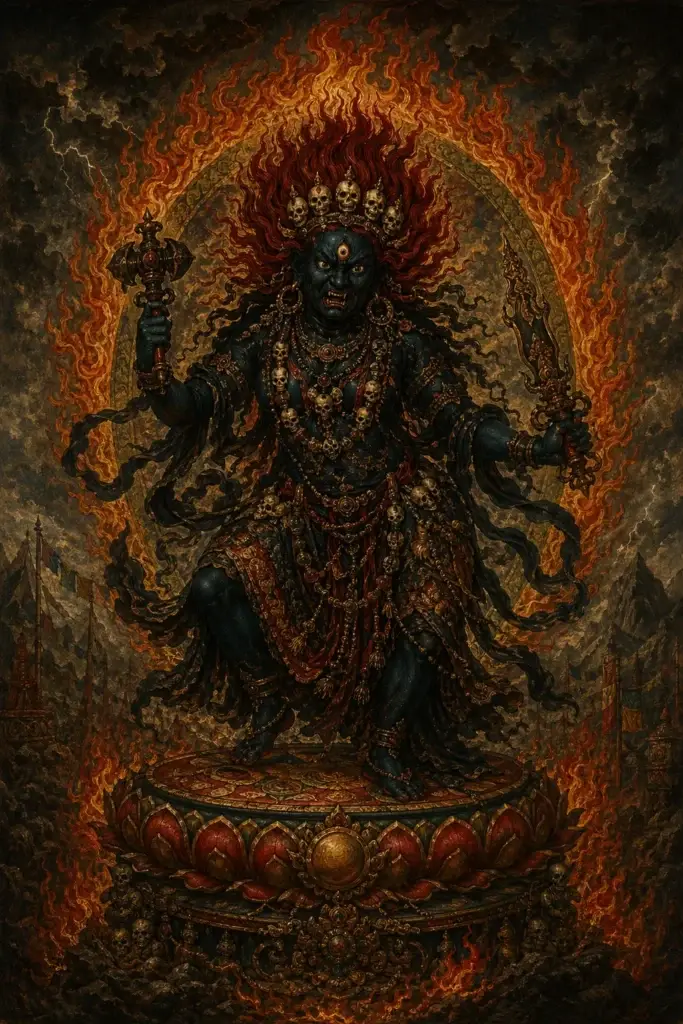
Ekajati
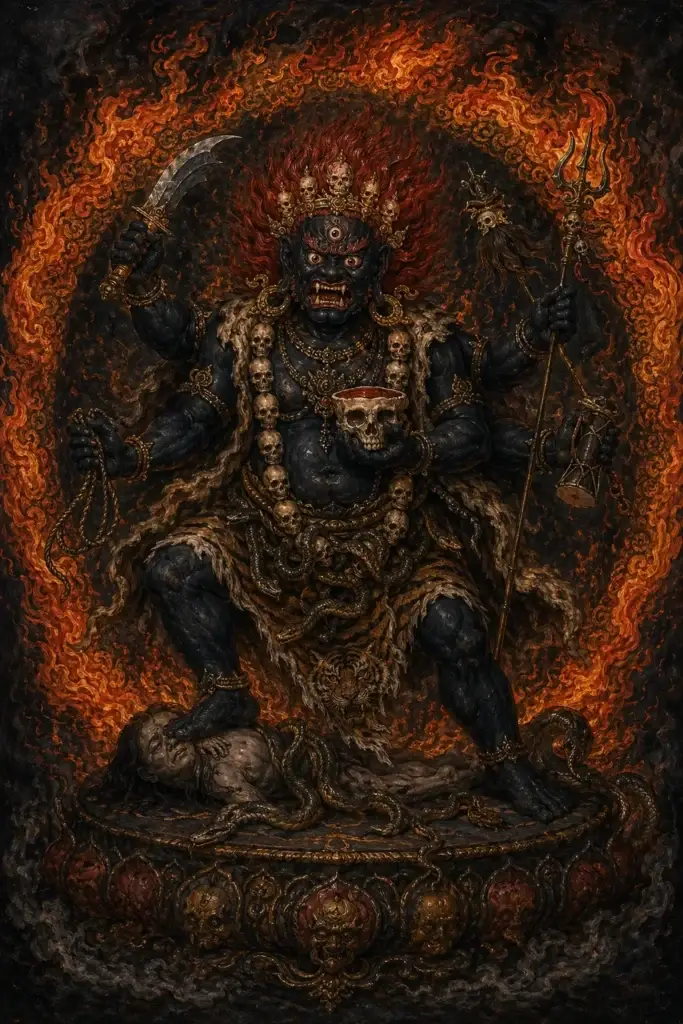
Ekajaṭī is depicted in iconography as blue-black or dark brown, with a single upright strand of hair, one eye, one fang, one breast and usually with a scorpion or a corpse in her hand.
Her functions include the protection of the mantric vows (samaya), the warding off of Dharma enemies and the preservation of the Tantra texts. In ritual sādhanas she is invoked together with Rāhula and Dorje Legpa as the triad of Nyingma protector deities, especially in the context of Dzogchen instructions.
At a glance: Ekajati
Type: Tibetan Buddhist principal protector goddess of the Nyingma tradition, mother of the mantras
Pantheon: Tibetan Buddhism (especially Nyingma, alongside Sakya and Bön)
Function: protection of the highest tantras (Dzogchen mantras), destroyer of the obstacles of saṃsāra
Main attributes: a single lock of hair, a single eye, a single tooth, a single breast, black skin colour
Main cult sites: the principal Nyingma monasteries (Mindrolling, Dorje Drak, Pelyul, Kathok, Shechen)
Meaning of Ekajati: Sanskrit, “one lock of hair”
Classification
Period of the texts
Ekajati (Tibetan Tsechigma, “One-Lock”) is one of the most important female protector goddesses of Vajrayana Buddhism. Her roots lie in the Hindu-tantric tradition. In Tibet she is especially central in the Nyingma tradition, principal protector of the Dzogchen teachings and of the highest mantra tradition.
The main flourishing period of Ekajati veneration: 11th to 14th centuries, with the tertön traditions (treasure-finders of Padmasambhava). In modern Tibet she remains central in every Nyingma monastery.
Area of distribution
Main cult sites: all principal Nyingma monasteries with their own Ekajati sadhana traditions (Mindrolling, Dorje Drak, Pelyul, Kathok, Shechen). In Bhutan and Nepal in many Tibetan Buddhist monasteries.
Internationally in Nyingma centres worldwide. In the Bön tradition as Sipai Gyalmo (a related female protector goddess). In modern exile Tibet she is cultivated especially within the Nyingma sangha.
State of the sources
Central sources: Tibetan tantric sadhana texts on Ekajati (especially from the Nyingma terma tradition), Padmasambhava hagiographies. Secondary literature: Beer, The Encyclopedia of Tibetan Symbols and Motifs; Linrothe, Ruthless Compassion; Nebesky-Wojkowitz, Oracles and Demons of Tibet; Lopez, Religions of Tibet in Practice; Karmay, The Arrow and the Spindle.
Designation and spellings
Ekajati is depicted with particular iconographic elements that are symbolically encoded and carry deep meaning. These elements convey, in a central way, the functions, sources of power, areas of responsibility and cosmic role of this entity.
In the case of Ekajati, the iconography is strictly fixed and full of meaning: she is depicted with a single knot of hair, a single eye, and a single tooth, usually with dark blue or black skin, a single breast, and an upper body that is bare or draped with human skin. In her hands she often holds a heart or a corpse, a phurba, and skull cups. These features point to her role as guardian of the mantras and protector of the Nyingma school and the Dzogchen teachings. The stability of these rules of depiction over the centuries is connected to the fact that each attribute is tied to specific texts and lines of transmission and may not be altered at will.
Description
Ekajati was central to the religious practice and everyday understanding of Tibet. People turned to this entity in critical situations or at particular ritual seasons, with structured rituals, prayers or offerings. The practice was precisely handed down and often led by priests or specialists.
The continuity of these practices across many generations shows that it was regarded as effective and necessary. The functions were manifold: preventive (warding off misfortune), healing (alleviation of suffering), transformative (accompaniment through transitions) and protective (continuous watching).
Appearance and symbolism
Ekajati is depicted as a dark brown or black woman with wild hair, a single glittering eye (hence the name) and with bared teeth.
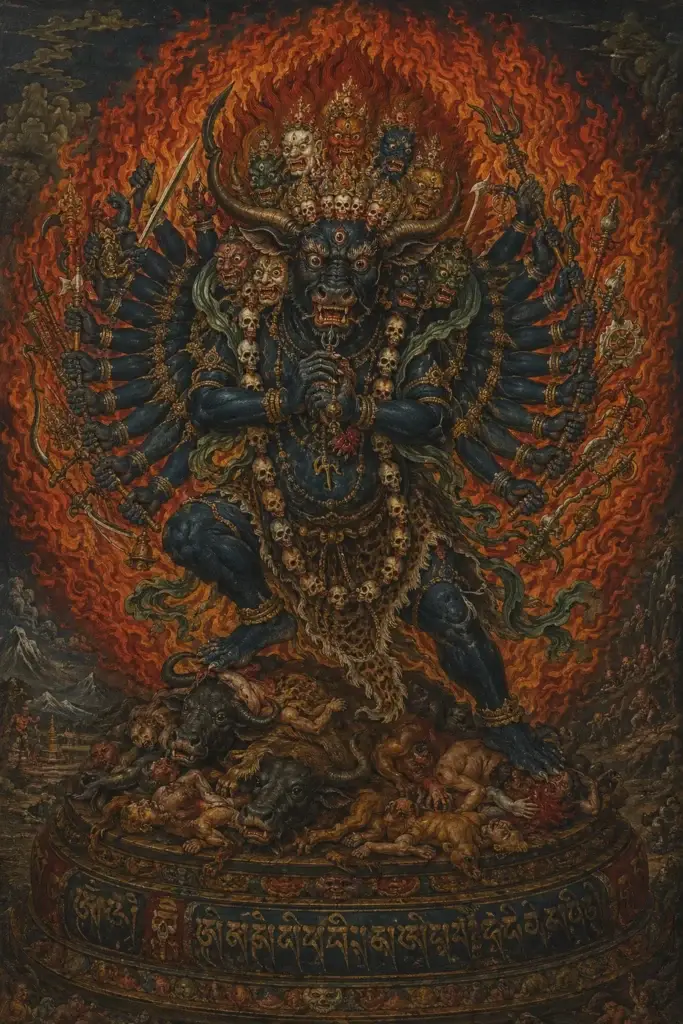
She wears a skull as a diadem and is naked or clad in skin. Her attributes are a scapular of human bones and a skull cup. She stands on an unconscious human body and is surrounded by flames.
Profile: Ekajati
The most important aspects of Ekajati at a glance. The following fields summarise origin, function, appearance, veneration, symbols and cultural parallels.
In the Nyingma tradition Ekajati is regarded as the mother of all mantras; from her emanate the protective aspects of all the highest tantras.
Her uniquely reduced iconography (one lock, one eye, one tooth, one breast) symbolises her singleness: she is undivided, unambiguous, undividedly focused on the destruction of the obstacles of saṃsāra. In the hierarchy of protector goddesses she belongs to the highest class.
Principal protector goddess of the Dzogchen teachings and of the highest mantra tradition. Destroyer of the obstacles to spiritual practice, especially the subtle, hard-to-recognise obstacles. In tantric practice, protection for the practitioners against all threats from supersensible spheres. Patroness of the tertön tradition (treasure-finders who discover teachings remaining within Padmasambhava).
The iconographically unique form makes Ekajati unmistakable: a single lock on the otherwise bald head, a single eye in the middle of the forehead, a single tooth protruding from the gaping mouth, a single breast in the centre of the chest.
Black (or dark blue) skin colour, very muscular body. In her hands: skull cup (kapala), khatvanga (skull staff), club with skull. A funnel-shaped loincloth of human skin. Standing on a prostrate human body, in a flaming aureole.
Sphere of effect: Ekajati is venerated in every Nyingma monastery, especially in Dzogchen practice. Before important tantric practices she is invoked for protection. In the personal practice context she is invoked against subtle obstacles that cannot be warded off by coarser protector deities (e.g. Mahakala).
In tantric initiation (wang) she is transmitted as a central protective deity. In cham dances she appears ritually as a figure worn by masked dancers.
One lock, one eye, one tooth, one breast (characteristic reduction), skull cup (kapala), khatvanga (skull staff), club with skull, funnel-shaped loincloth of human skin, bone ornaments, black skin colour, flaming aureole. Sacred plants: none specific. Sacred colours: black, dark blue.
Palden Lhamo (Buddhism, a related Tibetan protector goddess), Mahakala (Buddhism, male wrathful form), Sipai Gyalmo (Bön, a related female protector goddess), Yamantaka (Vajrayana), Kālī (Hinduism, a related wrathful mother goddess).
Functionally: all unique female tantric protector goddesses with a reduction iconography. In her symbolism of singularity, Ekajati is unique among the religions of the world.
Ekajati, parallels in other cultures
Ekajati belongs to the wrathful protector goddesses of Tibetan Vajrayana, closely related to Palden Lhamo and Mahakala. Functionally comparable are the Hindu Ugratara and Mahakali, the Japanese Kishimojin (Hariti) and the Chinese Bixia Yuanjun.
The profile of the maternal protectress with a simultaneously fearsome appearance is a basic motif of the Asian Tantra tradition. Different cultures recognised the same thing and manifested it in local, adapted forms. Universal patterns are more significant than specific variations.
Jewish tradition
No direct equivalent; distantly related are the protective figures of Merkabah mysticism (Sandalphon, Metatron), which, however, are not conceived as female and carry no function as guardian of vows.
Greco-Roman world
Structurally comparable are the Erinyes/Furies as wrathful female guardians of ritual order, who punish broken oaths and transgressions. Hekate too, as a nocturnal goddess of boundaries and protection, shares with Ekajaṭī the function of a keeper of hidden mysteries (Hekateion cults, cf. Walter Burkert: Greek Religion, Stuttgart 1977).
Mesopotamia
Lamashtu and related protective/harming goddesses with a wrathful countenance likewise fulfil apotropaic functions, though without the explicit aspect of guarding vows. Compare Frans Wiggermann: Mesopotamian Protective Spirits, Groningen 1992.
India/Asia
Ekajaṭī goes back to pre-Buddhist Hindu Tantra layers (Ekajaṭā as one of the Mahāvidyās in Shaktism, cf. David Kinsley: Tantric Visions of the Divine Feminine, Berkeley 1997). In Tibetan Buddhism she is integrated by Padmasambhava; in the Chinese Buddhist sphere she appears as Yiji Mu, in Japanese Shingon as a protective aspect of Ichiji Kinrin.
The protectress of the mantra teachings and the single braid
Ekajati (Sanskrit Ekajati, Tibetan Ral gcig ma, “she with the one tuft of hair”) is known in Tibetan Buddhism above all as the principal protectress of the Nyingma school and its secret teachings.
Her name points to her most striking iconographic feature: a single, upright tuft of hair or braid. This peculiarity is interpreted symbolically in the ritual texts as a sign of unity and of undivided concentration, the gathering of all powers into a single point.
Ekajati is regarded as the most important of the three great protectors of the Dzogchen teachings, the so-called Great Perfection, which forms the highest system of teaching of the Nyingma school.
To her in particular is entrusted the protection of the terma, those hidden treasure texts which, according to tradition, were concealed by Padmasambhava and his disciples in the 8th century and later rediscovered by appointed finders, the tertön.
Ekajati is said to guard these texts and to make them accessible only to the rightful finders, while she wards off unauthorised access.
This function makes her a deity with a markedly text-related task. She is not primarily the protectress of a place or a person, but the keeper of a lineage of transmission and of its written substance.
From the perspective of religious studies this is illuminating, because it shows how closely, in Tibetan Buddhism, the notion of protector deities could be bound up with concern for the authenticity and purity of teaching traditions. Whoever receives a secret teaching at the same time enters into a relationship with its protectress.
Iconography: the one eye, the one tooth, the one breast
The pictorial representation of Ekajati is governed by a principle of singularity that takes up her name and carries it through consistently. In her common form she has a single tuft of hair, a single eye in the middle of the forehead, a single tooth and a single breast.
Her skin is dark blue or black, her expression extremely wrathful. In her hands she usually holds a heart or a corpse, a phurba dagger and other attributes of the wrathful deities.
The individual features are interpreted symbolically in the ritual commentaries. The one eye stands for the undivided vision of absolute reality, the one tooth for the power to crush all obstacles, the one breast for the nourishment of the one teaching that does not disintegrate into many parts.
These interpretations are not incidental but part of the meditation instruction: in the uniform body of Ekajati the practitioner is to contemplate the principle of non-dual cognition.
Numerous variants of her form exist, with differing numbers of arms and with various accompanying figures, depending on the teaching tradition and the underlying terma text. Some forms link her closely with other protector deities of the Nyingma school.
In material culture Ekajati is represented above all by thangka paintings, which had their place in the secret protector chapels of the Nyingma monasteries and were often kept veiled.
Bronze figures are rarer than for some other protector deities. The iconographic diversity makes museum identification difficult, which is why depictions of Ekajati are frequently attributed with reservation in collection catalogues. Related wrathful protectresses are Palden Lhamo and the likewise wrathful Yamantaka.
Origins: Indian roots and Tibetan development
The origin of Ekajati cannot be determined unambiguously, and scholarship discusses several strands.
The name Ekajati is attested in Indian tantric Buddhism, where a figure of the same name appears in the circle of the deity Tara; in some sources she is regarded as a wrathful form or a companion of Tara. This Indian layer probably forms the point of departure.
In Tibet, however, Ekajati acquired an independent and greatly expanded significance that goes far beyond the Indian model. Above all in the Nyingma school and in the Dzogchen teachings she became the central protectress.
Tradition connects her installation in this function partly with Padmasambhava, partly with the great tertön figures of later centuries, who revealed their own Ekajati forms and ritual cycles in their treasure texts.
Since these texts are themselves the object of Ekajati’s protective function, a circular structure characteristic of the terma tradition arises: the protectress of the treasure texts is described in precisely these treasure texts.
From the perspective of religious studies, Ekajati is thus an example of how an originally marginal Indian figure could rise to become a principal deity in a new cultural context, because she filled a specific function that the Tibetan system required: the protection of a growing corpus of secret, continually newly discovered texts.
The exact historical sequence of this elevation is difficult to reconstruct for lack of datable sources. It is certain that, at the latest in the later development of the Nyingma school, that is from about the 14th century onward, Ekajati held her preeminent position.
Further links
Literature (selection)
Further standard works in the literature index.
Frequently asked questions about Ekajati
Who is Ekajati in Tibetan Buddhism?
Ekajati (Sanskrit, roughly “she with a single strand of hair”) is a wrathful protector goddess of Tibetan Buddhism and is regarded as the most important protectress of the secret mantra teachings, especially in the Nyingma school.
She is depicted with striking, deliberately imperfect-seeming features: a single eye, a single tooth, a single lock of hair and a single breast. This singleness symbolises the non-dual, undivided nature of the highest reality beyond all conceptual multiplicity.
What is Ekajati’s role as guardian of the terma?
In the Nyingma school Ekajati is regarded as the supreme guardian of the terma, the hidden treasures. Terma are teachings which, according to tradition, were concealed by Padmasambhava in the 8th century so that, at the right time, they would be rediscovered by masters appointed for the task, the tertöns.
Ekajati watches over the fact that these teachings do not fall into unauthorised hands and are not falsified. She is also one of the three principal protectresses of the Dzogchen teachings and is invoked before the transmission of secret instructions.