Khumbila, the unclimbed guardian of Khumbu
By Ralf Ittermann · last reviewed on
Khumbila is a god of the Sherpa tradition.
The sacred, unclimbed territorial deity of Khumbu. Khumbila remains the unclimbed guardian of Khumbu, left untouched out of reverence.
Khumbila, also known as Khumbi Yul Lha, is the protective and territorial deity, the yul lha, of the Khumbu region of the Sherpa in Nepal. The mountain, roughly 5761 metres high, is sacred and remains unclimbed out of respect; the entire region takes its name from this deity.
As protective god of the Sherpa, Khumbila watches over wellbeing, faith, water, pastureland and the yaks. He is fundamentally protective and caring; he becomes threatening only when taboos are violated.
Type: Protective and territorial deity, yul lha of Khumbu
Origin: Pre-Buddhist Tibetan mountain worship, integrated into Nyingma Buddhism
Texts: Sherpa ethnography, Fürer-Haimendorf and Ortner
Period: pre-Buddhist to the present
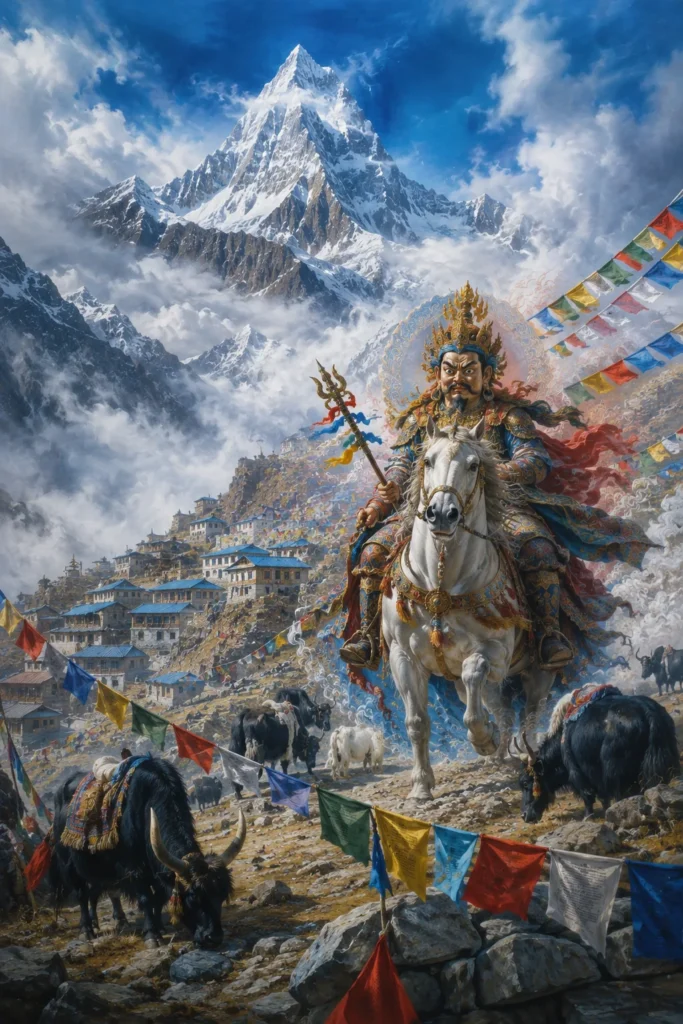
Appearance: Rider on a horse, mighty warrior
Textual history
Period of the Texts
Veneration mythically reaches back to the time when the ancestors of the Sherpa still lived in Tibet; it is documented above all through Sherpa ethnography of the 20th century.
Area of Diffusion
The Khumbu in eastern Nepal, the area of today’s Sagarmatha National Park: the land of the Sherpa community, whose territorial god is Khumbila.
Sources
Well documented: Sherpa ethnography, above all Fürer-Haimendorf and the studies of Sherry B. Ortner.
Name and variants
Tibetan (Sherpa): Khumbu, the region, combines with yul, land, and lha, god, hence god of the land of Khumbu, a classic yul lha. The spelling variants Khumbila, Khumbi Yul Lha and Khumbu Yul Lha refer to the same deity; the -la here is lha, god, not a mountain pass.
Appearance
Appearance
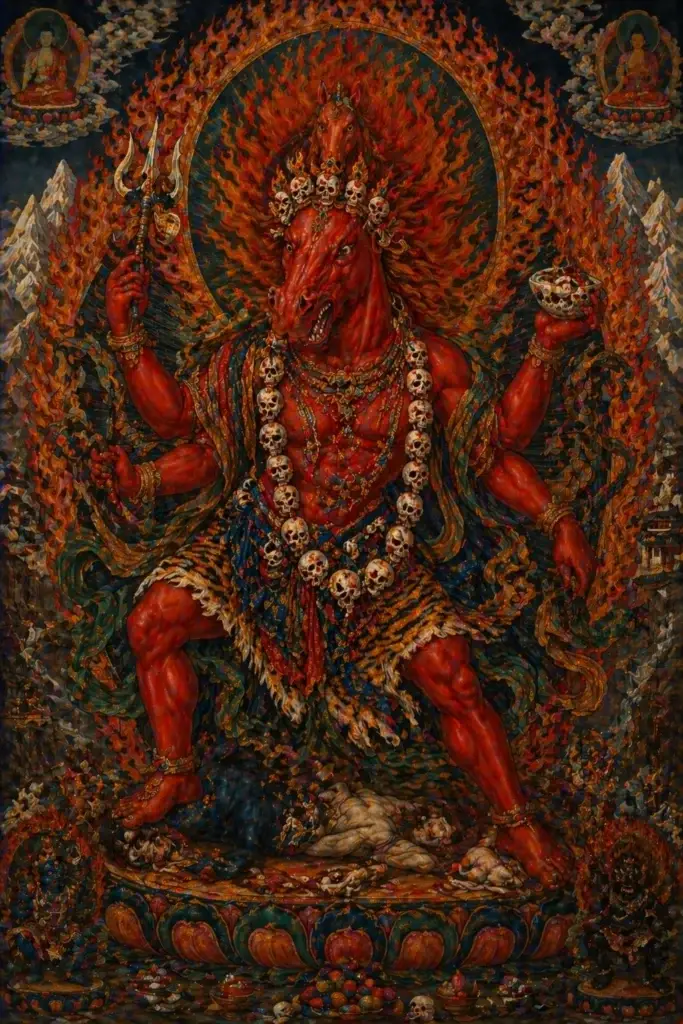
Khumbila appears anthropomorphically as a rider on a horse and as a mighty warrior; the colour of the horse is disputed, usually white, in one source red and dressed in white silk. His retinue includes yaks, goats, sheep and the Yeti.
Effect
Khumbila is the protective deity of the whole of Khumbu and the Sherpa community and protects wellbeing, faith, water, pastureland and the yaks. If angered, for instance by entering the sacred summit or by failing to make offerings, punishment threatens, traditionally also through sending out a Yeti.
Profile: Khumbila
The most important aspects of the territorial deity at a glance.
Pre-Buddhist Tibetan mountain worship, integrated into the Nyingma Buddhism of the Sherpa; subdued by Guru Rinpoche, Padmasambhava.
The Sherpa community of Khumbu: their wellbeing, their faith, water, pastureland and the yak herds.
Rider on a horse, mighty warrior; the colour of the horse is disputed, usually white, in one source red and dressed in white silk.
Territorial and protective deity of Khumbu; he punishes taboo violations, traditionally also by sending out a Yeti from his retinue.
Sang incense offerings, libations and prayer flags, along with the annual Lhapsang ritual and the Dumje festival with Cham mask dances; the summit remains unclimbed.
Comparable territorial mountain concepts exist in Bhutan and Kham; as mountain gods of the region there are Machen Pomra and Nyenchen Tanglha.
With the Sherpa from Tibet: the history of the yul lha
Khumbila’s roots lie in pre-Buddhist Tibetan mountain worship, integrated into the Nyingma Buddhism of the Sherpa; the deity was subdued by Guru Rinpoche, Padmasambhava. Veneration mythically reaches back to the time when the ancestors of the Sherpa still lived in Tibet, linking the deity to the Sherpa migration.
The Khumbu itself is regarded as a beyul, a hidden, blessed valley. That the entire region shares its name with the god shows how closely land and deity are interwoven here: Khumbila is not the god on the mountain, but the god of the land in the form of the mountain.
Reception and classification
Khumbila is one of the holiest protected peaks in Nepal and, alongside Machapuchare, Kailash and Gauri Shankar, represents mountains that remain unclimbed out of respect.
From a religious-studies perspective, Khumbila is a model example of the local territorial and protective deity of the Sherpa. Important clarifications: the spelling variants Khumbila, Khumbi Yul Lha and Khumbu Yul Lha refer to the same deity; the -la here is lha, god, not a mountain pass; and the precise term is yul lha, not the Hindu-Nepali borrowed term Kul Devta.
Lhapsang, Dumje and the unclimbed summit
Well documented are sang incense offerings, libations and prayer flags, as well as the annual Lhapsang ritual and the Dumje festival, usually in July, with Cham mask dances in Tengboche, Namche, Khumjung and other places. The summit remains unclimbed out of respect; no permit has ever been granted, for entering the summit is considered a sacrilege against the territorial deity.
Territorial gods and mountain neighbours
Khumbila is a model example of a yul lha; comparable territorial mountain concepts exist in Bhutan and in Kham. As territorial and protective mountain gods, Machen Pomra and Nyenchen Tanglha stand alongside him; in his own region, Miyolangsangma watches over Everest, and tradition counts the Yeti among his retinue.
Frequently asked questions about Khumbila
What does Khumbila mean?
God of the land of Khumbu, a yul lha; the entire region takes its name from him.
Why is the mountain unclimbed?
Out of respect; no climbing permit has ever been granted, entering the summit is considered a sacrilege.
What does he have to do with the Yeti?
If angered, he traditionally punishes by sending out a Yeti; the Yeti belongs to his retinue.
Further links
Further reading:
- Tibet – all beings of the Tibetan world of belief
- Miyolangsangma – the goddess of Everest in his neighbourhood
- Machen Pomra, Yeti – mountain god and retinue being of tradition
- Incense burning, Amulet, Protective candle – traditional protective means
- Protection Compass – protective means at a glance
Literature (selection)
Further standard works in the bibliography.
As the protective god of the Sherpas and the land deity of the Khumbu, Khumbila shows how closely mountain, land and community are bound together in the Himalayas: out of reverence, his summit remains untouched, and his name is the name of the land itself.