Yeti, wild being of the high Himalaya
By Ralf Ittermann · last reviewed on
The Yeti is a spirit of the Tibetan folk tradition of the Himalaya.
The snowman of the Himalaya: world-famous and unproven.
The Yeti, in Tibetan Migoi, wild man, is a wild, hairy mountain being of the Himalayan folk belief of the Sherpa and Tibetan regions as far as Bhutan. He is not a mountain god, but a being of folk belief; three levels must be strictly distinguished here: folklore, the Buddhist interpretation and modern cryptozoology.
In folklore, the Yeti is regarded as a dangerous killer of yaks, and the sight or call of him as a bad omen, while at the same time he is shy and bound to the mountain wilderness. The modern reception began in 1921, with a mistranslation that first created the Abominable Snowman. No scientific evidence for an unknown primate exists.
Type: Wild, hairy mountain being of folk belief
Origin: Himalaya, Sherpa and Tibetan regions, Bhutan
Texts: folklore tradition and cryptozoology research
Period: folk belief, modern reception since 1921
Appearance: wild, hairy mountain ape-man
Region of origin and sources
Period of the Texts
The Yeti belongs to folk belief with no fixed textual period. It becomes publicly documented from 1921, when the Howard-Bury expedition triggered its modern reception.
Area of Diffusion
The Himalaya, particularly the Sherpa and Tibetan regions as well as Bhutan: the high altitudes and glacial valleys of the mountain wilderness.
Sources
The source situation is good: folklore tradition and cryptozoology research, along with Reinhold Messner’s field research and the DNA study by Lindqvist and others from 2017.
Name and variants
Tibetan and Sherpa: Yeti probably derives from yeh-teh or meh-teh, whose origin is uncertain; Meh-Teh means roughly man-bear. Migoi, Tibetan mi rgod, means wild man; Dzu-Teh, cattle-bear, demonstrably refers to a large bear, the Himalayan brown bear. The expression Abominable Snowman is a mistranslation from 1921: the journalist Henry Newman wrongly translated the Sherpa word metoh, man-bear, as abominable.
Appearance and behaviour
Appearance
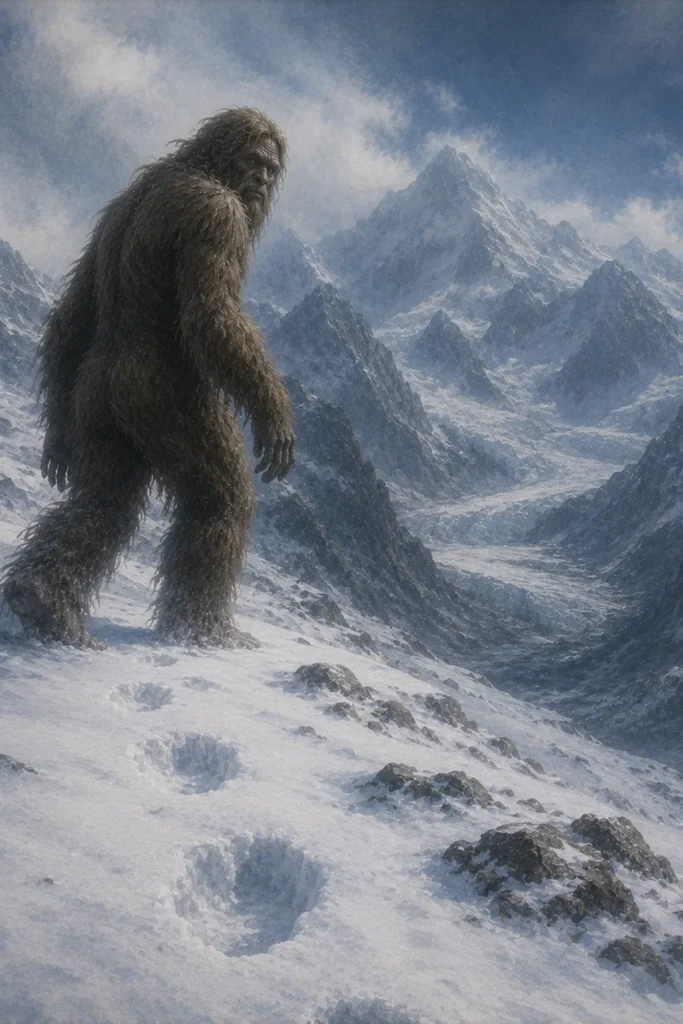
The Yeti is thought of as a wild, hairy mountain ape-man. A widespread motif is backward-facing feet, which confuse pursuers, a recurring folklore topos found worldwide. Tradition distinguishes three types: the Dzu-Teh, a large yak-killer that is in reality a brown bear, the Meh-Teh, the human-like true Yeti, and the small Thelma of the forest valleys.
Effect
As a wild mountain being, the Yeti is considered dangerous, a yak-killer, and the sight or call of it is seen as a bad omen. At the same time it is shy and bound to the mountain wilderness; it is not an arch-demon.
Profile: Yeti
The key aspects of the Yeti at a glance.
Folk belief of the Sherpa and Tibetan regions and Bhutan; classified in Buddhism as a non-human animal, sometimes interpreted as a guardian against evil spirits.
The mountain wilderness and its inhabitants: the Yeti is regarded as a yak-killer, and the sight or call of it as a bad omen for whoever encounters it.
Wild, hairy mountain ape-man; a common motif is backward-facing feet, which mislead pursuers.
The high altitudes of the Himalaya: a dangerous, yet shy and local threat being of the mountain wilderness, not an arch-demon.
Not a cult object: in Buddhism the Yeti is classified as an animal, tiragyoni; the idea of invisibility in Bhutan belongs to folklore, not to the canon.
From Meh-Teh to Abominable Snowman
The name Yeti probably derives from yeh-teh or meh-teh; the origin is uncertain, Meh-Teh meaning roughly man-bear. The central Tibetan term is Migoi, mi rgod, wild man. The Dzu-Teh, literally cattle-bear, on the other hand demonstrably refers to a large bear, the Himalayan brown bear.
The being’s modern career begins with a translation error: after the Howard-Bury expedition of 1921, the journalist Henry Newman wrongly translated the Sherpa word metoh, man-bear, as abominable. This gave rise to the Abominable Snowman, a name that the tradition of the Himalaya itself never gave it.
From proof photo to DNA study
In 1951 Eric Shipton photographed large footprints at the Menlung Glacier, the famous proof photograph. Alleged relics turned out to be forgeries; after eleven years of field research Reinhold Messner concluded that the Yeti was the Himalayan brown bear, and a DNA study by Lindqvist and others found in 2017 that of nine Yeti samples, eight came from bears and one from a dog.
From a religious studies perspective, the Yeti is folklorically a fixed, genuinely believed category of the mountain wilderness, but scientifically there is no evidence for an unknown primate. Important clarifications: Abominable Snowman is a mistranslation. The scalps and the hand are not Yeti relics. The DNA points to bears. The Migoi is a folk-religious category, whereas the Dzu-Teh is in reality a brown bear. And the Yeti must be clearly distinguished from the mountain god: it is a wild being, in Buddhism an animal.
Folk belief rather than cult
The Yeti is a being of folk belief and danger, not a cult object. In Buddhist interpretation it is classified as a non-human animal, tiragyoni, yet human enough to be able to follow the Dharma, and in part a guardian against evil spirits; seeing or hearing it is considered a bad omen. The idea of its invisibility, especially in Bhutan, belongs to folklore, not to the Buddhist canon.
Wild men of the mountains worldwide
The Yeti stands alongside the North American Bigfoot or Sasquatch, the Caucasian and Central Asian Almas or Almasty, and the Chinese Yeren: the motif of the wild, hairy mountain man is spread across the mountains of the world. Within the Himalaya, the Yeti is assigned to the retinue of the mountain deity Khumbila, but remains itself a wild being, not a god.
Frequently asked questions about the Yeti
Is the Yeti a mountain god?
No. It is a folk-belief being of the mountain wilderness, in Buddhism an animal, not a mountain god. In the Himalaya it is assigned to the retinue of the mountain deity Khumbila.
What does Migoi mean?
Wild man, the central Tibetan term for the Yeti; the Tibetan form is mi rgod.
What did the DNA research find?
Of nine examined Yeti samples, eight came from bears and one from a dog; no unknown primate could be verified.
Further links
Literature (selection)
Further standard works in the bibliography.
As the Himalaya’s snowman, the Yeti became world-famous, yet its Tibetan name Migoi means wild man: a shy wild being of the mountain wilderness, in Buddhism an animal, without scientific evidence, and precisely for that reason one of the most enduring figures of mountain folk belief.