Dzi beads: the eye-patterned agate beads of Tibet
By Ralf Ittermann · last reviewed on
Dzi beads are elongated agate beads from the Tibetan cultural sphere, marked by light, eye-like patterns on a dark ground. They are regarded as valued beads of protection and good fortune. Their origin is only partly known and, in tradition, is surrounded by legends.
The eye-patterned agate beads, called Dzi, are regarded in Tibet as a particularly powerful form of protection.
Classification
Dzi beads are elongated beads from the cultural sphere of Tibet and the adjoining regions. They are made of agate, a stone belonging to the group of quartzes.
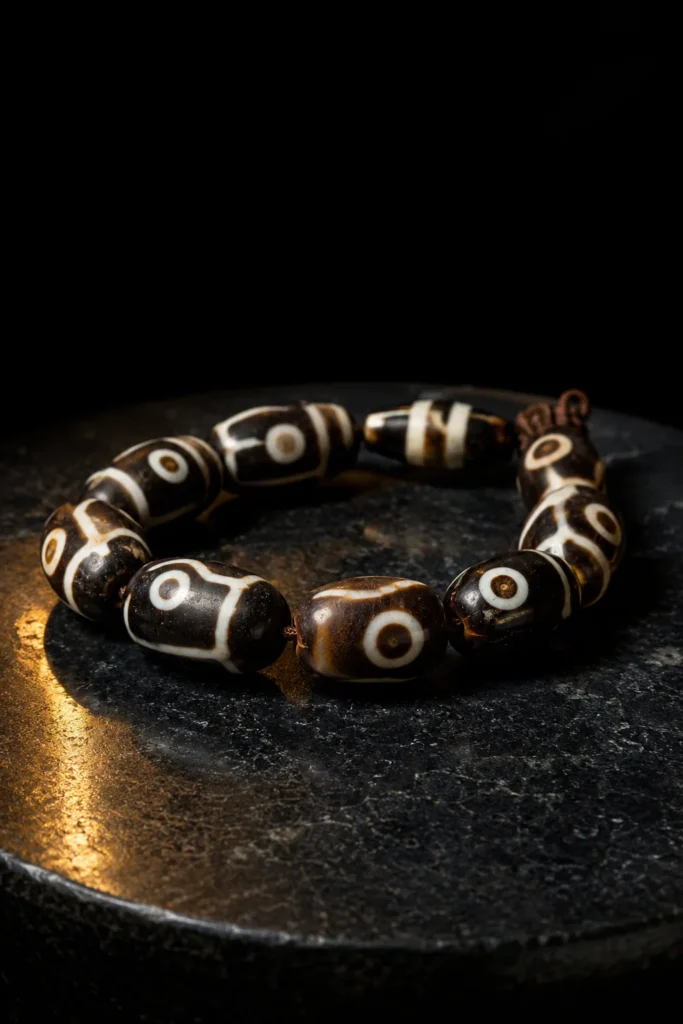
The distinctive feature of Dzi beads is their pattern. On a usually dark ground appear light markings, often in the form of rings or circles that resemble eyes.
These eye-like markings are referred to as the eyes of the bead. A Dzi bead is distinguished and named, among other things, by the number of its eyes.
In the Tibetan cultural sphere, Dzi beads are regarded as valued beads of protection and good fortune. They are worn, inherited, and held in high esteem.
The origin of the Dzi beads is only partly clarified. In tradition they are surrounded by legends, and it is precisely here that a careful separation of findings and interpretation is required.
In religious studies, the Dzi beads are a good example of a protective object whose esteem is high but whose precise origin is uncertain, and which must therefore be classified honestly.
What is known about the origin
Less is reliably known about the origin of the Dzi beads than their importance in the Tibetan cultural sphere might suggest. Here caution and honesty are called for.
It is established that these are old beads of agate that were given a pattern by a particular process. Such patterned agate beads are known from several ancient cultures.
Processes for giving agate light patterns are documented from the ancient world. With certain substances and with heat, light markings can be produced on the stone.
Exactly how old the individual Tibetan Dzi beads are and where they were made is, however, uncertain in many cases. Reliable evidence is often lacking.
Research assumes that at least some of the beads are very old and reached the Tibetan region by way of trade routes. More precise statements are difficult in individual cases.
The origin of the Dzi beads is thus an example of an object for which the established findings are slim. A factual account must state this openly rather than feign certainty.
The legends surrounding the Dzi beads
Where reliable knowledge is lacking, legends often take its place. With the Dzi beads this is the case to a particular degree.
A widespread Tibetan account does not regard the Dzi beads as made by humans. In this account they are held to be objects created by higher beings or left behind by them.
Other accounts report that the beads were, as it were, living beings that turned to stone when a human caught sight of them. Still others connect them with the sky or with insects.
These accounts are to be understood as legends. They do not reflect the real origin of the beads but express the high esteem in which these beads were held.
It is important to separate the legend from the findings. The accounts say a great deal about the importance of the beads, yet they provide no information about their actual formation.
The legends surrounding the Dzi beads thus illustrate a widespread process. A valued object that is mysterious in its origin becomes surrounded by accounts that explain its special standing.
Form and pattern of the beads
The Dzi beads have a distinctive form. They are usually elongated, sometimes cylindrical or slightly bulged, and pierced lengthwise.
The ground of the bead is often dark, black or dark brown. Against this dark ground the light, often whitish patterns stand out clearly.
The patterns consist of lines, stripes, diamonds, and above all rings. A light ring on a dark ground resembles an eye and is referred to as the eye of the bead.
The beads are distinguished by the number of these eyes. There are beads with one eye, with two, three, or more eyes. Each number of eyes is associated with its own meaning.
Besides the eyed beads there are Dzi with other patterns, for instance with stripes or with particular markings. These too bear their own names and meanings.
Form and pattern thus determine the standing of an individual Dzi bead. The number of eyes, the clarity of the marking, and the condition of the bead decide its esteem.
The eye as a protective motif
The most striking feature of the Dzi beads is the eye-like pattern. This eye motif is essential to their importance as beads of protection.
The eye is a widespread protective motif. In many cultures the depicted eye is regarded as a means against the evil eye and against harmful influences.
With the Dzi beads too the eye pattern is understood in this sense. The eyes of the bead are held to be watchful and to ward off whatever might harm the wearer.
The number of eyes is interpreted accordingly. Different numbers of eyes are associated with different effects, for instance with protection, with good fortune, with health, or with prosperity.
The eye motif thus places the Dzi beads within a larger family of eye amulets, to which the blue glass eye of the Mediterranean region belongs. All of them rest on the idea of the protecting eye.
The Dzi beads are therefore the Tibetan form of the eye amulet. What is distinctive is that here the eye is not painted or set but inscribed into the stone itself.
Dzi beads in people's lives
In the Tibetan cultural sphere the Dzi beads are deeply woven into people’s lives. They are far more than mere ornament.
Dzi beads are worn on the body, often strung in necklaces and combined with other beads. They adorn the neck and are at the same time meant to protect the wearer.
The beads are considered precious and are passed down over generations. A Dzi bead that comes from the ancestors connects the wearer with the family and its history.
The beads are credited with a preserving and a favorable effect. They are meant to protect against misfortune, to support health, and to favor good fortune and prosperity.
In illness too and in difficult circumstances importance was attached to the Dzi beads. In some notions even fine abrasion from the bead was regarded as having healing power.
The Dzi beads are thus an object of protection and good fortune that closely accompanies life. As a worn, inherited, and highly valued piece, they belong to the heritage of Tibetan families.
Value, authenticity, and the present-day market
The high esteem of the Dzi beads has led to their becoming highly sought-after and very costly objects. With this come questions of their own.
Old, genuine Dzi beads with clear patterns and many eyes fetch high prices. A significant old bead can have an extraordinary value.
These high values have given rise to a market in which newly made beads are also traded. There are modern reproductions modeled on old beads.
Distinguishing between old and new beads is often difficult. A reliable determination of age and origin is possible only for experts and only with effort.
An honest account must state this openly. Anyone holding a Dzi bead can in many cases not determine its age and origin with certainty.
The present-day market for Dzi beads thus shows a consequence of their high esteem. The valued family piece has become a sought-after object of trade whose authenticity is often hard to verify.
Keeping findings and interpretation clearly apart
The Dzi beads call to a particular degree for a clear separation of findings and interpretation. This separation is a precondition for a factual account.
The findings are slim. These are old patterned agate beads from the Tibetan cultural sphere. Their precise age, place of manufacture, and route are often uncertain.
The interpretation is rich. In the Tibetan cultural sphere the beads are regarded as powerful objects of protection and good fortune, surrounded by legends of an origin not stemming from humans.
The two must not be mixed. The legend of a heavenly origin is an interpretation, not a finding. It says something about the esteem of the beads, not about their real formation.
A factual account therefore names the Dzi beads as what they are according to established knowledge, as old patterned agate beads that were held in high esteem in the Tibetan region as beads of protection.
The Dzi beads are thus an instructive example. They show that a protective object can be described factually without glossing over the uncertain origin or presenting the legend as fact.
Present-day reception
The Dzi beads are still held in high esteem in the Tibetan cultural sphere today. As worn, inherited beads of protection and good fortune, they have retained their standing.
Beyond the Tibetan world, the Dzi beads have also become known in the West along with interest in Tibetan Buddhism and Tibetan culture. They are traded and collected.
In this wider spread, Dzi beads are in many cases worn as ornament and as good-luck charms. The precise religious and cultural embedding often recedes into the background.
With the wide spread there is also a lively trade in new reproductions. Genuine old beads and modern imitations are to be found side by side on the market.
A factual account names the Dzi beads as what they are, as valued patterned agate beads of the Tibetan region, whose origin is partly handed down as legend and not fully clarified.
The Dzi beads thus remain a striking example of a protective object. In them the eye-like pattern, the high esteem, and an origin that must honestly be called uncertain come together.
Literature (selection)
Related key terms: Dzi beads, agate beads, Tibet, eye pattern, protective bead, good-fortune bead, origin, legend, amulet bead.
iWell Guard and traditions of protection
iWell Guard stands in the cultural-historical line of wearable protective objects to which the Dzi beads also belong. A modern companion for people who live with protective symbols: made in Germany, 41 layers of solid gold, platinum, and silver, with a 30-day right of return.
Personal experiences may vary. Not a medical device. No promise of healing.