Miyolangsangma, the Giver of Everest
By Ralf Ittermann · last reviewed on
Miyolangsangma is a goddess of the Tibetan tradition.
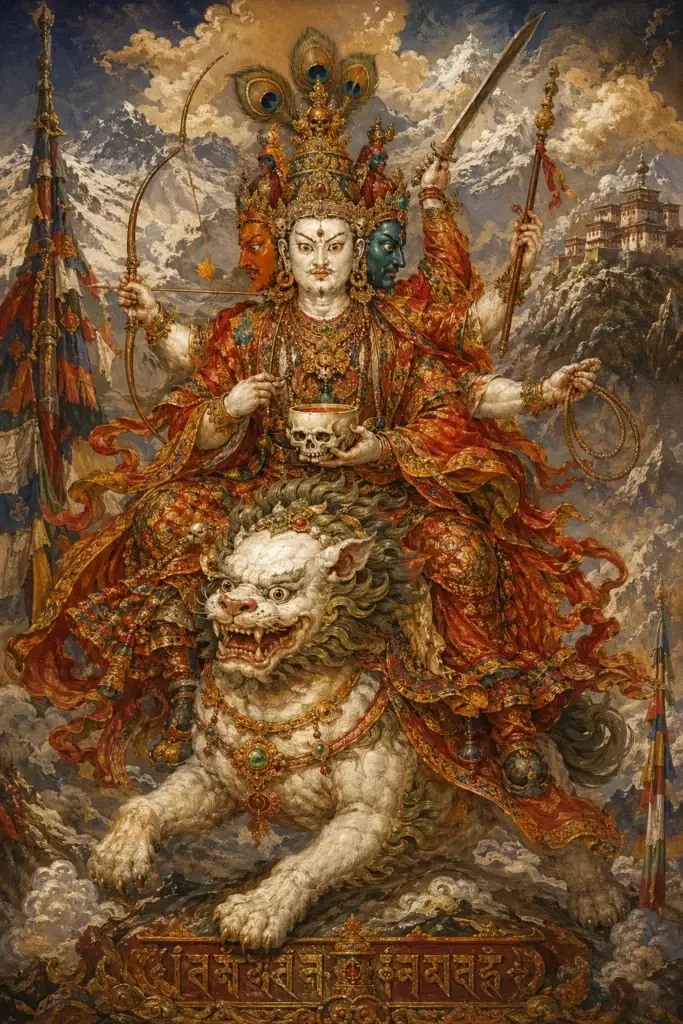
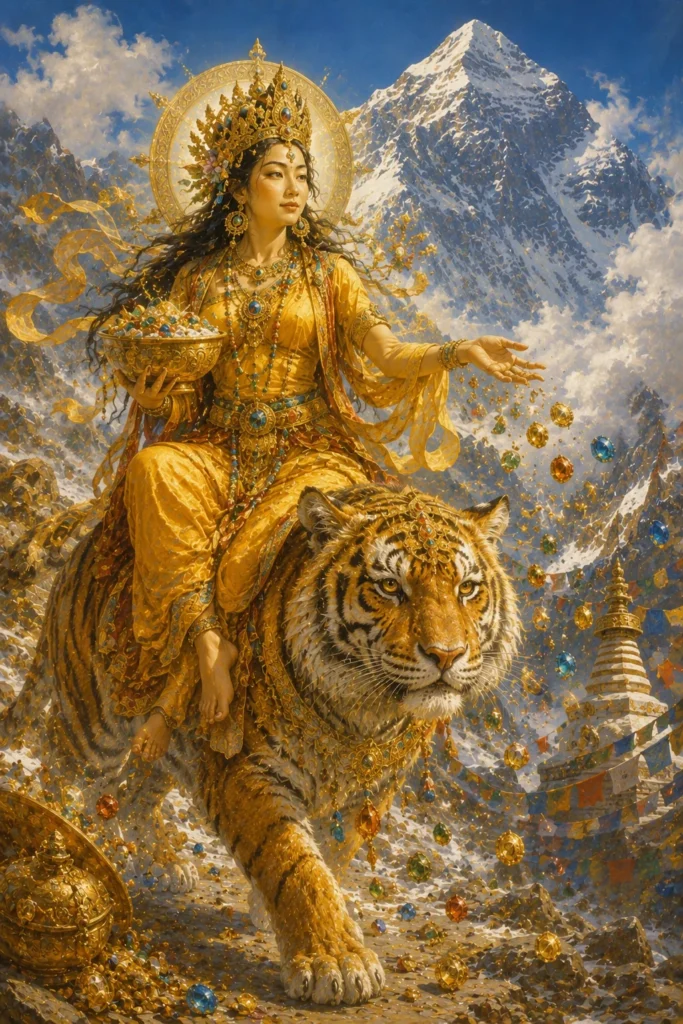
The giving goddess of Everest on her golden tigress. Miyolangsangma is honoured as the Giver of Everest, riding her golden tigress across the summit.
Miyolangsangma is the Buddhist goddess of Mount Everest, Chomolungma, and one of the Five Sisters of Long Life. She rides a tigress and is a goddess of inexhaustible giving, of food, abundance and wealth.
For the Sherpa and for Everest mountaineers, she is the mistress of the mountain: she grants or denies the ascent. According to tradition, she distributes the jewels of wishes to those who are worthy.
Type: Goddess of abundance, food and long life
Origin: Bön origin, bound by Buddhism, living tradition
Texts: Sherpa tradition, Bernbaum, memoirs of the Everest region
Period: from the Bön era to the present
Appearance: yellow goddess on a tigress, with a bowl of food
Context of tradition
Period of the Texts
The Five Sisters were originally wild Bön and mountain spirits; bound by Buddhism, their veneration continues in the Everest region to this day.
Area of Diffusion
The Everest region on both sides of the border between Tibet and Nepal, with the monasteries Rongbuk in the north and Tengboche in the south.
Sources
Well documented: the Sherpa tradition, Bernbaum’s standard work on sacred mountains, and Jamling Tenzing Norgay’s memoir.
Name and variants
Tibetan: Miyo derives from Sanskrit acala, meaning unshakeable, and -sang means good; the middle part lang is ambiguous, meaning pasture, yak-ox or elephant. The usual rendering is ‘the unshakeable good woman’; the formula ‘goddess of abundance’ describes her function, not the syllables. Name variants such as Lozangma refer to the same goddess.
Appearance and behaviour
Appearance
Miyolangsangma is yellow or golden, with her hair in a golden knot, and rides a golden-coloured tigress. Her attributes are a bowl with the finest food and a giving gesture, or a jewel-spitting mongoose as a symbol of wealth.
Effect
She is the goddess of inexhaustible giving, of food, abundance, wealth and long life. According to tradition, she distributes the jewels of wishes to those who are worthy; on Everest she grants or denies the ascent.
Profile: Miyolangsangma
The key aspects of the Everest goddess at a glance.
One of the Five Sisters of Long Life: originally wild Bön and mountain spirits, bound by Padmasambhava and made into protectors of the Kagyü teachings by Milarepa.
The Sherpa of the Everest region and the mountaineers on Everest, whose ascent she grants or denies.
Yellow or golden goddess with her hair in a golden knot, on a golden-coloured tigress, with a bowl of food, a giving gesture or a jewel-spitting mongoose.
Inexhaustible giving: food, abundance, wealth and long life; the jewels of wishes for those who are worthy.
Puja, prayers and ceremonies; Everest mountaineers ask her for favour at a stupa, a monk prays for them.
Her four sisters around the leader Tashi Tseringma; in the region alongside her, Khumbila and Nyenchen Tanglha as mountain deities.
From wild sisters to protector of the teaching
Miyolangsangma belongs to the Five Sisters of Long Life, whose leader is Tashi Tseringma. Originally the sisters were wild Bön and mountain spirits; Padmasambhava bound them, and Milarepa made them into protectors of the Kagyü teachings. Everest, Chomolungma, belongs to Miyolangsangma.
Her name too tells of this taming: Miyo derives from Sanskrit acala, meaning unshakeable, and -sang means good; the usual rendering is ‘the unshakeable good woman’. From a wild mountain spirit came a goddess who does not frighten, but gives.
Reception and classification
Miyolangsangma plays a central role in Jamling Tenzing Norgay’s memoir Touching My Father’s Soul and is connected to the Everest monasteries Rongbuk in the north and Tengboche in the south. Tenzing Norgay believed she had safely led him to the summit in 1953.
In terms of religious studies, Miyolangsangma is a benevolent goddess of giving and protection. Important clarifications: she is not the leader of the Five Sisters, that is Tashi Tseringma, yet Everest belongs to her; her mount is the tigress, not the lioness or the dragon; name variants such as Lozangma refer to the same goddess; and abundance is her function, not a matter of syllable etymology.
Puja on the mountain: the veneration of the goddess
Miyolangsangma is venerated through puja, prayers and ceremonies; Everest mountaineers ask her for favour at a stupa, a monk prays for them. She is closely bound to Sherpa culture and grants or denies the ascent. Tenzing Norgay believed she had safely led him in 1953; his son Jamling devoted an entire book to this bond.
The Five Sisters and their neighbours
Miyolangsangma belongs to the classic group of five female mountain protector goddesses in the Tibet-Nepal border region, the pattern of the wild local deity who becomes a bound protector of the dharma; the leader of the group is Tashi Tseringma. As mountain deities of the region, Khumbila, the land deity of Khumbu, and Nyenchen Tanglha, the mountain god of Central Tibet, stand at her side.
Frequently asked questions about Miyolangsangma
Who is Miyolangsangma?
The Buddhist goddess of Mount Everest and one of the Five Sisters of Long Life.
Is she the leader of the Five Sisters?
No. The leader is Tashi Tseringma; but Everest belongs to Miyolangsangma.
What animal does she ride?
A tigress, not a lioness or a dragon.
Further links
Further reading:
- Tibet – all beings of the Tibetan world of belief
- Khumbila – the land god of the Sherpa in Khumbu
- Nyenchen Tanglha, Machen Pomra – great mountain gods of Tibet
- Smudging, Amulet, Protective candle – traditional protective means
- Protection Compass – protective means at a glance
Literature (selection)
Further standard works in the bibliography.
As goddess of Everest and one of the Five Sisters of Long Life, Miyolangsangma represents the benevolent side of the world’s highest mountain: a deity who does not threaten but gives, and whose favour on the mountain is still sought today.