Nyenchen Tanglha, lord of the nyen in the Transhimalaya
By Ralf Ittermann · last reviewed on
Nyenchen Tanglha is a god of the Tibetan tradition.
Northern Tibet’s most powerful protector, consort of Lake Namtso.
Nyenchen Tanglha is a powerful mountain deity of Central Tibet and at the same time the highest mountain of the Transhimalaya at about 7,162 metres. As the mountain god of Central Tibet, he is regarded as the most powerful protective god of Northern Tibet.
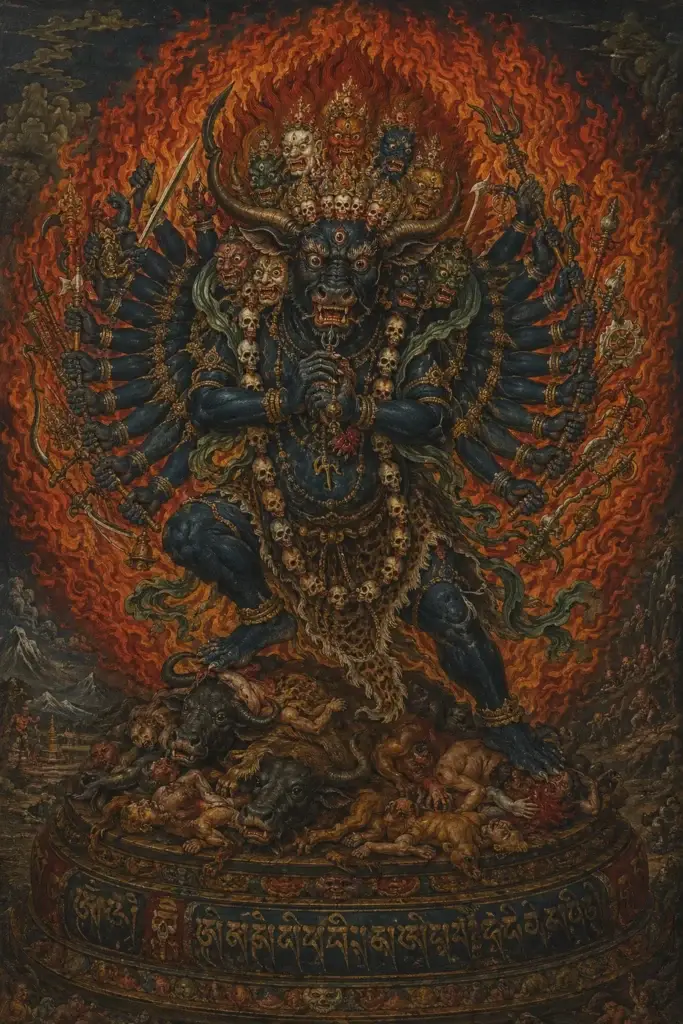
Yet his character is dual: he is also a feared hail and nyen spirit, to whom blood and animal sacrifices were formerly offered. He is paired as consort with Lake Namtso, the lake goddess; mountain and lake form Tibet’s most famous divine couple.
Type: Most powerful protective god of Northern Tibet, god of hail and weather
Origin: Pre-Buddhist Tibetan mountain worship
Texts: Ritual and prayer texts, Nebesky-Wojkowitz and more recent studies
Period: pre-Buddhist, integrated into Buddhism
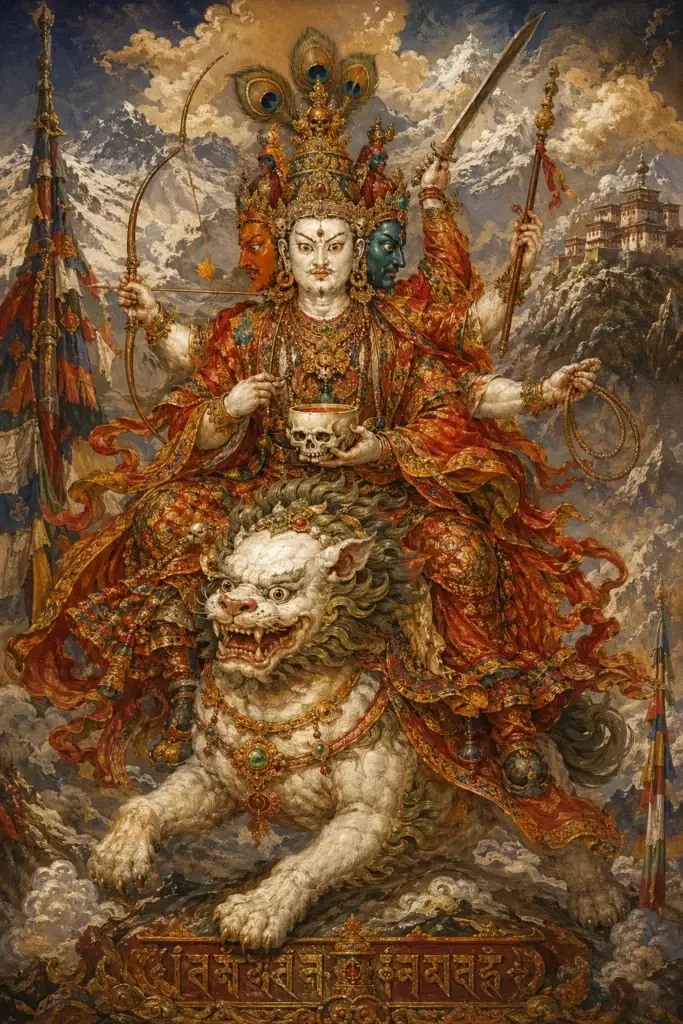
Appearance: white rider on a white horse

Source context
Period of the Texts
The figure is pre-Buddhist and was integrated into Buddhism; the evidence ranges from ritual and prayer texts to the classic study by Nebesky-Wojkowitz.
Area of Diffusion
The Transhimalaya and Central Tibet, near Lhasa; he is worshipped above all in Northern Tibet, along with pilgrims at the mountain range and Lake Namtso.
Sources
Well documented: Nebesky-Wojkowitz, Karmay and more recent studies, along with the liturgical prayer to the god of the plain.
Name and variants
Tibetan: The name combines nyen, a class of powerful, often dangerous autochthonous spirits, with chen, great, thang, plain or high plateau, and lha, god. Philologically, ‘god of the plain’ is closer; the popular rendering ‘god of the grassland’ is looser. He is regarded as the head of the nyen gods.
Beings and effect
Appearance
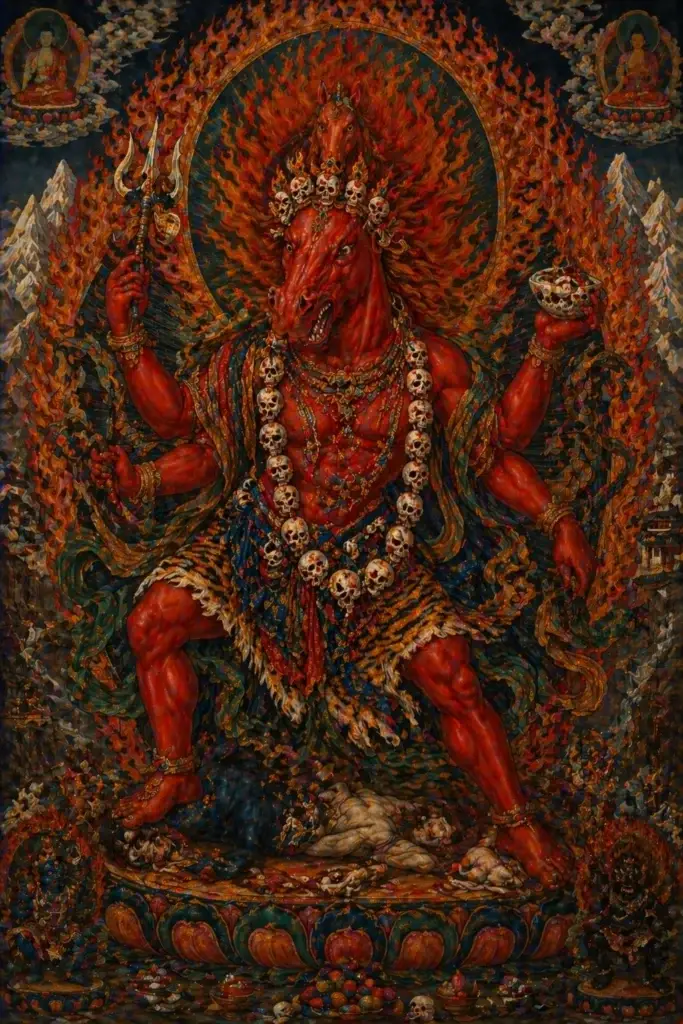
Nyenchen Tanglha is a white rider on a white horse. His attributes vary between a staff with a five-pronged vajra or a horsewhip in his right hand and a crystal prayer chain in his left; his character is warlike and regal.
Effect
He is the most powerful protective god of Northern Tibet, though in parts of the folk tradition he is a feared god of hail and weather, to whom blood and animal sacrifices were formerly offered, and he is also a guardian of treasure. Lake Namtso, the celestial lake, is female, the lake goddess and his consort, one of the Twelve Tenma.
Profile: Nyenchen Tanglha
The most important aspects of the mountain god at a glance.
Pre-Buddhist, one of the four great mountain gods and part of the nine creator gods, a yul lha and sku lha connected to the early Tibetan kings.
Northern Tibet and its people: protection of the land, along with power over hail and weather and the guardianship of hidden treasures.
White rider on a white horse, warlike and regal; a vajra staff or horsewhip in the right hand, a crystal prayer chain in the left.
Most powerful protective god of Northern Tibet, feared god of hail and weather, guardian of treasure; paired with the lake goddess of Namtso as consort.
Sang smoke offerings, prayer flags and latse cairns on the passes, the kora around Lake Namtso and the mountain range, as well as the liturgical prayer to the god of the plain.
Related to Yarlha Shampo, Odé Gungyal and Machen Pomra; as the northern position, part of the fourfold and ninefold systematics of the mountain gods.
From head of the nyen to Dharma protector
Nyenchen Tanglha is pre-Buddhist, one of the four great mountain gods and part of the nine creator gods, a yul lha and sku lha connected to the early Tibetan kings. His name marks him out as head of the nyen, a class of powerful, often dangerous autochthonous spirits.
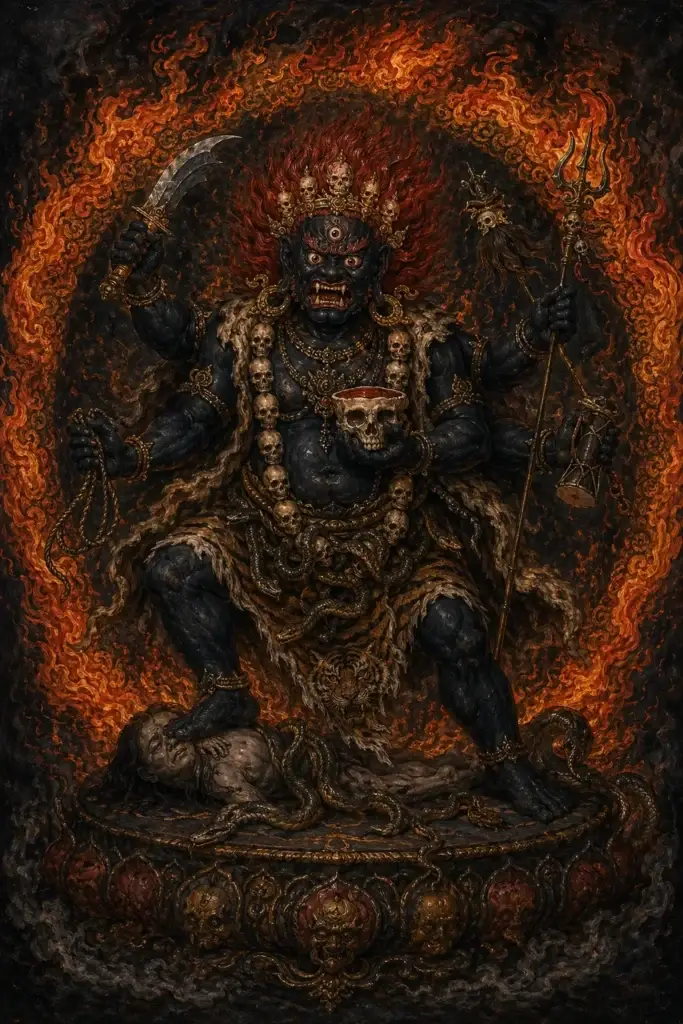
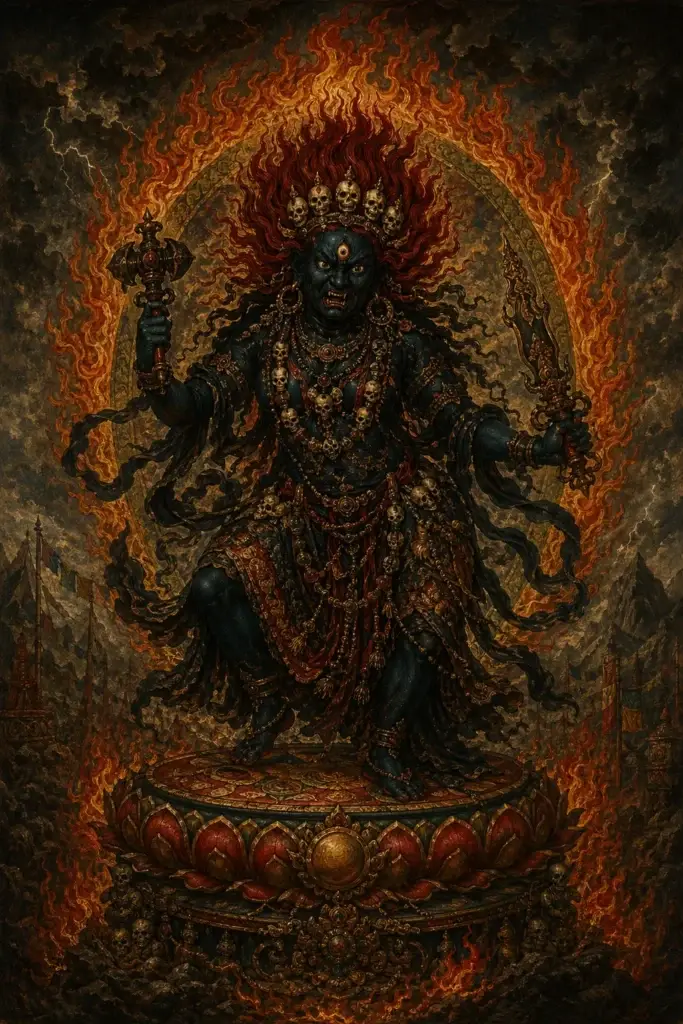
Buddhism did not simply adopt him without binding him: Padmasambhava bound him under oath and transformed him into a Dharma protector. His old dual nature was preserved even so; even as protector of the teaching, he remains the feared lord of hail and weather, to whom blood and animal sacrifices were formerly offered.
Reception and classification
The first ascent of the main summit was made in 1986 by a Japanese expedition; Lake Namtso is today a popular photo subject in Tibetan tourism.
In religious studies, Nyenchen Tanglha is predominantly a protective god, but also an ambivalent, feared nyen spirit with power over hail. Important clarifications: he is not the Tanggula range; he is not a purely Buddhist protector but primarily pre-Buddhist; Namtso is female, the lake goddess and consort, not male; ‘god of the plain’ is philologically more accurate than ‘grassland’; the height is 7,162 metres; and the attribute cannot be fixed as either whip or vajra.
Kora, latse and the prayer to the god of the plain
Well attested are sang smoke offerings, prayer flags and latse cairns on the passes, as well as the kora around Lake Namtso and the mountain range; to this is added the liturgical prayer to the god of the plain. The circumambulation of lake and mountain links both halves of the divine couple: whoever pays homage to the mountain god at the same time honours the lake goddess of the celestial lake.
The mountain god within the systematics
Nyenchen Tanglha represents the northern position in the fourfold and ninefold systematics of the mountain gods and is related to Yarlha Shampo, Odé Gungyal and Machen Pomra, his brother in Amdo. In the Himalayan region, Khumbila and Miyolangsangma stand alongside him as mountain deities.
Frequently asked questions about Nyenchen Tanglha
What does Nyenchen Tanglha mean?
Roughly, the great nyen god of the plain; nyen is a class of powerful, often dangerous spirits of which he is the head.
What about Lake Namtso?
Lake Namtso is female, the lake goddess and consort of the mountain god; together they form Tibet’s most famous divine couple.
Is he a benevolent god?
Mostly yes, but he is an ambivalent, feared spirit of hail and the nyen.
Further links
Further reading:
- Tibet – all beings of the Tibetan world of belief
- Machen Pomra – the brother and warrior mountain god of Amdo
- Khumbila, Miyolangsangma – mountain deities of the Himalaya
- Incense burning, Amulet, Protective candle – traditional protective means
- Protection Compass – protective means at a glance
Literature (selection)
Further standard works in the bibliography.
As the mountain god of Central Tibet and consort of Lake Namtso, Nyenchen Tanglha embodies both faces of the highland at once: the reliable protector of the north and the feared lord of hail and weather.