Kali is a goddess of the Hindu tradition.
The black goddess of time and destruction, protector and liberator. Kali is one of the most powerful figures in Hinduism, fierce, relentless, and at the same time the object of the deepest devotion.
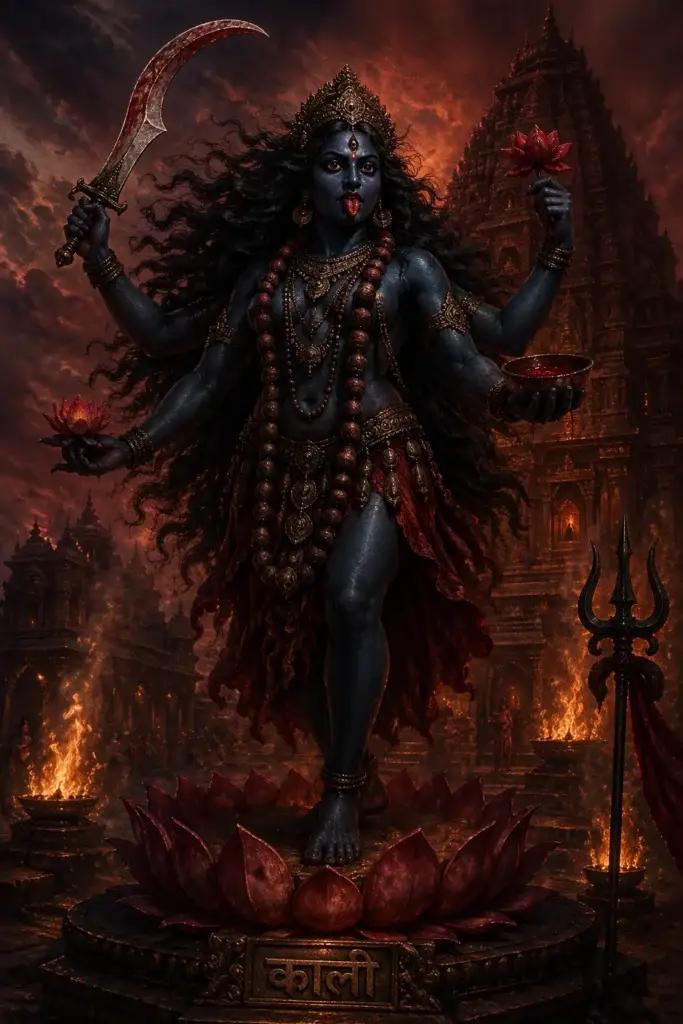
With black skin, a blood-red tongue hanging from her open mouth, a sword, and a bowl filled with demon skulls, she embodies the destructive energy needed to annihilate evil. She is Shiva’s terrifying form, the consort of the destroyer, and for some devotees the highest goddess herself, the *Shakti*, the cosmic force.
Type: Hindu principal goddess, wrathful manifestation of the Devi mother, destroyer of evil
Pantheon: Hinduism (especially Shaktism, Tantra), Buddhism (in Tibetan Tantric adaptation)
Function: Destruction of the ego, protection from demonic powers, death and rebirth
Main attributes: Sword, severed skull, necklace of 51 skulls, skirt of severed arms, protruding red tongue
Main cult sites: Kalighat (Kolkata), Dakshineswar (West Bengal), Kamakhya (Assam), Mt. Kailash
Aspect of: Parvati, Durga, Mahakali (cosmic form)
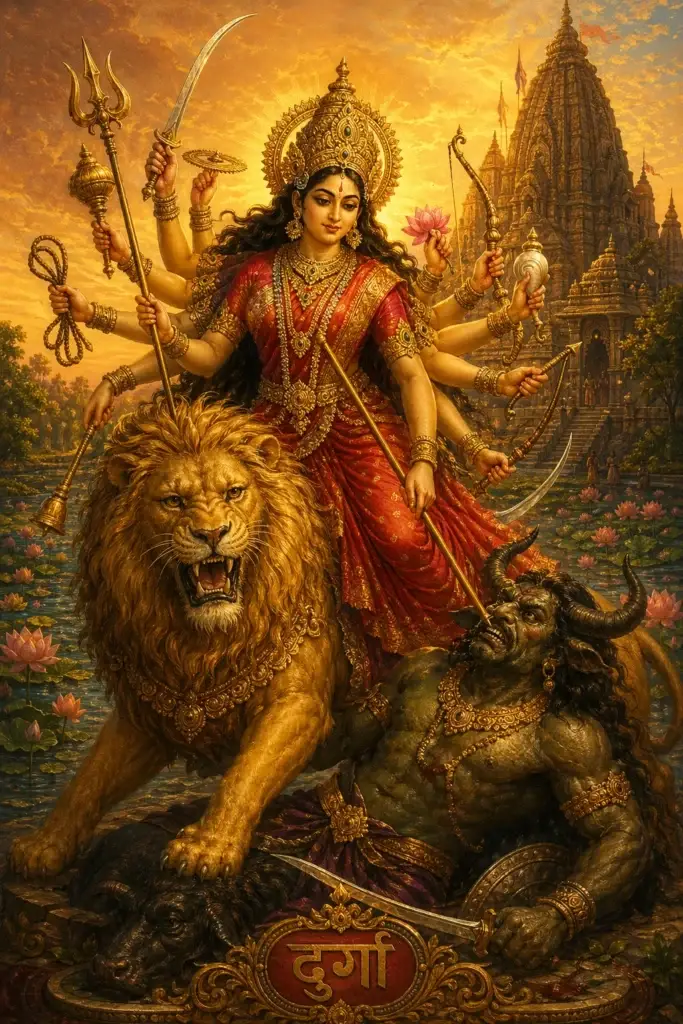
Kali has been attested since the Devi-Mahatmyam (5th/6th century CE, part of the Markandeya Purāṇa) as a wrathful manifestation of the Devi. In the central myth she emerges from the wrathful brow of Durga in the battle against the demon Raktabija.
The main flourishing of the Tantric Kali tradition (Vamacara) falls in the 8th to 12th centuries CE. In modern Hinduism she is especially popular in Bengal, and the great Kali Puja festival (October/November, coinciding with Diwali) is one of the most important regional Hindu festivals.
In the 19th century she became more widely known internationally through Sri Ramakrishna (priest at the Dakshineswar Kali temple) and the Ramakrishna Mission. In Western religious studies she has often been received since the 1960s as a feminist symbol.
Main cult sites: Kalighat (Kolkata, West Bengal, one of the 51 Shakti Pithas, where the fallen toe of Sati is said to have landed), Dakshineswar Kali temple (north of Kolkata, globally known through Sri Ramakrishna), Kamakhya (Assam, main cult site of menstrual Devi worship), Tarapith (West Bengal, Tantric sanctuary), Vaitarna (Maharashtra).
Internationally: in every larger Indian diaspora community, especially in the United States and the United Kingdom. Since 1971 in every ISKCON temple with a Devi pavilion.
Central sources: Devi-Mahatmyam (main source, in the Markandeya Purāṇa), Kalika Purāṇa, Mahabhagavata Purāṇa, Tantric texts (Mahānirvāṇa Tantra, Karpurādi Stotra). Bengali Kali bhakti poetry of the 18th century (Ramprasad Sen).
Sri Ramakrishna’s accounts of the Dakshineswar Kali experience (in Mahendra Gupta’s Kathamrita). Secondary literature: McDermott, Mother of My Heart, Daughter of My Dreams; McDaniel, Offering Flowers, Feeding Skulls; Kinsley, The Sword and the Flute; Michaels, Der Hinduismus.
Kali is black as the night, her skin a dark, absolute colour. Her tongue, bright red as blood, hangs from her open mouth. She wears a garland of the severed heads of demons and a skirt of severed arms.
In one hand she wields a sword, in another a bowl that catches blood. A tiger or lion is often her companion. Despite this terrifying depiction, around her neck Kali sometimes bears a tender caressing gesture of Shiva, her true consort.
Kali is the goddess who destroys in order to purify. She slays the demonic inclinations in the heart; the blood-drinking aspect is to be understood metaphysically, she drinks impurity.
The worshippers of Kali are not sadistic but see in her the unrelenting love that destroys old structures in order to make new ones possible. The nocturnal Kali Puja brings devotees to the temple to plead for liberation (Moksha). In Tantric practices Kali is venerated as the highest deity.
The most important aspects of Kālī at a glance. The following fields summarise origin, function, appearance, worship, symbols, and cultural parallels.
Kali emerges in the Devi-Mahatmyam from the wrathful brow of Durga in the battle against the demon Raktabija (“blood seed”), from each drop of whose blood a new demon arises; only Kali’s enormous tongue, which catches every drop before it touches the ground, can defeat the demon.
In theological consolidation Kali is regarded as the wrathful aspect of Parvati, and thus as the consort of Shiva.
In the Tantric scheme she is the highest form of the female creative energy (Mahashakti); in Kashmir Shaivism, the Spanda movement itself. Kali is one of the ten Mahavidyas (great wisdom goddesses) and their first.
Destroyer of all that is false, all that is demonically uncontrolled; in tradition, destroyer of egocentrism. In Tantric practice she is a tool of self-liberation through radical confrontation with the terrible (Kali as the wrathful aspect who shows the initiate his own mortality and limitation directly).
Patroness of the Vamacara Tantrikas (left path, extreme Tantric practice). Protection against demonic attacks and the effects of black magic. In the Bengali bhakti tradition (Ramprasad, Ramakrishna) she is also a gentle mother goddess despite her terrifying iconography.
A terrifying, dark-blue or black (kālī = “the black one”) female figure, naked or wearing only a tiger-skin loincloth. Three eyes (the third on her forehead).
Four or more arms: in the hands a sword (often a curved khadga), a severed skull (usually of the demon general), one hand in varada-mudra (gesture of granting), one in abhaya-mudra (gesture dispelling fear).
A necklace of 51 skulls (corresponding to the 51 Sanskrit letters), a skirt of severed arms. Protruding red tongue (the most famous detail). Long, dishevelled hair.
She stands or dances upon the unconscious Shiva lying beneath her (in one tradition: noticing her husband under her feet, she bites her tongue in shame, hence the protruding tongue). Accompanied by skulls and demonic beings.
Sphere of effect: Kali is invoked in acute protective emergencies, against illness, hexing, and black magic. In the Bengali tradition she is a central family deity (Kuldevi). Main festival: Kali Puja (October/November, in Bengal as large as Diwali in North India).
Daily pujas in thousands of temples. Tantric practitioners conduct nocturnal rites at cremation grounds (shmashana sadhana). In modern ISKCON and yogic traditions she is often invoked as “Universal Mother”. In Western feminist receptions she serves as a symbol of female power.
Sword (khadga), severed skull, necklace of 51 skulls, skirt of severed arms, protruding red tongue, tiger skin, third eye, long dishevelled hair, skull-cup (kapala), trishula. Sacred plant: hibiscus (red, her favourite flower). Sacred animals: jackal, crow (at cremation grounds). Sacred colours: black, blood red.
Durga (Hinduism, herself as her elder “mother”), Parvati (gentler form), Bhairava (Hinduism, male wrathful parallel), Mahakala and Yamantaka (Buddhism, Tantric male adaptations), Sekhmet (Egypt, blood-drunk lion goddess), Ereshkigal (Mesopotamia, underworld goddess), Hecate (Greece, crossroads, death, magic), Hel (Germanic, half-dead ruler of the underworld).
Functionally unique in world mythology: a female terrifying-and-maternal deity in one person.
Rituals of veneration
Kali (Sanskrit “the black one”) is the awe-inspiring form of the Devi/Mahadevi. Her main cult site is the Kalighat temple in Kolkata (one of the 51 Shakti Pithas).
The annual Kali Puja (month of Kartik, October/November, in Bengal) regionally surpasses even Diwali in importance. Tantric worship historically involved animal sacrifices (goat or water buffalo), today often replaced symbolically by pumpkin (cf. Kinsley, Hindu Goddesses).
Mantras and invocations
The Kali bija mantra “Krīm” and the longer “Om Krīm Kālikāyai Namaḥ” are central Tantric formulas. The Devi-Mahatmya (in the Markandeya Purana, c. 6th century), especially chapters 7-8 (Kali’s emergence from Durga’s brow, victory over Raktabija), is recited at Navaratri. Ramprasad’s Bengali devotional songs (18th century) are part of the popular standard repertoire.
Amulets and protective symbols
Black onyx or black carnelian as the Kali stone. The Trikona yantra (inverted triangle with bindu) as a geometric protective symbol on copper plates. Skull garlands (mundamala, often interpreted symbolically as the 50 Sanskrit letters) as pendants. Red hibiscus (japa) is her sacred flower, offered in pujas.
Further standard works in the literature index.
The most important mythological source for Kali is the Devi Mahatmya, a text from the milieu of the Markandeya Purana, composed around the 6th century CE and regarded as a foundational scripture of goddess worship.
In it Kali appears in the battle of the goddess against the demonic armies. The decisive episode concerns the demon Raktabija.
Raktabija possessed the gift that from every drop of his blood that touched the earth a new demon of his kind arose. In the battle against the goddess Durga and her helpers he therefore multiplied endlessly: every wound inflicted on him produced new adversaries.
The battlefield filled with countless Raktabijas. In this hopeless situation Kali steps forward, who according to one version emerges from the wrathfully furrowed brow of Durga.
Kali solves the problem in the only effective way: she catches the blood of Raktabija with her outstretched tongue and devours the demons arising from the blood before they can multiply. In this way the actual Raktabija can be killed without new demons growing back.
This narrative explains several iconographic features of Kali, above all the protruding tongue. It also shows the theological function of the figure: Kali is the power that intervenes where ordered means fail. She does not act through measure but through a radicality that removes the problem at its root.
Kali possesses one of the most distinctive and most precisely interpreted iconographies of Hinduism. She is depicted with dark, often black or deep-blue skin, from which her name derives, connected to the Sanskrit word kala, which can mean both “black” and “time”.
She is mostly naked or clothed only in a skirt of severed arms and wears a chain of severed heads. In her four arms she typically holds a sword and a severed head, while the other two hands show gestures of fearlessness and the granting of gifts.
The best-known pictorial motif shows Kali standing or dancing upon the outstretched body of the god Shiva, her tongue protruding. This motif is explained differently in the tradition.
A widespread interpretation reports that Kali could not halt in her battle frenzy and threatened the entire universe. Shiva thereupon lay down beneath her feet, and when Kali stepped on her husband she froze in shame and stuck out her tongue.
In the philosophical interpretation of the Tantric tradition the image takes on a different meaning. Kali stands for active energy, shakti, Shiva for resting, pure consciousness. Their conjunction shows that both are real only together: consciousness without energy is inactive, energy without consciousness is blind frenzy.
The severed heads are interpreted as the discarded egos of the devotees, the sword as the tool that cuts through ignorance. The iconography is therefore not a mere image of terror but a dense system of meanings that is expounded in doctrine.
Kali has two clearly distinct yet interconnected religious contexts. The first is Tantra, an esoteric current in which Kali ranks among the highest deities. In the Tantric tradition, especially in the school of the ten Mahavidyas, the great wisdom goddesses, Kali stands in first place.
Tantric practice seeks the deity precisely in what ordinary piety avoids and approaches Kali through rites performed at places such as cremation grounds. This practice depends on initiation and instruction by a teacher and is not intended for the general public.
The second context is the popular and devotional veneration, especially in Bengal, Assam, and eastern India. Here Kali is invoked as Ma Kali, as Mother Kali. This current gained particular expression through the poet and singer Ramprasad Sen in the 18th century.
His songs address Kali in a tone that does not deny the terrifying aspect but places the loving, motherly devotion in the foreground. In the 19th century the mystic Ramakrishna, a priest at the Kali temple of Dakshineswar near Kolkata, decisively shaped this piety.
The high point of the Bengali Kali cult is the festival Kali Puja, celebrated on the new-moon night of the month of Kartik, often close in time to the festival of lights. Famous cult sites include the Kalighat temple in Kolkata and the temple of Dakshineswar.
That the same goddess is venerated both as a fearsome Tantric power and as a tenderly invoked mother is not a contradiction but an expression of the conviction that ultimate reality encompasses both sides.
Kali is theologically closely connected with the conception of time. The word kala, from which her name is derived, means time, and Kali is regarded as the power that also consumes everything that arises in time.
In this interpretation she is less a being among others than a foundational reality: the force that determines coming-to-be and passing-away. Her dark colour is interpreted accordingly, for just as all colours dissolve into black, so everything created dissolves into Kali.
This connection with time and death explains why Kali is not to be understood as a mere figure of terror. In Hindu teaching, clinging to the transient, to the self, and to the world of appearances is the root of suffering.
Kali, who dissolves everything, is therefore in theological interpretation at the same time the liberator: she does not destroy out of malice but liberates from what binds the human being. Her appearance is meant to confront the devotee with the fact of transience rather than to suppress it.
The connection with the cremation ground, which is her dwelling place in many depictions, belongs to the same context. The place where bodies burn is the place where the truth about transience becomes directly visible. Tantric practice seeks Kali precisely there, because there the ordinary certainties collapse.
From the perspective of religious studies, Kali is thus a striking example of how a figure that at first sight embodies only terror has, within her theological system, a precisely determined and positively turned function. Fear is not the goal but the passage to insight.

Scarcely any Hindu deity has been so well known in the West and at the same time so often misunderstood as Kali.
The colonial perception of the 19th century often reduced her to an embodiment of terror and placed her in a sensationally portrayed connection with so-called Thuggee criminality, a connection that later research has recognised as strongly exaggerated and ideologically coloured. This distorted view long shaped the Kali image of Western popular culture.
Scholarly engagement set in above all in the second half of the 20th century. Religious scholars such as David Kinsley produced studies that rendered Kali intelligible within the framework of Hindu goddess theology rather than treating her as a mere curiosity.
Later works, for instance by Rachel Fell McDermott on Bengali Kali piety and on Ramprasad Sen, or collected volumes examining Kali from various angles, further refined the picture.
In parallel, since the 1970s a Western appropriation of Kali in spiritual and feminist contexts has emerged, in which she has been interpreted as a symbol of female power and as a counter-image to domesticated images of women.
This reception is interesting from the perspective of religious studies but stands in tension with the meaning of Kali within living Hinduism, where she is first and foremost the object of concrete ritual veneration and not an abstract symbol.
Research therefore cautions that one should carefully distinguish between the deity within the Hindu cult and her Western reinterpretations. Whoever wants to understand Kali must begin with the Indian sources, the temples, and the living practice, not with her Western mirroring.
Kali (from kala, time, black) is one of the most powerful goddesses of Hinduism, the terrifying form of the great goddess (Mahadevi).
Iconographically typical: four or more arms, in the hands a sword and the severed head of a demon, a necklace of skulls, a skirt of severed arms, the protruding tongue, black or dark-blue skin. Kali usually stands on Shiva, her consort, who has thrown himself beneath her in order to stop her destructive wrath.
The terrifying iconography has a spiritual meaning: Kali is the destroyer of illusion (Maya) and of ego attachments. The sword cuts through ignorance, the severed heads are the discarded ego bonds, the skull necklace stands for the letters of the Sanskrit alphabet, language as cosmic power.
The protruding tongue is a gesture of shame (she realises that she is standing on Shiva). In Tantra Kali is the liberator: she does not destroy out of malice but out of love for truth.
Against its influence, cross-cultural tradition names these protective means:
Recommended protective means
The simplest protective means in this collection: 41 layers of fine gold 999, platinum, silver and silicon, manufactured in Ruhla, Thuringia. It requires no activation, is bound to no person, and is effective within a radius of around 50 meters, even without being worn.
Related Beings

Iku-Turso, the malevolent sea monster of the Kalevala. Origin, appearance during the theft of the...

The written record concerning Astaroth reaches back several centuries into the past, very likely ...

Umm al-Duwais, the seductive djinniya of Gulf folklore. Origin, the fragrance motif and the class...

Egungun, the embodied ancestor spirits of the Yoruba. Origin, the masquerades, the blessing of th...

Lu, water and earth spirits of the Tibetan tradition. Guardians of springs, lakes and soils: clas...

The Žaltys, the sacred house snake of the Lithuanians and Latvians. Origin, the milk cult and its...