Gyalpo, Spirit of the rNying-ma School
By Ralf Ittermann · last reviewed on
Gyalpo is a spirit of the rNying-ma school.
King-demons of the Tibetan tradition: fallen monks, deposed rulers, vengeful spirits.
Gyalpo (rgyal po)
The Gyalpo (Tib. rgyal po, “king”) form a particularly feared class of Tibetan spirit beings.
The term “king-demons” denotes spirits of people who held high positions in life, monks, abbots, princes, scholars, and who after death return as vengeful spirits out of disappointment, anger or lust for power. Their high intellectual and spiritual training makes them more dangerous than ordinary restless dead.
Gyalpo usually do not attack directly and physically; they act through possession, discord, doubt, apostasy, conflicts in monasteries and families. In tantric practice they are banished or bound through special rituals or, in the ideal case, integrated into the Dharma as bound protective spirits.
Padmasambhava binding and territorial kingship
The greater part of the Gyalpo traditions is closely tied to the work of the master Padmasambhava, who in the 8th century contributed to the Buddhicization of Tibet. According to tradition, Padmasambhava summoned powerful local spirits, among them many Gyalpo, and tamed them through magical pacts.
These Gyalpo were obliged to protect the Dharma and to harm people no longer.
The binding of the Gyalpo by Padmasambhava is not a destruction of their power but a reorientation: they remain territorial, powerful and dangerous, but their aggression is placed in the service of Buddhism. This transformation shows how the local was not displaced but integrated.
Quick Overview: Gyalpo
Type: King-demons, vengeful spirits of high-ranking deceased
Origin: Fallen monks, deposed rulers, ambitious scholars
Texts: Padmasambhava cycles, Nyingma terma texts, ritual manuals of the bound protective spirits
Effect: Possession, discord, doubt, apostasy, intrigues in monasteries
Defense: Tantric banishing rituals, torma ceremonies, invocation of protective deities
Distinction from Mamo: Unlike the Mamo, the female dark mother spirits, the Gyalpo are male king-demons, fallen monks and deposed kings of the Tibetan tradition, whose hatred and jealousy drives them into malice.
Context
Period of the Texts
The category of the Gyalpo arises in the condensation of Tibetan monastic history, in which conflicts between powerful monks and their order leaderships repeatedly came to a head. Historically it is connected with figures who are said to return as spirits after a violent death or disappointment.
A particularly famous Gyalpo is Dorje Shugden, a figure who appears in the 17th century and remains to the present day a source of theological controversies within the Gelug school. Other Gyalpo were bound in the course of the Padmasambhava cycles and integrated into the pantheon.
Area of Distribution
Gyalpo are bound to monasteries, former seats of high-ranking lamas, historical battlefields and sites of political conflict. Monasteries in the Amdo and Kham regions know individual, local Gyalpo traditions; in the core regions of Central Tibet too there are famous Gyalpo shrines.
Modern Gyalpo cults have differentiated further among exile Tibetans; the controversies around Dorje Shugden have acquired worldwide ramifications.
Source Situation
Core sources: Padmasambhava cycles with their subjugation narratives; terma texts of the Nyingma school; ritual manuals of individual monasteries. On the Dorje Shugden theme there exists an extensive modern literature. Standard works: Nebesky-Wojkowitz (1956); Dreyfus, Georges (1998) “The Shuk-den Affair”; Cabezon, Jose Ignacio (1994) Buddhism and Language.
Designation and Spellings
Tibetan rgyal po means literally “king, ruler”.
- Rgyal chen, “great king”; the highest Gyalpo.
- Pehar rgyal po, Pehar; historically prominent, institutionalized in the Nechung oracle.
- Dorje Shugden, controversial Gyalpo of the Gelug tradition.
- Tsiu Marpo, another prominent Gyalpo, connected with Samye monastery.
Characteristics
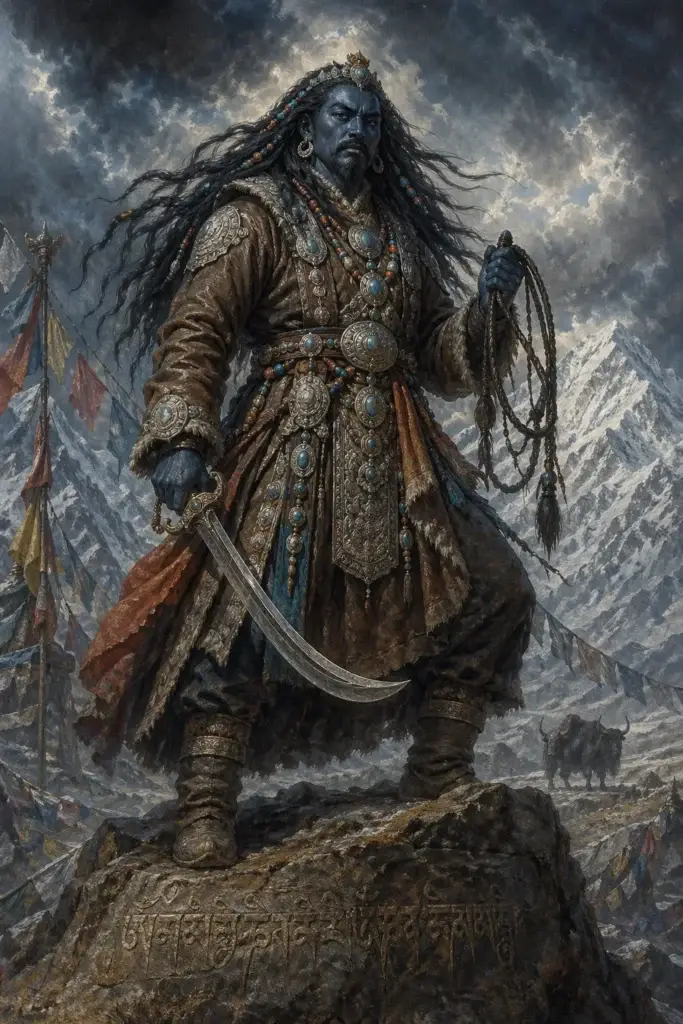
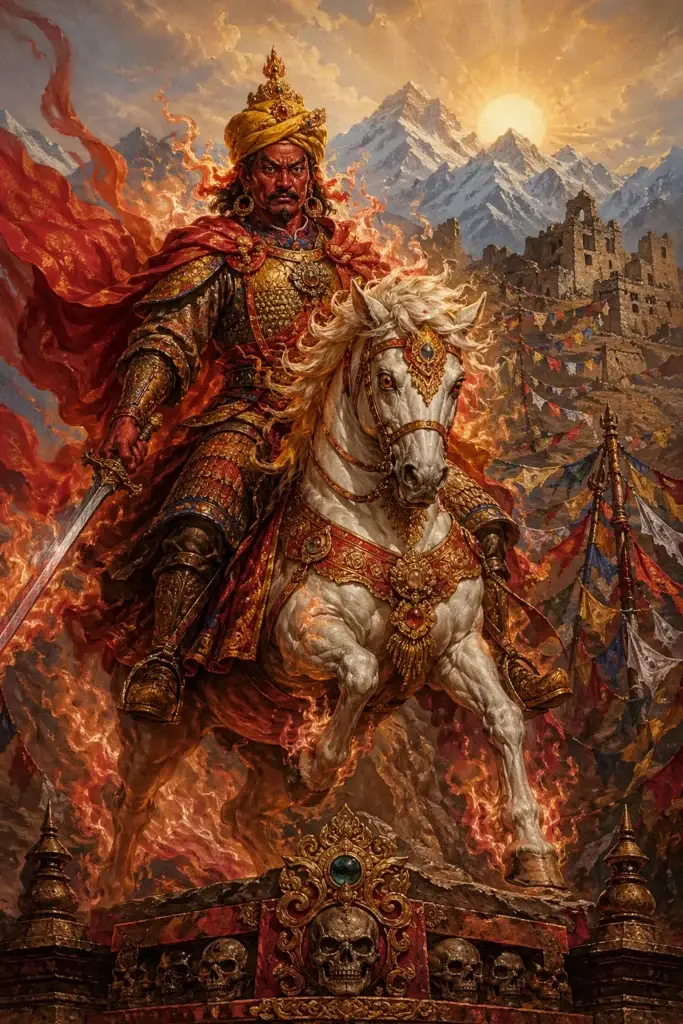
Appearance. The iconographic depiction varies. Often as a white-faced or pale-yellow male figure with a princely hat, gold jewelry, riding horse. Some Gyalpo (such as Tsiu Marpo) are red; Dorje Shugden is depicted as a terrifying yellow warrior on a snow lion.
Behavior. Gyalpo act subtly. They enter dreams, sow doubt, create misunderstandings between fellow monks, trigger discord in families. In stronger cases they draw people into possession, produce delusion and apostasy.
Binding. Bound through tantric rituals, Gyalpo can become powerful protective spirits, yet they retain their dangerous nature, which must be kept in check through correct care.
Pehar as the most prominent Gyalpo
Among all Gyalpo, Pehar is the most significant. According to tradition, Pehar was originally a warrior king who, after his death, became a powerful Gyalpo. He was housed in a special shrine in Samye monastery. Pehar is often depicted as a war god with armor and weapon.
His relationship to the Tibetan state and to monastic authority was always ambivalent: on the one hand he was installed as protector of the Dharma and the nation, on the other hand he was feared as a being that punished disobedience with plague and political unrest.
More recent traditions read Pehar as a site of political tension: a local warrior king made into a state protective being who retained his original nature.
Profile: Gyalpo
The most important aspects of the Gyalpo at a glance.
Fallen monks, ambitious abbots, deposed princes who return as vengeful spirits after a conflict-laden death.
Monks and lamas, especially in lineage disputes; families of high-ranking deceased; political opponents of the historical Gyalpo figures.
Princely male figure with hat and gold jewelry, on a riding horse or snow lion; white, yellow or red depending on the figure.
Possession, doubt, apostasy, intrigues, discord between clerics, dissolution of monastic communities.
Tantric banishing rituals after the Padmasambhava model; torma ceremonies; invocation of the great protective deities (Mahakala, Palden Lhamo); strict observance of lineage loyalty.
Japanese goryo (vengeful spirits of high-placed persons); European “cursed princes”; Indian bhuta and preta of high-ranking deceased.
Defense in Everyday Life
Tantric banishing rituals. Great rituals such as the Drak-po Ngagpa ceremonies bind individual Gyalpo by oath to particular shrines. The ritual is complex and must be led by a qualified lama.
Torma ceremonies. Regular torma offerings in monasteries keep bound Gyalpo graciously disposed; neglecting them can have negative consequences.
Invocation of great protective deities. Mahakala and Palden Lhamo as high Dharmapalas are invoked when Gyalpo influence is suspected.
Lineage loyalty. Traditionally it holds: correct care of the teaching lineage, respect for the teachers and avoidance of political maneuvering in the monastery are the best protection against Gyalpo attacks.
Gyalpo, Parallels in Other Cultures
Japan. The goryo, vengeful spirits of high-placed persons (Sugawara no Michizane, Taira no Masakado), share the basic motif of the figure, including the later incorporation as a protective deity.
India. Bhuta and preta of high-ranking deceased in the Indian tradition know similar trajectories; the tantric method of banishing is a common heritage.
Europe. Motifs of cursed princes who return as ghosts are found in English, Scottish and German-language legend literature.
Mongolia. Through the Buddhist permeation, the Mongolian tradition takes over Gyalpo-like figures and their ritual treatment.
Protective function and the renegotiation of authority
The protective function of the Gyalpo shows a subtle theological concept: a spirit with a tendency to harm is transformed into a protector through a contract. This is not moral purification but a pragmatic arrangement. The Gyalpo protects not out of compassion but out of obligation.
In modern Tibet, the veneration of the Gyalpo is often politicized: they are read as protectors of Tibetan independence and identity. Spiritual practitioners work with Gyalpo meditations in order to defend local centers of power. This shows how pre-Buddhist spirit religion is reactivated in contemporary contexts.
The rgyal po as a Class of King Spirits
The rgyal po (pronounced gyalpo) are, in Tibetan spirit lore, the class of king spirits.
The term rgyal po simply means king, and precisely therein lies the key to the conception of their origin: according to traditional understanding, they are often the restless spirits of deceased kings, high-ranking lamas or powerful persons whose death was overshadowed by pride, broken oaths or violence.
A strong personality that did not come to rest could thus become a particularly powerful and dangerous spirit.
Rene de Nebesky-Wojkowitz treats the rgyal po in Oracles and Demons of Tibet as one of the most important spirit classes. Iconographically they often appear white, in royal or warlike garb, on horseback.
They are attributed above all illnesses and disturbances that have to do with madness, confusion and sudden mental disorders. An rgyal po attack was considered particularly serious because it struck not only the body but the mind.
The class is closely connected with the highest protective deities of Tibet. The state protector Pehar is assigned to the rgyal po class and is regarded as the head of a group of five king spirits, the rgyal po sku lnga.
Here the same dual nature shows itself as with the other Tibetan spirit classes: an unbound rgyal po is a danger, an rgyal po bound by oath can become a powerful protector of monasteries and teaching lineages.
The boundary between demon and protective god runs not through the nature of the being but through the relationship in which the spirit is placed.
The Motif of the Broken Oath and the Dangerous Death
Characteristic of the origin narratives of the rgyal po is the motif of the broken promise. A frequent narrative pattern: a person of high rank, a lama or a monk, dies in a state of resentment, wounded pride, broken vow or with the wish for revenge.
Instead of a good rebirth, an rgyal po arises whose original spiritual power is preserved but is now turned in a destructive direction. Precisely because the person in question was religiously or politically powerful in life, the resulting spirit is particularly dangerous.
This pattern links the rgyal po conception with Tibetan religious history itself. Several Tibetan protective and quarrel deities have origin narratives in which a religious conflict, a rupture between teacher and student or a violated vow stands at the beginning.
The controversial deity who in recent Tibetan-Buddhist history became the object of bitter debates under the name Dorje Shugden belongs, according to some classifications, in this milieu of royal spirits that emerged from a dramatic death. Scholarship discusses such classifications controversially and in connection with the respective sectarian disputes.
The ritual handling followed the familiar logic: an rgyal po had to be either driven out and subjugated or, if it was strong enough and bound to the teaching, venerated as a protector and held in this role through regular offerings and recitations of oaths.
This binding was considered permanently precarious. A neglected rgyal po protector could turn against its own community. The class is thus a particularly clear example of the Tibetan idea that power is neither good nor evil but must be administered.
Further Links
Literature (Selection)
Further standard works in the literature index.
The protective practice described here is a religious-studies classification of historical traditions. iWell Guard ties into this cultural-historical line of portable protective objects and represents a contemporary form of it. More about the iWell Guard →