Goryo, from vengeful spirit to protective deity of the court
By Ralf Ittermann · last reviewed on
Goryo is a spirit of Japanese tradition.
The wrath of high-ranking dead brings plagues and lightning strikes. This profile traces its transformation from vengeful spirit to protective deity of the court. Goryo originally stems from the vengeful spirits of the nobility.
Goryo are the vengeful spirits of high-ranking dead, often unjustly overthrown, in Heian-period Japan. Unlike the vengeful spirit of an individual, they act collectively: they bring plagues, lightning and fire upon the community until they are appeased through veneration.
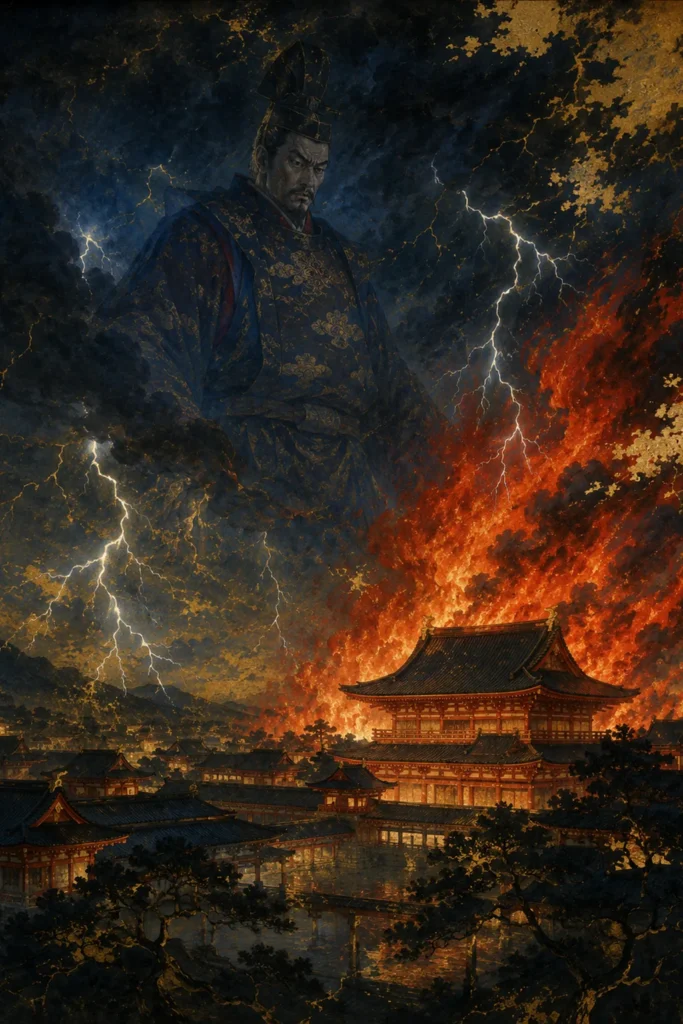
The most important example is the scholar and court official Sugawara no Michizane, who was overthrown by rivals and sent into exile, where he died in 903. After his death, lightning strikes, fires, and the deaths of leading opponents and the crown prince followed, until Michizane was elevated to the god Tenjin and began to be venerated at Kitano Tenmangu Shrine.
Type: Vengeful spirit of a high-ranking, unjustly overthrown dead person
Origin: Japanese court belief of the Heian period
Texts: well documented, a central category of Japanese religious history
Period: historically since the Heian period, the appeasement rite goryo-e attested from 863
Appearance: usually no fixed form, acts as an invisible cause of catastrophes
Historical Background
Period of the Texts
Historically documented since the Heian period: the appeasement rite goryo-e is recorded from the year 863 and forms the starting point of the shrine cult still practised today.
Area of Diffusion
Originally the court culture and the capital Kyoto, from where it spread nationwide via the shrine cult.
Sources
Good: a central category of Japanese religious history, documented among others by Borgen and Plutschow.
Name and variants
Japanese: The name go-ryo combines the honorific prefix go with ryo, soul or spirit, meaning honourable or wrathful spirit.
Appearance
Appearance
The typical Goryo is a high-ranking dead person with a distinguished career, who died through intrigue, false accusation or forced death far from home, without receiving proper rites. It usually has no fixed form but acts as an invisible cause, embodying the political fear that injustice by the court will be avenged as a natural disaster.
Effect
The Goryo brings epidemics, drought, lightning, fire and storm upon the community until it is appeased. Its effect strikes not a single household but entire communities and the state.
Profile: Goryo
The key aspects of the vengeful spirit at a glance.
A central category of Japanese religious history, originating in the court belief of the Heian period.
Entire communities, the state and the court, not individual persons or households.
Usually no fixed form, acts as an invisible cause of plagues and catastrophes.
Epidemics, drought, lightning, fire and storm, until the spirit is appeased.
The Goryo-shinko: rites, shrine building, posthumous titles and finally the deification of the dead.
Closely related to the Onryo and the Ubume, as well as the Gashadokuro.
Sugawara no Michizane and the Birth of the Goryo-shinko
The name go-ryo combines the honorific prefix go with ryo, meaning soul or spirit, and translates as venerable or wrathful spirit. The belief is documented since the Heian period, and the appeasement rite goryo-e is recorded from the year 863.
The most important example is Sugawara no Michizane, a scholar and court official who was toppled by rivals and exiled, where he died in 903. His death was followed by lightning strikes, fires and the deaths of leading opponents and the crown prince. To appease his wrath, Michizane was elevated to the god Tenjin and venerated at the Kitano Tenmangu shrine.
The Tenjin Cult and its Cultural-Historical Significance
The Goryo is the foundation of the Tenjin cult and has shaped Japanese culture’s approach to political dead. In popular culture it appears less often directly, but forms the conceptual background of many vengeful-spirit narratives.
In religious studies, the Goryo is the classic case of Goryo-shinko: the ritual transformation from a dangerous vengeful spirit into a protective kami. It is a central example of the Japanese principle of not fighting dangerous forces but integrating them through veneration.
Appeasement through the Goryo-shinko
Well documented is the Goryo-shinko, the cult of appeasement: rites, the erection of shrines, the posthumous conferral of titles and ranks and finally deification transform the vengeful spirit into a protective deity. Thus Michizane became the god Tenjin, patron of learning, venerated at the Kitano and Goryo shrines. Dealing with the wrathful spirit involves holy water as a consecrated sign, along with incense burning and offerings, which are firmly part of the Goryo-shinko. A worn amulet stands for the invocation of the spirit transformed into a protective deity.
Goryo and Onryo: Two Degrees of Vengeance
The Goryo is closely related to the Onryo and the Ubume. While the Onryo is usually the vengeful spirit of an individual directed against specific people, the Goryo, as the spirit of a high-ranking deceased person, strikes the entire community with collective catastrophic effects, such as plagues, lightning and fire across court and land. In other cultures, the appeased ancestral spirits of Rome correspond to it, as does the idea that someone wrongfully killed haunts the community until atonement is made.
Frequently Asked Questions about the Goryo
Is a Goryo the same as an Onryo?
The categories overlap significantly; the Goryo emphasises the high rank of the deceased and the collective effect on the community.
How was Michizane appeased?
Through the construction of shrines, posthumous titles and deification as the god Tenjin.
Does a Goryo affect individuals?
It affects the community through plagues and disasters rather than individual people.
Further links
Further reading:
- Japan – all beings of the Japanese tradition
- Onryo – the vengeful spirit of the individual
- Ubume, Gashadokuro – related Japanese spirits of the dead
- Holy water, incense burning, amulet – traditional protective means
- Protection Compass – protective means at a glance
Literature (selection)
Further standard works in the bibliography.
As a vengeful spirit haunting nobility and court, the Goryo was precisely the figure appeased through the ritual of the Goryo-shinko and, as in the case of Michizane, elevated to a protective god.